

Security Camera Registry: How It Works and Whether to Join
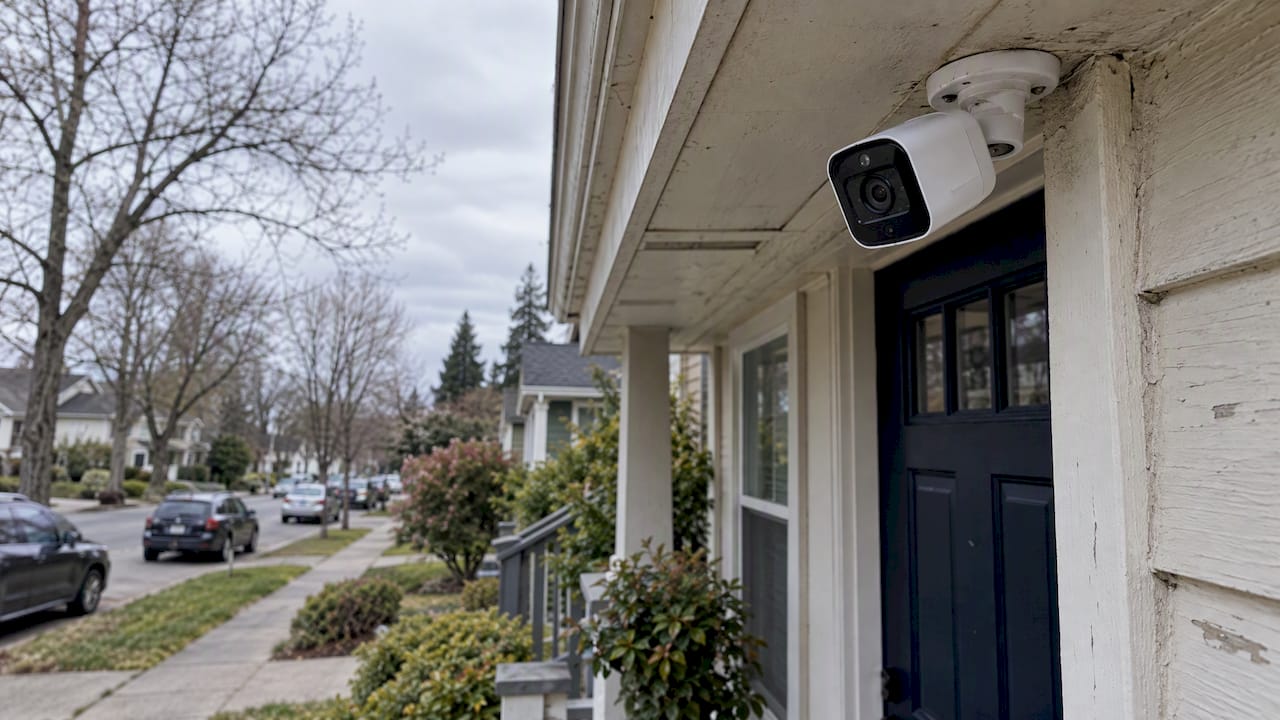
A security camera registry is a voluntary list, run by a police department or sheriff’s office, of who has cameras where. You give your address and contact details. When a crime happens nearby, detectives check the map and call you to ask whether you have useful footage. They do not get a login to your cameras, and you can say no. Below you will find how these programs work, what they ask of you, the privacy trade-offs, and how to register.
TL;DR
- A camera registry is a map of camera locations and owner contacts. Police do not get live or remote access to your video.
- Registration is voluntary and, in the programs we reviewed, free. Owners can withdraw and can decline any footage request.
- The main benefit is speed: detectives skip hours of door-to-door canvassing and reach the right people first.
- The main cost is that you become an easy person to ask. Know your state’s rules on recording before you sign up, especially for audio.
- To join, search your city or county name plus “camera registry” and use the official police or sheriff page.
Table of Contents
- What a camera registry actually is
- Why police want your camera on the map
- What you give up, and what you keep
- Privacy and legal questions to settle first
- Registries versus license plate readers
- How to register, step by step
- Perspective: why registries matter in cold cases
- Using camera footage in missing-person and cold-case work
- Where Crime Solvers Central fits
- Is a registry right for you?
- FAQ
- Sources
What a camera registry actually is
Police have always asked neighbors for video. A registry just does the asking in advance. Washington, DC’s CameraConnect program describes it as a way for residents, businesses and institutions to help police solve crime in their neighborhood, and says registration takes less than a minute and lets police generate a map of nearby cameras during an emergency or investigation. Police must then contact the owner directly to request specific footage.
Orlando’s program makes the same point from the investigator’s side. Its camera registry is a way to locate the nearest cameras in a designated area during an investigation, an emergency event or an emergency response.
A registry is not:
- A live feed. Registering does not connect your system to the police.
- A mandate. Programs like Scottsdale’s say registration is voluntary and can be withdrawn at any time.
- A license plate reader network. Those are separate systems, covered below.
Why police want your camera on the map
The old method is canvassing. After a burglary, shooting or hit-and-run, officers walk the neighborhood knocking on doors, hoping someone is home and happens to have a doorbell camera. Scottsdale’s police department notes that this process is time consuming and can delay the apprehension of a suspect. With a registry, an analyst can pull up every participating camera within a few blocks and start calling.
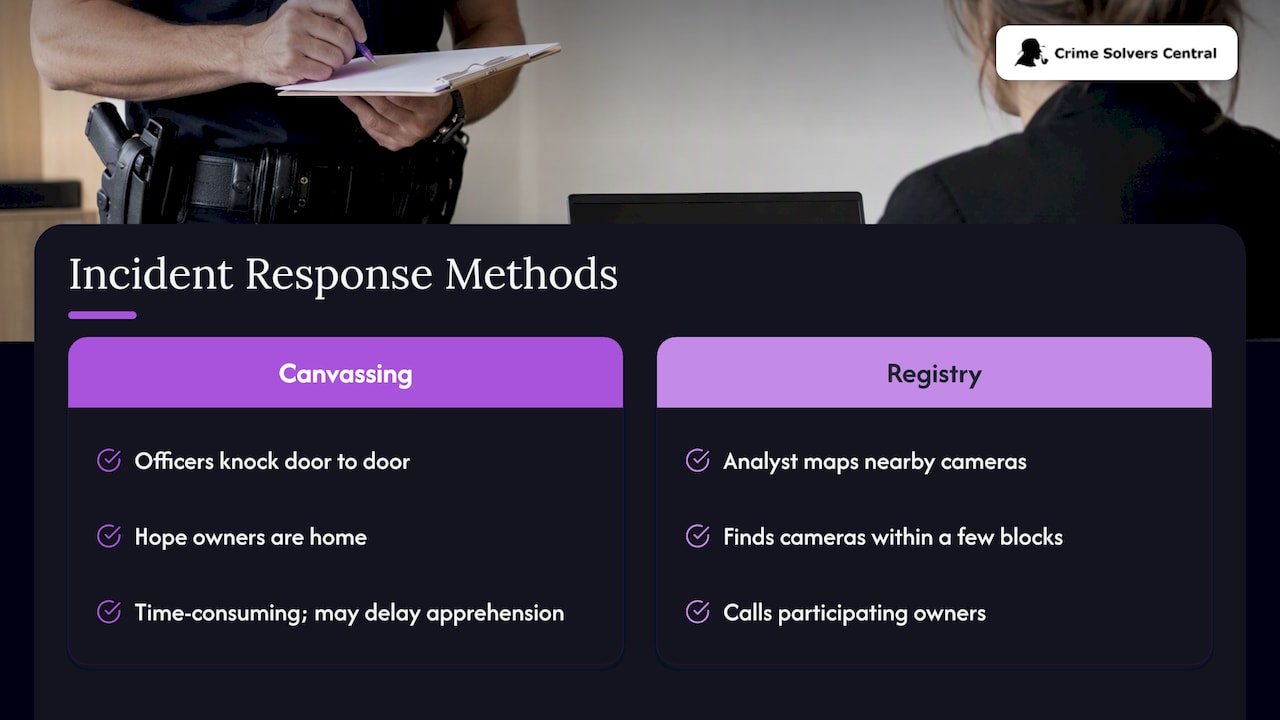
A vendor-written overview in Officer.com argues that community camera registries bring law enforcement, public entities and private businesses closer together, and that private video is a crucial part of modern investigations. Read it as an industry view, but the logic holds up: the first hours after an incident are when footage matters most, and the camera that caught a face or a car is often on a house nobody thought to check.
The same logic applies to missing persons. A last-seen location is only useful if someone can find video from that street. We cover that angle in our guide to the first hours of a community search.
What you give up, and what you keep
The programs we reviewed share a common bargain. Here is how the pieces compare.
| Question | Typical answer in city and county programs |
|---|---|
| Cost | Free in the programs we checked (DC, Scottsdale) |
| Who can join | Residents and businesses; some programs also take institutions |
| What you submit | Name, address, contact details, camera type and placement |
| Police access to live video | None |
| Obligation to hand over footage | None; you can decline |
| Can you leave? | Yes, at any time in programs like Scottsdale’s |
Campbell, California runs a similar voluntary program that lets residents and businesses register the location of private cameras to assist investigators. The details differ by town, so read your local page before you submit anything.
The honest downside
A registry does not take away your rights, but it changes your position. Detectives know you have a camera and know how to reach you. If footage later matters to a case, a request becomes more likely. Footage that exists can also be demanded through legal process in a way that footage nobody knew about cannot, so if you are a privacy-first owner, think about that before joining. Many owners decide the community benefit outweighs it. Others do not. Both choices are reasonable.
Privacy and legal questions to settle first
Joining a registry does not change the law on how you record. A few points matter before you point a lens at the street.
Where your camera can look
The guiding idea is the reasonable expectation of privacy. The Texas State Law Library’s neighbor-law guide explains that recording your own property and public spaces is generally legal, but intentionally recording a neighbor’s private backyard or intimate areas can lead to civil or criminal liability. It notes that some states, New York among them, give people a private right of action over unwarranted video imaging of residential premises.
Google’s Nest help pages give practical advice in the same spirit: owners are responsible for placement and use, and adjusting the field of view to keep neighbors’ property out of frame is a sensible habit. Display notice where guests or tenants would expect it.
Audio is a different matter
Video and audio are treated differently. The same Texas guide says that about 38 states and the District of Columbia use one-party consent rules for recording private conversations, while others require all parties to consent. A camera that records sound inside your home or rental can create exposure you did not intend.
Colorado’s Division of Real Estate warns sellers about recording during showings: if you are not a party to the conversation and have not given notice, recording buyers can create criminal or civil liability. If you list a home, turn off audio and post notice, or switch cameras off during showings.
Rules abroad are tighter
If you compare the US with Europe, the gap is clear. Sweden, for instance, regulates private and public camera use closely, and a recent case of a Swedish camera surveillance law breach by a municipality shows how seriously those limits are enforced. US registries rely on voluntary participation and local policy instead, which is why reading your own program’s terms matters.
Registries versus license plate readers
People often mix up registries and automated license plate readers (ALPR). They are different tools.
A registry lists cameras owned by private parties who opted in. ALPRs are cameras a department installs, usually on poles or roads, to capture plate images. The Okaloosa County Sheriff’s Office explains in its FAQ that its 79 Flock Safety cameras are ALPRs, with a 30-day default data retention period and audit trails. The same page reports that since 2021 the vendor has helped recover over 100 missing children and over 1,000 missing persons nationwide. That figure is the vendor’s own, as reported by the sheriff’s office.
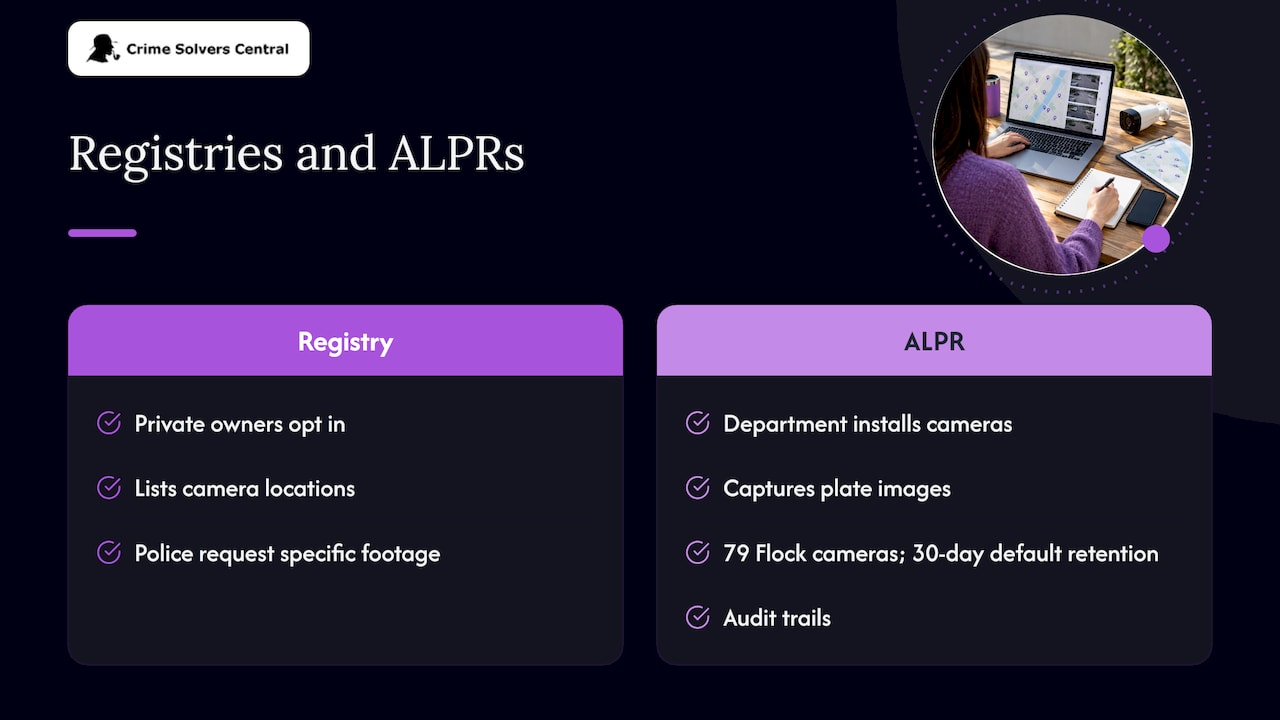
The practical difference for you: registering your doorbell camera does not feed any plate-reading network. If a registry page ever says otherwise, ask the agency before you sign.
How to register, step by step
- Find your program. Search your city or county plus “camera registry,” and look for a .gov or official sheriff or police address. Examples include DC’s CameraConnect, Scottsdale’s CamerEyes and Campbell’s Camera Registry. Avoid third-party sites that collect your details without being tied to an agency.
- Read the privacy page. Look for three statements: no remote access, no obligation to share footage, and how to withdraw.
- Gather your details. You will usually need your address, phone or email, and the number and type of cameras (doorbell, exterior, interior). Know whether your cameras record audio.
- Check your field of view. Adjust any camera that captures a neighbor’s windows or yard before you list it.
- Submit the form. It typically takes minutes.
- Decide your response plan. If police call, you can ask for the request in writing, check what dates and times they want, and export only that clip.
- Update or remove. If you move, replace cameras or change your mind, update the record or withdraw.
Storage matters here. Footage only helps if it still exists when police call. Consumer testers, such as Germany’s Stiftung Warentest, point out the cost split between self-hosted systems with a recorder, which give you full data control, and cloud systems that often come with monthly fees and some privacy trade-offs. Check how many days your plan keeps video. Seven days of retention will not help with an incident you discover next month.
Perspective: why registries matter in cold cases
We work with unsolved homicides, missing persons and unidentified remains, so we see the other end of the timeline. Video that nobody collected in the first days often never gets collected at all. Cameras get replaced, hard drives overwrite, and neighbors move. A registry is a small step that keeps one link in that chain alive.
We also see how much trust matters. Families and volunteers who want to help need to work with law enforcement, not around it. That means using official channels, sharing tips with investigators and never posting footage or names that could harm an investigation. Our guides on how to help solve cold cases safely and collaborate with communities on unsolved crimes lay out what that looks like.
Our view is simple. If you are comfortable with it, register your cameras, point them at your own property, keep your retention long enough to be useful, and answer police requests promptly. If you are not comfortable, that is your right, and you can still help in other ways.
— Crime
Using camera footage in missing-person and cold-case work
If you are a relative or volunteer, a camera registry helps indirectly. You cannot query a police registry yourself, but you can do three useful things.
- Tell the investigator which streets matter. The last confirmed sighting, a route, a bus stop or a parking lot tells police where to look on their map.
- Ask neighbors to keep footage. A polite note asking people to save video from specific dates and to contact the detective, not you, keeps the chain clean.
- Do not collect or post private video yourself. Hand it to the case detective. Footage shared publicly can expose bystanders and complicate evidence handling.
Our citizen detective guide for beginners explains how to stay inside those lines, and our National Security Camera Registry page collects law-enforcement-facing resources on the topic.
Where Crime Solvers Central fits
Camera registries are local. Cold cases are national. We built a searchable database of cold cases, covering missing persons, unsolved homicides and unidentified or unclaimed remains, sorted by state and type, so families and volunteers can see cases in one place. Members get full case details, sources, videos, forums, digital evidence boards, a flyer builder and volunteer coordination tools.
Plans on our pricing page are:
- Jr. Detective: $3.97 per month or $39 per year
- Sr. Detective: $9.97 per month or $99 per year
- True Crime Influencer: $39.97 per month or $399 per year
If you want to see how we operate first, read about us or browse the community forums.
Is a registry right for you?
A short checklist helps.
Join if:
- Your cameras face a street, driveway or business entrance.
- You keep video at least a couple of weeks.
- You are willing to take a call from a detective and export a clip.
Think twice if:
- Your cameras record audio in shared or rental spaces.
- You are unsure of your state’s recording rules.
- You would prefer police not know your system exists.
Fix first:
- Cameras that capture a neighbor’s yard or windows.
- Weak passwords and old firmware on the cameras themselves. A registry does nothing for security, and a hacked camera helps nobody.
Businesses have a special reason to join. Storefronts and parking lots often capture the best angles on street crime. Check that employee areas and any audio recording meet your state’s rules, and set one person as the contact.
FAQ
Does registering my security camera give police access to my footage?
No. Programs such as DC’s CameraConnect and Scottsdale’s CamerEyes say police get a map and contact details, not live or remote access. Officers must contact you to request specific footage, and you can decline.
Does it cost anything to register?
In the programs we reviewed, no. DC’s program and Scottsdale’s CamerEyes are free for residents and businesses. Check your own city or county page, and be wary of any site that charges for registration.
Can I take my camera off the registry later?
In many programs, yes. Scottsdale states that registration can be withdrawn at any time. Look for withdrawal instructions on your local program’s page, and update your record if you move or replace your system.
Is it legal to point my camera at the street or at a neighbor’s yard?
Recording your own property and public spaces is generally legal, but recording private areas such as a neighbor’s backyard can create civil or criminal liability, according to the Texas State Law Library. Rules differ by state, especially for audio, so check yours or ask a local attorney before aiming a camera near a property line.
Sources
- CameraConnect DC, Metropolitan Police Department
- Security Camera Registration, City of Scottsdale
- Camera Registry, Campbell, CA
- Privacy FAQs, Orlando Connect
- Community Camera Registry, Officer.com
- Security cameras, Texas State Law Library neighbor law guide
- Google Nest help on camera placement
- Audio and Video Surveillance in Properties, Colorado Division of Real Estate
- OCSO Flock Safety FAQ, Okaloosa County Sheriff’s Office
- Surveillance camera test, Stiftung Warentest
- Swedish camera surveillance law breach, Evertrust Consulting