

Online Evidence Boards for Cold Cases: How to Build One

An online evidence board is a digital canvas where you place people, places, dates, documents and photos, then draw labeled links between them so patterns and gaps become visible. It is a thinking tool, not an official record. Used well, it helps families and volunteers organize what is publicly known about a cold case and turn it into a short, factual summary an investigator can act on. Used badly, it becomes a place where guesses harden into “facts.” This guide shows how to build one the careful way.
TL;DR
- An online evidence board organizes information visually. It does not replace the evidence systems that police and courts use to store and authenticate exhibits.
- Build it in four steps: define one question, collect sources, sort items by type, and connect them with labeled links.
- Label every item as confirmed, reported or unverified, and always record the source and date.
- Share conclusions with the investigating agency through its official channel. Never accuse anyone publicly.
- Crime Solvers Central members get digital evidence boards alongside case files, forums and a flyer builder, starting at $3.97 per month.
Table of Contents
- What an online evidence board is (and is not)
- Why boards help cold cases
- How to build an online evidence board, step by step
- Features worth having in an online evidence board
- Keeping a board accurate when several people edit
- Limits you should understand before relying on a board
- Privacy and safety when you share a board
- From board to tip: what to send an investigator
- Our perspective
- Using evidence boards on Crime Solvers Central
- Starting small: a first-week plan
- FAQ
- Sources
What an online evidence board is (and is not)
The classic version is a cork board, pushpins and red string. The online version keeps the idea and removes the limits: you can drag in photos, PDFs, audio and video, add text notes, and connect items with lines that carry a label such as “supports” or “contradicts.” One guide to digital evidence boards describes sorting items into categories like people, artifacts, locations and events, then using labeled connections to expose gaps and patterns.
The key point for cold case volunteers is what a board is not. Police and courts use a different kind of tool. The National Center for State Courts defines a digital evidence management system as a system built to receive, store, organize and securely provide access to digital evidence across its lifecycle, typically with audit logging and role-based access controls. That is custody and recordkeeping. A visual board is analysis and communication.
| Online evidence board | Evidence management system | |
|---|---|---|
| Purpose | Spot connections, organize leads | Store and protect evidence |
| Who uses it | Families, volunteers, researchers, investigators | Police, prosecutors, courts |
| Audit trail | Depends on the tool | Core requirement |
| Weight in court | None on its own | Supports documented chain of custody |
| Best output | A clear summary and question list | Admissible, traceable exhibits |
Even the professional systems have limits. A vendor guide published in 2026 notes that software alone does not determine admissibility or replace agency procedures and legal review. If that is true for the official tools, it is certainly true for a volunteer’s board.
Why boards help cold cases
Cold cases usually fail for ordinary reasons: information sits in different places, timelines are never lined up, and names appear in three documents without anyone noticing. A board makes those problems visible.
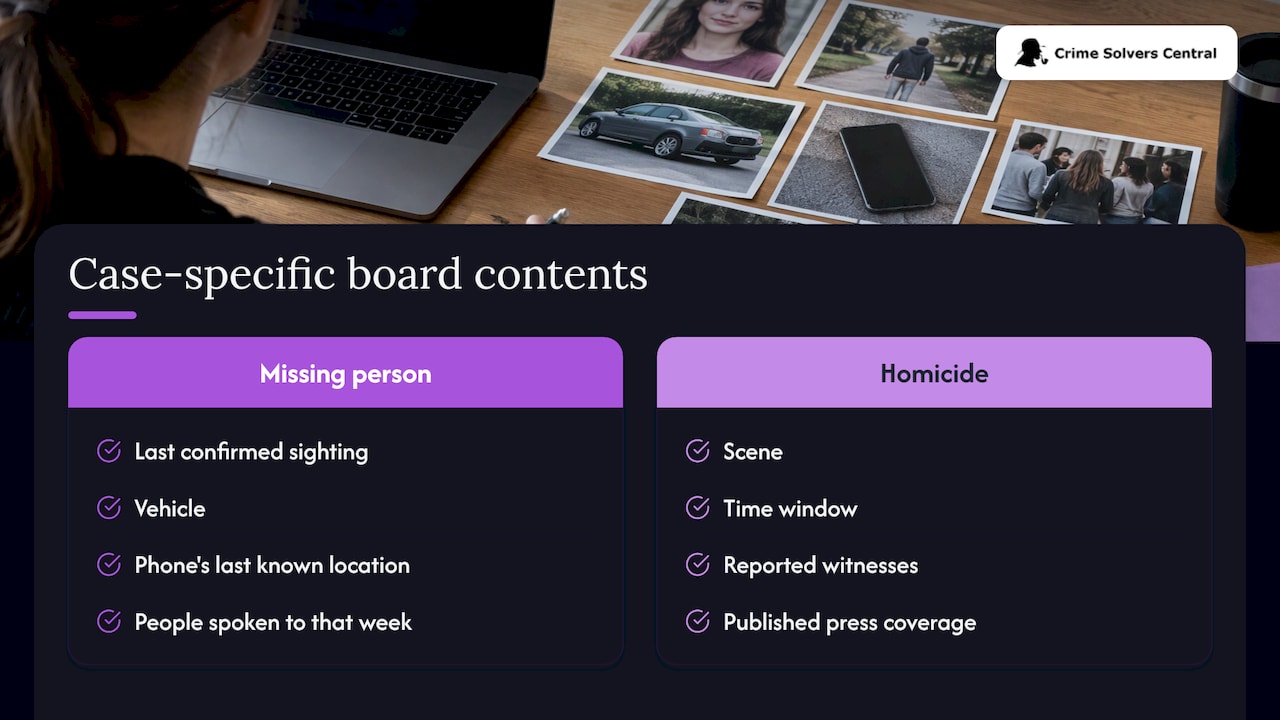
For a missing person, you might line up the last confirmed sighting, the vehicle, the phone’s last known location, and the people the person spoke to that week. For an unsolved homicide, you might place the scene, the time window, reported witnesses and published press coverage on one timeline. Gaps jump out: a week with no confirmed activity, a witness who appears in one article but never in another.
A board also helps families who feel overwhelmed. Years of paperwork, news clippings and messages become a structure you can explain to a detective in five minutes.
How to build an online evidence board, step by step
1. Define one question
Start narrow. “What happened to my sister?” is too wide to map. “Where was she between 6 p.m. and midnight on the last night she was seen?” is a question a board can answer. Write it at the top of the canvas. If you have several questions, make several boards.
2. Collect and log sources first
Before you place anything, gather documents, articles, public records, photos and your own notes. For each item, record where it came from, the date you found it, and who wrote it. Guidance on responsible amateur research recommends that a tip include sources, dates and verifiable facts, and you can only do that if the log exists from the start.
3. Sort items by type
Use simple categories that match how investigators think:
- People: victim, family, witnesses, named persons of interest in official reports
- Places: last seen, scene, recovery location, relevant routes
- Events: dated entries on a timeline
- Objects and records: vehicles, phones, clothing, reports, autopsy or dental records
- Media: photos, video, audio, news coverage
Color-code by reliability as well as type. A three-level system works: green for confirmed in an official document, yellow for reported by a credible source, red for unverified or rumor.
4. Connect with labeled links
An unlabeled line says only that two things are related. A labeled one says how. Use short verbs: “seen with,” “owned by,” “contradicts,” “same location as,” “reported by.” If you cannot label a link with a sourced reason, do not draw it. Many bad theories begin with a line that felt right.
5. Add a timeline and a question list
Keep a running list of open questions beside the board: what is unknown, who might know it, and which official record would answer it. This list, more than the board itself, is what you hand to investigators.
6. Review on a schedule
Cold case information changes: a case is reclassified, a name is corrected, a new article appears. Set a monthly review, date your edits, and remove or downgrade anything that has been contradicted.
Features worth having in an online evidence board
When you choose a tool, look for the basics that make the steps above possible:
- A visual canvas with room for documents, images, audio and video
- Connectors and annotations, so every link can carry a label and a note
- A way to attach a source and date to each item
- Comments and version history if more than one person edits
- Access controls, so you decide who can view the board
- Export to PDF or image, so you can send a clean summary
Collaboration matters most when a family and several volunteers share one board. Tools in this category typically offer real-time comments and version control, and those are the features that keep a shared board from drifting. Assign one person as editor of record, so changes are deliberate rather than accidental.
On Crime Solvers Central, digital evidence boards sit inside the same membership as the case catalog, which means a board can live next to the case profile, sources and discussion that prompted it. If you want a worked example of how to structure one, see our evidence board examples for cold case volunteers and our step-by-step guide to building one for a cold case.
Keeping a board accurate when several people edit
A shared board is only as good as its rules. Agree on these before anyone adds a pin:
- Every item needs a source. No source, no pin.
- Separate fact from inference. Put inferences in a distinct color or note type, never in the same style as confirmed facts.
- One editor of record. Others suggest changes in comments.
- Date everything. Include the date you found the item and the date it was published.
- Retire, don’t delete. When something is disproven, mark it and keep the note on why. That stops the same rumor from returning.
If you follow people-search results or social media posts, treat them as leads. Researchers who work with these tools stress that results are leads, not proof, to be confirmed against other public sources, and that individuals should not be accused in public.
Limits you should understand before relying on a board
A board is a good map and a poor verdict. A 2025 academic paper on open-source intelligence in cold cases points to problems of unreliability, inconsistency and fuzziness in online material. It also describes cases where citizens without training crossed the line between police and civilian roles, for example by confronting people over personal suspicions or breaking chain of custody.
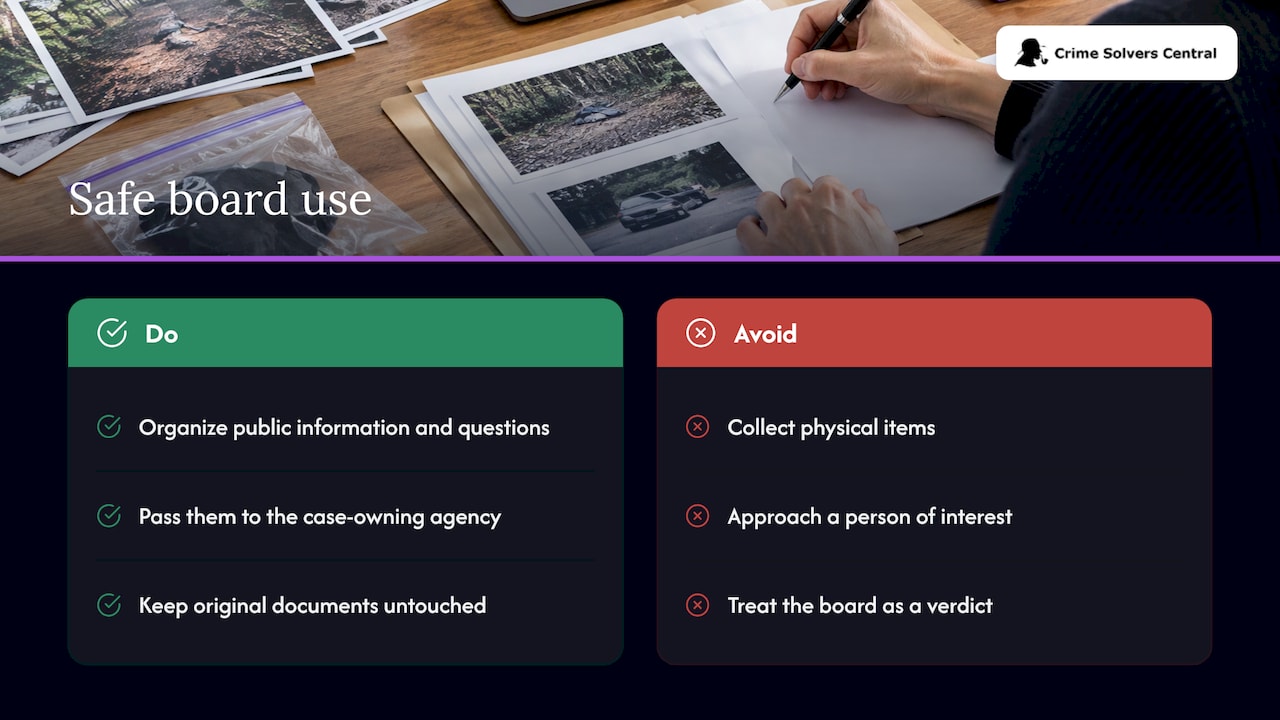
The practical lesson is simple. Information gathered informally can still be valuable intelligence, but if it is gathered without proper standards a decision maker may not be able to use it as evidence. That is why the safest use of a board is to organize public information and questions, then pass them to the agency that owns the case. Keep original documents untouched, do not collect physical items, and never approach a person of interest.
Privacy and safety when you share a board
A board often contains the names of living people, photos of children, addresses and details about a family’s worst day. Treat it accordingly.
- Keep it private by default. Share with named people, not with a public link.
- Leave out what is not needed. Home addresses, phone numbers and the names of minors rarely help a tip and can cause real harm.
- Strip photo metadata. Images can carry location and device data. Our guide to anonymous tips and removing EXIF data explains how.
- Do not name suspects publicly. Online “websleuthing” without rules is associated with speculation and harassment, and a wrongly accused person can be hurt permanently.
- Protect your own safety. Do not post your location or routine while you investigate, and do not contact people connected to the case on your own.
- Use official channels for tips. The FBI accepts federal-crime tips at tips.fbi.gov, and tips can be anonymous. For local cases, use the number or form listed by the investigating police department or sheriff.
For missing persons, also look at the national database NamUs. Cases there are only published after a regional administrator verifies the report with the law enforcement agency and obtains permission, and some sensitive details are visible only to vetted criminal justice personnel. That design is a good model for your own habits: verify first, then share, and limit who sees the sensitive parts.
From board to tip: what to send an investigator
Detectives rarely want a screenshot of a tangle of strings. They want a clear summary. A good submission has:
- A one-paragraph headline: the case name, case number if known, and what new information you are offering.
- A short list of facts: each with its source and date.
- A short list of questions: what you could not resolve.
- Your contact details and how you came across the information.
Submit it through the agency’s preferred channel and keep a copy. Guidance for amateur researchers recommends concise, factual summaries over long theories. Our guide on how to report information about a cold case walks through the process, and common mistakes in missing persons searches lists what to avoid.
Our perspective
We built the evidence board tools on Crime Solvers Central because families and volunteers were already making boards, in notebooks, on kitchen walls and in scattered files, and the work kept getting lost.
Our view is that a board belongs next to the case itself. When the profile, sources, forum discussion and board sit in one place, it is far easier to keep every pin tied to a source and to see what changed. With a national database of more than 264,000 cases sorted by state and situation, a member can move from a case profile to an organized board without starting from zero.
We also believe that community effort works best when it ends with the right person reading the right summary. That is why our tools include a flyer builder, volunteer coordination and safety initiatives alongside the boards. The goal is not a bigger theory. It is a clearer, better-sourced tip that gives an investigator a reason to look again.
Crime
Using evidence boards on Crime Solvers Central
Crime Solvers Central is a searchable national database of cold cases, covering missing persons, unsolved homicides and unidentified or unclaimed remains, with profiles organized by state and type. Membership unlocks full case details, sources, videos, forums, digital evidence boards, a flyer builder, AI image tools and volunteer coordination.
Plans, as published on our pricing page:
| Plan | Monthly | Yearly |
|---|---|---|
| Jr. Detective | $3.97 | $39 |
| Sr. Detective | $9.97 | $99 |
| True Crime Influencer | $39.97 | $399 |
If you are just starting out and want a safe approach, begin with our plan for helping solve cold cases safely, then pick the plan that fits how deeply you want to work. Already a member? Log in and open your board.
Starting small: a first-week plan
If the whole process feels heavy, break it down:
- Day 1: Write your single question and choose one case.
- Days 2 to 3: Gather public sources and log each with source and date.
- Day 4: Build the timeline only. Do not draw connections yet.
- Day 5: Add people and places, with reliability colors.
- Day 6: Add labeled connections you can support from a source.
- Day 7: Write the one-page summary and the list of open questions. Decide whether you have anything to send, and to whom.
Many boards never need to go beyond this. A tidy timeline with sourced entries is already more useful to an investigator than a sprawling web of guesses. For ideas on working with others in your area, see our guide to collaborating with communities on unsolved crimes and our four priority actions for helping online ethically.
FAQ
Is an online evidence board admissible in court?
No, not on its own. A board is a visual aid for organizing information, while courts rely on exhibits with documented custody. Official evidence systems are built to store and secure digital evidence with audit logs and access controls. Use your board to prepare a clear summary, then give it to the agency handling the case.
What should I put on an evidence board for a missing person?
Start with a dated timeline of the last confirmed activity, then add places, people named in official or credible public sources, and records such as vehicle or phone details. Label each item by reliability and attach its source. Leave out private details that do not help a tip, such as home addresses and information about minors.
Can I share my board publicly to get more tips?
It is safer to share a flyer or a short factual case summary than the board itself. Boards often hold unverified connections and personal details that can harm innocent people if posted. Keep the board private or limited to trusted collaborators, and send findings through the agency’s official tip channel.
How often should I update a shared board?
Review it monthly, and any time you learn something that changes a fact. Date every edit, keep one editor of record, and mark disproven items rather than deleting them. That keeps everyone working from the same version.
What if my board points to a specific person?
Do not confront or accuse them. Write down the sourced facts that raised your concern and submit them to investigators. Research warns that citizens acting on personal suspicion have crossed into police roles and compromised cases, so let the agency decide what to do next.
Sources
- Digital Evidence Board: How to Build One
- Managing Digital Evidence in Courts (National Center for State Courts)
- 8 Digital Evidence Management Systems Compared (2026)
- How amateur researchers can responsibly assist cold case investigations
- Free Evidence Board Maker
- Actionable Open-source Intelligence Architecture for Cold Cases
- What a Court Digital Evidence Management System Does
- FBI Electronic Tip Form
- NamUs User Guide: Entering Missing Person Cases