

Online Detective Board: How to Build One for a Real Case

An online detective board is a digital version of the corkboard with photos and red string: one shared space where the facts of a missing-person or cold case, the people involved, the timeline and the open leads are laid out so you can see how they connect. For a real case, a good board does three things: it keeps confirmed facts apart from unverified leads, it protects sensitive details, and it sends anything worth acting on to the agency that owns the case. Members of Crime Solvers Central can use digital evidence boards alongside a searchable national database of more than 264,000 cases.
TL;DR
- An online detective board organizes a case in one place: people, places, dates, sources and open questions, with the links between them.
- Label every item as confirmed, unverified or an open question, and record where each came from.
- Start from the official record: the case’s entry in a national database and the agency in charge.
- Keep family details and unpublished leads private, and give tips to law enforcement rather than acting on them yourself.
- Boards that look like entertainment (a stylized corkboard with strings) are different from boards built to support an actual case.
Table of Contents
- What an online detective board is
- Start with the official record, not a blank canvas
- How to set up the board, step by step
- Verifying a lead before it goes on the board
- Sharing a lead with the agency that owns the case
- Collaborating without causing harm
- The risks, and how to reduce them
- What to look for in a board for a real case
- Perspective
- Where Crime Solvers Central fits
- FAQ
- Sources
What an online detective board is
The search results for this phrase mix three things: decorative corkboard images for parties and film sets, whiteboards police departments use to track crime statistics, and software where you sign in to build your own investigation board. Only the last one matters if you are working on a real person’s disappearance or death.
In that use, a board is a working map. Each card is a person, place, event, document or question. Lines show relationships: who saw the person last, which vehicle appears in which report, which statement conflicts with another. The value is not the visual. It is that gaps and contradictions become obvious, and that a group of people can see the same picture.
That last point matters for families and volunteers. A cold case often has years of scattered material: news clippings, a flyer, a few lines from a police report, social media posts. A board gives it one structure.
Start with the official record, not a blank canvas
Before you add a single card, find out what already exists. In the United States, the central public resource is NamUs, a free national database for missing, unclaimed and unidentified persons run through the Department of Justice’s National Institute of Justice. It can be used by law enforcement, medical examiners, families and the public, and 17 states now require law enforcement to enter case information into it.
Two details help you build a better board:
- A published NamUs case needs 18 complete and accurate fields, including the date of last contact and the city and state where the person was last seen. Use those as the first cards on your board.
- The federal review of cold case resources explains that NamUs captures demographics, circumstances of disappearance, physical descriptors, clothing and DNA information, while NCIC, the FBI’s national crime information system, holds 22 person and property files that officers can query in real time. Your board should record whether the person appears in each.
If you are new to searching, our guides to a NamUs database search and the official missing persons database walk through it step by step. For remains that have not been identified, see why families must search beyond NamUs.
How to set up the board, step by step
1. Define the question
Write one sentence at the top: what are you trying to learn? “Where was Alex seen after the 9 p.m. shift ended?” is useful. “Solve the case” is not. A narrow question keeps the board from becoming a pile.
2. Create the fixed cards
Add the basics from the official record: full name, date of last contact, place last seen, physical description, clothing, case number and the agency in charge. Copy these exactly. A wrong date or spelling spreads through every later card.
3. Build a timeline
Place events in order with times where known. Mark gaps clearly. In many cold cases the most valuable thing a board shows is a stretch of hours nobody has accounted for.
4. Add people and places as separate cards
Each witness, relative, employer, vehicle, address and business gets its own card, linked to the events it touches. Keep descriptions factual: what a person said and when, not what you suspect.
5. Tag everything by status
Use three tags and apply them to every card:
| Tag | Meaning | Example |
|---|---|---|
| Confirmed | Stated in an official record or by a verified primary source | Date of last contact in the case entry |
| Unverified | Reported but not checked | A social media comment saying the person was seen at a bus station |
| Question | Something you need answered | Was the vehicle ever located? |
This matters beyond neatness. Guidance for crime-reporting communities warns against presenting circumstantial or unconfirmed information as established fact, and the FBI’s own tip system handles public submissions with caveats that they are unvetted leads.
6. Record the source on every card
Write where each item came from, the date you found it and a link. If you cannot say where a claim came from, it is a rumor, and it goes under Unverified.
Verifying a lead before it goes on the board
Online material is easy to mistake. A photo can be old or from another place. A username can belong to someone else. First Draft’s verification guide recommends checking a piece of content’s provenance, source, date, location and motivation, identifying the uploader, running reverse image searches and looking for identical material elsewhere.
A practical checklist for each lead:
- Who posted it, and can you identify them?
- When was it first posted? Does a reverse image search show an earlier copy?
- Does the location match what is visible, and does the date fit the timeline?
- Does an independent source agree?
- Why might someone be sharing this? A grudge or a wish for attention can produce convincing false leads.
A lead that passes stays tagged Unverified until an agency confirms it. Passing your checks does not make it a fact.
Sharing a lead with the agency that owns the case
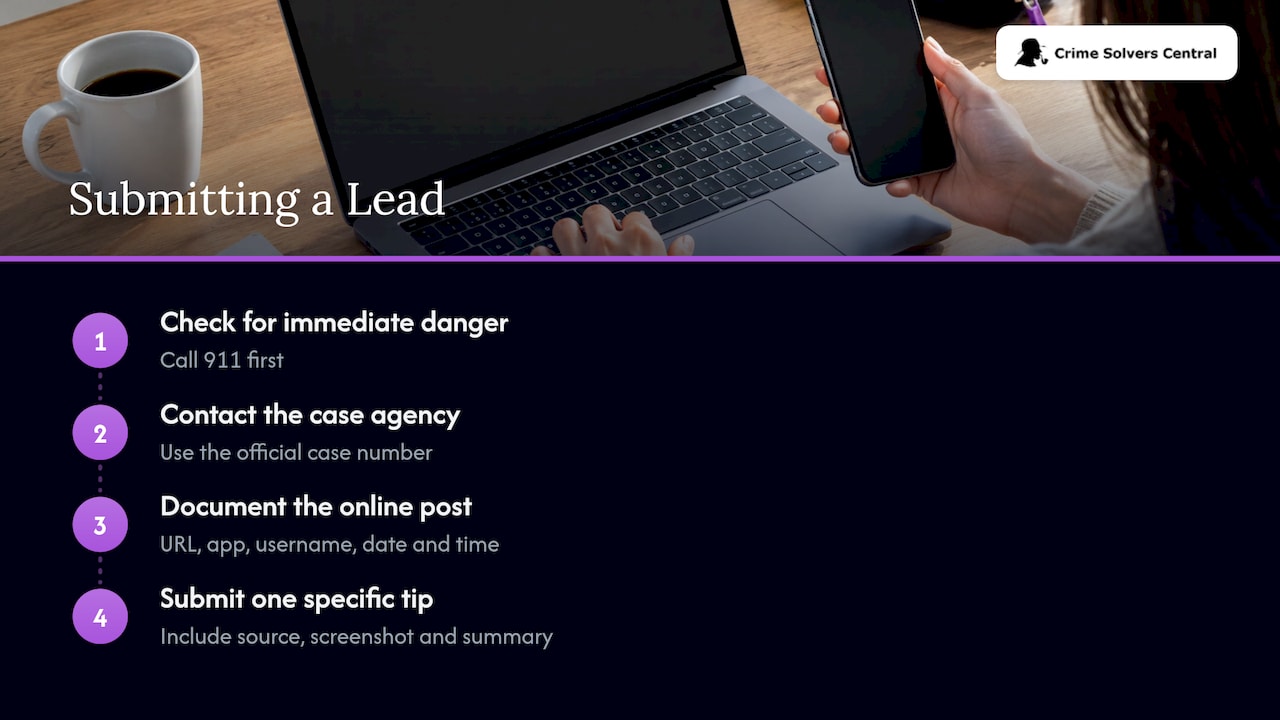
The board is for organizing. Action belongs to investigators. When you have something specific, contact the agency handling the case, using the case number from the official record.
For tips to the FBI, the National Threat Operations Center is the primary channel. Per a California DOJ bulletin, since January 1, 2024, non-emergency state, local and tribal tips, including missing-person reports with no FBI case, are passed directly to the responsible agencies. Check the details at the bulletin.
The FBI’s tip form asks you to be specific: for an online post, give the URL, app name, username and date and time, and submit once. Giving your name is voluntary, but leaving out requested information may hinder follow-up. If you prefer to stay anonymous, read about anonymous tips on Crime Solvers Central.
A board makes a tip better. You can hand over a dated source, a screenshot, the URL and a one-paragraph summary instead of a hunch.
If there is any sign of immediate danger to someone, call 911 first.
Collaborating without causing harm
Boards are often shared by families, volunteers and sometimes investigators. That is where most problems start.
Respect the investigation. The KlaasKids community guide stresses that volunteers must respect law enforcement’s efforts and not impede the investigation, build relationships with the family and investigators and obey all local, state and federal laws.
Let the family act as the filter. A 2024 peer-reviewed study of true-crime podcast communities found that families act as filters, taking crowdsourced leads to formal investigators. That is a good model for your board: volunteers propose, the family decides what is worth passing on, and the agency decides what to do.
Use roles. NamUs separates a public area from a restricted one: it is a permission-based system with a publicly viewable area and a restricted criminal-justice-sensitive environment. Copy the idea. Let everyone see confirmed public facts; limit unpublished details and personal information to a few trusted people. The FBI’s tip system reduces misuse of personal data with two-factor authentication, role-based access and restricted-file designations.
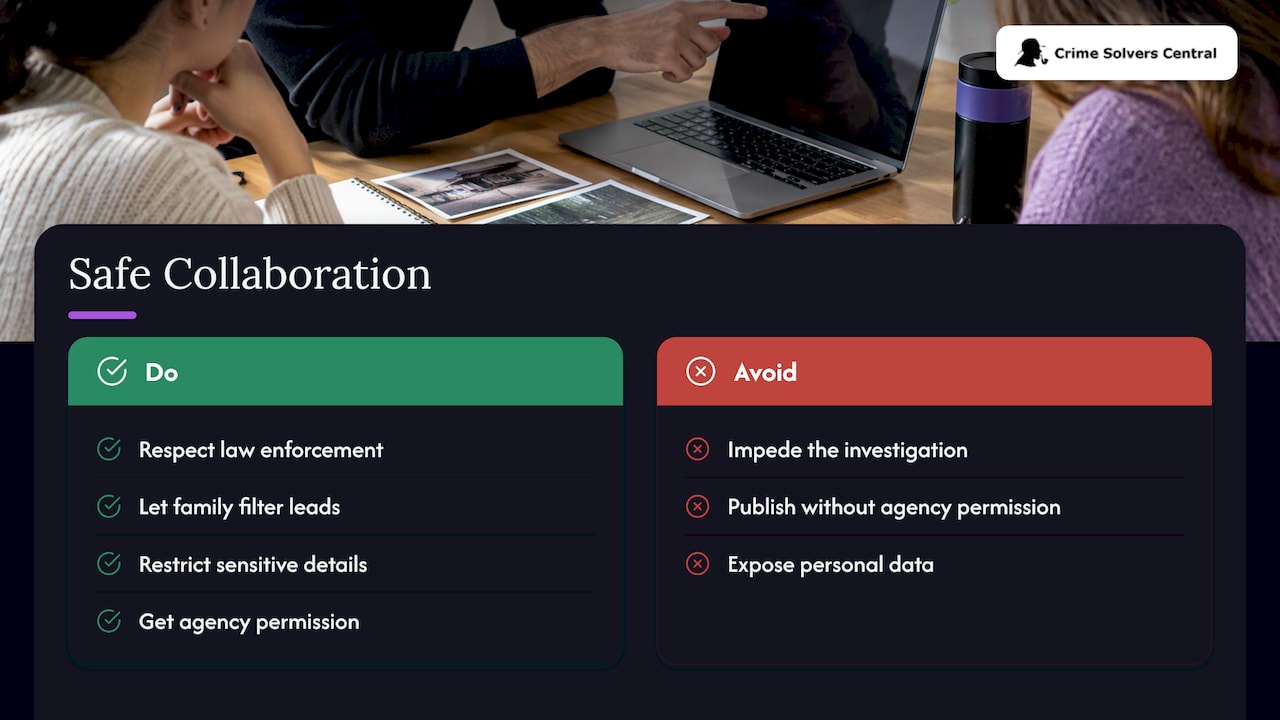
Get permission before publishing. NamUs has a regional administrator verify the report with law enforcement and obtain the agency’s permission to publish. If a case is not public, ask the agency before your board puts details online.
The risks, and how to reduce them
- Mistaken identification. Naming a suspect on a public board can ruin an innocent person’s life and damage a prosecution. Keep suspicion off public boards. Record facts and questions, and give concerns to investigators.
- Harassment. Never post the addresses, workplaces or family details of witnesses or relatives. The FBI’s tip system keeps a block list for baseless, harassing or excessive tips, a reminder that tip systems treat harassment as misuse.
- Interference. Contacting witnesses yourself or sharing details only investigators know can compromise a case. Ask the agency what should stay unpublished.
- Exposed storage. A board on a wall or in a poorly secured cloud account can be seen by people who should not see it. Use strong passwords, two-factor sign-in and sharing limited to named people.
The same ethical principles run through our guides on helping solve crime online ethically and collaborating with communities on unsolved crimes.
What to look for in a board for a real case
- A link to the official record. The board should start from, and point back to, the case in NamUs or the agency’s page.
- Status tagging and source fields for every item.
- Access controls, so you can separate public facts from private ones.
- Easy export, so you can give an agency a tidy summary.
- Case discovery. You need to find the case before you can organize it. Our guide to finding missing persons cases in the U.S. and the comparison of missing persons databases help here.
Perspective
We built Crime Solvers Central around a simple idea: a case board is only as good as the case file behind it. With more than 264,000 cases sorted by state and type, our members can start from a real profile rather than a blank page, then use digital evidence boards, forums and volunteer coordination to work with others.
The families we serve need practical tools. A flyer builder helps get a face and a description in front of people quickly. Our AI image tools, including age progression, are designed to support that work. The point is the same each time: organize what is known, get it in front of the right people and channel tips to those who can act.
We think community participation works best when it is organized, respectful and tied to the official record. That is why we put structure, shared access and cooperation with investigators at the center of how our members work.
Crime
Where Crime Solvers Central fits
Members get full case details, sources, videos, forums, digital evidence boards, a flyer builder and volunteer coordination tools. The Jr. Detective plan is $3.97 per month or $39 per year, Sr. Detective is $9.97 per month or $99 per year, and True Crime Influencer is $39.97 per month or $399 per year. See the membership plans for what each includes, or join the community forums to talk through a case with other members.
FAQ
Is an online detective board legal to use for a real case?
Organizing publicly available information privately is generally lawful. Trouble starts when a board publishes private details, accuses a named person without proof or leads someone to interfere with an investigation. Follow all local, state and federal laws, and ask the agency in charge what can be shared.
Can a board help solve a cold case?
It can help you see gaps, conflicts and patterns, and it makes a tip clearer when you pass it on. Cases are resolved by investigators, so the board’s job is to prepare better information for them.
What should I put on the board first?
Start with the confirmed basics: name, date of last contact, place last seen, description, case number and agency. NamUs lists 18 required fields for a published case, which makes a good starting list.
Who should see my board?
Keep it limited to the family and trusted collaborators while it contains unverified leads or personal details. Share only confirmed, public facts widely.
What do I do if I find a real lead?
Check it against the steps above, then send it to the agency handling the case with the case number, URL and dates. If someone is in immediate danger, call 911.
Sources
- National Missing and Unidentified Persons System (NIJ)
- NamUs User Guide
- Unresolved Cases: A Review of Protocols and Resources (DOJ COPS)
- Lost but Not Forgotten: Finding the Nation’s Missing (NIJ)
- FBI TIPS Privacy Impact Assessment
- KlaasKids Community Search Resource Guide
- True Crime Podcasting as Participatory Journalism (MDPI)
- Verifying Online Information (First Draft)
- California DOJ CJIS Information Bulletin 24-02
- FBI Electronic Tip Form