

National Missing Persons Databases: Where to Search in the U.S.

There is no single national missing persons database in the United States. There are three federal systems that serve different people, and only one of them is open to the public. Families, volunteers and students get the most from them when they start with the public federal system, then add a searchable case catalog that organizes long-term cases by state and type. That is what Crime Solvers Central is built to be, with more than 264,000 cold cases sorted by state and situation.
This guide explains what each system holds, who can see it, how to search and report, and how community members can help without harming an investigation.
TL;DR
- The FBI describes three national systems for missing persons: NCIC, NGI and NamUs. They are not linked, so a case entered in one does not automatically appear in the others.
- NamUs is the one the public can search. NCIC and NGI are for law enforcement.
- Families can register with NamUs to enter and track a case, and every public entry is vetted by the investigating agency first.
- Searching for unidentified remains is part of the job: compare your missing person’s details with unidentified-person records, starting near where they disappeared and widening outward.
- Crime Solvers Central organizes more than 264,000 cases by state and type, with member tools for volunteers, families and students.
Table of Contents
- The three national systems, and why they are separate
- NamUs: the public federal database
- Who qualifies as missing, and how long you wait
- How a family reports and searches
- Searching for unidentified remains
- What the public sees, and what stays private
- Law enforcement: entering and updating records
- Where a public case catalog adds to the federal systems
- Who gets what from each resource
- Membership plans
- FAQ
- Sources
The three national systems, and why they are separate
The FBI’s guidance on submitting missing person information names three systems: the NCIC Missing Person File, the Next Generation Identification (NGI) system, and NamUs. It also says they are not linked, so reporting to each one raises the odds of a lead surfacing anywhere in the country.
Here is what each one does.
| System | What it holds | Who can search it |
|---|---|---|
| NCIC (National Crime Information Center) | Biographic information on missing and unidentified persons, among 21 files | Authorized criminal justice agencies only |
| NGI (Next Generation Identification) | Biometric data, such as fingerprints, used to generate leads when later prints match | Law enforcement |
| NamUs (National Missing and Unidentified Persons System) | Demographics, case circumstances, clothing, accessories, and sometimes biometrics | Public view on a limited basis; professionals get more |
The Operation Lady Justice fact sheet from the Office of Justice Programs notes that NCIC is reachable only through state or federal CJIS Systems Agencies, not by the public. A 2022 NIJ podcast adds some history: NCIC launched in 1967, its Missing Persons Index began in 1975, and its Unidentified Persons Index followed in 1983.
For a family, the practical meaning is simple. You cannot log in to NCIC. Your local law enforcement agency enters the case there. Your own searching happens in NamUs and in public case catalogs.
NamUs: the public federal database
NamUs is administered by the National Institute of Justice, part of the Department of Justice. It serves law enforcement, medical examiners, coroners, investigators and families working to resolve missing, unclaimed and unidentified persons cases.
It is really three databases in one. According to the NIJ podcast cited above, the unidentified persons database launched in 2007, the missing persons database in 2008 and the unclaimed persons database in 2010, with a redesign in 2018 for more robust searches. A Congressional Research Service report describes how they differ:
- Missing persons: searchable by photo, circumstances, dental records, DNA, appearance and police contact.
- Unidentified remains: entered only by medical examiners and coroners. The public can view profiles and search by demographics, location and body features.
- Unclaimed remains: people who have been identified but whose next of kin have not been located or have not claimed them.
NamUs automatically cross-compares all three, which is the point. A missing person profile and an unidentified person profile can match without anyone noticing by eye.
The scale is worth knowing. The NamUs Fiscal Year 2024 Annual Report reports 61,492 cases resolved since the system began, including more than 11,300 identifications through DNA, forensic genetic genealogy, dental, fingerprint, anthropological or radiograph comparisons. In that same year, over 50 cases were resolved because a family recognized a photograph or personal effects. Those are cases where a relative looking at a public profile made the difference.
Who qualifies as missing, and how long you wait
People often believe a person must be gone 24 or 48 hours before a report. The NamUs User Guide does not set a waiting period for reporting to police. What it does say is about timing inside NamUs: the system is designed to complement NCIC for long-term cases, and its resources help most with cases active longer than 180 days, unless there is imminent risk of harm or death. You can read that in the NamUs User Guide.
If someone is in danger now, call your local police first. Do not wait on any database.
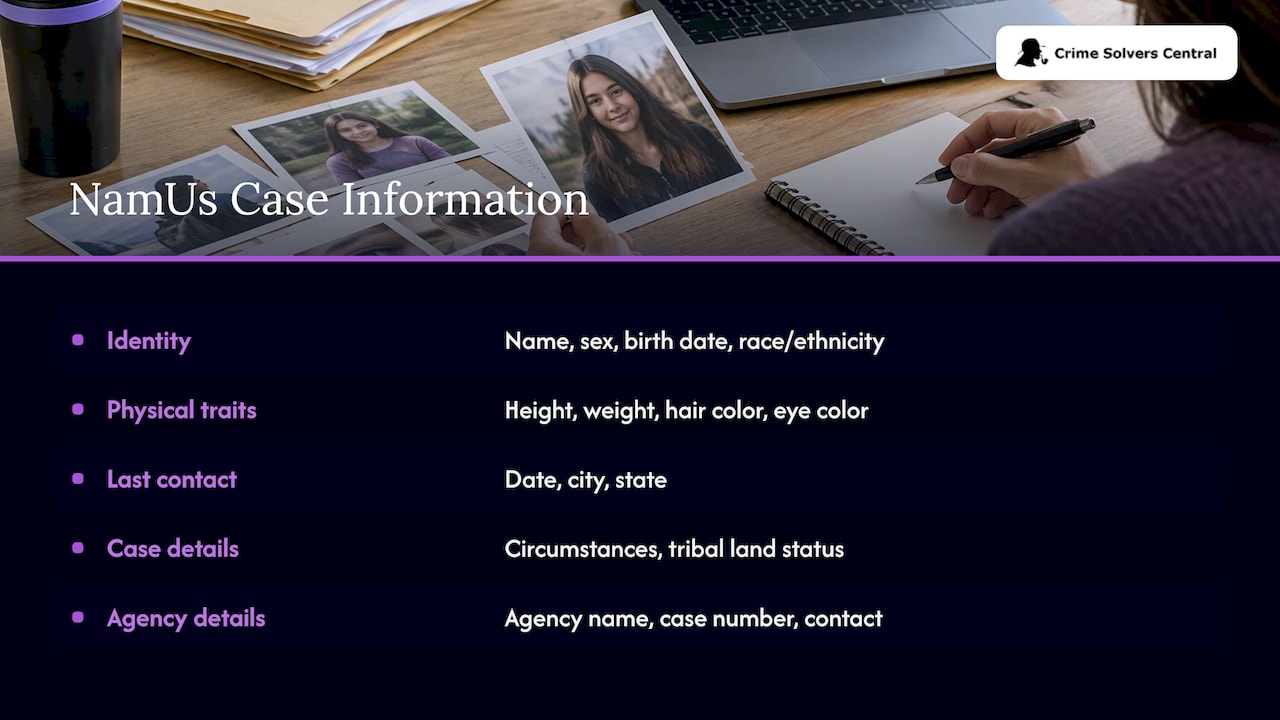
The same guide lists 18 data fields needed before a case can be published: name, sex, date of birth, race or ethnicity, height, weight, hair and eye color, last contact date, city and state, circumstances, tribal land status, and the investigating agency’s name, case number and contact. That list is a useful checklist even before you register. Gather it at the kitchen table.
For children, federal law adds urgency. Minnesota’s Department of Public Safety explains in its NamUs basic training that Billy’s Law requires entry of missing children within 72 hours, and critical missing adult cases should be entered right away. Federal law requires entry into NCIC for children under 18 and adults aged 18 to 20, but does not mandate it for adults over 21, according to House Report 111-416. That gap is one reason adult cases can sit untouched, and why NamUs and public catalogs matter for them.
How a family reports and searches
Start with law enforcement. NamUs will not publish a case without an agency’s name and case number, and NamUs staff must get permission directly from that agency. That is stated in the Minnesota training page above. Here is the usual order.
- File a police report with the agency where the person was last seen, and get the case number and the detective’s contact.
- Register as a NamUs public user. The NamUs for Loved Ones of the Missing guide confirms that families can register to enter cases, track them and search publicly visible information.
- Submit the case. Per the NamUs User Guide, a Regional System Administrator reviews it, the investigating agency approves it, and only then is it published.
- Offer DNA reference samples. The same loved-ones guide says NamUs provides free investigative services, including technical assistance, forensic analysis and case status information, and hosts Missing Persons Days where families give DNA samples and unshared personal items, such as a toothbrush.
- Check back. A published case is a living record. Ask the agency to update it when new details emerge.
Some adults who are reported missing are actually in custody somewhere. In Texas, for instance, a Texas inmate search guide walks through checking the state corrections system and county portals. Ruling that out early can save weeks of worry, and it is a reminder that law enforcement records and public records answer different questions.
For a deeper walkthrough of the search screens, our NamUs database search family guide goes field by field, and the overview of federal resources and what families can share covers what to prepare before you call.
Searching for unidentified remains
Families often ask whether there is a database for unidentified bodies. There is: the unidentified persons records in NamUs, entered by medical examiners and coroners. The public can search them but cannot add to them.
Minnesota’s training describes families who used NamUs advanced searches to find a missing loved one listed as an unidentified person. The advice is to start near where the person went missing and then expand outward, because a person who has died may have been transported elsewhere in the country.
A practical approach:
- Use the broadest physical details first (sex, approximate age range, height range), then narrow with distinguishing features such as tattoos, scars or healed injuries.
- Search neighboring states, not only the state of disappearance.
- Repeat the search periodically, because new unidentified records are added over time.
Detail matters enormously. The Minnesota training cites a case in which autopsy findings of prior trauma, a healing broken neck and facial injuries, matched the family’s description of their missing relative. A professional user connected the agencies, and both cases were resolved as the same man. If you know about an old injury, say so in your report.
Our guides to identifying unidentified remains and where to find unidentified and unclaimed persons records cover these searches in more detail, and our piece on why families should search beyond a single federal system explains how to build a complete search routine.
What the public sees, and what stays private
Public databases are careful about what they show. According to the Minnesota training, public-facing circumstance text in NamUs is kept generic. Sensitive details, such as medical history, mental health history, date of birth and family locations, go in “holdback” fields visible only to NamUs staff and law enforcement. Resolved cases are archived at the agency’s request.
This shapes how volunteers should behave. If you spot what looks like a match, you are not expected to confirm it yourself. The FY2024 annual report says NamUs staff review all investigative tips and leads. Your job is to pass along what you noticed, with the case number, and let the agency and forensic professionals verify it.
Good tip hygiene looks like this:
- Reference the exact case number and the source you looked at.
- State what you saw, not what you conclude.
- Do not contact the family or the person you suspect on your own.
- Do not post unverified matches publicly.
Law enforcement: entering and updating records
For agencies, the FBI page lists the routes. Cases can be submitted to NCIC, missing persons can be enrolled in NGI with the MPR transaction, and cases can be reported to NamUs through Regional Program Specialists. Agencies should keep the numeric identifiers each system assigns. The page also lists contact points, such as [email protected] for NCIC entry and the Regional Program Specialist contact on the NamUs site.
Professional NamUs users must register with supervisor contact information so employment can be verified. A University of Texas System training bulletin explains that registration gives public access right away and law enforcement access after employer verification, and that portal information must be treated as law-enforcement sensitive.
NamUs also added capacity for older cases. The FY2024 report describes the Cold Case Advisory team, introduced in April of that fiscal year, which positively affected 409 cases through record updates, added biometric collection and case archival. Agencies that want public tips on a cold case benefit from a complete, current record before any outside help arrives.
Where a public case catalog adds to the federal systems
Federal systems are built for records and forensic matching. Many families and volunteers also need something else: a way to browse long-term cases by place, read the circumstances in one view, and take action. That is where Crime Solvers Central fits.
Our national database holds more than 264,000 cases, including missing persons, unsolved homicides and unidentified or unclaimed remains, categorized by state and type. You can browse the cold case database by state and use the guide to finding missing persons cases to learn the search routine. If you want to compare resources by type, the 2026 comparison of missing persons databases lays out what each kind provides.
Members unlock full case details, sources and videos, forums, digital evidence boards, volunteer coordination, and a flyer builder. Families who have registered with NamUs can also read how to connect with advocate-vetted families in similar situations.
Who gets what from each resource
- Families: police report, NamUs registration, DNA samples, then a public catalog and flyers to widen visibility.
- Volunteers: study cases by state, organize findings on an evidence board, and route tips through the investigating agency.
- Law enforcement: keep NCIC, NGI and NamUs entries current, and welcome organized public attention on cold cases.
- Students and activists: the federal reports above give hard figures on resolution and system design, while a state-by-state catalog shows patterns in who is missing and where.
Our view: the database is only the start
A record in a database does not find anyone. People do. Every case that has been resolved started with a name, a photograph and someone willing to look at it twice.
That is why we built our national database around the way people actually look for cases: by state, by situation, by type. More than 264,000 cases are organized so a volunteer in Ohio can find Ohio cases and a family in Arizona can see who else has gone missing near them.
We also build tools for the work that comes after the search. Digital evidence boards help volunteers organize what they have read. The flyer builder helps families put a face in front of a neighborhood. Our A.I. image progression tool helps picture how a long-missing person might look today. Forums and volunteer coordination connect people who care about the same cases.
Our position is that federal systems and community effort belong together. Register the case with NamUs and the investigating agency. Then give it the sustained attention that long-term cases rarely get.
Crime
Membership plans
Free summaries and guides let anyone start. Full case files, forums and tools are part of membership, which is listed on our pricing page:
| Plan | Monthly | Yearly |
|---|---|---|
| Jr. Detective | $3.97 | $39 |
| Sr. Detective | $9.97 | $99 |
| True Crime Influencer | $39.97 | $399 |
Families who need a printed flyer today can go straight to the flyer builder.
FAQ
Is there one national database that covers every missing person?
No. The FBI describes three separate national systems, NCIC, NGI and NamUs, and says they are not linked. Reporting to each increases the chance of a lead. Your local agency handles NCIC and NGI entries, and you can register in NamUs yourself.
Can the public search NamUs?
Yes. Anyone can search publicly visible case information, and registered public users can also enter missing person cases and track them. Every public entry is vetted with the investigating agency before it is published, and sensitive details stay in fields only staff and law enforcement can see.
Is there a database for unidentified bodies?
Yes. NamUs has an unidentified persons database, entered only by medical examiners and coroners. The public can search it by demographics, location and body features. Start your search near where the person disappeared and widen it, since they may have been moved or traveled far away.
How long must someone be missing before NamUs helps?
There is no waiting period to report someone to police. NamUs resources help most with cases open longer than 180 days, unless there is imminent risk of harm or death. For children, Billy’s Law requires entry within 72 hours.
Sources
- FBI guidance on submitting missing person information to three national systems
- National Institute of Justice: NamUs
- Operation Lady Justice: Comparison of the NamUs and NCIC databases
- NIJ podcast: Leveraging databases for human identification
- Congressional Research Service: Missing Adults
- NamUs Fiscal Year 2024 Annual Report
- NamUs User Guide
- Minnesota DPS: NamUs basic training
- House Report 111-416: Help Find the Missing Act or Billy’s Law
- NamUs for Loved Ones of the Missing
- University of Texas System Training Bulletin 033
- Texas inmate search tips