

The Official Missing Persons Database Guide for Families

The two core systems to check are NamUs (the National Missing and Unidentified Persons System, publicly searchable) and NCIC (the FBI’s National Crime Information Center, restricted to law enforcement). Your immediate next step: file a police report with your local agency and confirm that the case has been entered into NCIC. From there, request or verify a NamUs entry to extend public visibility.
Who can access each system and what to do right now:
- NamUs — open to the public at namus.nij.ojp.gov. You can search cases, view case pages, and submit tips without an account. Families and advocates can also request that a new case be entered.
- NCIC — law-enforcement-only. You cannot search it directly. File a police report and ask the officer to confirm NCIC entry and note the case number.
- NCMEC — for missing children under 18. Call 1-800-THE-LOST (1-800-843-5678) immediately.
- State portals — many state DOJ or state police sites offer public search tools. Check your state’s official site alongside NamUs.
Key Takeaways
Filing a police report and confirming NCIC entry is the single most critical action in any missing-person case, because without it the case is invisible to law enforcement outside the filing jurisdiction.
| Point | Details |
|---|---|
| File and confirm NCIC entry | Ask the officer for the NCIC case number and which flags are applied before leaving the station. |
| Search NamUs publicly | Use namus.nij.ojp.gov to search cases, submit tips, and request new case entries at no cost. |
| Check state portals too | State DOJ and state police sites often hold records not yet in NamUs; look for .gov domains. |
| Protect investigative integrity | Coordinate public appeals with investigators; never post sensitive forensic or witness details. |
| Crimesolverscentral for long-term tracking | Over 264,913 cases searchable by state, with member tools for flyers, evidence boards, and volunteer coordination. |
Table of Contents
- What is NamUs and what cases does it hold?
- How to search NamUs and interpret what you find
- NCIC explained: why families cannot search it and why it still matters
- Other federal resources to check alongside the main databases
- State and local databases: how to find your state’s search tools
- First 48 hours: what families should do immediately
- Privacy, sensitive information, and the limits of public databases
- How the public can help without interfering
- How NCIC and NamUs work together under federal law
- An editorial perspective on what official databases miss
- Crimesolverscentral: deeper case tracking for families and volunteers
- Sources
- FAQ
What is NamUs and what cases does it hold?
NamUs is the National Missing and Unidentified Persons System, administered by the National Institute of Justice (NIJ). Think of it as the public-facing national clearinghouse for three distinct case types: missing persons, unidentified decedents, and unclaimed remains. Each category has its own searchable database, and they are designed to be cross-referenced so that a missing-person entry can be compared against unidentified remains entries from across the country.
The legal foundation for NamUs comes from 34 U.S.C. §40506, commonly called Billy’s Law, which authorizes the Attorney General and NIJ to maintain NamUs as a national clearinghouse and to coordinate database technology and forensic services for missing and unidentified person cases. That statutory backing matters: it means NamUs is not a volunteer project or a nonprofit database. It is a federally authorized system with a legal mandate to function.
Who actually uses NamUs? Families searching for a loved one are the most visible users, but the system also serves coroners and medical examiners who enter unidentified decedent records, forensic laboratories that upload DNA and dental data, and law enforcement agencies that manage case files. Professional users have expanded access, including the ability to view restricted fields and upload forensic evidence. Public users see a curated version: photos, physical descriptors, case notes, and the contact information for the investigating agency.
One important caveat: NIJ notes that 17 states require law enforcement to enter information into NamUs, while the remaining states rely on voluntary submission. That gap means not every active missing-person case appears in NamUs, particularly in states without a mandate. Knowing that limitation helps you interpret search results accurately rather than assuming a blank result means no case exists.
How to search NamUs and interpret what you find
Searching NamUs is straightforward, but a few techniques make a real difference in what you surface.
- Go to namus.nij.ojp.gov and select the database you want: Missing Persons, Unidentified Persons, or Unclaimed Persons.
- Enter what you know. The basic filters include first and last name, state, county, age range, and date of disappearance. You do not need all fields; partial information works.
- Try alternate spellings and nicknames. If a name has common variants (e.g., “Jon” vs. “John,” “Liz” vs. “Elizabeth”), run separate searches. NamUs does not always surface phonetic matches automatically.
- Widen the date range. If you are unsure of the exact date, extend the range by several months in both directions. Cases are sometimes entered weeks or months after the disappearance.
- Review the case page carefully. A public case page typically shows a photo (if available), physical descriptors (height, weight, hair and eye color, distinguishing marks), case notes, the investigating agency, and a case number. Some fields are marked restricted and visible only to professional users.
- Submit a tip directly from the case page. Each case page has a tip-submission link. Include as much specific detail as possible: dates, locations, vehicle descriptions, and any corroborating information. Vague tips are harder for investigators to act on.
- Request a new case entry. If a case is not in NamUs, families or advocates can submit a request through the site. The entry is vetted with the investigating agency before it goes public, so allow time for that process.
Pro Tip: Save your search parameters and check back periodically. NamUs case pages are updated as new information comes in, and a case that showed no photo last month may have one now. You can also contact the NamUs case manager listed on a case page directly if you have information that does not fit neatly into a tip form.
For a detailed family-focused walkthrough, the NamUs database search guide at Crimesolverscentral covers interpreting case fields step by step.
NCIC explained: why families cannot search it and why it still matters
NCIC, the FBI’s National Crime Information Center, is the authoritative law-enforcement record for missing and unidentified persons in the United States. Every patrol officer, every detective, and every border agent who runs a name check is querying NCIC. That nationwide reach is exactly why getting a case entered there is the single most operationally important step a family can take.
The catch: NCIC is accessible only to authorized law enforcement personnel. You cannot search it yourself, and no public portal mirrors its data. The only way to get a case into NCIC is through a law enforcement agency filing a missing-person report. Once entered, the record is visible to every agency in the country that queries the system.
NCIC also supports special flags that change how a case is handled. The Child Abduction (CA) flag and the Amber Alert (AA) flag, for example, trigger automated notifications to partner agencies and can activate regional alert systems. The OJJDP Family Survival Guide specifically recommends that families ask the investigating officer which flags have been applied to the case and why, since the presence or absence of a flag affects case priority and the notifications sent to other agencies.
What to ask your officer:
- “Has the case been entered into NCIC? Can you give me the NCIC case number?”
- “What flags are applied to the record?”
- “How do I request an update if new information comes in?”
- “If there is a delay in entry, who is the supervisor I should contact?”
If entry is delayed, escalate. Contact the state missing-persons clearinghouse, or for children, call NCMEC. Delays are common and often addressable, but they require families to be persistent.
| Feature | NCIC | NamUs |
|---|---|---|
| Access | Law enforcement only | Public and professional users |
| Primary purpose | Nationwide law-enforcement record sharing | Public clearinghouse and forensic support |
| Who adds data | Authorized law enforcement agencies | Law enforcement, coroners, families (via request) |
| Forensic services | No | Yes (DNA, dental, fingerprint support) |
| Public search | No | Yes |
Pro Tip: Bring a printed timeline of events and a recent photo to the police station. Officers entering a case into NCIC need specific data fields completed accurately. A prepared family member speeds that process and reduces the chance of a data entry error that could affect how the record matches against other queries.
Other federal resources to check alongside the main databases
NamUs and NCIC are the backbone, but the DOJ action center lists several additional federal tools that serve specific situations.
- FBI kidnappings and missing persons listings. The FBI’s public pages include active wanted and missing-persons notices for cases where federal jurisdiction applies, such as suspected interstate abductions or cases with a federal nexus. These are publicly viewable and searchable by name.
- ViCAP (Violent Criminal Apprehension Program). ViCAP is an FBI program designed to identify patterns across violent crimes, including disappearances that may be linked to a serial offender or an unidentified homicide victim. Law enforcement agencies submit case data to ViCAP; families cannot submit directly, but they can ask their investigating agency whether a ViCAP submission is appropriate for their case.
- NCMEC (National Center for Missing and Exploited Children). For anyone under 18, NCMEC at 1-800-THE-LOST (1-800-843-5678) is the right first call alongside local law enforcement. NCMEC operates 24 hours a day, maintains its own case database, and can coordinate with law enforcement agencies across the country. The first 48 hours guidance from NCMEC and OJJDP is clear: do not wait to report, and do not assume a waiting period is required.
- When to use which resource. FBI public pages are most useful for suspected abductions or cases with a federal angle. ViCAP is relevant when a disappearance may be linked to a violent crime or when remains are unidentified and a homicide is suspected. NCMEC is the right resource any time the missing person is a minor.
State and local databases: how to find your state’s search tools
Many states maintain their own public-facing missing-persons portals, and they are worth checking in parallel with NamUs because state entries are sometimes more current or more detailed for local cases.
The California Department of Justice Missing Person Search is one of the most accessible state examples. It allows public searches by name, case number, or physical description, and it pulls from the state’s own records rather than relying solely on NamUs data. Other states, including Texas, Florida, and New York, maintain similar portals through their state police or state DOJ websites.
To find your state’s portal, search “[your state] missing persons” on the official state DOJ or state police website. Look for a .gov domain and HTTPS. Third-party aggregators exist, but they are not authoritative sources and may carry outdated or incomplete records.
State portals and NamUs entries do not always match. A case may appear in a state database but not yet in NamUs if the investigating agency has not submitted the NamUs entry, or vice versa. When records differ, contact the investigating agency listed on the state case page directly. They are the authoritative source for that case’s current status.
Why do records diverge? NamUs relies on voluntary submission in most states, and state portals pull from their own law-enforcement systems. An entry in one system does not automatically populate the other. If you find a discrepancy, document it and raise it with the assigned investigator. For more on how data gaps affect research and families, the missing persons data analysis at Crimesolverscentral explains the coverage gaps across systems.
First 48 hours: what families should do immediately
Speed matters. The actions taken in the first 48 hours shape how quickly a case gains national visibility and investigative momentum.
- File a missing-person report with local law enforcement immediately. There is no mandatory waiting period. Any officer can take the report. Bring a recent photo, a physical description, and any information about the person’s last known location, contacts, and routine.
- Confirm NCIC entry. Ask the officer directly: “Has this case been entered into NCIC?” Get the case number in writing.
- Ask about applicable flags. For children, ask about the CA and AA flags. For adults believed to be in danger, ask about the Endangered Missing (EM) designation.
- Preserve evidence. Do not clean the person’s room or car. Preserve their phone, computer, and any written notes. Investigators may need to examine these items.
- Record a detailed timeline. Write down the last time you saw or spoke to the person, what they were wearing, who they were with, and any recent changes in behavior or circumstances.
- Contact NCMEC if the missing person is under 18. Call 1-800-THE-LOST immediately and in parallel with the police report.
- Request NamUs entry or verify it has been submitted. Ask the investigating officer whether the case will be entered into NamUs. If not, families can initiate a request directly through the NamUs site.
- Document every communication. Keep a log of every call, email, and in-person conversation with law enforcement, including the officer’s name, badge number, and what was discussed.
Pro Tip: Bring a missing person case file to the station: a folder with a printed photo, physical description, medical identifiers (dental records, fingerprints if available), and a written timeline. Officers can pull information directly from it, which reduces errors and speeds NCIC data entry.
For a full breakdown of what happens after a report is filed, the missing persons report guide at Crimesolverscentral covers the procedural steps in detail.
Privacy, sensitive information, and the limits of public databases
Not everything in a missing-person case is public, and that is intentional.
Certain fields in NamUs are restricted to professional users: forensic details, DNA profiles, investigative notes, and information that could compromise an ongoing operation. NCIC records are entirely off-limits to the public. These restrictions exist to protect the integrity of investigations, not to frustrate families.
Posting sensitive case details publicly, including specific forensic information, last-known locations that investigators have not disclosed, or details about witnesses, can actively harm an investigation. Before sharing anything beyond a basic description and photo, coordinate with the assigned investigator on what is safe to release.
What families should avoid:
- Publishing information that investigators have asked to keep confidential.
- Sharing unverified tips or rumors on social media as if they are confirmed facts.
- Contacting witnesses or persons of interest directly, which can compromise witness testimony and create legal complications.
What families can safely do: share official flyers, post the NamUs case number, and direct the public to submit tips through official channels rather than to the family directly.
A word on scams: families of missing persons are sometimes targeted by individuals claiming to be investigators, psychics, or private searchers who demand payment or personal information. Verify any person claiming to represent law enforcement by calling the agency directly using a number from the official website, not one provided by the caller. For a fuller list of search pitfalls, the common mistakes in missing persons searches guide at Crimesolverscentral is worth reading before launching a public appeal.
How the public can help without interfering
Public involvement has resolved cases that sat cold for years. The key is channeling that energy through the right outlets.
- Submit tips through official channels. NamUs case pages have a tip-submission link. The FBI tip line (tips.fbi.gov) handles federal cases. NCMEC accepts tips for child cases. Always use the official contact point listed on the case page rather than reaching out to the family directly.
- Make tips specific and verifiable. A useful tip includes a date, a precise location, a vehicle description with partial plate if possible, and any corroborating detail. “I saw someone matching the description near [specific intersection] on [date] at approximately [time]” is actionable. “I think I saw someone” is not.
- Volunteer through organized groups. Local search-and-rescue teams, community canvassing organizations, and NamUs data-entry volunteer programs all offer structured ways to help. Uncoordinated private searches risk evidence contamination and can create safety hazards.
- Share vetted flyers. Distribute only official flyers from NamUs, NCMEC, or the investigating agency. Unofficial flyers with incorrect information can send searches in the wrong direction.
- Respect investigative boundaries. Never approach a person of interest, enter private property, or conduct surveillance. These actions can compromise prosecutions and put volunteers at risk.
NIJ and DOJ describe public tip submission as a meaningful force multiplier for investigations, which is why NamUs provides public access in the first place. The system was designed with community participation in mind.
How NCIC and NamUs work together under federal law
The relationship between NCIC and NamUs is not accidental. 34 U.S.C. §40506 directs the Attorney General and NIJ to coordinate NamUs with NCIC, with the explicit goal of improving data sharing between the law-enforcement-only system and the public-facing clearinghouse.
The 117th Congress strengthened that coordination through Public Law 117-327, the Help Find the Missing Act (Billy’s Law), which mandated assessments of data-sharing timelines and set requirements for transmitting certain flagged case categories from NCIC to NamUs. The policy intent is clear: NCIC entry should trigger a pathway toward NamUs visibility for cases that meet specified criteria, particularly child abductions and endangered-missing designations.
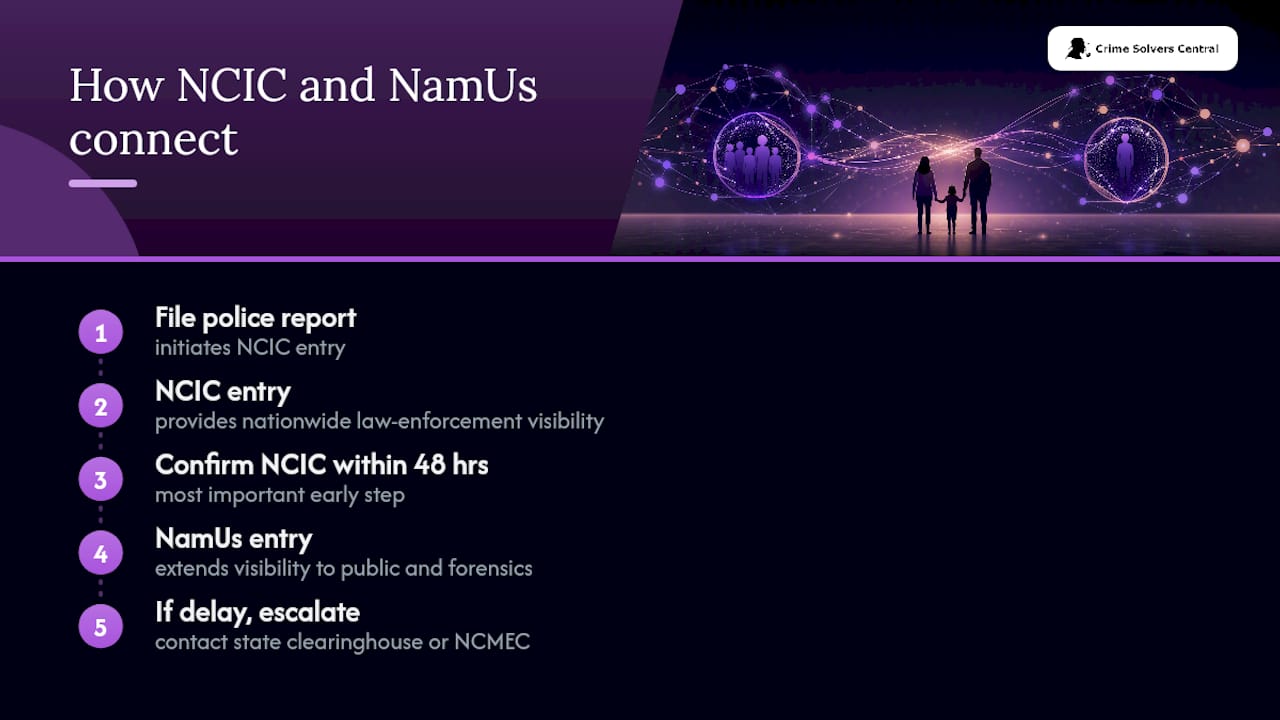
In practice, the sequence works like this: a police report generates an NCIC entry, which gives the case nationwide law-enforcement visibility. NamUs entry then extends that visibility to the public, forensic labs, and coroners who can cross-reference the record against unidentified remains. The two systems are designed to reinforce each other, not to operate in isolation.
Confirming NCIC entry is the single most operationally important step a family can take in the first 48 hours. Without it, the case is invisible to every law enforcement agency outside the filing jurisdiction. NamUs entry then broadens that reach to the public and forensic community, creating two overlapping layers of visibility.
Delays in either system are common. The OJJDP Family Survival Guide recommends that families document all communications with law enforcement and escalate to state clearinghouses or NCMEC when entry is delayed. For more on navigating those delays, the common delays in missing persons reports guide at Crimesolverscentral covers escalation paths in detail.
An editorial perspective on what official databases miss
Official databases are indispensable. NamUs and NCIC together represent the most authoritative infrastructure the United States has for tracking missing persons, and the statutory framework behind them is real. But there is a gap that families run into repeatedly: official systems are built for law enforcement workflows, not for sustained community attention.
A case entered into NamUs gets a page. It does not get a community. It does not get someone checking back every week, cross-referencing new tips against old case notes, or building a flyer for a new anniversary push. That sustained, organized attention is what moves cold cases, and it is largely absent from the official infrastructure.
The other thing official databases do not do well is connect cases across jurisdictions in ways that non-law-enforcement researchers can act on. ViCAP does this for law enforcement, but a family in Ohio has no way to know whether an unidentified remains case in Nevada might be their loved one unless someone is actively cross-referencing. That cross-referencing work, done carefully and in coordination with investigators, is where community platforms add real value.
The ethical line is clear: community involvement should amplify official investigations, not replace or interfere with them. Sharing a NamUs case number is helpful. Conducting your own interrogation of a witness is not. The most effective community advocates are the ones who understand that distinction and stay on the right side of it.
Crimesolverscentral: deeper case tracking for families and volunteers
When official databases give you a case number but not a community, Crimesolverscentral fills that gap. The platform holds over 264,913 cold cases, categorized by state and case type, including missing persons, unsolved homicides, and unidentified remains. Free summaries are publicly accessible; a monthly membership unlocks full case files, source documents, video evidence, digital evidence boards, a flyer builder, AI image tools, and forum access where families and volunteers coordinate.
These tools are designed to complement NamUs and NCIC, not to replace them. A family that has already filed a police report and confirmed NCIC entry can use Crimesolverscentral to sustain public attention, organize volunteer efforts, and build a documented case file that supports investigators over the long term. The flyer builder and AI image tools are particularly useful for anniversary pushes and social media campaigns that keep older cases visible.
Browse the cold case database by state to search cases in your area, or register for a membership to access the full suite of investigative and community tools.
Sources
- National Missing and Unidentified Persons System | National Institute of Justice
- 34 USC 40506: Authorization of the National Missing and Unidentified Persons System
- 34 U.S. Code § 40506 - Authorization of the National Missing and Unidentified Persons System | LII / Legal Information Institute
- Report and Identify Missing Persons | U.S. Department of Justice
- NCIC | Federal Bureau of Investigation
Always verify that any site you use carries a .gov domain and HTTPS before submitting personal information or case details.
FAQ
Is there a national database for missing persons?
Yes. NamUs (the National Missing and Unidentified Persons System) is the primary public-facing national missing persons database, administered by the NIJ and authorized under 34 U.S.C. §40506. NCIC is the law-enforcement-only national system; families access it indirectly by filing a police report.
How do I check if someone is listed as a missing person?
Search namus.nij.ojp.gov using the person’s name, state, and approximate date of disappearance. For children, also check the NCMEC database at missingkids.org. NCIC records are not publicly searchable; contact the investigating law enforcement agency for that information.
Can I report a missing person directly to NamUs?
Families and advocates can request a new case entry through NamUs, but the entry is vetted with the investigating agency before it appears publicly. Filing a police report first is the required first step, since NCIC entry through law enforcement is the authoritative record.
What is ViCAP and when should I ask about it?
ViCAP is the FBI’s Violent Criminal Apprehension Program, designed to identify patterns linking violent crimes, disappearances, and unidentified remains across jurisdictions. Ask the investigating agency whether a ViCAP submission is appropriate if the disappearance may be connected to a violent crime or if remains have been found that could be linked to the case.
How do I track a missing person case over time?
Confirm NCIC entry and check NamUs periodically for updates to the case page. For long-term tracking, community platforms like Crimesolverscentral provide searchable case files, evidence boards, and volunteer coordination tools that keep cases visible beyond the initial investigation period.