

How to Apply Qualitative Research to Unsolved Crimes

Qualitative research in criminology is defined as the systematic use of interviews, ethnographic observation, and linguistic analysis to uncover meaning, context, and overlooked evidence in criminal investigations. Researchers and advocates who apply qualitative research to unsolved crimes gain access to dimensions of a case that forensic data alone cannot provide. Methods like phenomenological interviewing, criminological ethnography, and discourse analysis each target a different layer of the investigative record. The Indiana State Police forensic DNA genealogy team and the Ramapo College Investigative Genetic Genealogy Center both demonstrate that forensic breakthroughs accelerate when paired with deep qualitative review. Crimesolverscentral catalogs over 264,913 cold cases, giving researchers a structured starting point for applying these methods at scale.
What qualitative research methods are most effective for unsolved crimes?
Phenomenological interviewing is the most direct method for applying qualitative analysis to cold cases. It asks participants to describe their lived experience of an event without leading them toward a predetermined answer. Interviews averaging 39.5 minutes with police professionals and advocates have surfaced solvability factors that original investigations missed entirely. That average reflects a meaningful depth of engagement, not a quick survey.
Semi-structured interviews offer a middle path between rigid questionnaires and open conversation. The researcher prepares a guide with core topics but allows the participant to expand in unexpected directions. This flexibility is what makes the method productive for cold cases, where the most useful information is often what a witness did not know they remembered.
Criminological ethnography goes further. Criminologist James Treadwell identifies ethnography as the only methodology capable of capturing detailed human perceptions of criminal conduct. Spending time inside a community, a precinct, or a victim advocacy group reveals social dynamics that no interview can fully reproduce. Ethnographic fieldwork is slow and resource intensive, but it produces context that transforms how investigators read existing evidence.
Linguistic and discourse analysis rounds out the core toolkit. This method examines witness statements, police reports, and media coverage for patterns of omission, contradiction, and framing. Linguistic analysis of witness statements regularly identifies withheld or overlooked information that original investigators dismissed.
Key methods at a glance:
- Phenomenological interviews: Capture lived experience; average 39.5 minutes; ideal for witnesses, families, and first responders
- Semi-structured interviews: Flexible guide-based conversations; productive for investigators and advocates
- Criminological ethnography: Immersive observation of communities or agencies; reveals social context
- Linguistic and discourse analysis: Examines documents and statements for hidden patterns and contradictions
- Visual criminology and photo voice: Visual methodologies give victims and families an inclusive way to communicate experience that verbal interviews miss
Pro Tip: Combine at least two methods in every cold case study. Phenomenological interviews surface what people remember; linguistic analysis of their statements then tests whether that memory is consistent with the documentary record.
What tools and preparation are needed before conducting qualitative research on cold cases?

Preparation determines whether a qualitative study produces usable findings or stalls at the access stage. Researchers who skip this phase routinely lose months to bureaucratic delays and ethical review complications.
The preparation process follows a clear sequence:
-
Build your data collection toolkit. Prepare a semi-structured interview guide tailored to the case type. Secure audio recording equipment and a reliable transcription method. NVivo and ATLAS.ti are widely used qualitative data analysis platforms for coding transcripts and identifying themes.
-
Obtain formal access. Submit a records request to the relevant law enforcement agency under applicable state public records laws. Cold case units vary widely in openness. Frame your request around research outcomes that benefit the agency, not just academic publication.
-
Complete ethical review. Any research involving human participants requires Institutional Review Board (IRB) approval. Cases involving deceased victims and grieving families require additional sensitivity protocols. Informed consent forms must address how recordings will be stored and who will have access.
-
Engage stakeholders early. Contact victim advocacy organizations before you contact law enforcement. Advocates often hold informal access to families and can vouch for your credibility. Community engagement with advocacy groups has repeatedly opened doors that formal requests could not.
-
Plan for investigator emotional fatigue. Occupational stress directly affects cold case solvability and limits how much time investigators will give you. Schedule interviews in short blocks. Build in debrief time for both the participant and yourself.
Pro Tip: Request case summaries rather than full investigative files in your initial access request. Summaries are less likely to trigger legal holds and give you enough context to design a targeted interview guide.
How to execute qualitative research on unsolved crimes step by step
Execution is where most researchers lose momentum. A clear sequence prevents the most common failure modes.
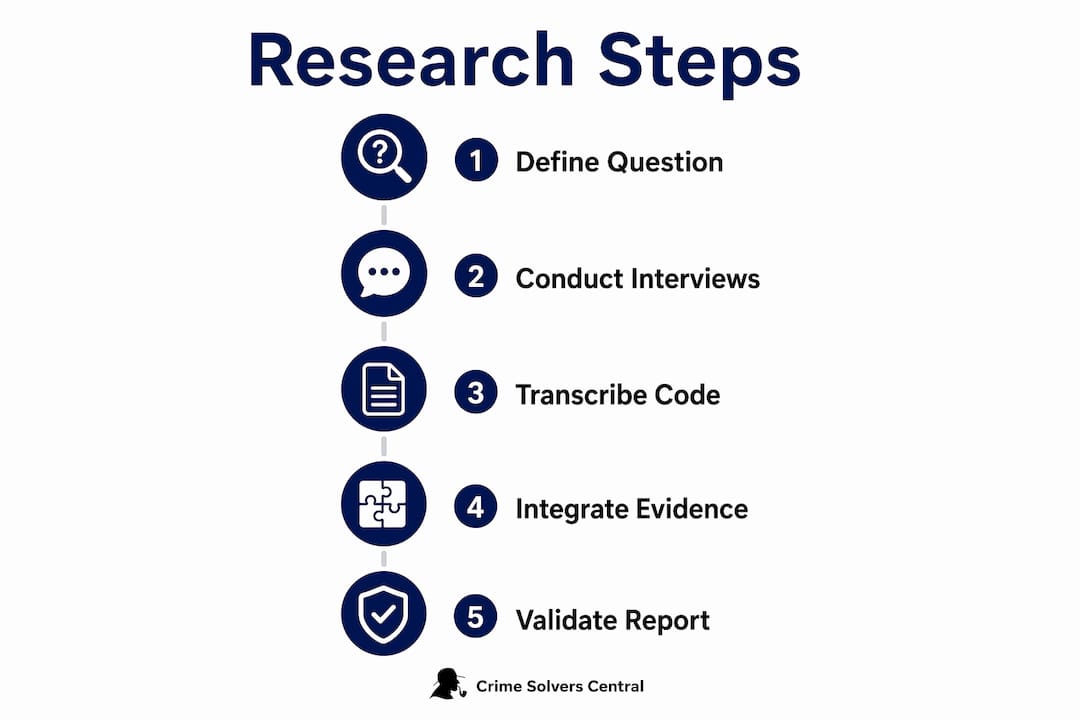
Step 1: Define the research question
Write one specific question the study will answer. “What solvability factors did the original investigation overlook?” is a workable question. “What happened?” is not. A narrow question keeps coding and analysis focused.
Step 2: Conduct and record interviews
Run interviews in a neutral, private setting. Confirm recording consent at the start of each session. Aim for the 39.5-minute average as a floor, not a ceiling. Participants who feel unrushed consistently provide richer detail.
Step 3: Transcribe and code
Transcribe recordings verbatim within 48 hours while context is fresh. Apply open coding first, labeling every distinct idea. Then move to axial coding, grouping related labels into categories. Thematic saturation, the point where new interviews stop producing new codes, typically signals that data collection is complete.
Step 4: Integrate forensic findings
Qualitative findings gain authority when they align with or challenge physical evidence. The Indiana State Police increased its forensic budget by 20% in 2026 to support combined forensic and investigative efforts. That investment reflects a broader recognition that qualitative review and forensic science produce better outcomes together than either does alone. Cross-reference your thematic findings with DNA and forensic evidence to identify where the two records agree and where they conflict.
Step 5: Validate and report
Share preliminary findings with a peer reviewer outside the investigation. Present conclusions to law enforcement with specific, evidence-backed recommendations rather than open-ended observations. Concrete recommendations are more likely to prompt action.
| Phase | Core activity | Common failure |
|---|---|---|
| Planning | Define research question | Question too broad to code |
| Data collection | Semi-structured interviews | Insufficient access to participants |
| Coding | Open then axial coding | Skipping thematic saturation check |
| Integration | Cross-reference with forensic data | Treating qualitative findings in isolation |
| Reporting | Evidence-backed recommendations | Vague conclusions that agencies cannot act on |
What are the common challenges in qualitative cold case research?
Every researcher who works on unsolved cases encounters the same set of obstacles. Knowing them in advance reduces their impact.
- Emotional fatigue in investigators. Cold case detectives carry years of unresolved cases. Stress measurably influences how much information they share and how accurately they recall early decisions. Build rapport before asking about sensitive case details.
- Limited access to files. Many agencies restrict access to active or recently reopened cases. A cold case audit approach that focuses on procedural gaps rather than specific suspects often receives broader cooperation.
- Media narrative interference. True crime podcasts and documentaries shape public perception before researchers arrive. True crime media impacts advocacy but researchers must balance media exposure with investigative integrity. Participants who have consumed extensive media coverage often conflate their original memories with later narratives.
- Confirmation bias in original records. Original investigators sometimes pursued a single theory and documented evidence selectively. Qualitative review must treat every document as a potential artifact of that bias, not as a neutral record.
- Maintaining research independence. Advocacy groups and law enforcement agencies both have interests in how findings are framed. A researcher who loses independence loses credibility with both audiences.
“Qualitative research often reveals ‘hidden information’ missed by original investigations due to bias or lack of forensic context. Linguistic and semi-structured interviews identify overlooked or withheld information in witness statements, improving understanding in cold cases.”
The most productive response to these challenges is iterative engagement. Return to the same participants across multiple sessions. Patterns that appear contradictory in a first interview often resolve when a participant has time to reflect.
Key Takeaways
Applying qualitative research to unsolved crimes requires combining structured interviews, ethnographic observation, and linguistic analysis with forensic evidence to surface what original investigations missed.
| Point | Details |
|---|---|
| Start with a narrow research question | A focused question keeps coding manageable and findings actionable. |
| Use multiple methods | Combining phenomenological interviews with linguistic analysis catches contradictions that single methods miss. |
| Integrate forensic and qualitative data | Agencies like the Indiana State Police invest in both because neither approach alone resolves cold cases. |
| Prepare for access barriers | Early stakeholder engagement and IRB approval reduce delays that stall most qualitative cold case studies. |
| Manage emotional fatigue | Investigator stress limits data quality; short, well-spaced interviews produce more reliable findings. |
What I’ve learned from qualitative work on cold cases
The biggest misconception researchers bring to cold case work is that qualitative methods are a fallback when forensic evidence runs out. They are not. The Ramapo College Investigative Genetic Genealogy Center resolved 43 violent crime cold cases since 2022, and the pattern in those resolutions is consistent: a qualitative review of the case file identified the gap that the forensic team then targeted. The science closes the case. The qualitative work points the science in the right direction.
The ethical complexity surprises most students. Families of victims are not research subjects in the traditional sense. They are stakeholders with a direct interest in the outcome. Treating them as data sources without genuine reciprocity damages trust and, in some cases, damages the investigation. Photo voice and visual criminology methods work precisely because they give families agency in how their experience is represented.
The other thing I would tell any researcher starting this work: the pace is uncomfortable. Qualitative inquiry is slow. Global qualitative assessments of cold case homicides consistently show that agencies which integrate qualitative policy review alongside forensic upgrades outperform those that treat the two as separate tracks. Patience is not a soft skill here. It is a methodological requirement.
— Crime
How Crimesolverscentral supports qualitative cold case research
Researchers and advocates who want to apply qualitative methods to unsolved cases need a reliable starting point for case selection and context. Crimesolverscentral provides access to a national cold case database covering over 264,913 missing persons and unsolved homicide cases, organized by state and case type. That structure lets researchers identify geographic clusters, case-type patterns, and investigative gaps before they design a single interview guide. The platform also connects researchers with community members and advocacy groups who are already engaged with specific cases, shortening the stakeholder access timeline that stalls most qualitative studies. For anyone serious about collaborative cold case investigation, Crimesolverscentral is a practical first resource.
FAQ
What does it mean to apply qualitative research to unsolved crimes?
Applying qualitative research to unsolved crimes means using systematic interviews, ethnographic observation, and linguistic analysis to uncover context and overlooked evidence that forensic methods cannot capture alone.
How long do qualitative interviews typically last in cold case research?
Qualitative interviews with police professionals and advocates in cold case studies average 39.5 minutes, with a range of 21–84 minutes depending on participant availability and case complexity.
What is thematic saturation and why does it matter?
Thematic saturation is the point in qualitative data collection where new interviews stop producing new codes or themes. Reaching saturation confirms that the dataset is sufficient to support reliable conclusions.
How do qualitative methods complement forensic DNA analysis?
Qualitative case file reviews identify investigative gaps that forensic teams can then target with DNA genealogy tools. The Indiana State Police and Ramapo College’s center both demonstrate that the two approaches produce better outcomes together than either does independently.
What ethical standards apply to qualitative cold case research?
Researchers must obtain IRB approval, secure informed consent from all participants, and apply additional sensitivity protocols when working with families of deceased victims. Maintaining participant confidentiality and research independence are non-negotiable requirements.