

How to File a FOIA Request: A Step-by-Step Guide

A FOIA request is a written request for records held by a federal agency, made under the Freedom of Information Act. You send it to the agency that holds the records, describe what you want clearly, and wait for a response. No special form is needed, and you don’t have to explain why you want the records. This guide covers each step, what agencies can withhold, how long the wait runs, and how to appeal. It also covers what families and volunteers working on missing persons and cold cases should know before they file.
TL;DR
- FOIA gives you the right to request records from federal agencies. It does not cover state or local police, which fall under separate state public-records laws.
- Check whether the records are already public, pick the right agency, and describe the records as specifically as you can.
- The standard response deadline is 20 working days, but complex requests often take longer. Narrow requests move faster.
- Law-enforcement records are the most heavily protected category. Expect redactions, and know how to appeal.
- For cold cases, combine FOIA with state records requests and a searchable case database so your requests are targeted.
Table of Contents
- What a FOIA request is and what it is for
- Federal FOIA versus state public-records requests
- Step 1: Check whether the records are already public
- Step 2: Find the right agency
- Step 3: Write the request
- Step 4: Submit it and keep a record
- How long a FOIA request takes
- What it costs
- What agencies can withhold
- If your request is denied
- Using FOIA on a cold case: a practical approach
- Our perspective
- Organizing what you get with Crime Solvers Central
- FAQ
- Sources
What a FOIA request is and what it is for
The Freedom of Information Act gives the public the right to request records from any federal agency. It is often described as the law that keeps citizens informed about their government. Journalists, researchers, attorneys and ordinary people use it to see how agencies make decisions and spend money. They also use it to see what agencies know about a particular event or case.
Two limits matter right away.
- It covers federal agencies only. Each agency handles requests for its own records, and there is no central office that processes FOIA requests for all of them. You have to send your request to the right place.
- It covers existing records only. FOIA does not require agencies to create new records, conduct research, analyze data or answer written questions. A request that reads like a list of questions invites a denial. A request for a specific report, file or email thread gets processed.
Federal FOIA versus state public-records requests
This is where many people get stuck, especially in missing-person and homicide cases. Most of those investigations are run by a city police department, a sheriff’s office or a state agency. Federal FOIA does not reach those offices.
All 50 states and Washington, D.C. have their own public-records laws, often called Freedom of Information laws, Sunshine laws or Right to Know laws. Your state’s statute sets the timeline, the exemptions, the redaction rules and the fees. People often say “FOIA” for any records request, but the legal rules depend on which government holds the file.
A practical way to sort it out:
| If the records are held by | The law that usually applies | Where to send it |
|---|---|---|
| FBI, U.S. Marshals, DEA, ATF, federal courts’ executive components, other federal agencies | Federal FOIA | The specific agency’s FOIA office |
| State police, state bureau of investigation, state medical examiner | Your state’s public-records law | The agency’s records custodian |
| City police, sheriff, county coroner | Your state’s public-records law | The department’s records unit |
State rules also differ on what counts as public. Booking photos are one example: the rules on mugshots as public records in Texas show how a single type of record can carry its own exceptions and privacy limits from one state to the next. Always read your own state’s statute or its attorney general’s guidance before you file.
Step 1: Check whether the records are already public
FOIA.gov advises that you first see whether the information is already available on agency websites or through a government-wide search. This saves weeks. For law-enforcement material, a few places are worth checking first:
- The FBI’s electronic FOIA library, The Vault, holds many records that are open to public review. Check it before you request anything from the FBI.
- Agency reading rooms and FOIA logs, which show what others have already asked for.
- Court dockets, which often contain documents that no agency will need to release because they are already filed.
For cold cases, a case database can also help you decide what to ask for. Our guide on how public records support cold cases walks through which documents tend to matter and where they sit.
Step 2: Find the right agency
There are more than 100 federal agencies, and each one processes its own requests. FOIA.gov offers a search tool that helps you find the correct agency and start a request with it. Think about who would have created the record:
- A missing-person case that crossed state lines or involved a federal land, tribal or military jurisdiction may have federal files.
- An unidentified-remains case may involve several agencies, each with a piece of the file.
- Military-related cases go through that branch’s own process. The Naval Criminal Investigative Service, for instance, uses a two-part process that includes completing and uploading a declaration of identity.
If you aren’t sure, a short request to the most likely agency is better than a vague request to several. Agencies often refer requests onward when they hold only part of what you asked for.
Step 3: Write the request
The rule from FOIA.gov is simple: submit a written request that reasonably describes the records you want. Most federal agencies accept electronic submissions, and no specific form is required. Many also have a portal, and some accept mail, email or fax.
A strong request has these parts:
- A clear statement that it is a FOIA request. Put “Freedom of Information Act request” in the subject line or first sentence.
- A specific description of the records. Include names, dates, locations, case or report numbers, and the type of document (incident report, autopsy report, 911 audio, interview summaries).
- A date range. “All records from March 2004 through December 2005” beats “everything about the case.”
- Your contact information and preferred format. Say whether you want electronic copies.
- A fee statement. State whether you will pay fees and up to what amount, and say whether you are asking for a fee waiver.
Here is a short template for a records request:
To the FOIA Officer: Under the Freedom of Information Act, 5 U.S.C. 552, I request copies of the investigative report and any witness interview summaries for [case name or number], concerning [person’s full name], last seen on or about [date] in [city, state]. I am willing to pay fees up to $[amount]. Please send records electronically to [email]. If any portion is withheld, please release all reasonably segregable material and cite the exemption applied.
Keep it to one topic. One tight request that asks for a single report will usually be processed sooner than a sprawling one.
Step 4: Submit it and keep a record
Submit through the agency’s portal if there is one, because portals issue a tracking number. If you use email or mail, save the confirmation or use a trackable mail service. Write down the date you sent it. Your response clock, appeal rights and any later legal action all depend on that date.
An agency may ask you to clarify or narrow your request. Respond quickly, since an unanswered clarification can lead to your request being closed.
How long a FOIA request takes
The standard time limit for an agency to respond is 20 working days, though many cases need more time. When an extension is needed, the Executive Office for U.S. Attorneys says it will notify you in writing and give you the chance to modify or limit your request.
In practice, response time depends on three things:
- Complexity. Records spread across several offices take longer.
- Backlog. Large agencies with many requests have longer queues.
- Volume. FOIA.gov notes that simple, targeted requests for fewer pages can be processed faster.
Agencies place requests in separate tracks based on the work involved, so a narrow request can move ahead of a broad one. Plan for weeks at the least, and for months or longer on a large investigative file. If the agency misses its deadline, you can follow up with its FOIA public liaison.
What it costs
Many requests cost little or nothing, but fees are set by category. Agency rules describe commercial requesters, educational and noncommercial scientific institutions, and news media. As one example, FinCEN’s published policy charges educational and noncommercial scientific requesters only for reproduction, with the first 100 pages provided without charge. Other requesters can be charged for search time, and you may be charged for search time even if nothing is found. If you want a fee waiver or reduction, ask for it in your initial request.
Stating a maximum amount you will pay up front prevents delays while the agency waits for your approval.
What agencies can withhold
FOIA has nine exemptions covering categories such as personal privacy, national security and law-enforcement information. It also has three exclusions for certain sensitive law-enforcement and national-security records, which are not subject to FOIA’s requirements at all.
For missing-person and homicide files, the ones you will meet most are:
- Personal privacy. Names and details of witnesses, informants, and third parties are commonly redacted.
- Law-enforcement records. Material that could interfere with enforcement proceedings, reveal confidential sources or disclose techniques can be withheld.
- Partial release. An agency may release a document with portions blacked out, and it should say which exemption it relied on.
The Justice Department’s guide explains that Congress gave special protection to three categories of particularly sensitive law-enforcement information, called exclusions, which let agencies treat certain records as outside FOIA.
Can you FOIA an active investigation?
You can ask, but expect resistance. The Justice Department explains that a statutory exclusion may apply to records of an ongoing criminal investigation when the subject is unaware the investigation is pending and disclosure of the records’ existence could reasonably be expected to interfere with enforcement proceedings. Cold cases are different in degree, not in kind: a case that is formally open can still be protected even if no one has worked it in years. Closed files are usually more open to release, though privacy redactions still apply.
If your request is denied
A denial is not the end. You can file an administrative appeal with the agency. Deadlines vary by agency, so read the denial letter closely. As one example, the National Archives says appeals must be received within 90 calendar days of the date of the denial. The same guide says agencies must respond to administrative appeals within 20 working days of receipt.
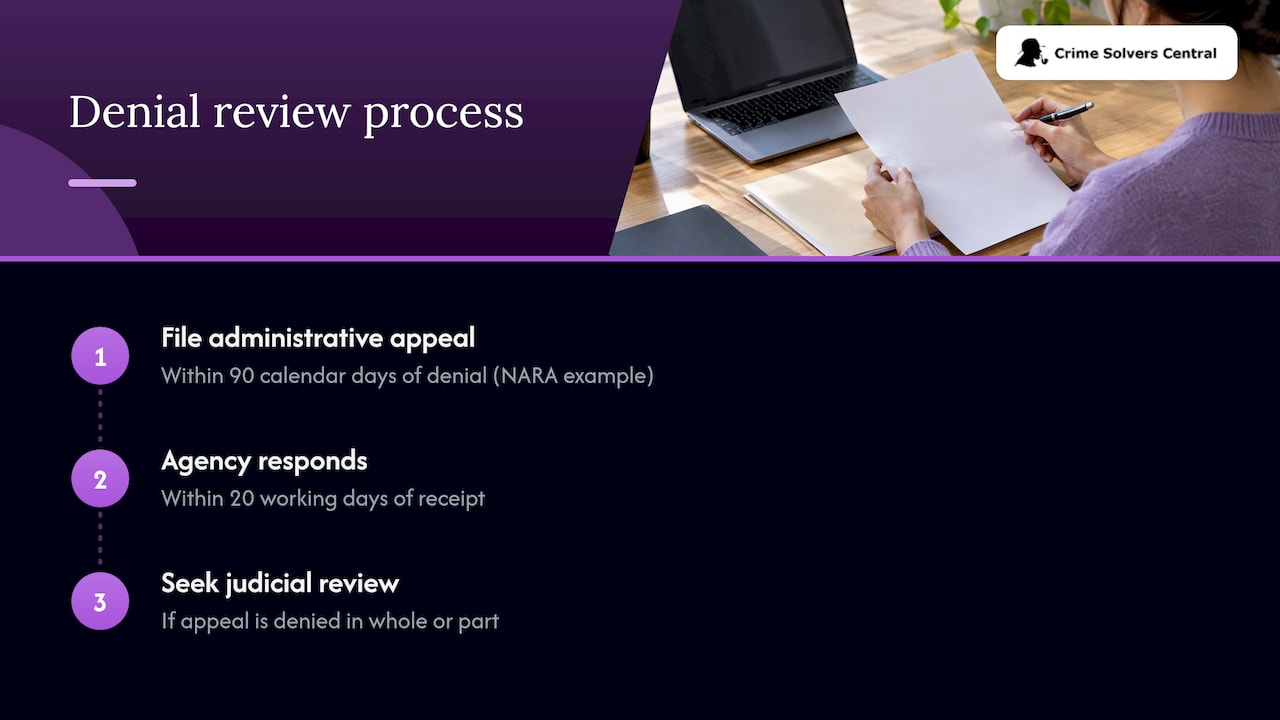
If an appeal is denied in whole or in part, you can seek judicial review. Many requesters never go that far. A well-argued appeal that points to segregable material, or narrows the request to avoid an exemption, often gets more released.
Using FOIA on a cold case: a practical approach
Families and volunteers often file requests too broad to succeed. These habits help:
- Build a timeline first. Know the dates, jurisdictions and agencies involved before you write anything.
- Ask for specific documents. An incident report, an autopsy report, a property inventory, a dispatch log. These are things agencies can find.
- Request locally and federally. The local police file lives under your state’s law. Any federal involvement lives under FOIA.
- Expect redactions and plan around them. A redacted report still gives you dates, case numbers and names of agencies to follow up on.
- Keep a request log. Track who you asked, when, what you asked for and what came back.
Records you obtain are only useful if they connect to something. Our piece on the role of public records in investigations explains how documents get cross-referenced, and our look at why public databases aid law enforcement shows what open data can add. If your question is about patterns across many cases, searching U.S. unsolved killings in public records is a good place to begin.
Our perspective
We have spent years organizing cold cases, so we see the same pattern again and again. A family or volunteer waits months for a response, then finds the request went to the wrong office or asked for something no agency keeps. The law is not the main obstacle. Aiming is.
That is why we built our database the way we did: cases grouped by state and by type, so you can see which jurisdiction holds a case before you write a single letter. The right agency, the right date range and a case number turn a request that gets denied into one that gets answered.
We also believe records work best when people share what they learn. A redacted report that one person reads in isolation may fill in a gap for someone else working a related case. Treat every response, even a denial, as information, and bring it to people who can read it with fresh eyes.
— Crime
Organizing what you get with Crime Solvers Central
Once records start arriving, you need somewhere to put them. Crime Solvers Central lists more than 264,000 cold cases, including missing persons, unsolved homicides and unidentified remains, sorted by state and situation. Members can open full case details, sources and videos, use digital evidence boards, build flyers, and talk with others in the community forums.
Membership plans are listed on our pricing page:
| Plan | Monthly | Yearly |
|---|---|---|
| Jr. Detective | $3.97 | $39 |
| Sr. Detective | $9.97 | $99 |
| True Crime Influencer | $39.97 | $399 |
You can learn more about who we are on our About page, or start at the Crime Solvers Central home page to search cases by state.
FAQ
What is a FOIA request used for?
It is used to obtain copies of records held by federal agencies, such as reports, correspondence and policy documents. Reporters, researchers, attorneys and families all use it. You do not need to state a reason for wanting the records.
Does FOIA apply to state and local police records?
No. Federal FOIA covers federal agencies. Local police, sheriffs and state agencies are governed by your state’s public-records law, which sets its own deadlines, fees and exemptions. Check your state attorney general’s website for the process.
Can you FOIA an active investigation?
You can submit a request, but agencies can often withhold records tied to ongoing enforcement proceedings, and in narrow circumstances an exclusion may apply. Closed investigations are more likely to yield records, usually with privacy redactions.
What does FOIA not apply to?
It does not apply to state or local government, Congress or the federal courts. It also does not require agencies to create records or answer questions, and nine exemptions and three exclusions let agencies withhold certain material. Records about national security, personal privacy and law enforcement are common examples.
How do I appeal a FOIA denial?
Follow the instructions in the denial letter and file an administrative appeal within the stated deadline. Some agencies allow 90 calendar days, so read yours closely. If the appeal fails, judicial review is available.
Sources
- FOIA.gov: Frequently Asked Questions
- FOIA.gov: How to Make a FOIA Request
- FOIA.gov home and agency search
- OMB: Freedom of Information Act
- FBI: Freedom of Information/Privacy Act
- NCIS: FOIA
- U.S. Attorneys: FOIA Frequently Asked Questions
- Department of Justice Guide to FOIA: Exclusions
- National Archives: FOIA Reference Guide
- FinCEN: FOIA Fees and Fee Waivers
- CivicPlus: FOIA requests vs. records requests