

Find Matches Faster: 6 Steps to Search DoeNetwork.org

DoeNetwork.org is the public face of the Doe Network, a volunteer-run nonprofit that maintains a searchable database of missing persons and unidentified decedents. Anyone can browse case files, read physical descriptions and recovery details, and submit a tip on a specific case. Volunteers and law enforcement contacts work each listing, and the organization is widely recognized as a legitimate public resource for cold-case exposure.
TL;DR:
- Search strategies such as starting broad and layering filters improve the chances of matching unidentified remains or missing persons cases effectively.
- The Doe Network’s database includes a wide range of cases with variable documentation, making detailed case notes and photos essential for identification efforts.
- Cross-referencing case IDs with official databases like NamUs enhances verification and helps avoid duplicate or mismatched listings.
- Tips should always be directed to law enforcement or official agencies first, with the Doe Network serving primarily for public exposure and awareness.
- The organization relies solely on volunteers, and participation involves research, case management, or outreach, complementing official forensic systems without replacing them.
Table of Contents
- What Is the Doe Network and Who Runs It?
- How Do You Search Cases on doenetwork.org?
- What Kinds of Cases Appear on the Site?
- How Do You Submit a Tip or Volunteer?
- How Does the Doe Network Compare to Official Databases?
- Why Public Exposure Still Matters in Cold Cases
- How Crime Solvers Central Complements Your Case Research
- Where to Verify Cases and Report Information
- Sources
- FAQ
What Is the Doe Network and Who Runs It?
The Doe Network formed in 1999 as a network of volunteers determined to connect missing-person reports with unidentified remains sitting in coroners’ offices around the country, according to Wikipedia’s history of the organization. No paid staff runs the site. Retired investigators, forensic hobbyists, researchers, and ordinary people with a knack for detail work each case as volunteers, often for years on a single file.
The mission is narrow and specific: expose cold cases to enough eyes that someone, somewhere, recognizes a detail law enforcement missed. That model depends on three things working together:
- Volunteer research that digs through old news archives, dental records, and missing-person reports to flag possible matches.
- Public visibility that puts obscure cases in front of people who might recognize a tattoo, a scar, or a piece of jewelry.
- Cooperation with investigators, who supply case details and follow up when a tip has substance.
Journalistic coverage, including NPR’s reporting on volunteer databases, has documented cases where this kind of public exposure produced real investigative leads. That track record is why the Doe Network gets cited alongside official channels rather than dismissed as amateur hour.
How Do You Search Cases on doenetwork.org?
The official Doe Network site organizes cases into missing-person files and unidentified-decedent files, each searchable by state, and the search tools let you narrow by sex, age range, and date of disappearance or discovery. Getting useful results takes a bit of strategy rather than a single lucky query.
- Start broad. Search by state first if you are trying to identify a possible match rather than researching one specific person you already know about.
- Layer in filters. Add age range, sex, and date range once the broad list loads, since narrowing too fast can bury a case that has slightly wrong or estimated data attached to it.
- Scan photos and composite images first. Many unidentified-decedent files include forensic reconstructions, which is often the fastest way to rule cases in or out visually.
- Read the full case notes. Height, weight, dental work, distinguishing marks, clothing found at recovery, and the exact recovery location all matter more than the photo alone.
- Record the case number. Every file carries a unique ID. Write it down before you navigate away, since these sites do not always make it easy to relocate a specific entry later.
- Cross-reference dates and names. If you are researching a family case, compare the disappearance date and last-known location against your own records before assuming a match.
Pro Tip: Keep a simple spreadsheet with case numbers, dates, and jurisdictions as you search. Cold-case research often means revisiting the same handful of files over weeks or months, and a saved case ID beats trying to remember which of forty near-identical descriptions you were looking at.
For a broader look at how searchable case databases are structured, this guide to missing persons databases walks through the mechanics in more depth.

What Kinds of Cases Appear on the Site?
The Doe Network splits its records into two distinct categories, and knowing the difference changes how you read a file.
- Missing-person files cover people reported missing, sometimes decades ago, with photos, last-known clothing, height and weight at the time, and circumstances of disappearance.
- Unidentified-decedent files cover remains recovered by authorities that have never been matched to a name, listing recovery location, estimated age and sex, dental and skeletal notes, and any personal items found nearby.
Detail level varies a lot from case to case. A file from a well-documented disappearance in the last decade might include multiple photos, dental charts, and a detailed narrative. An older case from the 1970s or 1980s might carry just a few paragraphs and a forensic sketch, because that is all the original investigation ever produced. Featured cases on the homepage tend to be the ones with enough distinguishing detail, like tattoos, unusual dental work, or specific jewelry, to make public recognition realistic. That variability is worth remembering before assuming a sparse file means the case is unsolvable.
How Do You Submit a Tip or Volunteer?
Every case page lists contact information for the investigating agency or the Doe Network volunteer managing that file, and the process for acting on what you find is straightforward.
- Read the full file before contacting anyone. Note the case number, jurisdiction, and any specific identifying detail you think matches.
- Contact the listed investigator or agency directly rather than posting speculation publicly, especially for anything involving a possible identification.
- Call local law enforcement immediately if you have information about a current missing person or believe someone is in danger. Tip forms and volunteer channels are not built for emergencies.
- Preserve any physical evidence or documents you might have, like old photographs or dental records, rather than discarding them after you report the tip.
Beyond tips, the organization runs entirely on volunteer labor: researchers who dig through archives, people who manage case pages, and outreach volunteers who keep cases visible on social media. If you want a broader sense of how community involvement works on cold cases generally, this guide to collaborating with communities on unsolved crimes covers the volunteer side in more detail.
How Does the Doe Network Compare to Official Databases?
The Doe Network is a volunteer publicity engine, not a forensic authority, and that distinction matters when you decide where to send information.
- NamUs is the government-maintained system for official missing-person and unidentified-remains matching, staffed by forensic professionals with access to DNA databases, dental records, and fingerprint systems that volunteer sites cannot touch.
- The Doe Network excels at public exposure and cross-checking older or under-publicized cases that might have slipped through official channels years ago.
- Cross-checking case IDs between the two sites, and between either site and a guide to identifying unidentified remains, helps confirm you are looking at the same case rather than two separate listings for the same person.
File tips with law enforcement or NamUs first when the information involves potential identification evidence. Send the same tip to the Doe Network to keep the case visible to the wider public.
Why Public Exposure Still Matters in Cold Cases
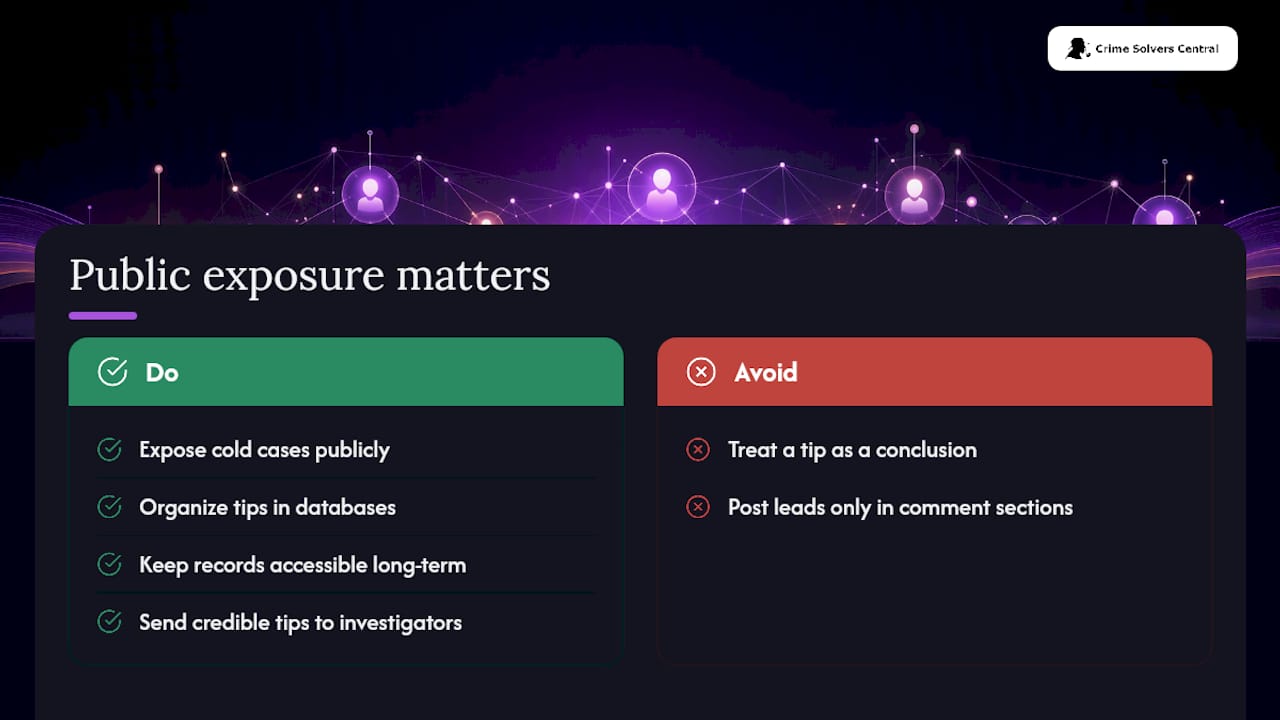
Databases like the Doe Network work because cold cases usually go cold from lack of attention, not lack of evidence. A file that sits unseen for twenty years can break open the moment the right person scrolls past a forensic sketch and recognizes a jaw line or a piece of jewelry. Crime Solvers Central’s own national database, built to organize tips and evidence across cold cases by state, exists on that same premise: the more organized eyes on a case, the better the odds someone connects the dots.
None of that replaces verification. A tip is a lead, not a conclusion, and every credible one belongs in front of the investigating agency, not just a comment section.
— Crime
How Crime Solvers Central Complements Your Case Research
If you are already digging through DoeNetwork.org and want tools built for organizing what you find, Crime Solvers Central gives you a place to put it. Membership starts at $3.97 per month for the Jr. Detective plan, with a Sr. Detective tier at $9.97 per month and a True Crime Influencer tier at $39.97 per month, each unlocking deeper access to full case files, digital evidence boards, a flyer builder, and forum discussion with other researchers. Where the Doe Network’s strength is public exposure, membership gives you a structured workspace: a place to track case notes, build flyers for distribution, and connect with a community doing the same kind of research you are.
Browse the national cold case database to see how cases are organized by state, then check the membership pricing page to find the plan that matches how deep you want to go.
Where to Verify Cases and Report Information
Use the Doe Network’s official site and NamUs as your two primary references. Doe Network case pages list investigator contacts directly; for public records tied to arrests or custody status, The Bail Network’s guide to free inmate search tools covers a related resource. For emergencies, always contact local law enforcement first.
Sources
- The Doe Network — Wikipedia
- National Missing and Unidentified Persons System (NamUs)
- NPR coverage referencing volunteer databases and cold-case publicity
FAQ
Is Doe Network Legit?
Yes. The Doe Network is a nonprofit volunteer organization formed in 1999, and its case exposure work has been documented in journalistic coverage tied to real investigative leads. It cooperates with law enforcement agencies rather than operating independently of them.
Where Do Most Missing Persons Go?
There is no single answer since circumstances vary widely, from voluntary disappearances to abductions to accidents in remote areas. This is exactly why searchable databases matter: cases get resolved when a description, location, or recovered item eventually connects to a name someone recognizes.
How Many Unidentified Remains Are in the US?
Exact national totals shift as cases get resolved and new remains are recovered, so no single static figure stays accurate for long. NamUs maintains the official count as part of its national identification system, and it remains the most current reference for that number.