

Crime Statistics: A Cold Case Investigator’s Guide

What are crime statistics and how do U.S. programs collect them?
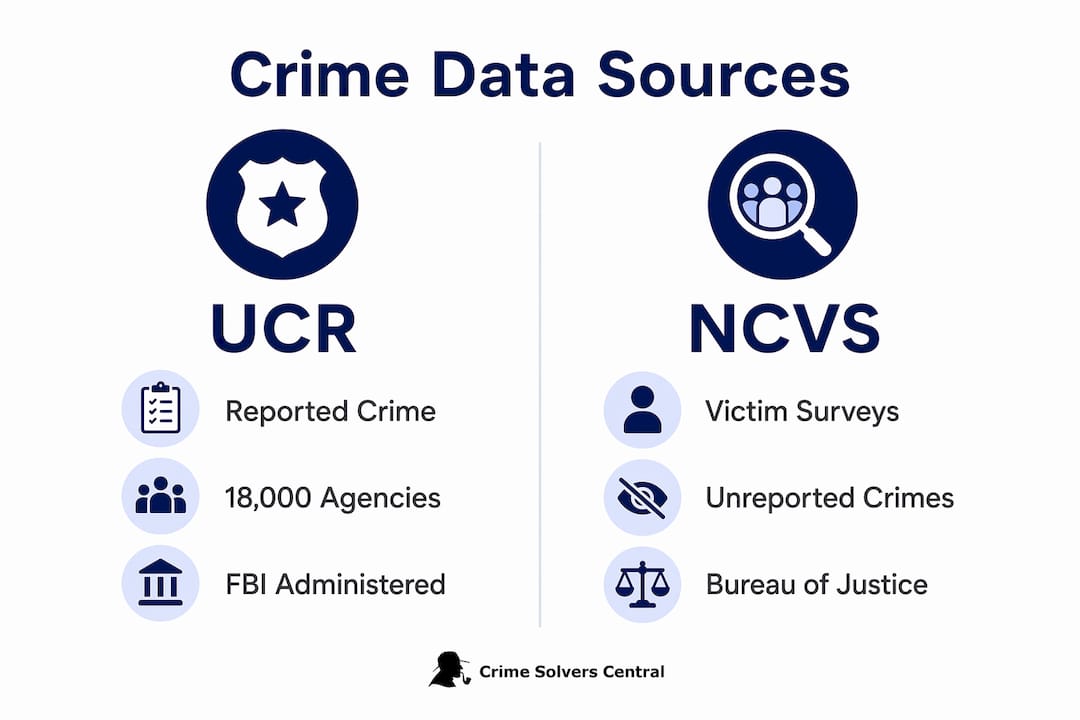
The United States collects crime data through two primary national programs that serve very different purposes. The FBI’s Uniform Crime Reporting (UCR) Program gathers standardized offense and arrest data from over 18,000 law enforcement agencies voluntarily, building a nationwide picture of reported crime since 1930. The National Crime Victimization Survey (NCVS), run by the Bureau of Justice Statistics, surveys victims directly to capture crimes that never reach a police report.
These two programs are complementary, not interchangeable:
- UCR tracks crimes and arrests reported to law enforcement, organized by offense type and jurisdiction
- NCVS captures victim demographics, offender characteristics, and reasons crimes go unreported
- NamUs (National Missing and Unidentified Persons System) operates as the only national repository specifically for missing, unidentified, and unclaimed persons cases
- Aggregated vs. individual data: crime statistics programs report trends across populations; NamUs stores individual case records searchable by investigators and families
None of these programs are real-time investigative tools. They are structured data systems, each built for a specific purpose. Understanding which one answers which question is the starting point for any serious cold case effort.
Table of Contents
- How UCR and NCVS differ and why both matter for investigations
- Why crime statistics alone won’t solve a cold case
- How NamUs fills the gap for missing persons and cold cases
- How to use crime statistics and databases effectively in cold case work
- Key Takeaways
- FAQ
How UCR and NCVS differ and why both matter for investigations
The UCR and NCVS were designed to answer different questions, and that distinction matters when you are trying to interpret current crime data for investigative purposes.
UCR’s original Summary Reporting System counted offenses by category. Its successor, the National Incident-Based Reporting System (NIBRS), went fully national by 2021 and now collects up to 52 offense types with incident-level detail: victim data, offender characteristics, property involved, and arrest outcomes. That granularity is a significant upgrade for analysts tracking violent crime statistics or property crime rates across jurisdictions.
NCVS works differently. Interviewers contact households and ask about victimization experiences, including crimes never reported to police. The survey captures why victims stayed silent, what the offender relationship was, and what circumstances surrounded the incident. For cold case researchers, that context can reveal patterns invisible in UCR data.
- UCR reflects what law enforcement knows about; NCVS reflects what actually happened to victims
- NIBRS incident-level records allow cross-referencing offense types, locations, and offender profiles
- NCVS demographic breakdowns help identify underreported crime categories in specific communities
- Neither program links to individual case files or provides victim-identifying information
Pro Tip: When analyzing crime rate trends for a specific region, pull UCR data for reported offense counts and layer NCVS estimates on top to gauge how much crime likely went unreported. The gap between the two figures often tells you more than either number alone. For deeper context on how data analysis transforms investigations, forensic data methodology is worth studying alongside these programs.
Why crime statistics alone won’t solve a cold case
Here is the honest limitation most guides skip: UCR and NCVS were built for policy and management, not case resolution. The FBI itself is clear that UCR does not publicly provide detailed case statuses or victim information. Treating it as a case-search tool is a fundamental misreading of what the data is.
Several structural problems compound this:
- Voluntary reporting gaps: UCR participation is voluntary, and agency reporting consistency fluctuates. A spike or drop in local crime statistics may reflect a change in reporting practices rather than actual criminal activity
- Jurisdictional fragmentation: Disparate, isolated databases across counties and states make it extremely difficult to link a missing persons case in one jurisdiction to unidentified remains in another
- Classification inconsistencies: Offense definitions have changed over time, and agencies sometimes reclassify crimes differently, making long-term trend comparisons unreliable
- Privacy restrictions: Individual case details within crime statistics programs are protected; researchers cannot access victim-level records through UCR or NCVS
Because not all agencies submit complete data, the FBI estimates figures for missing reports using population size, jurisdiction type, and geographic location. Those estimates are methodologically sound for national trend analysis, but they are not a substitute for case-specific records.
How NamUs fills the gap for missing persons and cold cases
NamUs was created precisely because the crime statistics infrastructure could not do what investigators needed. Authorized under 34 USC 40506 and administered by the National Institute of Justice, it functions as a national clearinghouse where missing persons records and unidentified decedent cases can be searched, cross-referenced, and matched.
The scope is substantial. NamUs currently holds a substantial number of missing persons cases and unidentified decedent cases, with the vast majority classified as cold cases. A significant portion of cases entered into the system have been resolved through its forensic and investigative support.
What sets NamUs apart from a simple database:
- Forensic services: DNA typing, fingerprint examination, forensic odontology, and forensic anthropology are available free of charge to law enforcement and medical examiners
- Cross-agency coordination: NamUs integrates with the FBI’s ViCAP (Violent Criminal Apprehension Program) and NCIC (National Crime Information Center) to improve case concordance across federal and local systems
- Public and professional access: Families, researchers, and law enforcement all have access, though at different permission levels
- Advanced search tools: Boolean and geospatial queries let investigators filter by physical characteristics, geographic area, time period, and case type
For anyone working a missing persons database angle on a cold case, NamUs is the most direct federal resource available. The national database approach to cold cases works precisely because it consolidates what fragmented local records cannot.
How to use crime statistics and databases effectively in cold case work
Knowing the tools exist is one thing. Using them strategically is another. Here is how to approach each resource without wasting time on what it cannot do.

Start with UCR and NCVS for context, not leads. Pull national crime reports or local crime statistics to understand the crime environment around a case: what offense types were prevalent in that area and time period, whether violent crime statistics spiked, and how property crime rates compared regionally. This background shapes your investigative framing.
Use NamUs for the actual case work. Enter physical descriptors, geographic parameters, and time windows to search unidentified decedent records against missing persons reports. If you are working an unidentified remains case, NamUs forensic services can initiate DNA comparison against the FBI’s CODIS (Combined DNA Index System) database at no cost to families or small agencies.
- Always cross-reference NamUs entries with NCIC records, since not all agencies update both systems simultaneously
- GIS mapping tools can overlay crime hot spot data with geographic clusters of missing persons cases, revealing patterns that linear database searches miss
- Predictive analytics platforms are increasingly used by law enforcement to flag geographic and temporal correlations in cold case data
- Legal considerations matter: accessing individual case data requires proper authorization; families have different access rights than credentialed law enforcement
Pro Tip: Combine UCR’s crime data analysis for regional context with NamUs case records for individual leads. Neither source alone gives you the full picture. Apply forensic data best practices when interpreting results to avoid misreading statistical noise as investigative signal.
Monitor NamUs for database updates regularly. New entries, forensic matches, and case status changes happen continuously, and a case that had no match last year may have one today.
Crimesolverscentral maintains a national database of numerous cold cases organized by state and situation, giving investigators and families a structured starting point before they even reach federal systems. Search the cold case database by state to locate cases relevant to your investigation.
Key Takeaways
The most effective approach to cold case investigation combines UCR and NCVS data for crime trend context with NamUs and CODIS for individual case resolution.
| Point | Details |
|---|---|
| UCR covers reported crime only | Over 18,000 agencies report voluntarily; gaps and estimation are built into the methodology. |
| NCVS captures unreported crime | Victim surveys reveal crimes that never reach law enforcement, filling a critical blind spot. |
| NamUs holds over 43,000 missing persons cases and 18,000 unidentified decedent cases; about 24% of total cases have been resolved through forensic and investigative support. | |
| Jurisdictional fragmentation is the core problem | Isolated local databases prevent case linking; NamUs and NCIC integration directly address this. |
| Statistics set context; databases solve cases | Use UCR/NCVS for background analysis, NamUs and CODIS for active case leads. |
FAQ
What is the UCR Program and who runs it?
The FBI administers the Uniform Crime Reporting Program, a voluntary system where a large number of law enforcement agencies submit standardized offense and arrest data. It has tracked national crime trends since 1930.
How is NCVS different from UCR?
NCVS surveys victims directly, capturing crimes that were never reported to police, while UCR only counts offenses and arrests that law enforcement agencies document and submit.
Can you search UCR data for a specific cold case?
No. UCR aggregates crime data for policy and trend analysis and does not provide individual case records, victim information, or real-time investigative data.
What forensic services does NamUs offer?
NamUs provides DNA typing, fingerprint examination, forensic odontology, and forensic anthropology free of charge to support the identification of missing and unidentified persons in cold cases.
Where can I search cold cases by state?
Crimesolverscentral maintains a national database of numerous cold cases categorized by state and situation, accessible at crimesolverscentral.com.