

10 Steps to Conduct Ethical Cold Case Interviews
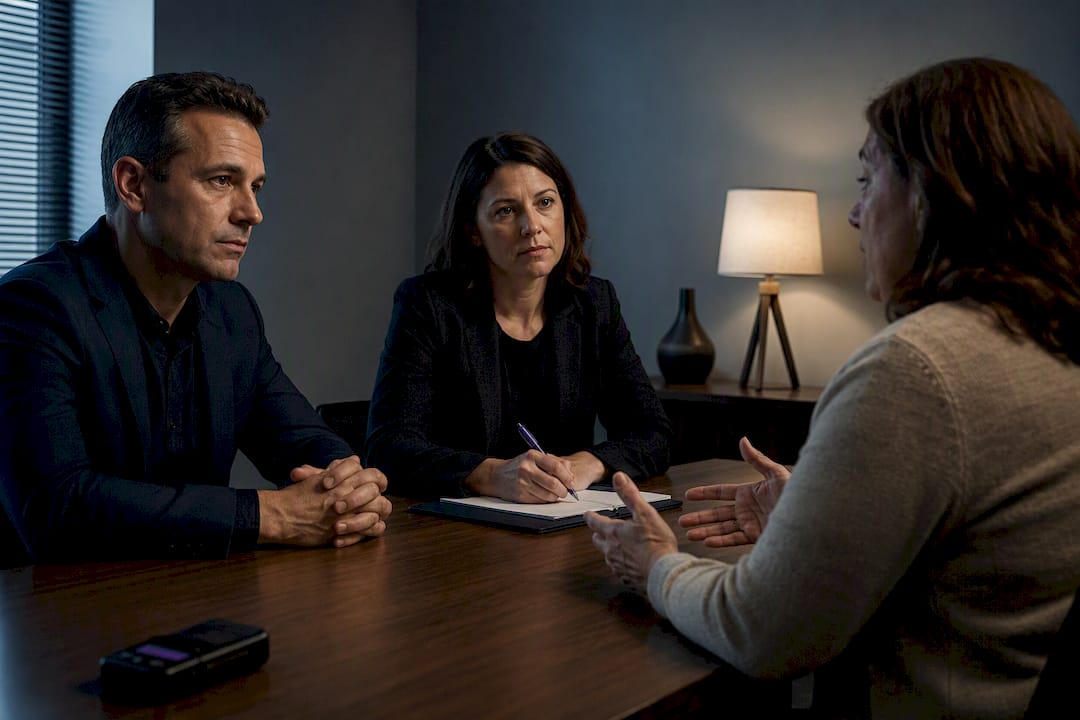
Conduct ethical cold case interviews by combining a trauma-informed, victim-centered approach with electronic recording and careful documentation that preserves evidence integrity. That means building rapport before asking a single substantive question, starting the recording as the subject enters the interview area, and looping in a victim specialist when the case calls for one. The sections below walk through the interview stages, the legal recording rules, and a checklist you can adapt into agency protocol.
TL;DR:
- Ensuring consistent electronic recording of custody interviews is critical, with the presumption to record from entry and only exceptions documented on the spot.
- Interviews should follow a staged process, starting with rapport building and free narration, then moving to carefully timed probes, ending with a respectful summary.
- Trauma-informed techniques combined with the cognitive interview approach enhance memory retrieval without increasing the risk of incorrect details.
- Proper documentation, including metadata and evidence linking, is essential for preserving the integrity and usefulness of interview records.
- Early involvement of victim specialists and prosecutors improves case outcome quality and supports victim dignity throughout the interview process.
Table of Contents
- Core ethical principles for cold case interviews
- Step-by-step interview stages: prepare, open, narrate, probe, close
- Trauma-informed technique versus the cognitive interview
- Recording practices and the DOJ e-Recording policy
- Preventing false confessions and protecting vulnerable interviewees
- Documentation and evidence preservation for interview artifacts
- Coordinating with victim specialists and prosecutors
- Operational checklist for ethical cold case interviews
- How Crime Solvers Central’s resources support ethical interviewing
- Balancing compassion and evidentiary rigor
- Turning ethical practice into case continuity
- Sources
- FAQ
Core ethical principles for cold case interviews
A trauma-informed interview treats the person across the table as someone whose safety and dignity come first, not as a source to extract information from. In practice, this means the interviewer explains what will happen before it happens, watches for signs of distress, and paces questions to the interviewee’s capacity to answer them rather than the investigator’s schedule. The National Institute of Justice recommends a victim-centered approach built on open-ended questions, a non-judgmental tone, and the deliberate avoidance of leading or coercive phrasing, since those tactics both retraumatize victims and degrade the accuracy of what they remember.
Ethical boundaries in cold case work are not abstract. They show up in specific decisions during the interview:
- Never offer off-the-record promises about charges, outcomes, or confidentiality that the investigator cannot guarantee.
- Disclose that the session is being recorded, and explain why, rather than treating the camera as incidental.
- Avoid any question phrased to suggest the expected answer, since a suggestible witness will often supply it.
- Treat inconsistency in a victim’s account as a normal feature of traumatic memory, not evidence of dishonesty.
Cultural humility matters just as much as procedural correctness. An interviewer who assumes a shared frame of reference with someone from a different background, immigration status, or religious community risks misreading silence, deference, or indirect speech as evasiveness. Where consent for recording or for involving a third party is legally required, get it in plain language and document the response, including a refusal. Safety planning belongs in the same conversation: if a domestic violence survivor or a witness in a small community faces retaliation risk, the interview plan should address where and when the conversation happens, not just what is asked.
Pro Tip: Before the interview, write down the two or three facts you actually need to move the case forward. It keeps the conversation from drifting into leading questions when the free narrative slows down.
Step-by-step interview stages: prepare, open, narrate, probe, close
Cold case interviews go better when they follow a predictable sequence, borrowed from cognitive interview training and adapted for the emotional weight of reopened cases. The staged structure, moving from calm and rapport to free narrative to targeted probing, is documented in NIJ guidance on memory enhancement techniques and consistently improves both cooperation and recall.
- Prepare. Review the full case file, including prior statements, forensic reports, and any prior interview recordings, so you never ask a question the file already answers.
- Audit the evidence. Confirm what physical evidence exists, what has been tested, and what gaps the interview might fill; this shapes your objectives without dictating your questions.
- Set a narrow objective. Decide what this specific conversation needs to accomplish rather than trying to relitigate the entire case in one sitting.
- Check equipment. Test recording devices, backup power, and storage before the subject arrives, not after the conversation starts.
- Open calmly. Explain who you are, why you are reaching out again after years or decades, and what will happen during the session.
- Set expectations. Tell the interviewee they can take breaks, ask questions, or stop, and that the recording protects their account as much as the investigation.
- Invite a free narrative. Ask an open question like “Tell me what you remember about that day” and let the person talk without interruption.
- Hold your probes. Wait until the narrative winds down before asking clarifying questions, and keep them open-ended rather than yes-or-no.
- Close respectfully. Summarize what was said, ask if anything was missed, and thank the person regardless of what the interview produced.
- Plan follow-up. Note whether a second session, a victim specialist referral, or a prosecutor briefing is warranted, and communicate the next step to the interviewee.
The opening minutes do more work than investigators often credit. Someone who was interviewed once, years ago, and never contacted again may arrive defensive or exhausted by false hope. Acknowledging that history directly, rather than jumping into questions, tends to lower resistance faster than any rapport-building script.
The free narrative stage is where most information gets lost through impatience. Interviewers trained to fill silence will jump in with a specific question the moment the account slows, but a brief pause often produces the detail that mattered. Save your probes, even the ones that feel urgent, until the person signals they are done. When you do probe, ask about one detail at a time and let the answer finish before moving to the next.
Closing an interview ethically means treating the person’s time and disclosure as valuable even when the session did not produce a breakthrough. A short, honest summary of what was covered, paired with a clear description of what happens next, does more for long-term cooperation than an abrupt end. For interviewers preparing case files ahead of these sessions, a structured evidence audit before the interview reduces the odds of asking a question the record already answers.
Trauma-informed technique versus the cognitive interview
The cognitive interview and trauma-informed care are often presented as separate schools of practice, but the strongest cold case interviews use both at once. Field tests summarized by the National Institute of Justice found the revised cognitive interview elicited substantially more information than standard interview formats, without a matching rise in incorrect details. That gain comes from technique, not pressure.
The cognitive interview reported a significant increase in correct information over standard interviews in field testing, according to the NIJ evaluation, which means the extra detail comes from memory retrieval methods rather than more aggressive questioning.
The core moves translate well into trauma-informed practice when paced correctly:
- Mental reinstatement of context, asking the person to picture the setting, sounds, and their own emotional state at the time, works best introduced slowly, with permission, rather than as a rapid-fire instruction.
- Witness-compatible questioning means following the order the person’s memory naturally surfaces details in, instead of forcing a chronological retelling that fights their recall pattern.
- Varied retrieval attempts, such as asking the person to describe the scene from a different vantage point, can surface new detail but should be offered as an option, not a demand, when the account already feels effortful.
Pacing is the difference between a technique that helps and one that harms. A witness recalling a traumatic event needs the retrieval broken into smaller segments with room to disengage, rather than one long continuous reconstruction. Training for these techniques should go beyond a single workshop: interviewers benefit from supervised practice sessions and periodic review of recorded interviews to check whether probes drifted toward leading language under pressure. Evaluating effectiveness in the field means tracking whether the additional detail produced by these methods actually corroborates against physical evidence, not just whether the interview felt productive.
Recording practices and the DOJ e-Recording policy
Electronic recording is not an optional add-on to an ethical interview, it is the mechanism that makes the rest of the process verifiable. Department of Justice components operate under a presumption to record custodial interviews starting the moment the subject enters the interview area, as detailed in the DOJ Office of Inspector General audit of the e-Recording policy. That presumption exists because recordings protect both the accuracy of the investigation and the rights of the person being interviewed.
The workflow is straightforward in principle: start recording before the substantive conversation begins, keep the device running through breaks unless a documented exception applies, and stop only when the interview is genuinely over. The same OIG audit found gaps in training and compliance across agencies, which means the policy only works when personnel are refreshed on it regularly, not read once at onboarding.
Exceptions exist, but they are narrow and each one requires documentation:
- The subject refuses to be recorded, which must be noted in writing along with the time and circumstance of the refusal.
- Recording is impracticable due to equipment failure or an unplanned location, documented at the time it occurs.
- A public safety concern requires an unrecorded exchange, logged immediately afterward.
- A residual exception applies under agency-specific policy, which should be cited by name in the file.
Pro Tip: Log the exception the moment it happens, not at the end of the day. A same-day note holds up far better under later scrutiny than a reconstructed memory of why the recorder was off.
Storage and access control matter as much as the recording itself. Task-force partners from outside agencies need the same training on start and stop rules, exception documentation, and secure handoff procedures, since a break in that chain is exactly where compliance gaps tend to appear.
Preventing false confessions and protecting vulnerable interviewees
Cold cases often reopen because a new lead, an anonymous tip, or an advance in forensic testing puts pressure on investigators to produce a confession quickly, and that pressure is exactly where false confessions take root. The Innocence Project documents that coercive interrogation tactics, including deception about evidence and extended questioning without breaks, are recurring factors in confessions later proven false.
Known risk factors deserve deliberate countermeasures:
- Deceptive claims about evidence that does not exist increase the odds of a false admission, particularly from suggestible or anxious interviewees.
- Extended interview duration without breaks wears down resistance in ways unrelated to guilt or innocence.
- Sleep deprivation before or during questioning impairs judgment and memory reliability.
- Language barriers without a qualified interpreter invite misunderstanding that can be mistaken for admission.
Protections should be standard practice rather than case-by-case judgment calls. Juveniles and interviewees with cognitive or mental health vulnerabilities should have an advocate or counsel present, breaks should be offered on a fixed schedule rather than left to the interviewer’s discretion, and interrogation duration should have a defined ceiling written into agency protocol. Recording every minute of the exchange, without gaps, is the clearest safeguard against a disputed account later.
Verification matters as much as prevention. Any confession or admission should be checked against independent physical evidence, timeline data, and other witness statements before it anchors the case theory, and investigators should actively look for disconfirming evidence rather than treating a confession as the finish line.

Documentation and evidence preservation for interview artifacts
An interview that produces good information is only as useful as the record that survives it. The NIJ best practices guidance for cold case units recommends logging device identifiers and file hashes for recordings, along with a short synopsis tying the interview to the physical evidence and lab submissions it touches, so nothing gets lost in a later corroboration chain.
Minimum metadata for every interview record should include:
- Full names and roles of everyone present, including advocates, interpreters, or victim specialists.
- Start and stop times, plus timestamps for any breaks or exceptions to continuous recording.
- Device identifiers and file hashes for the recording itself.
- A written note of consent given or refused, in the interviewee’s own words where possible.
Storage should follow the same rigor as physical evidence: encrypted files, access limited to personnel with a case-specific need, and a retention schedule that matches agency policy rather than informal habit. Linking the interview content to physical evidence, such as noting which statement corresponds to which lab submission, closes a gap that often surfaces during later review. A concise evidentiary summary for prosecutors, a page or two that maps statements to corroborating evidence, saves significant preparation time when a case finally reaches trial-readiness review.
Coordinating with victim specialists and prosecutors
Cold case interviews rarely belong to the investigator alone. Victim specialists bring safety planning, emotional support, and continuity that an investigator focused on facts cannot always provide in the same conversation, and their involvement is part of the operational recommendations in NIJ’s cold case unit guidance.
Bringing in the right partners at the right time changes outcomes:
- Invite a victim specialist before the interview when the case involves a surviving family member, a sexual assault victim, or anyone with a documented history of trauma related to the case.
- Loop in a prosecutor early enough to flag evidentiary gaps or admissibility concerns before they surface as surprises at trial.
- Formalize these relationships through a memorandum of understanding that spells out referral triggers and role boundaries.
- Keep the investigator’s role distinct from the advocate’s role so the interviewee understands who represents what interest.
Early prosecutor engagement in particular avoids the scenario where a strong interview turns out to have a fatal evidentiary flaw discovered only after the case is charged. Agencies that build referral workflows for community and volunteer coordination, such as the guidance in collaborating with communities on unsolved crimes, tend to formalize these partnerships rather than improvising them case by case.
Operational checklist for ethical cold case interviews
A written protocol turns these principles into something a whole cold case unit can follow consistently, rather than something that depends on one investigator’s memory of best practice.
- Pre-interview: Complete a file and evidence audit, test recording equipment, and identify whether a victim specialist, interpreter, or advocate should be present.
- During the interview: Open with rapport-building, invite a free narrative, hold probes until the narrative slows, and document any breaks with timestamps.
- Post-interview: Secure the recording with proper metadata, log follow-up plans, and notify the prosecutor if the statement affects trial-readiness.
| Stage | Primary action | Documentation output |
|---|---|---|
| Pre-interview | File and evidence audit, equipment check | Objective statement, equipment log |
| During interview | Rapport, free narrative, probing, breaks | Timestamped recording, break log |
| Post-interview | Secure storage, follow-up planning | Metadata entry, evidentiary summary |
Agencies building out a database-driven case review process before interviews often find it useful to pull existing case data first, since a national case database can help prioritize which leads justify a new interview.
How Crime Solvers Central’s resources support ethical interviewing
Ethical interviewing depends on preparation, and preparation depends on having organized case information before an investigator walks into the room. There are searchable databases of cold cases, categorized by state and case type, that give investigators and case reviewers a starting point for the file review stage described above.
The platform’s tools are built to support that workflow rather than to substitute for it:
- A searchable national case catalog, organized by state and situation, for reviewing prior details before an interview.
- Digital evidence boards that let case teams organize timelines and statements alongside physical evidence notes.
- A flyer builder and volunteer coordination tools for maintaining public engagement between interview sessions.
- Community and safety initiative resources that support victim families during a reopened investigation.
These tools help organize information and coordinate community resources. They do not replace an investigator’s legal obligations around recording, consent, or evidentiary handling, and they are not a substitute for the training and protocol described in the sections above.
Balancing compassion and evidentiary rigor
The hardest part of cold case work is not the sequence of steps in an interview, it is holding compassion and rigor in the same conversation without letting either one crowd out the other. An interviewer who treats a grieving family member gently but skips the documentation that makes their statement usable has failed them just as surely as one who records everything but never earns their trust.
Ethics in this work is not a soft add-on to good investigation, it is the mechanism that makes the investigation defensible years later when a case finally reaches a courtroom. That means routine refresher training on recording policy, honest documentation of exceptions when they happen, and a willingness to revisit protocol when an audit or a case review turns up a gap. Cold case units that treat compliance as a one-time training event, rather than a standing practice, tend to be the ones an audit catches off guard.
Compassion and documentation are not competing priorities in cold case work. The interview that protects a victim’s dignity and the interview that survives cross-examination years later are, done correctly, the same interview.
— Crime
Turning ethical practice into case continuity
Ethical interviewing produces better information, but that information only helps a cold case when it is organized, cross-referenced, and kept accessible to everyone working the file, including volunteers, family advocates, and the public tips that sometimes reopen a case in the first place. Crime Solvers Central’s database and digital evidence board tools give investigators and case reviewers a place to keep that material organized between interview sessions, alongside volunteer coordination features for cases that rely on public tips.
These tools support case organization and public engagement. They do not replace an investigator’s legal responsibilities around recording, documentation, or evidence handling, which remain governed by agency protocol and the standards described above. For teams or family advocates who want ongoing access to case details, evidence boards, and community coordination features, membership plans are listed on the Crime Solvers Central pricing page, starting with the Jr. Detective plan at $3.97 per month.
Sources
The guidance in this article draws on primary government and research sources that investigators should keep on hand for policy verification.
- Interviewing victims and witnesses of crime | National Institute of Justice
- Audit of the Department of Justice’s Implementation of its Policy to Electronically Record Statements of Arrestees in Custody | DOJ OIG
- National Best Practices for Implementing and Sustaining a Cold Case Investigation Unit | NIJ
FAQ
What are some examples of ethical interview questions?
Ethical interview questions are open-ended and invite a free account, such as “Tell me what you remember about that day” or “What happened next?” rather than questions that suggest an answer. The NIJ’s interviewing guidance recommends avoiding leading phrasing entirely, since it can shape the response rather than reveal it.
What are the five stages of a cognitive interview?
A cognitive interview generally moves through rapport building, context reinstatement, free narrative, varied retrieval or probing, and a closing summary. This staged sequence, described in NIJ’s memory enhancement research, is designed to maximize accurate recall without pressuring the witness.
What ethical guidelines govern cold case interviews?
Core guidelines include avoiding coercion, disclosing that a session is being recorded, obtaining and documenting consent where required, and maintaining a trauma-informed, non-judgmental approach throughout. These principles are detailed in NIJ’s guidance on victim and witness interviews and reinforced by the recording safeguards in the DOJ OIG audit.
What formats do cold case interviews typically take?
Cold case interviews vary by purpose and range from initial victim or witness interviews to follow-up interviews, cognitive interviews focused on memory retrieval, and custodial interviews subject to recording requirements. Each format follows the same underlying principle of open-ended, trauma-informed questioning described in NIJ’s interviewing guidance.
Why does electronic recording matter in cold case interviews?
Recording protects the accuracy of the account and the rights of the person being interviewed, and DOJ components operate under a presumption to record custodial interviews from the moment the subject enters the interview area. The DOJ OIG audit found that gaps in this practice weaken both compliance and the evidentiary record.