

Cold Case Database: Where to Search and Submit Tips

You can search U.S. cold case records right now using state-run databases, NamUs (the National Missing and Unidentified Persons System), the DOJ Civil Rights Cold Case Records Portal, and Crimesolverscentral’s national index of many cases. Here are the fastest next steps:
- Search your state’s database first. Most state police or bureau of investigation sites host searchable portals filtered by case type, county, and year.
- Check NamUs at Namus for cross-jurisdictional missing persons and unidentified remains.
- Gather identifiers before you search: full name or alias, approximate year, county, and case number if known.
- Submit a tip through the “Submit a Tip” form on the case page, or contact the listed reporting agency directly.
One caveat: some fields are withheld for investigative reasons. Expect redactions on witness details, forensic specifics, and evidence chain information in active cases.
Key Takeaways
The most effective approach to searching U.S. cold case records is to start with the state database for the relevant jurisdiction, cross-check NamUs for unidentified remains, and use Crimesolverscentral for a consolidated national search.
| Point | Details |
|---|---|
| Start with state databases | Search the state portal where the case occurred before checking national systems. |
| NamUs for cross-state cases | Use NamUs for unidentified remains and cases that may have crossed state lines. |
| Thresholds vary by state | Colorado lists cases unsolved 3+ years; Virginia requires 5+ years by statute. |
| Submit organized tips | Structured, verifiable leads with case numbers and timelines get prioritized by investigators. |
| Crimesolverscentral | Offers a national index of 264,913+ cases with member tools for deeper research and tip coordination. |
Table of Contents
- What a cold case database profile typically contains
- How to search a cold case database effectively
- Who operates these databases and how cases qualify
- How to submit tips safely and effectively
- Federal and national systems worth checking
- What Crimesolverscentral offers as a national searchable index
- How to create an account and access full database features
- Protecting your privacy when submitting sensitive information
- How to interpret case status updates
- The role of community in solving cold cases
- Crimesolverscentral gives you the national database and tools to act
- Sources
- FAQ
What a cold case database profile typically contains
Most databases list three case types: unsolved homicides, long-term missing persons, and unidentified remains. Within each profile, you can generally expect:
- Victim name or alias (or “John/Jane Doe” for unidentified)
- Photo, when available and released by the agency
- Demographics: age, sex, race, height, weight, hair and eye color
- Case synopsis summarizing known circumstances
- Reporting agency name and case number
- Year the case was opened and the date last updated
- Contact information for the investigating agency
What you will not find: witness identities, forensic evidence details, investigative theories, or anything the agency has determined could compromise an active lead. Virginia’s official Cold Case Database displays cases at random to give each equal visibility and links directly to reporting agency contacts on every case page. Some state portals, including Colorado’s, offer paginated results and CSV download options so you can export and organize search results for follow-up research.
How to search a cold case database effectively
The most efficient path: start with the state database for the jurisdiction where the case occurred, then check NamUs for cross-state or unidentified-remains cases, then use Crimesolverscentral for a consolidated national search.
- Gather your identifiers. Pull together the victim’s full name, any known aliases, approximate year, county or city, and the reporting agency if you know it.
- Run a broad name search first. Spelling variations are common in older records. Try last name only before adding first name.
- Apply case type filters. Narrow to “homicide,” “missing person,” or “unidentified remains” to cut noise.
- Use year ranges, not exact years. Records may be filed under the year a case was reclassified, not the original incident year.
- Add demographic filters incrementally. Colorado’s search fields include age, gender, hair color, eye color, city, and county. Add one filter at a time to avoid over-restricting results.
- Export results. Where CSV download is available, export and annotate locally. It is far easier to cross-reference multiple databases when you have a local file.
- If no results appear: widen the date range, remove hair and eye color filters (those details change or get recorded inconsistently), and try adjacent counties. If still nothing, contact the agency directly.
Pro Tip: When searching for unidentified remains, skip name fields entirely and filter by estimated age range, sex, and year. Partial physical descriptors often return matches that a name search never would.
Public records requests can supplement database searches. FOIA and state records laws can yield additional documents, though agencies frequently withhold investigative materials. Closed cases are more likely to produce records than technically open ones, and targeted, specific requests outperform broad ones.
Who operates these databases and how cases qualify
State police agencies, bureaus of investigation, and attorney general offices run most official cold case portals. At the federal level, DOJ and FBI maintain separate systems. Nonprofit and crowdsourced projects also exist, though their verification practices vary.
The threshold for listing a case differs by state law:
- Colorado: HB 1272 (2007) established the Colorado Bureau of Investigation’s database, which lists cases unsolved for at least three years, with records dating back to 1970.
- Virginia: Code § 52-34.16 requires the Superintendent of State Police to maintain a public searchable database and defines a cold case as one unsolved for at least five years.
- Utah: The Bureau of Criminal Identification hosts a cold case database updated by the Statewide Information and Analysis Center.
How cases get added varies. Virginia’s database accepts voluntary submissions from local agencies. Colorado’s CBI conducts periodic outreach. Some states require agencies to report cases meeting the statutory threshold; others rely on voluntary participation.
Agencies also retain discretion over which details appear publicly, regardless of whether a case meets the listing threshold.
How to submit tips safely and effectively
Use the “Submit a Tip” form on the case page, or contact the listed reporting agency directly. For civil-rights-era cases, the DOJ Civil Rights Division is the appropriate contact. For federal investigations, the FBI’s tip line applies.
- Locate the case page on the relevant state database or Crimesolverscentral and find the tip form or agency contact.
- Prepare your information before submitting: case number, what you observed or know, how you came to know it, specific dates and locations, and any names or descriptions.
- Choose anonymous or identified submission. Anonymous tips are accepted, but investigators may have limited ability to follow up without contact information.
- Submit in writing when possible. A written record of what you submitted and when protects you and creates a reference point.
- Follow up once if you have not heard back within 30 days and the information is time-sensitive. Contact the reporting agency by phone and reference your submission date.
Pro Tip: Organize your information into a clean timeline before submitting. Presenting verifiable, structured leads dramatically increases the likelihood that detectives will act on them. Agencies prioritize organized, specific information over vague recollections.
After submission, tips go to a tip unit for triage. Investigators assess credibility, cross-reference existing case files, and determine whether follow-up is warranted. You may not receive a response, especially on anonymous submissions. That silence does not mean your tip was ignored.
Safety rules that are non-negotiable:
- Never handle, move, or photograph physical evidence. Report its location to police and leave it untouched.
- Avoid posting accusations or case theories on social media before contacting investigators.
- Document where and when you found any information you plan to submit.
Federal and national systems worth checking
Beyond state portals, these national resources cover gaps that no single state database can fill:
- NamUs: The federally supported National Missing and Unidentified Persons System is the primary tool for cross-jurisdictional searches and unidentified remains. Law enforcement, medical examiners, and the public can all search it. Use NamUs when a case may have crossed state lines or when the victim is unidentified.
- DOJ Civil Rights Cold Case Records Portal: Created by the Civil Rights Cold Case Records Collection Act, this portal centralizes federal records from DOJ, FBI, and NARA for civil-rights-era cases. It releases records for public review; it does not by itself reopen investigations. If reviewing those records surfaces new information, the portal’s FAQ directs you to contact DOJ.
- FBI Cold Case Initiative: The FBI maintains federal cold case investigations and can reopen cases when new evidence warrants it. Contact the FBI field office with jurisdiction over the original case.
- Forensic genealogy groups and nonprofit databases: Organizations using DNA genealogy to identify unidentified remains have resolved cases that sat open for decades. These groups typically work directly with law enforcement. Nonprofit and crowdsourced databases expand visibility but vary in verification rigor. Confirm how each project collects and validates case details before relying on it.
For leveraging national database cold cases most effectively, use NamUs for unidentified remains and cross-state searches, the DOJ portal specifically for civil-rights-era records, and state databases for jurisdictionally specific cases.
What Crimesolverscentral offers as a national searchable index
Crimesolverscentral consolidates cold case records from across the country into a single searchable index, covering missing persons, unsolved homicides, and unidentified remains. Cases are categorized by state and situation, which makes it faster to narrow a search without jumping between dozens of individual state portals.
Free access gives you case summaries, basic demographics, and links to reporting agencies. Membership unlocks:
- Full case files with complete documentation and source links
- Video content and media associated with cases
- Member forums for coordinating research with other investigators
- Digital evidence boards for organizing case materials
- A flyer builder and AI image tools for creating awareness materials
- Volunteer coordination and safety initiative participation
- Contact templates for reaching reporting agencies
To submit a tip through Crimesolverscentral, locate the case, note the reporting agency and case number, and use the contact information or tip form listed. The platform links directly to the responsible agency so your tip reaches the right investigators.
How to create an account and access full database features
Registration on Crimesolverscentral is straightforward. Go to Crimesolverscentral, select the membership option, and complete the sign-up form with your name and email. Membership is month-to-month with no long-term commitment required. Once your account is active, full case files, forums, and member tools are immediately accessible. No law enforcement affiliation or special credential is required to join.
For state databases like Virginia’s and Colorado’s, no account is needed to search or view case profiles. NamUs allows public searching without registration, though law enforcement and medical examiners have additional access levels that require verified credentials.
Protecting your privacy when submitting sensitive information
Submitting a tip carries real privacy considerations, especially if you witnessed something or have information that could identify you.
Use anonymous tip options when your safety is a concern. Most state portals and the FBI’s tip line accept anonymous submissions. If you choose to identify yourself, use a secondary email address rather than your primary one. Avoid including your home address unless the agency specifically requires it for follow-up.
Never submit information through unofficial channels, social media direct messages, or unverified third-party sites. Stick to official agency forms, verified state portals, or Crimesolverscentral’s contact workflows. For guidance on how public records and tip submissions interact, the distinction between what you submit and what becomes part of the public record matters: tip content is generally protected from public disclosure during an active investigation.
How to interpret case status updates
Most cold case databases display one of a few status labels: open, closed, inactive, or under review. Here is what they generally signal:
Open means the case is unsolved and the agency is still accepting leads. It does not necessarily mean detectives are actively working it daily. Closed typically means the case was solved, the suspect died, or the agency determined no further investigation is possible. Inactive often indicates the case has no active leads but remains officially unsolved. Under review usually means new evidence or a tip has prompted a fresh look.
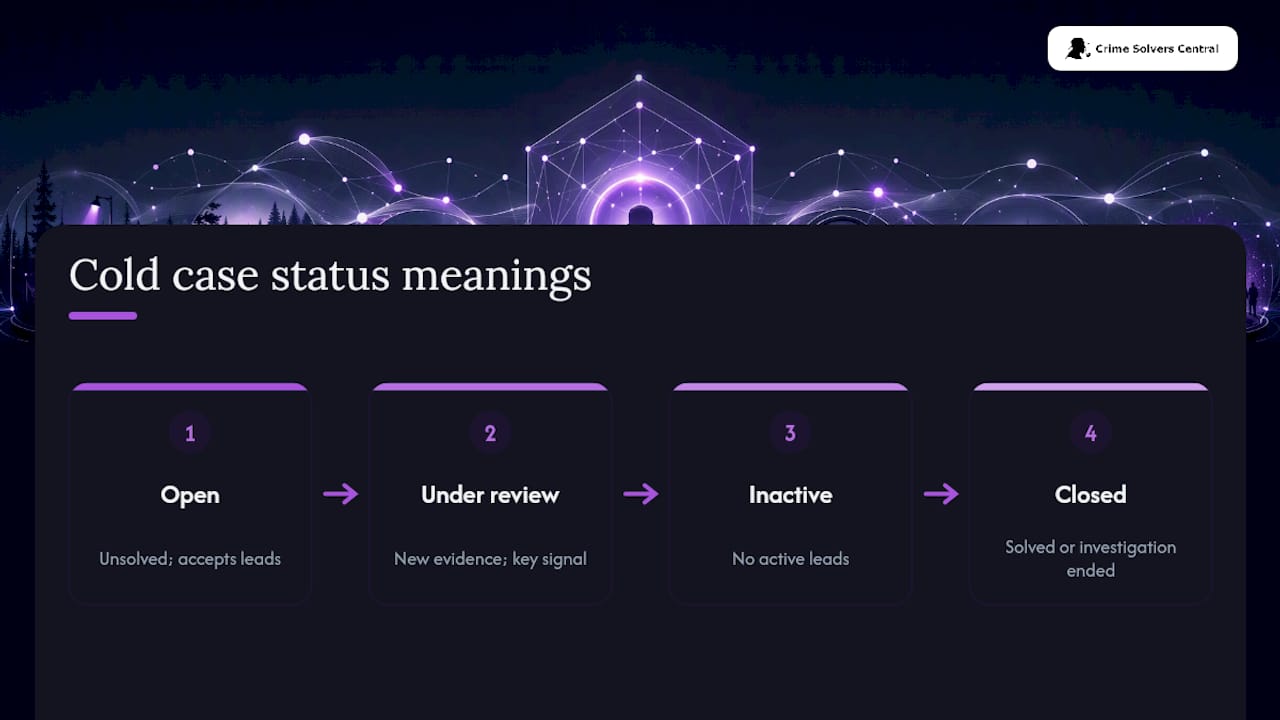
A status change from “open” to “under review” is the most meaningful signal for a tip submitter. It suggests your information, or someone else’s, may have moved the needle. Do not interpret a long-unchanged “open” status as neglect. Many cases remain open for years between active investigative phases.
The role of community in solving cold cases
Cold case databases are tools. What turns them into results is the community that uses them. Families, researchers, and advocates who submit organized, verifiable tips have contributed to case resolutions that official resources alone could not achieve. The collaboration between communities and law enforcement on unsolved crimes works best when citizen researchers stay within ethical boundaries: gather and share information, never interfere with evidence, and always route findings through official channels.

Crimesolverscentral was built around that principle. The platform’s data accuracy depends on working alongside law enforcement, not around it. Membership tools like forums and evidence boards exist to coordinate research, not to replace investigators. If you want to do more than search, the volunteer coordination and safety initiative programs inside the membership are where that work happens.
Crimesolverscentral gives you the national database and tools to act
Searching dozens of state portals one by one takes hours. Crimesolverscentral consolidates a large number of cases into a single national index, organized by state and case type, so you can find what you need and reach the right agency without the runaround.
Membership goes further than a search bar. Full case files, a flyer builder, AI image tools, and member forums give families and researchers the resources to build organized, credible leads that investigators actually act on. Month-to-month membership means no long-term commitment.
Search the national cold case database and sign up for membership to access full case files, member tools, and coordinated contact workflows.
Sources
- Cold Case Unit | Colorado Bureau of Investigation
- Colorado Cold Case Files - Cold Case Help
- § 52-34.16. Cold case searchable database established
- Virginia Cold Case Database
- Civil Rights Cold Case Records Portal: Homepage
FAQ
Is there a national cold case database?
Yes. NamUs is the federally supported national system for missing persons and unidentified remains. Crimesolverscentral maintains a national index of over 264,913 cases across all states, searchable by state and case type.
Can civilians look at cold case files?
Yes, though with limits. State cold case portals and NamUs are publicly accessible without registration. Full investigative files may require a FOIA or state public records request, and agencies frequently withhold materials from active cases.
Are cold case files public record?
Partially. Public access to cold case files depends on whether a case is open or closed and what exemptions apply. Closed cases are more likely to yield records; open investigations commonly involve redactions to protect witnesses and evidence.
What is NamUs and who can use it?
NamUs is the National Missing and Unidentified Persons System, a federally supported database used by law enforcement, medical examiners, and the general public to search missing persons and unidentified remains cases across jurisdictions.
How do I submit a tip on a cold case?
Use the “Submit a Tip” form on the case page of the relevant state database or Crimesolverscentral, or contact the listed reporting agency directly. Organize your information with the case number, specific dates, and locations before submitting.