

Turn AI Age Progression Into Leads for Investigators and Families
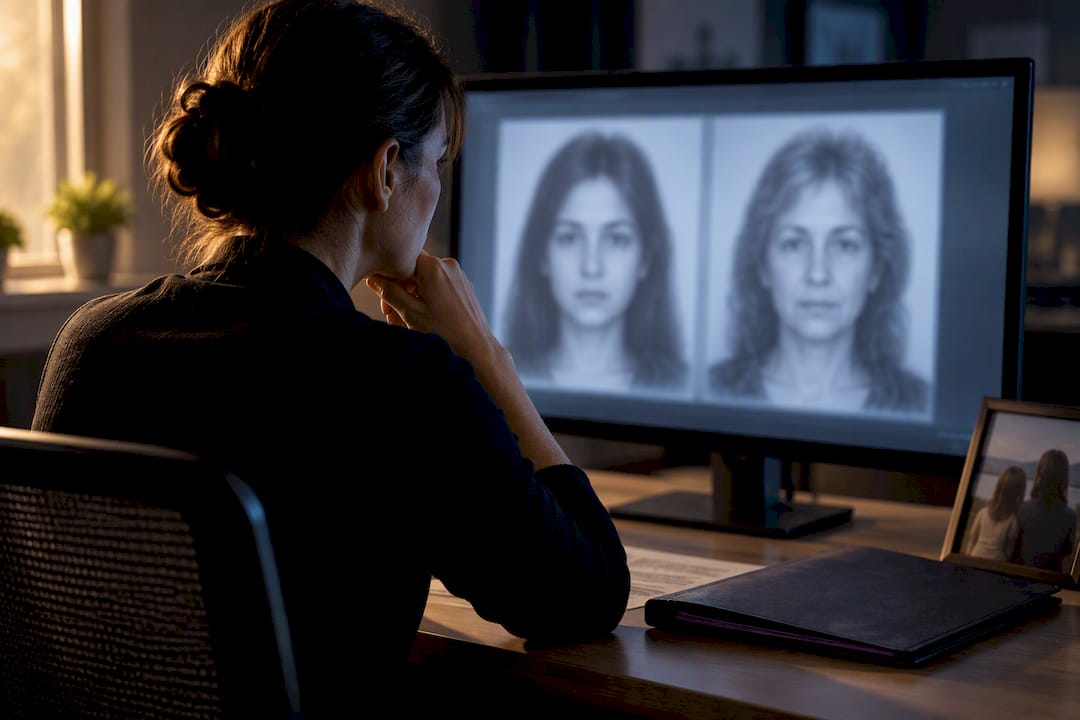
An AI-generated age progression is a plausible investigative lead, not proof of identity. Treat it the way the National Institute of Justice and the International Association for Identification treat it: a tool to widen a search and jog public memory, backed by a 2026 pilot study showing accuracy that swings dramatically by subject. It supports a case. It doesn’t close one.
TL;DR:
- AI age progressions are useful for generating updated public appeals but should always be treated as leads, not definitive identifications.
- Accuracy is highly variable and depends on image quality, the time span involved, and the use of external features like hairstyles or glasses, which can introduce errors.
- Proper procedures include collecting high-quality source images, documenting case details, obtaining human review, and saving all prompts and edits for future verification.
- Public release of age-progressed images requires official approval, clear labeling as AI-assisted, and must route tips through authorized channels to avoid jeopardizing investigations.
- Age progressions are tools to narrow search pools but never replace forensic science such as DNA or dental analysis for confirming identities.
Table of Contents
- How AI Age Progression Gets Used in Real Investigations
- What the Evidence Says About Accuracy and Limits
- Building a Forensic-Grade Age Progression: The Workflow That Works
- Sharing and Publishing an Age-Progressed Image Without Causing Harm
- Where Age Progression Fits in the Evidence Hierarchy
- Why We Push Rigor Alongside Hope
- Getting Investigative Support for Age Progression Cases
- Sources
- FAQ
How AI Age Progression Gets Used in Real Investigations
Forensic AI age progression starts with a real photo of a missing person and applies growth and aging patterns, guided by family reference images, to estimate a current appearance. That’s a fundamentally different exercise than a phone app that adds wrinkles for entertainment. The forensic version has an evidentiary purpose, and it gets used in a few specific ways.
Investigators and volunteer organizations generate progressed images to refresh public appeals, especially when a case has gone quiet for years. A missing child’s flyer from 2016 looks nothing like that same person a decade later, and a fresh image can pull in tips from people who’d otherwise scroll past an outdated photo. Progressions also feed into facial matching systems and internal case galleries, where an image becomes a search input rather than just a poster graphic. The NIJ’s own research into missing children technologies described ten prototype systems built around this kind of integration, all of them dependent on active law enforcement participation to run comparisons against databases.
A few operating rules matter regardless of which tool produces the image:
- Never discard the original source photo. It’s the baseline every progression gets judged against.
- Keep the progressed image and the original filed together with the case record, not scattered across social posts.
- Treat any match generated through facial recognition software as a lead to investigate, not a result to act on.
- Loop in the investigating agency before using a progression as a search input against any law-enforcement database.
What the Evidence Says About Accuracy and Limits
Accuracy in age progression is not a fixed number. It moves by subject, image quality, and how much time has passed. The 2026 pilot study on forensic age progression put that variability in stark terms.
Same method, same general approach, wildly different outcomes. The authors attributed the gap to lighting, facial orientation, and how distinctive each person’s underlying bone structure was to begin with, and they explicitly called for larger validation studies before anyone leans too hard on the technology.
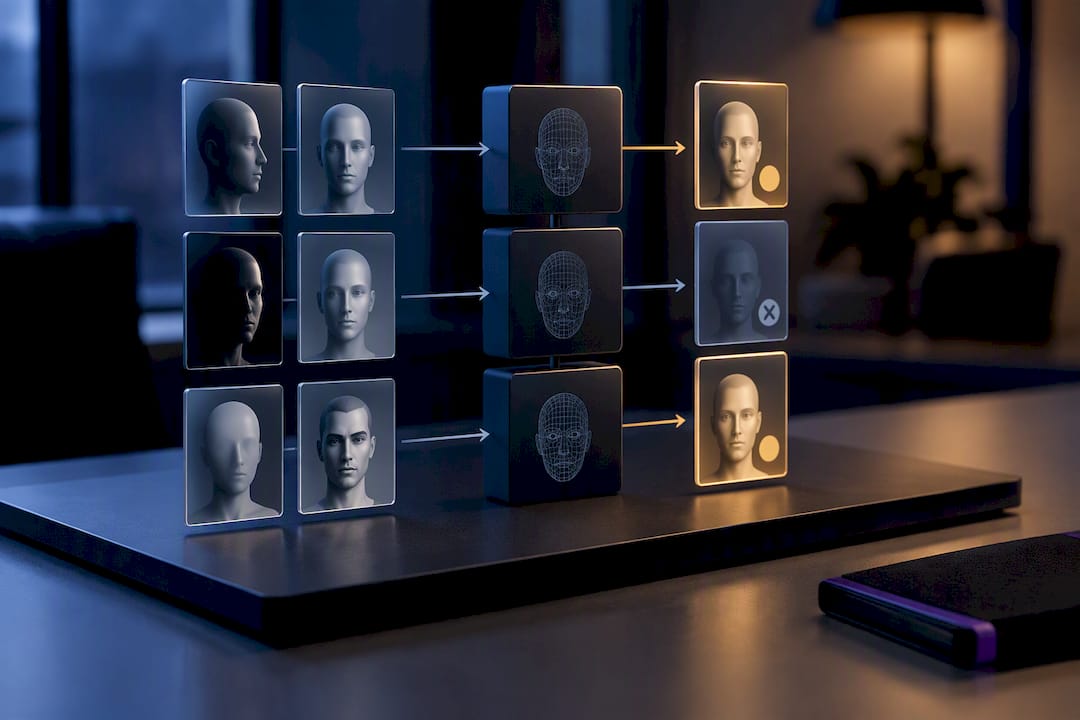
Older research backs up the pattern. Studies associated with Lampinen and colleagues found that age progression accuracy and even agreement between different forensic artists varies significantly, and that under some conditions, an outdated but real photo performed no worse than a freshly progressed one for identifying an unfamiliar face.
A few conditions reliably hurt accuracy:
- Long age gaps, especially progressions spanning ten or more years from the last confirmed photo.
- Low-resolution or poorly lit source images, which limit what any model has to work with.
- External features like hairstyles, facial hair, or glasses, which change independently of the aging process and are essentially guesses.
- Heavy reliance on parental photos to predict how a child’s face will mature, which introduces its own error.
The practical takeaway: age progression widens the pool of plausible leads, but it also risks generating false positives. A NIJ conversation with facial recognition experts makes the point directly. Even a high match score out of an algorithm needs a second form of corroboration before anyone treats it as meaningful.
Building a Forensic-Grade Age Progression: The Workflow That Works
Producing a usable progression is a process, not a single prompt into a piece of software. Skipping steps is exactly how a well-meaning family member ends up circulating an image that misleads more than it helps.
- Collect the best available source image. High resolution, front-facing, and recent as possible. A blurry snapshot limits everything downstream.
- Gather reference photos of biological relatives at ages close to the target age, since family resemblance patterns inform how a face is likely to mature.
- Document the case context. Note the date of the last confirmed photo, the estimated current age, and who authorized the request.
- Generate two to four labeled variants, varying hairstyle, weight, and facial hair rather than producing one “final” image presented as definitive.
- Get sign-off from a forensic-trained reviewer before anything leaves the file. IAI guidance treats human oversight as non-negotiable, not optional polish.
- Preserve the originals, the settings used, and reviewer notes as a permanent part of the case file.
Timing rules matter more than most people expect. IAI guidance specifically advises against attempting age progressions for children under two, and recommends waiting at least two years from the most recent photo before progressing a child’s image at all. Shorter age ranges consistently produce more reliable results than one dramatic ten-year jump.
Pro Tip: Ask whoever generates the progression to save every prompt, setting, and edit alongside the output. If a case reopens in five years, that provenance trail is what lets a new investigator trust, or challenge, the image.
Sharing and Publishing an Age-Progressed Image Without Causing Harm
An age-progressed image circulating without context can do damage fast, especially if someone gets misidentified in public based on a rough resemblance. A few guardrails keep that risk contained.
- Get approval from the investigating agency or case owner before any public release. This isn’t a courtesy step. It’s how you avoid interfering with an active investigation.
- Label the image clearly as “AI-assisted” or “artist’s impression,” and include the target age and the date it was created.
- Route tips through official channels only, such as a case hotline or agency tip line, never by encouraging the public to approach or confront someone who looks similar.
- Record exactly when and where a resemblance was reported, and preserve the original image and its context for investigators to review later.
Pro Tip: If a sighting comes in based on a progressed image, resist the urge to post the tipster’s account publicly. Send it straight to the case officer with the who, what, when, and where intact. Crimesolverscentral’s guide on contributing safely to cold cases covers this in more depth for volunteers who want to help without overstepping.
Where Age Progression Fits in the Evidence Hierarchy
Age-progressed images never outrank DNA, fingerprints, or dental records as identification evidence. DOJ and INTERPOL guidance is explicit on this point: primary identification rests on forensic science, and a progression’s job is to generate and prioritize leads, not confirm who someone is.
In practice, that means using a progression to narrow which records get pulled first in a gallery search, then following up every promising hit with corroborating evidence before any enforcement action happens. Every step needs a paper trail: the progression file itself, which candidate records got flagged, and notes on how and where each lead surfaced. Crimesolverscentral’s guide to identifying unidentified remains walks through how DNA and dental comparison actually close a case once a lead like this points investigators in the right direction.
Why We Push Rigor Alongside Hope
Crime Solvers Central tracks more than 264,000 cold cases, and image tools like age progression only matter if they connect to that larger record, not if they replace it. Families should always contact the assigned case officer first and route any tip or resemblance report through official channels before posting publicly. Our platform exists to support that process, not substitute for it. If you’re weighing how to contribute without derailing an investigation, the armchair detective guide is a good next stop.
— Crime
Getting Investigative Support for Age Progression Cases
Crimesolverscentral gives families and investigators a structured place to put an age-progressed image to work, instead of letting it float around social media with no case attached. Members get access to AI image tools alongside a searchable national cold case database, a flyer builder for labeled public appeals, and volunteer coordination features built for exactly the handoff this article describes: generate the image, document it, then get it in front of the right people with agency approval attached.
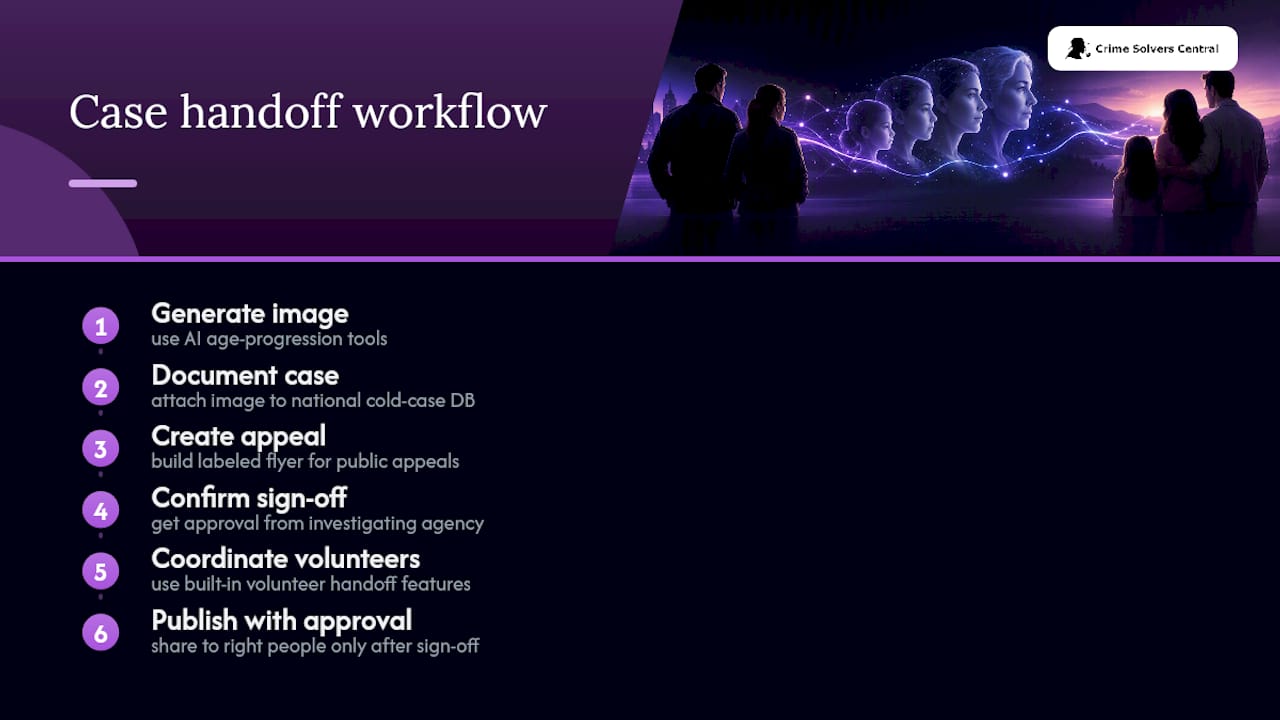
Membership starts at $3.97 a month for the Jr. Detective plan, with Sr. Detective and True Crime Influencer tiers unlocking deeper case tools for those doing more sustained casework. Before publishing anything, confirm sign-off with the investigating agency. Then explore membership options to see which tier fits how involved you plan to be.
Sources
- Forensic age progression pilot study (2026)
- Technologies for Identifying Missing Children, Final Report | NIJ
- International Association for Identification (IAI) forensic-art guidance
- NamUs / DOJ guidance on missing persons and unidentified remains
FAQ
How accurate is AI age progression?
Accuracy varies widely by subject rather than sitting at one fixed rate. The 2026 pilot study recorded a 79.1% recognition rate for one subject and just 54.3% for another using comparable methods.
Can I publish an age-progressed image myself?
Only after getting approval from the investigating agency or case owner. Label it clearly as AI-assisted with the target age and creation date, and route any resulting tips through official channels rather than social media alone.
What should I do if I recognize someone in a progressed photo?
Contact the official tip line or case officer directly and record exactly when and where you saw the resemblance. Don’t approach or contact the person yourself.
How is AI age progression different from a forensic artist’s manual work?
Both start from a real photo and family references, but AI tools can generate several variants quickly while a hand-drawn progression relies entirely on one artist’s technique. Forensic guidance from the IAI treats either method as requiring trained human review before release.
Does Crimesolverscentral offer age progression tools?
Yes. Members get access to AI image tools alongside the case database, with plans starting at $3.97 a month for the Jr. Detective tier.