

Anonymous Tips: How to Submit One Safely and Make It Count

An anonymous tip is information about a crime that you give to law enforcement or a tip program without giving your name. You can send one by phone, web form, text or app. How anonymous it really is depends on the system you use and on what you include in the tip itself. This guide covers the channels, the limits of anonymity, what investigators need from you, and how to handle tips about missing persons and cold cases.
If someone is in danger right now, stop reading and dial 911. A tip line is not an emergency service.
TL;DR
- Use phone, web form, text or app tip channels for non-emergency information. Call 911 for anything happening now.
- “Anonymous” usually means you are not asked for a name. It does not guarantee that nothing about you can be recorded, so keep your own details out of the tip.
- A useful tip is specific: what happened, when, who, what vehicle, and what evidence exists.
- Some programs pay cash rewards, but only under set conditions, usually an arrest or indictment.
- For missing persons and cold cases, send the tip to the investigating agency or an approved tip channel, and use community research only to organize what you already know.
Table of Contents
- How anonymous tips work
- Are anonymous tips really anonymous?
- What makes an anonymous tip useful
- What can you anonymously report?
- Do anonymous tips get paid?
- Our perspective: tips are the start, organization is the work
- Before you submit: a safety routine
- Where Crime Solvers Central fits
- FAQ
- Sources
How anonymous tips work
Most tip systems are built the same way. You contact a hotline, a web form, a text number or a mobile app. You describe what you know. The program passes it to the agency that can act on it, often a detective unit or a patrol division. Some programs assign you a tip number so you can check back or add details without revealing who you are.
Three things are worth knowing before you submit.
A tip is a lead, not a report. Information sent through an anonymous online form for non-emergency crime or suspicious activity is forwarded to the appropriate units, but it does not create an official police report. If you want a formal record, or if you are a victim, file a report the regular way.
Tip channels are not monitored around the clock. Many agencies state that their tip submission processes are meant for non-emergency information and are not watched 24/7. A tip about a crime in progress may sit unread for hours.
Local rules differ. Sheriff’s offices, city police departments, state police and regional tip programs each run their own forms and phone numbers. Search for the one covering the place where the crime happened, not where you live.
The main ways to submit
| Channel | Good for | Watch out for |
|---|---|---|
| Toll-free hotline | Tipsters who prefer talking to a person | Call from a phone you are comfortable with, and do not give your name or number |
| Web form | Long, detailed tips with attachments | Photos can carry hidden location data, covered below |
| Text-a-tip | Quick tips in the moment | Your carrier still handles the message; use a service that says it masks your number |
| Mobile app | Ongoing two-way contact under a tip number | Read the app’s privacy terms before installing |
| Direct call to a local unit | Cases where investigators want to talk to you | Not anonymous by default; ask first |
Some agencies say plainly that tips are most effective when you add contact details. One state police tip page, for example, notes that anonymous submissions work by calling a local troop, but it asks for your name and contact information for maximum effectiveness. That is a trade-off, not a rule: if you are afraid of retaliation, stay anonymous and make the tip as complete as you can.
Are anonymous tips really anonymous?
Often, yes. Never absolutely. Here is what could expose you.
Public records laws
Identifying information that a local government receives can become a public record. In North Carolina, for instance, it must be provided on request unless an exception applies. Other states handle this differently, and many carve out exceptions for criminal investigations. If you are tipping a city or county office rather than a dedicated tip program, give no identifying information at all. For a sense of how records requests work in practice, see this overview of police records requests in California.
IP addresses and system logs
When you use a web form, your device’s IP address passes through the system. The Electronic Frontier Foundation has cautioned that IP address information is often unreliable for identifying a person or exact location without significant corroboration. That is reassuring in one sense: an IP address alone is a weak identifier. It is not a guarantee, though, and a program that logs IPs can still hold them.
A 2026 report on a breach of crime tip data described systems with session information features that could expose tipster IP addresses for a set time, which complicates blanket promises of anonymity. The practical lesson is simple. Do not assume that a promise on a web page covers every vendor behind it. If you are worried, use a public computer or a network that is not tied to your home, or call instead of using a form.
What you tell them
The most common way tipsters identify themselves is inside the tip. “I saw it from my back window” narrows the field to a handful of neighbors. Details only you could know, such as a private conversation or a vehicle only you had access to, can point to you just as well as a name. Ask yourself before you hit send: if the person I am describing read this, who would they think wrote it?
Hidden data in photos and files
Photos and videos often carry metadata, including the time, the device model and sometimes GPS coordinates. If you attach evidence, remove that data first. We walk through the steps in our guide to stripping EXIF data before an anonymous tip.
Trust in the program
Some communities do not trust the standard tip programs. In Minnesota, a police chief said a reward program linked to the state’s Missing and Murdered Indigenous Relatives office might build trust with tipsters who are wary of other programs. Where you feel safe reporting is a legitimate factor in choosing a channel.
What makes an anonymous tip useful
Investigators cannot call you back to ask questions, so the first message has to carry the weight. A sheriff’s office in Indiana lists what an effective tip should include: the nature of the crime, date and time, names or descriptions of the people involved, vehicle information, and supporting evidence such as photos or video. It asks for as much specific detail as you can give.
A workable checklist:
- What happened. One sentence naming the type of crime.
- Where. Street address, intersection or landmark. Say whether you saw it or heard it from someone else.
- When. Date, and time of day, or the best range you can give.
- Who. Names, nicknames, approximate age, height, clothing, tattoos, distinguishing features.
- Vehicles. Make, model, color, damage, plate or partial plate, and direction of travel.
- Evidence. What exists and where it is: video, messages, a weapon, a storage unit. Do not collect or move physical evidence yourself.
- Why you believe it. Firsthand or secondhand, and how recent.
A weak tip and a strong tip
Weak: “My neighbor’s boyfriend is dealing drugs and he is dangerous.”
Stronger: “A man who goes by ‘Dre’, about 30, heavy build, drives a dark gray four-door sedan with a cracked rear window. He meets people in the rear lot of the strip mall on the east side of town most weekdays between 4 and 6 p.m. I saw hand-to-hand exchanges twice this week.”
The second version gives detectives something to verify. The first gives them an opinion. Keep the second free of anything that places you at the scene.
What can you anonymously report?
Almost any criminal activity: theft, assault, drug dealing, fraud, weapons offenses, threats, vandalism, school safety concerns and suspicious activity. Most programs also take information about wanted fugitives and unsolved cases. Some sheriff’s offices and police departments also take non-criminal public safety concerns on the same form.
Two limits apply. First, a tip line is for information, not for complaints about service or personal disputes. Second, anything involving imminent harm belongs with 911.
Tips about missing persons and cold cases
The same channels work for missing persons, unsolved homicides and unidentified remains. The difference is that the case already has an investigating agency, and that agency often has a dedicated tip line or detective unit. Your information is most valuable when it reaches them.
National databases exist to connect those cases. The federal NamUs program was designed as a complement to the FBI’s National Crime Information Center for long-term cases that have exhausted other means of resolution. It publishes a case only after verifying it with the relevant law enforcement agency, so the investigating agency stays the source of truth.
If you know something about an older case:
- Find the investigating agency and case number listed in the case profile.
- Send the tip to that agency, or to a tip channel it names.
- Say clearly whether your information is firsthand, and what is new compared with public reports.
- Do not confront suspects, post accusations online, or contact witnesses on your own.
We cover this in more depth in our guides on how to report information about a cold case and how to submit a cold case tip.
Do anonymous tips get paid?
Sometimes. Rewards are set by each program, and they come with conditions. A county sheriff’s program in Ohio, for example, offers cash rewards up to $5,000 if information leads to an arrest or grand jury indictment of a felony offender. Payment depends on the outcome, not on the tip itself. A good tip that does not lead to an arrest or indictment usually earns nothing.
Some rewards are tied to specific kinds of cases. In 2025, Minnesota opened a reward fund for Missing and Murdered Indigenous Relatives cases with tiers from $1,000 for identifying persons of interest up to $10,000 for locating remains or closing long-term cases.
How anonymous rewards are collected varies. Typically you receive a tip number or code when you submit, and you quote it later to claim payment without giving your name. Keep that code somewhere safe, and do not share it. If a program does not offer a code system, ask before you tip whether a reward is possible and how it would be paid.
Be cautious with anyone online who offers to “buy” or “sell” tip information. Legitimate rewards come from the agency or its official tip program.
Our perspective: tips are the start, organization is the work
We built Crime Solvers Central around a national database of more than 264,000 cold cases, sorted by state and by type: missing persons, unsolved homicides, and unidentified or unclaimed remains. We see the same pattern again and again from families and volunteers. They hold a piece of information, they are not sure who should get it, and they are afraid that sending it to the wrong place will bury it or expose them.
Our view is that the tip itself should always go to the investigating agency or its official tip channel. What a community can add is everything around the tip. Reading the full case file, checking dates against public reports, noticing what has never been asked, and building a clear, well-sourced message are all things a volunteer can do before pressing send. A tip that arrives organized gets read. A tip that arrives as a vague post in a comment section does not.
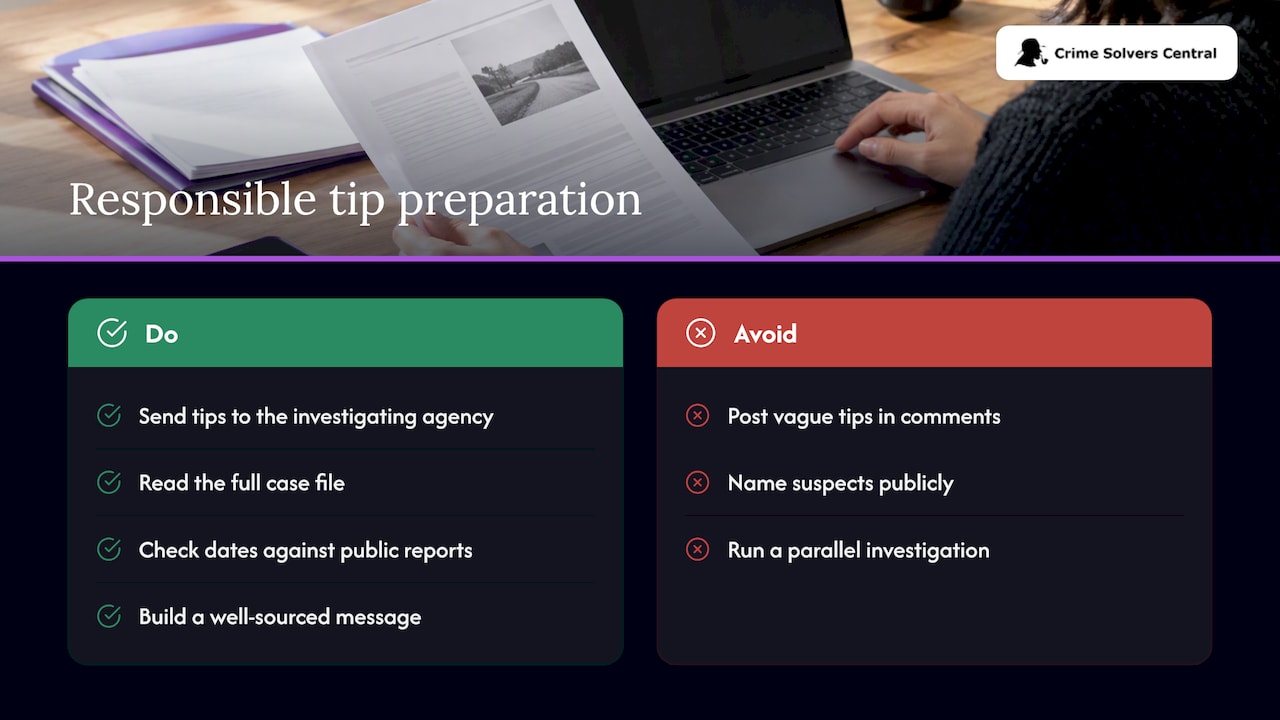
We also think families deserve a safer path than public speculation. That is why our member tools, including digital evidence boards, a flyer builder and volunteer coordination, are built to help people prepare information and share it responsibly, not to run parallel investigations. Anyone who insists on naming a suspect in public is likely to hurt the case.
For families starting out, our family action guide on missing and murdered people explains who to contact and in what order. For volunteers, our guide to helping solve cold cases safely sets out what is useful and what is risky.
— Crime
Before you submit: a safety routine
- Decide whether it is an emergency. If yes, call 911.
- Pick the right agency. Use the jurisdiction where the event happened, or the agency named in the case profile.
- Choose a channel you trust. Phone if you worry about logs, a web form if you have documents.
- Clean your files. Strip metadata from photos and videos.
- Write out the tip first. Draft it in a notes app, then remove anything that points to you.
- Avoid sharing it elsewhere. Do not announce on social media that you tipped.
- Save your tip number. You will need it to add details or claim a reward.
The second part of that routine matters more than any technical trick. Most breaches of anonymity come from people talking, not from servers.
Where Crime Solvers Central fits
If your tip concerns a missing person or cold case, you can start by looking up the case in our cold case database by state. Free case summaries help you confirm you have the right person, date and location. Members unlock full case details, sources, videos, forums and tools that help you organize what you know before you contact the agency.
Our plans are Jr. Detective at $3.97 per month or $39 per year, Sr. Detective at $9.97 per month or $99 per year, and True Crime Influencer at $39.97 per month or $399 per year. You can compare them on the membership pricing page. Law enforcement, students and the general public can use free summaries, news and guides.
FAQ
Can an anonymous tip be traced back to you?
It can be, if you leave a trail. Details only you would know, hidden metadata in photos, and logged IP addresses can all point toward a tipster. A program may also be subject to public records rules, depending on the state. Use a channel that states how it handles your information, and keep your own details out of the message.
Do anonymous tips get paid?
Some do. Rewards depend on the program and on results, usually an arrest or indictment, and amounts vary. One Ohio county sheriff’s program lists up to $5,000 for felony cases. Save your tip number so you can claim a reward without revealing your name.
What can you anonymously report someone for?
You can report most criminal activity, including theft, assault, drug dealing, fraud and weapons offenses, plus suspicious activity and information about unsolved cases. Anything that is happening right now or involves immediate danger should go to 911 instead. A tip line is not the place for personal disputes or customer service complaints.
Does an anonymous tip create a police report?
Usually not. Information from an anonymous online form is forwarded to the right unit but does not become an official report in many agencies. If you need a formal record, file a regular report.
Can I send an anonymous tip about a cold case or missing person?
Yes. Send it to the investigating agency or the tip channel it lists, and include the case number if you have one. Be specific about what you know firsthand and what is new. Our guide on reporting information about a cold case walks through the steps.
Sources
- Report a crime, USAGov
- Anonymous Crime Tips, City of Sacramento
- Submit a Tip, DeKalb County Sheriff’s Office
- Anonymous Tips: Can They Really Be Anonymous?, UNC School of Government
- IP Address White Paper, Electronic Frontier Foundation
- Crime tip data exposure, Gadget Review
- MN Opens Tip Reward Program for Missing and Murdered Indigenous Relatives, Lakeland News
- Programs & Services, Cuyahoga County Sheriff
- NamUs User Guide