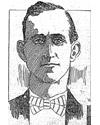
Randolph W. Cathey, a 30-year-old male assistant city marshal in Pauls Valley, Oklahoma, spent the last evening of his life much as he had many others, moving between the town’s cafes and saloons as he enforced local ordinances in a community increasingly divided over liquor and law. In the months leading up to his death, Cathey had become the particular enemy of Jim Stephenson a local saloon or “joint” operator. After Cathey arrested Stephenson’s nephew for violating city liquor ordinances and had to beat the young man into submission when he resisted arrest, Stephenson himself was later taken into custody for drunkenness and “handled roughly” on the way to jail. From that point on, Stephenson was said to have made open, repeated threats that he would kill the marshal at the first opportunity, a menace that many town officials and citizens took seriously even before the violence finally erupted.
On Sunday, November 3, 1907, Cathey ate his evening meal at the Valley Cafe, a familiar stop on his regular beat, around 6:30 p.m. When he stepped out the front door to return to his patrol, Stephenson was waiting for him in the darkness beside the entrance, armed with an automatic pistol. Without warning, Stephenson opened fire at close range. The first bullet was believed to have passed through Cathey’s chest near the heart, and another struck his abdomen, wounds that dropped the officer instantly to the sidewalk. Witness accounts and later newspaper reports described how Stephenson continued to fire until his pistol was empty, sending additional rounds into the prone officer and even into the pavement, as if to make absolutely certain his enemy would not rise again. Yet even mortally wounded, Cathey managed to draw his own revolver. Lying on his side, he fired five shots back “at random” over his head; three of those bullets found their mark, shattering bone in Stephenson’s left hip and tearing through his legs. The saloon man tried to flee but collapsed in the street, bleeding, while Cathey rolled onto his back and died where he had fallen.
Officers rushed to secure Stephenson before the gathering crowd could act on its fury. He was taken first to the local jail, where his wounds were dressed, and then moved under guard to the federal jail in Ardmore the next morning. Authorities feared that if he remained in Pauls Valley, enraged citizens might attempt a lynching. As word of the ambush spread, the town’s simmering resentment toward the liquor joints boiled over. On Monday morning, the fire bell summoned residents not to a blaze, but to a mass meeting at the opera house, called to order by Mayor Bruce. Speakers bluntly blamed the saloons and “joints” for fostering the atmosphere that led to the marshal’s murder and declared that the establishments had no more place in their town. A committee was appointed to inform every liquor dealer that they had three hours to move all stock and fixtures to the railroad depot platform and secure bills of lading to ship them away. Any goods still in town after the deadline, the citizens vowed, would be dragged into the street and burned. One operator, John Stump, failed to comply in time; when the grace period expired, a large crowd hauled his equipment out and set it ablaze in the street, sending up a public, fiery warning that the community intended to honor its fallen lawman by driving out the trade they believed had cost him his life.
The mourning that followed was as intense as the anger. After Cathey’s body was prepared for shipment to his family in Texas, townspeople pressed so strongly to see him and offer flowers that officials decided to move the coffin to the Methodist church and open the doors. Businesses were ordered closed for two hours in the afternoon, and the schools dismissed so that teachers and children could march together to the church and file past the bier. The sanctuary filled beyond standing room long before the service began. Local clergy and civic leaders delivered eulogies, and a spontaneous collection was taken for a monument in Cathey’s honor, with donations pouring in faster than they could be recorded. The coffin, covered in elaborate floral tributes worth hundreds of dollars at greenhouse prices, was then placed on a train and sent to Youngsport, Texas, where Cathey’s parents lived, with a cousin accompanying the body. Later accounts note that he was buried at Cedar Knob Cemetery in Bell County, Texas, linking the small Oklahoma town where he died to the rural Texas landscape where his family laid him to rest.
In the legal arena, the story took a very different turn. Within days of the killing, federal Judge Dickerson of the Southern District called a special session of the grand jury in Purcell to investigate the case, and Stephenson—already notorious for a prior federal prison term for liquor offenses—stood at the center of the proceedings as the lone suspect. In time, his case was moved on a change of venue to Cleveland County, and delays pushed the trial well into the next year and beyond. When he finally faced a jury on a charge of murdering the marshal, Stephenson was defended by Moman Pruiett, a celebrated and controversial criminal lawyer renowned throughout the region for winning acquittals in seemingly hopeless murder cases. Despite the eyewitness accounts of the ambush, the history of threats, and the town’s certainty about who had fired the first shot, the jury acquitted Stephenson of Cathey’s murder on April 17, 1909, leaving the community without the conviction many had expected. Years later, writers would note the irony that the man who had once escaped the hangman for killing a lawman in Pauls Valley was himself beaten to death in Tulsa decades afterward, reportedly by a burglar for a handful of dollars—a grim postscript to a killing that had already cast a long shadow over the town and the family of the fallen marshal.