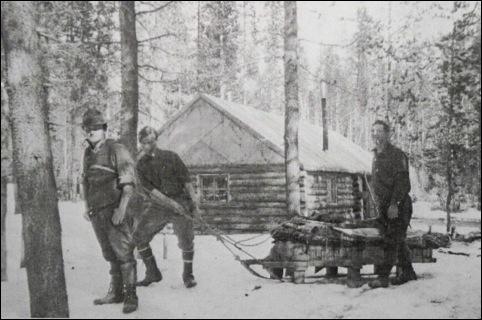
In the cold winter of 1923, Roy Wilson, a 35-year-old male logger, embarked on a fur-trapping venture in the remote wilderness of Deschutes County, Oregon. He, along with his companions Edward Nickols, 50, and Dewey Morris, 25, settled into a log cabin near Little Lava Lake, intending to spend the season harvesting valuable furs. The trio, all residents of Bend, had a promising start. Just before Christmas, Nickols had traveled to town in good spirits, reporting that their trapping efforts were proving successful. The last known contact with the men came on January 15, 1924, when a local resort owner, Allen Wilcoxen, snowshoed to their cabin and spent the night. He found the trappers to be in a jovial mood before he departed the following morning on January 16th.
As winter thawed into spring, concern grew for the three men. Dewey Morris's brother, having not heard from the group since December, initiated a search. In April, the search party reached the cabin and discovered a disturbing scene. Food was left burned on the stove and a meal sat untouched on the table, suggesting a sudden and unexpected interruption. The men's heavy sled was missing from the cabin, and a grim trail led towards the nearby lake. On the path, searchers found pools of blood, clumps of hair, and a human tooth in the thawing snow. Near the edge of the frozen lake, they found the sled, stained with blood, and a large, crudely cut hole in the ice. When the ice melted, the bodies of all three men were recovered from the water.
The investigation revealed a brutal slaying. All three trappers had been murdered, victims of both gunshots and severe blunt force trauma. Wilson had been shot in the right shoulder and again in the back of the head. Nickols suffered a devastating shotgun blast to his jaw and another bullet to his head. Morris had been shot in the arm and his skull was fractured, likely by a hammer. The crime scene suggested the men may have been lured from their cabin and ambushed. Suspicion quickly fell upon a man named Charles Kimzey, a former trapping partner of Nickols. The two had a falling out, during which Kimzey had allegedly threatened to kill Nickols.
The hunt for Kimzey began immediately. Investigators learned that a man matching his description had sold the trappers' furs in Portland just days after the estimated time of the murders. Despite a reward being offered for his capture, Kimzey vanished. The case went cold for nine long years until he was finally located and apprehended in Montana in 1933. Although he was extradited back to Oregon and faced with a strong circumstantial case, the fur dealer who had bought the stolen pelts could not positively identify Kimzey as the seller. Lacking definitive proof, authorities were never able to convict him of the Lava Lake murders. He was, however, sentenced to life in prison for an unrelated attempted murder charge. To this day, the brutal killing of Roy Wilson and his two partners remains one of Oregon's oldest and most notorious unsolved crimes.