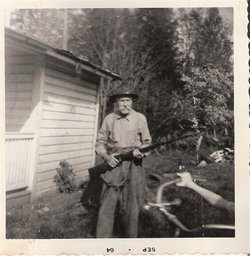
Wean Sylvester Vandevander, a 65-year-old White male, died on February 25, 1951, in Pendleton County, West Virginia. The surviving death certificate places his residence in rural Cherry Grove and gives Cherry Grove as his birthplace, tying his life closely to that part of Pendleton County. It records a birth date of August 10, 1885, and describes his occupation as a general farmer working on a farm. The document names Adam Vandevander as his father and Elva Bennett as his mother. What might otherwise have been a routine vital record becomes unmistakably a record of violent death: the certificate classifies the manner of death as homicide.
The handwritten cause-of-death entry states that Vandevander died from gunshot wounds and attributes those wounds to another person.
The writing identifies the responsible person by the first name Jesse; the surname appears to read Vandevander, although the handwriting in the surviving online image is not clear enough to present that surname as completely certain. The important point preserved by the original record is that authorities did not regard the shooting as accidental, self-inflicted, or unexplained. The death was formally recorded as a homicide, and the certificate itself associated a person named Jesse with inflicting the fatal gunshot wounds.
Beyond that stark notation, the online paper trail becomes much thinner. West Virginia's archival program confirms that statewide death certificates from this period and Pendleton County records have been preserved online, while historical newspaper databases also contain West Virginia newspapers from 1951, including extensive holdings of the Charleston Daily Mail. Those collections provide avenues for contemporary reporting, but the independently accessible material located for this synopsis did not produce a sufficiently reliable case account establishing the complete identity of Jesse, the circumstances that led to the shooting, a motive, the type of firearm used, or the precise sequence of events immediately before the fatal shots.
The same limitation applies to the criminal proceedings that may have followed. No independently verifiable online record located in the available newspaper, archival, genealogical, or case-law material documents an arrest for Vandevander's killing. Likewise, no reliable accessible record was found establishing that Jesse or another suspect was formally charged, indicted, brought to trial, convicted, acquitted, or sentenced. That absence in the searchable online record should not be taken to mean that no arrest or prosecution occurred; it means only that such a proceeding could not be substantiated from the online sources available for this account. West Virginia historical court and county material is not comprehensively digitized, so a prosecution from 1951 could remain only in courthouse files, archival microfilm, or newspaper pages that have not been fully indexed online.
What survives most clearly is the official death record itself. Vandevander was a Pendleton County farmer whose life ended by gunfire on February 25, 1951, and the official certificate explicitly called the death a homicide. Its handwritten notation points to Jesse as the person responsible, with the accompanying surname apparently matching Vandevander's own but remaining difficult to read with absolute confidence. Until a clearer contemporary newspaper report, police record, indictment, or court file can be located online, the record supports identifying Jesse as the person implicated in the killing but does not support claiming that a particular suspect was arrested, prosecuted, or convicted.