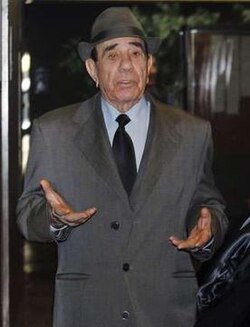
Dino Bravo, born Adolfo Bresciano, was a 44-year-old Italian Canadian man who had spent more than two decades building a prominent professional wrestling career before retiring shortly before his death. Known throughout Quebec and internationally for his years in the World Wrestling Federation, he was living with his wife and young daughter in the Vimont area of Laval when his life ended violently in March 1993.
Behind his public identity as a former wrestling star, investigators and later reporting would focus heavily on alleged connections to Montreal organized crime and the lucrative cigarette-smuggling trade operating in Quebec at the time. :chatgpt-content-reference
On the night of March 10, Bravo was at home while his wife was away. When she returned after midnight, she discovered him in an armchair in the living room, dead from multiple gunshot wounds. The room contained 17 spent shell casings from two different firearms, identified by Laval police as. 22- and. 380-calibre weapons. Contemporary police reporting said there were no signs of a struggle, robbery or forced entry. Nothing about the scene suggested a random burglar had broken into the residence and been surprised by its occupant. The circumstances instead raised the possibility that whoever entered the home had been admitted willingly or was already known to Bravo. :chatgpt-content-reference
The precise number of bullets that struck Bravo has been reported differently over the years, but there was no dispute that he had been shot repeatedly at close range in what appeared to be a deliberate killing. Police initially told reporters that they had no established motive and no suspects. Bravo's wife had found him sitting where he had apparently been watching television, and investigators were left with a crime scene that showed extraordinary violence without the usual evidence of a robbery or confrontation. :chatgpt-content-reference
Attention soon turned toward Bravo's alleged activities outside professional wrestling. He was related by marriage to Vincenzo "Vic" Cotroni, a longtime Montreal organized-crime figure, and authorities were reported to have believed that Bravo had associations with the Cotroni organization. Later investigative reporting connected him to the enormous cigarette-smuggling business that flourished around Quebec and the Canada-U.S. border during the early 1990s, when heavy tobacco taxes created a highly profitable black market. Bravo was described as having been involved in collecting money and other work for a mob-linked smuggling network. :chatgpt-content-reference
Evidence found after his death strengthened investigators' interest in the cigarette trade. Later accounts reported that cash, contraband cigarettes and documents connected with cigarette smuggling were found at his residence. One investigative account said Bravo had also become involved in a cigarette relabeling and warehousing operation in Champlain, New York, where Canadian-brand cigarettes could be repackaged before being moved back across the border. The illegal tobacco market was enormously profitable during this period, and organized-crime groups competed for control of shipments, distribution routes and proceeds. :chatgpt-content-reference
One theory that emerged years later was that Bravo had been taking money for himself from a criminal smuggling operation. An investigator interviewed by the International Consortium of Investigative Journalists said Bravo was killed because he had been skimming money from a network for which he collected proceeds. A Canadian smuggler interviewed during the same investigation offered a similar account. Those claims provided a possible motive, but they did not result in a publicly identified killer, and they remained accounts from sources rather than a conclusion tested in court. :chatgpt-content-reference
Other accounts have suggested that a dispute involving a major cigarette shipment may have contributed to the killing. Former wrestling associates later said Bravo had spoken about his involvement in cigarette trafficking, while longtime Montreal crime reporter Claude Poirier advanced a theory that trouble developed after authorities intercepted a valuable shipment connected with the smuggling business. Such explanations have reinforced the longstanding belief that Bravo's death was an organized-crime killing, but none has produced a publicly proven chain of responsibility. :chatgpt-content-reference
The manner of the attack remained one of the strongest indications that Bravo was deliberately targeted. Two different calibres were used, there was no evidence of forced entry, substantial violence was directed specifically at him, and money reportedly remained inside the residence. Investigators therefore had little reason to treat the killing as an ordinary burglary. The possibility that two gunmen participated has repeatedly appeared in accounts of the case, although no publicly named individuals have ever been established as Bravo's killers. :chatgpt-content-reference
Despite decades of theories involving cigarette smuggling, organized crime and disputes over money, Bravo's homicide has never resulted in a publicly reported arrest for his murder. No suspect has been prosecuted, no one has gone to trial for killing him, and there has been no conviction. The killing remains officially unsolved, leaving the circumstances surrounding his final hours clearer than the identities of the people who entered his Laval home and opened fire. :chatgpt-content-reference