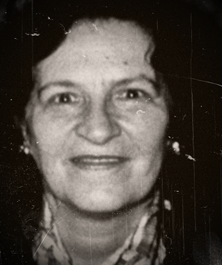
Janet Kennedy Smith was a 22-year-old female Scottish-born nursemaid of mixed Irish, English, Scottish and Norwegian ancestry who died under deeply suspicious circumstances in Point Grey, now part of Vancouver, British Columbia, on July 26, 1924. Born in Perth, Scotland, she had trained as a nursemaid and was hired in 1923 by Frederick and Doreen Baker to care for their infant child. She traveled with the family to Paris and later accompanied them to Vancouver.
By May 1924, the Bakers were staying at the home of Frederick Baker's brother, Richard Plunkett Baker, at 3851 Osler Avenue in the affluent Shaughnessy Heights area.
On the morning of July 26, Smith was in the basement laundry area of the Baker residence when she suffered a fatal gunshot wound to the head. Her body was found near an ironing board, with a revolver lying close to her outstretched hand. The other domestic employee at the house, Wong Foon Sing, told investigators that he had been working upstairs when he heard a sound resembling a car backfiring. He said he went downstairs to investigate and discovered Smith on the basement floor. The Bakers' infant was also in the residence, but no other adult was known to have been present when the shot was heard.
The first police response would become one of the most controversial aspects of the case. Point Grey authorities quickly treated the shooting as self-inflicted. The revolver was handled at the scene, compromising the possibility of recovering useful fingerprints, and investigators did not preserve the basement with the care that would be expected in a suspected homicide investigation. Smith also had unexplained burns on her body and a stain on one of her fingers. Contemporary testimony during the later inquiry described burns on the inside of her right arm and beneath her right shoulder blade.
The physical position of Smith's body also raised questions. Medical witnesses examining the case later attempted to reproduce a position in which she could have fired the weapon into her own head and reportedly had difficulty doing so. Testimony at the second inquest described the bullet's path as traveling through the right side of her head, while her body had been found on its back with the handgun near her right hand. The circumstances surrounding the weapon, the position of the body and the absence of a convincing reconstruction of an accidental shooting contributed to growing doubts about the original conclusion.
Despite those irregularities, the initial inquiry concluded that Smith's death had resulted from a self-inflicted, accidental gunshot. No full postmortem examination was conducted before her body was embalmed, a decision that destroyed or compromised evidence that might have helped determine precisely what happened before her death. She was subsequently buried at Vancouver's Mountain View Cemetery.
Smith's friends did not accept the official explanation. They appealed to local Scottish organizations and religious leaders, and the case soon attracted intense newspaper attention. Pressure mounted on the British Columbia government to conduct a more thorough investigation. Her body was exhumed on August 28, 1924, and a second coroner's inquest began in September. After hearing extensive medical and circumstantial testimony, the second jury reached a dramatically different conclusion: Smith had been murdered by an unknown person or persons.
Suspicion increasingly focused on Wong Foon Sing because he had been in the residence at the time of the shooting and had discovered the body. Smith's friends reportedly testified that she had expressed fear of him, while surviving diary material indicated a more complicated relationship in which Wong had given her gifts and appeared attracted to her. The evidence establishing his involvement in her death, however, remained circumstantial. Newspapers nevertheless portrayed him as the leading suspect, and the investigation unfolded amid intense anti-Chinese prejudice in British Columbia.
Wong was subjected to extraordinary extrajudicial efforts to force information from him. Historical accounts indicate that he was abducted and beaten during an earlier interrogation in August 1924. On March 20, 1925, he was abducted again, this time by a group that included men disguised in Ku Klux Klan robes. He was secretly confined for approximately six weeks, shackled and repeatedly abused while his captors tried to force him to confess to Smith's killing or identify someone responsible. He continued to deny involvement. The episode later developed into a major scandal when connections between the abduction, private investigators, local officials and members of law enforcement became public.
Wong was released by his captors on May 1, 1925, only to be immediately arrested by Point Grey police and charged with Smith's murder. A preliminary hearing began on May 8. The prosecution attempted to build a case around his presence in the house, his relationship with Smith and the suspicious circumstances surrounding her death. Wong was represented by prominent attorney John Harold Senkler, with support from Vancouver's Chinese community. He was eventually released on bail while the prosecution proceeded.
The murder charge ultimately collapsed. On October 9, 1925, a grand jury returned a "no bill," meaning the evidence was considered insufficient to indict Wong and send him to a murder trial. The proceeding against him ended without a conviction, and he was never legally established as Smith's killer. He subsequently continued working for the Baker family for a time before returning to China in 1926.
The kidnapping of Wong produced prosecutions of its own. Several participants were charged in connection with his unlawful confinement, and three men were ultimately imprisoned. Other defendants, including officials connected with Point Grey and the investigation, were acquitted. The controversy became even more serious when it emerged that British Columbia Attorney General Alexander Malcolm Manson had learned where Wong was being held but did not immediately intervene, apparently hoping the illegal interrogation would produce information that solved Smith's death.
Other theories circulated as the investigation deteriorated. One widely publicized allegation claimed that Smith had been killed following a party involving affluent men and that the true circumstances were concealed afterward. Another later theory connected her death to illicit drug activity allegedly involving people in the Baker family's social or business circles. These stories became part of the mythology surrounding the case, but investigators never produced evidence sufficient to establish any of them in court.
The conflicting inquests, the mishandling of the original scene, the embalming of Smith's body before a proper postmortem, the racial prejudice surrounding the investigation and the illegal campaign against Wong Foon Sing left the case permanently clouded. Although the second inquest formally determined that Janet Smith had been murdered, no person was ever convicted of killing her. More than a century later, her death remains one of Vancouver's best-known unsolved homicide mysteries.