

Why Some Disappearances Stay Unsolved: Key Factors

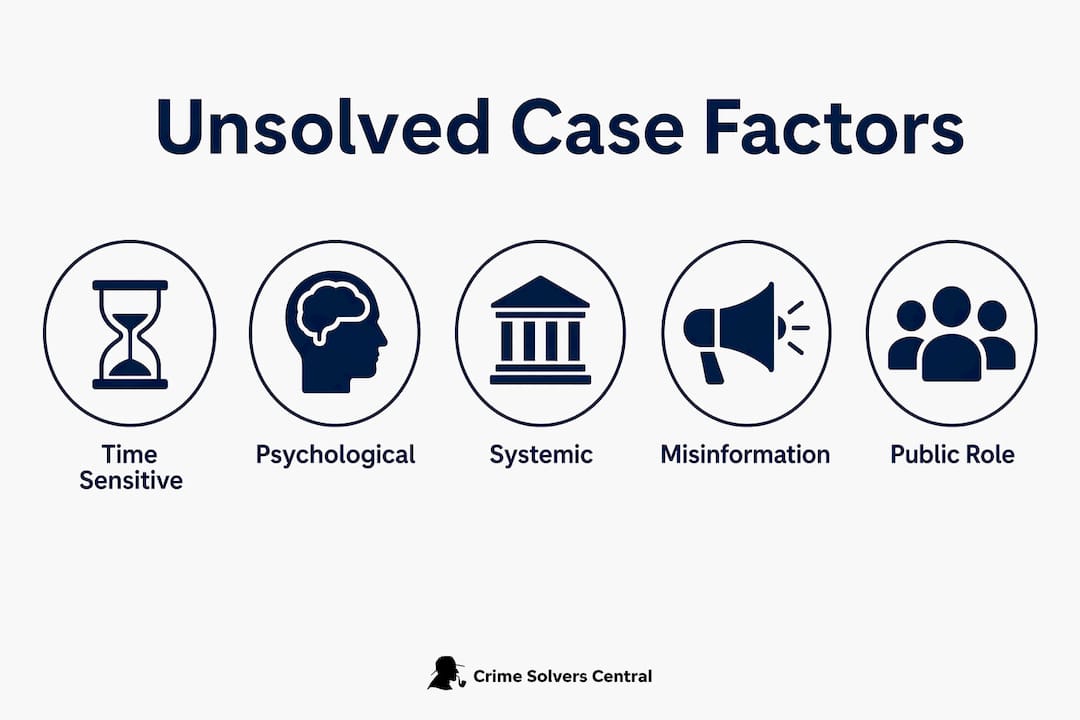
Unresolved missing persons cases persist because critical evidence disappears within hours, psychological complexity obscures motive, and systemic resource limits prevent thorough follow-through. Understanding why some disappearances stay unsolved requires looking at three converging forces: the biology of time-sensitive clues, the psychology of people who vanish, and the procedural gaps that let cases go cold. The Nancy Guthrie case, the Carla Anderson disappearance, and thousands of cases in the Crimesolverscentral database of over 264,913 records all reflect these same patterns. This is not a failure of effort alone. It is a failure of timing, support, and structure.
Why some disappearances stay unsolved from the first 48 hours
The first 48 hours of a missing persons case are the most decisive window investigators have. Survival chances decrease significantly after that threshold due to exposure, medical need, and the rapid decay of physical evidence. Scent trails fade. Surveillance footage gets overwritten. Eyewitnesses forget details or move on. Every hour of delay compounds the loss.
One of the most damaging myths in missing persons cases is the so-called 24-hour wait rule. Law enforcement has consistently stated that immediate reporting is critical to preserve time-sensitive evidence. Families who wait, often because they believe police will not act sooner, lose the window when fresh scent trails, undeleted footage, and sharp eyewitness memory are still available. That myth costs lives.
Timeline gaps compound the problem further. A 30-minute gap early in a timeline can force investigators to spend years reconstructing what should have taken hours to establish. A suspect’s location, a vehicle seen nearby, a phone ping: all of these become harder to verify the longer the gap exists. Cases that start with incomplete timelines rarely recover full clarity.
Key early-stage factors that determine case solvability:
- Fresh physical evidence: Scent trails, fingerprints, and DNA degrade rapidly outdoors.
- Surveillance footage: Most systems overwrite footage within 24–72 hours without manual preservation.
- Eyewitness memory: Recall accuracy drops sharply after 48 hours, especially for peripheral details.
- Digital records: Cell tower pings, app activity, and card transactions become harder to subpoena quickly after the fact.
- Correct case classification: Mislabeling a case as a voluntary disappearance delays the full investigative response.
Pro Tip: If someone you know goes missing, contact law enforcement immediately and simultaneously document every detail you can recall: last known location, clothing, vehicle, phone activity, and any recent behavioral changes. Do not wait for a “clear sign” of foul play.
What psychological and social factors drive unresolved cases?
Many disappearances are not crimes in the traditional sense. They are exits. Psychological strain before a voluntary disappearance often includes social withdrawal, financial collapse, and a growing sense that vanishing is the only way to regain control. That context makes these cases harder to investigate because there is no crime scene, no suspect, and no clear motive for law enforcement to pursue.

Isolation plays a specific and underappreciated role. When a person withdraws socially over weeks or months, their thinking becomes increasingly distorted. Isolation amplifies distorted thinking to the point where disappearing feels rational, even necessary. By the time someone acts on that impulse, the people around them often have no idea how serious the situation had become. That gap between internal crisis and visible warning signs is where cases begin to go cold before they even start.
Repeat disappearances reveal a structural failure in how society handles returns. Adults who go missing repeatedly often lack meaningful follow-up support after they return home. Without mental health intervention, financial stabilization, or social reconnection, the same conditions that drove the first disappearance rebuild themselves. The cycle continues, and each subsequent disappearance is harder to resolve than the last.
The four most common psychological precursors to disappearance:
- Depression and untreated trauma: Both reduce a person’s ability to seek help through conventional channels.
- Financial hardship: Debt, job loss, or housing instability can trigger a flight response rather than a help-seeking one.
- Relationship breakdown: Domestic conflict or estrangement from family often precedes voluntary exits.
- Perceived loss of control: When people feel trapped, disappearing can feel like the only decision they can make for themselves.
“Return home is often an unsupported stage after disappearance, leaving individuals vulnerable to repeat vanishings.” — phys.org, 2026
These factors do not just explain why people go missing. They explain why cases that start as voluntary disappearances become long-term unresolved missing persons cases when the person does not return and no support structure existed to catch them.
How systemic obstacles prevent cases from being solved
Investigators are not indifferent to unresolved cases. They are often buried under competing demands. The Nancy Guthrie investigation received 18,000 tips in 11 days, a volume that overwhelmed available resources and forced triage decisions that inevitably left some leads unexamined. That is not a failure of will. It is a structural problem.
Misinformation makes the resource problem worse. High-profile cases attract rumors, false sightings, and coordinated misdirection. Investigators must actively counteract misinformation in these cases to keep resources focused on credible leads. Every hour spent chasing a false tip is an hour not spent on evidence that could actually close the case.
| Factor | Impact on investigation |
|---|---|
| High tip volume | Forces triage; credible leads may be delayed or missed |
| Misinformation | Diverts investigator time toward false leads |
| Cold case resource limits | Active emergencies take priority over older files |
| Mislabeled cases | Voluntary disappearance classification delays full response |
| Lack of nonprofit coordination | Reduces public awareness reach and tip generation |
Public involvement, when properly channeled, is one of the most effective tools available. Releasing surveillance footage and public pleas generates actionable tips that investigators cannot produce on their own. Nonprofit organizations and community platforms that help manage missing persons searches extend investigative reach without straining law enforcement budgets.
Pro Tip: When following a high-profile missing persons case, avoid sharing unverified sightings or rumors on social media. False tips consume investigator time. If you have a credible lead, report it directly to the investigating agency or through a verified tip line.
Can technology reopen cold missing persons cases?
Modern forensic tools have changed what is possible in cases that seemed permanently closed. Cold case breakthroughs emerge not from a single new clue but from the persistent reanalysis of old evidence using current DNA technology, genealogy databases, and digital forensics. Carla Anderson vanished decades ago. Investigators have not given up, and the tools available to them today are fundamentally different from those available when she disappeared.
The most effective approaches to reopening cold cases:
- Advanced DNA analysis: Techniques like genetic genealogy can identify suspects from trace evidence that older methods could not process.
- Digital reanalysis: Old phone records, email archives, and early internet activity can now be cross-referenced with modern databases.
- Fresh investigative review: New detectives reviewing old files without prior assumptions often spot overlooked connections.
- Crowdsourced tips: Public databases and platforms that allow community members to submit tips on cold cases generate leads that investigators alone cannot produce.
- National database cross-referencing: Matching unidentified remains against missing persons reports across state lines has resolved cases that sat open for decades.
| Technology | Application in cold cases |
|---|---|
| Genetic genealogy | Identifies suspects from decades-old DNA evidence |
| Digital forensics | Recovers deleted records and reconstructs digital timelines |
| National databases | Cross-references unidentified remains with open missing persons files |
| Public tip platforms | Generates community-sourced leads at scale |
The Crimesolverscentral database catalogs over 264,913 cases by state and situation, giving investigators, families, and community members a structured way to leverage national cold case data and identify patterns across jurisdictions.
Key Takeaways
Unresolved missing persons cases persist because time-sensitive evidence loss, psychological complexity, and systemic resource limits converge to prevent resolution.
| Point | Details |
|---|---|
| The 48-hour window is decisive | Survival probability and evidence quality both drop sharply after the first 48 hours. |
| The 24-hour wait myth causes harm | Delayed reporting destroys fresh evidence and reduces the chance of finding the missing person. |
| Psychological factors complicate cases | Isolation, depression, and financial hardship drive voluntary disappearances that lack a clear investigative entry point. |
| Systemic overload is real | Cases like Nancy Guthrie’s show how 18,000 tips in 11 days can overwhelm even well-resourced investigations. |
| Technology reopens cold cases | Genetic genealogy and digital reanalysis have resolved cases that sat cold for decades. |
What working these cases has taught me about patience and pressure
The cases that stay with me are not always the most dramatic ones. They are the ones where a 30-minute gap in a timeline, or a family that waited two days to call, changed everything. I have seen investigators work with genuine dedication on cases that the public had already written off. The problem is rarely indifference. It is the collision of limited resources, overwhelming public response, and evidence that was already gone before anyone knew to look for it.
What the research on repeat disappearances confirms is something investigators have known for years: returning home is not the end of the crisis. It is often just a pause. Families celebrate the return and assume the worst is over. But without mental health support, financial stabilization, and honest conversation about what drove the disappearance, the same conditions rebuild. The next disappearance is harder to solve than the first.
The psychological side of these cases deserves more attention than it gets in true crime coverage. The focus tends to land on suspects, evidence, and timelines. Those matter. But understanding why a person reached the point of vanishing, whether voluntarily or under duress, is often the key that unlocks the case. Investigators who treat the missing person as a full human being with a history, not just a name on a report, tend to find the threads that others miss.
Public involvement is not a distraction. It is a force multiplier. Surveillance footage released to the public, tip lines managed well, and community platforms that organize information all extend what investigators can do alone. The challenge is channeling that energy toward credible leads and away from rumors. That balance is hard to strike, but it is the difference between a case that breaks and one that goes cold.
— Crime
Crimesolverscentral and the cases that need your attention
Crimesolverscentral maintains a national database of over 264,913 missing persons and unsolved homicide cases, organized by state and situation. That structure matters because it lets community members, families, and investigators find specific cases quickly rather than searching through undifferentiated records. The platform supports public participation through tip submission, membership, and awareness campaigns that keep cold cases visible. If you want to contribute to cases that have gone unresolved for years, the Cold Case Database by State is the place to start. Every tip, every share, and every hour of community attention increases the pressure on cases that would otherwise stay buried.
FAQ
Why do missing persons cases go cold so quickly?
Cases go cold when time-sensitive evidence like scent trails, surveillance footage, and eyewitness memory degrades before investigators can collect it. A 30-minute timeline gap early in an investigation can require years of reconstruction work to resolve.
What is the 24-hour wait rule and why is it dangerous?
The 24-hour wait rule is the false belief that police will not accept a missing persons report until a full day has passed. Law enforcement consistently states that immediate reporting is critical because the first hours are when the most recoverable evidence exists.
How does psychology contribute to unsolved disappearances?
Depression, financial hardship, and social isolation are common precursors to voluntary disappearances. Isolation amplifies distorted thinking to the point where vanishing feels like the only available option, which makes these cases difficult to classify and investigate.
Can cold missing persons cases actually be solved years later?
Cold cases are solved through persistent reanalysis of old evidence using modern tools like genetic genealogy and digital forensics. The Carla Anderson case shows that investigators do not give up even when decades have passed, and new technology regularly reopens cases that seemed permanently closed.
How can the public help with unresolved missing persons cases?
The public helps most by reporting credible tips directly to law enforcement or verified platforms, avoiding the spread of unverified rumors, and keeping cases visible through community awareness. Platforms like Crimesolverscentral provide structured ways to engage with unsolved cases and contribute information that investigators can act on.