

Why Public Databases Aid Law Enforcement: A 2026 Guide

Public databases aid law enforcement by consolidating fragmented data sources into searchable systems that accelerate suspect identification, missing persons recovery, and cold case resolution. Systems like IDENT1, the National DNA Database (NDNAD), and the Schengen Information System (SIS) give investigators access to millions of records in seconds, replacing days of manual cross-referencing. For community advocates and law enforcement professionals alike, understanding why public databases aid law enforcement means understanding how modern investigations actually get solved. The difference between a case closed and a case cold often comes down to whether the right data was accessible at the right moment.
Why public databases aid law enforcement investigations
Public databases in law enforcement are structured repositories of forensic, biographical, and criminal justice records that authorized investigators can query to identify individuals, locate missing persons, and link suspects to crimes. These systems unify what would otherwise be siloed records held by separate agencies, jurisdictions, or countries. The benefits of public databases for police extend far beyond simple record lookup. They create a connective layer across the entire investigative process.
The UK’s IDENT1 system, for example, hosts a unified Tenprint fingerprint collection that allows speculative crime scene matching across law enforcement agencies nationwide. A fingerprint lifted from a burglary in Manchester can be checked against prints collected in London, Birmingham, or Edinburgh in a single query. That kind of reach was impossible when records lived in separate filing cabinets. IDENT1 also links palm prints to multiple crime scenes, giving detectives a way to connect offenses that would otherwise appear unrelated.
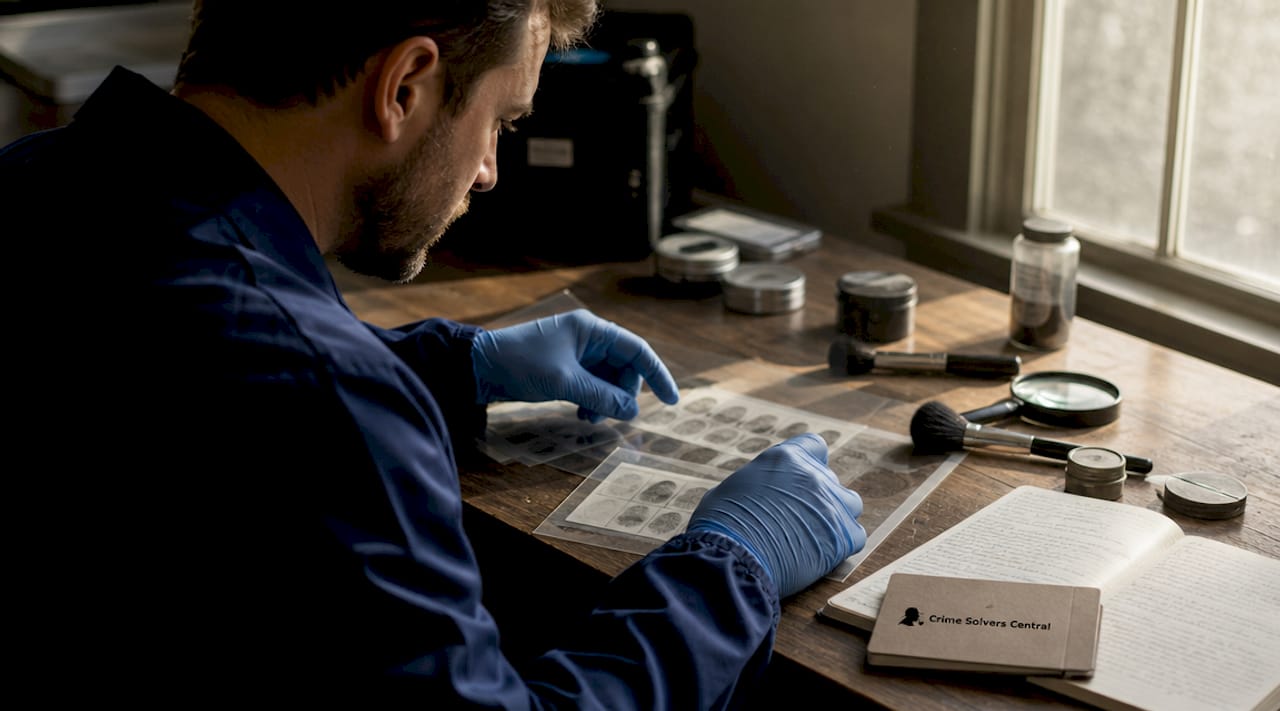
The NDNAD operates on the same principle for DNA. When a crime scene sample is uploaded, the system compares it against millions of stored profiles and returns matches ranked by confidence. The SIS, operating across the European Union and associated states, extends this logic to an international scale. These systems share a common purpose: replace guesswork with data.
How do public forensic databases accelerate criminal investigations?
Forensic databases accelerate investigations by converting biological evidence into searchable digital profiles that return matches within hours rather than weeks. The UK’s NDNAD and PoFA (Protection of Freedoms Act) framework govern how DNA profiles are stored, searched, and retained, with full matches requiring 16 paired loci plus a sex marker for maximum evidentiary weight.
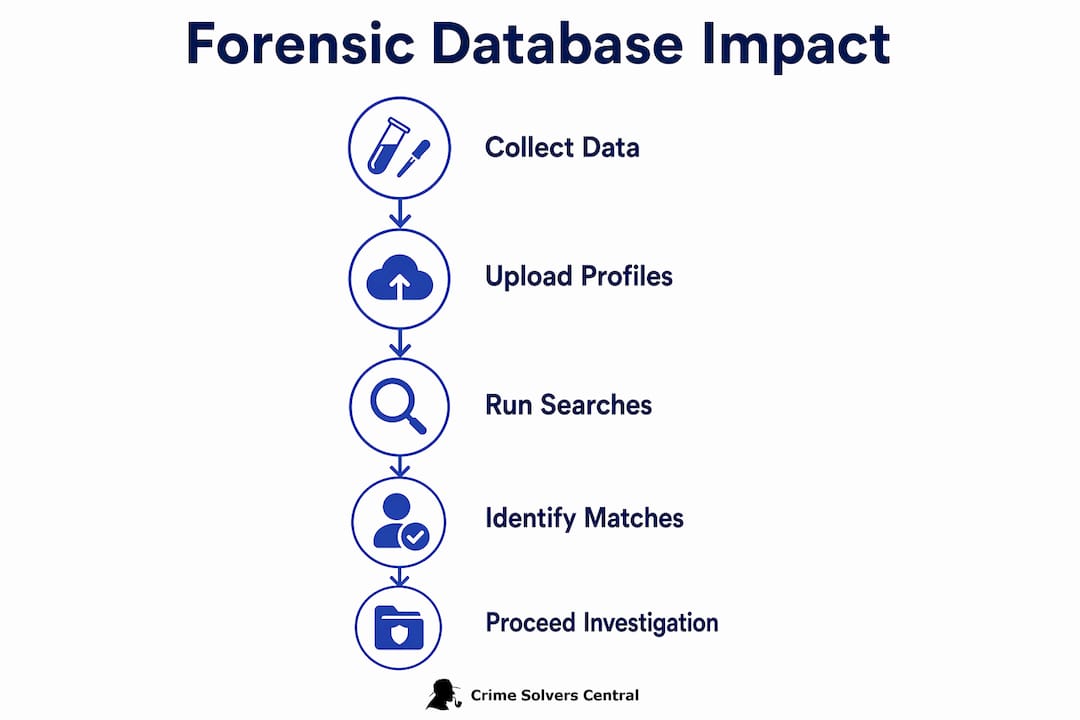
Full matches carry the strongest legal standing in court. Partial matches, where fewer loci align, carry lower evidential weight but remain operationally valuable. A partial match can narrow a suspect pool from thousands to dozens, giving detectives a concrete direction when a case has stalled. Full and partial matches together form a spectrum of investigative utility rather than a binary hit-or-miss system.
The impact on missing persons work is equally significant. PoFA supports controlled speculative searches where unidentified DNA or fingerprint data is compared against existing profiles. If no match is retained, the uploaded profile is deleted after the search completes. This keeps the process legally defensible while still generating leads.
Key forensic database capabilities that speed investigations include:
-
DNA profile matching against NDNAD to identify or eliminate suspects from crime scene samples
-
Fingerprint and palm print searches through IDENT1 to link a single individual to multiple crime scenes
-
Speculative searches that compare unidentified remains or missing persons data against stored profiles
-
Partial match analysis to generate investigative leads when a full match is not available
Pro Tip: When working with partial DNA matches, treat the result as a lead to investigate rather than evidence to prosecute. Cross-reference with other database records, such as address history or vehicle registration, to build corroborating context before acting.
What role do integrated databases play in reducing investigative fragmentation?
Investigations slow down not because detectives lack information, but because that information is scattered across systems that do not talk to each other. Fragmented data silos in records management systems, computer-aided dispatch logs, and social media archives force investigators to manually bridge gaps that technology should close automatically. The result is delays measured in days or weeks on cases where hours matter.
Unified portals solve this by querying multiple databases simultaneously and returning consolidated results. The PsPortals platform, for example, queries NCIC (National Crime Information Center), Nlets (the National Law Enforcement Telecommunications System), and state and local systems in a single interface. A detective running a warrant check no longer needs to log into four separate systems. Unified criminal justice portals return results from all of them at once, reducing both time and the risk of missing a critical alert.
The practical steps that integrated database access enables include:
-
Run a single query that checks NCIC, Nlets, and state systems simultaneously
-
Receive real-time warrant alerts and wanted person flags across jurisdictions
-
Identify connections between individuals, addresses, and vehicles that span multiple agencies
-
Cross-reference Records Management System (RMS) data with Computer-Aided Dispatch (CAD) logs to establish timelines
-
Surface social media and phone data links within the same investigative interface
“Faster investigations result not from more information but from better integration and real-time cross-jurisdictional database queries, minimizing manual bridging.” — Police1 Innovation Report
Public records investigations build identity and network links through corroborated, cross-checked sources rather than relying on single searches. This is why cross-checked public records training for investigators emphasizes layering results from multiple databases rather than treating any single hit as conclusive. Integration does not just save time. It catches connections that isolated searches miss entirely.
How do public databases help solve cold cases and missing persons investigations?
Cold cases and missing persons investigations represent the highest-stakes application of public database access, and the results over the past decade have been extraordinary. Genetic genealogy has helped solve more than 1,300 cases since 2018 by matching crime scene DNA against consumer genealogy databases to identify relatives as distant as third or fourth cousins. That kinship data allows investigators to build family trees and work forward to a likely suspect, even when the offender’s own DNA profile has never been collected.
The technique shifts the investigative model entirely. Instead of searching for a direct offender match, detectives search for biological relatives who have voluntarily submitted DNA to platforms like GEDmatch or FamilyTreeDNA. Genetic genealogy’s reach extends the effective database size by orders of magnitude, because a single relative’s profile can point toward an entire family network.
The table below compares traditional forensic database searches with genetic genealogy approaches:
| Method | Database used | Match type | Best suited for |
|---|---|---|---|
| NDNAD/CODIS DNA search | Law enforcement only | Direct offender profile | Active investigations with recent DNA |
| Genetic genealogy | Consumer databases (GEDmatch, FamilyTreeDNA) | Relative kinship links | Cold cases with no direct offender match |
| Fingerprint search (IDENT1) | Law enforcement only | Direct individual match | Crime scene prints with prior arrest records |
| Speculative forensic search | PoFA/NDNAD | Unidentified remains vs. stored profiles | Missing persons identification |
Missing persons cases face a specific technical obstacle that databases are only beginning to address. Keyword mismatches between family descriptions and medical examiner records limit search success. A family might describe a missing relative as having a “broken nose,” while the examiner’s record uses clinical terminology like “nasal fracture with deviation.” Semantic search tools that interpret meaning rather than exact terms are improving match rates in these cases, closing a gap that has left families without answers for years.
Pro Tip: If you are a community advocate working on a missing persons case, request that the family’s physical descriptions be submitted in both plain language and clinical terminology. This doubles the chance of a database match when records use different vocabulary.
Privacy governance matters here too. Speculative searches under UK forensic frameworks delete profiles post-search unless a specific retention power applies. This legal structure keeps the process proportionate while still generating the leads investigators need.
What measurable impact do public databases have on law enforcement effectiveness?
The scale of public database usage in law enforcement is difficult to overstate. The Schengen Information System processed 17.76 billion searches in 2025, with over 49 million daily searches across participating European states. The system stored 94,605,202 alerts at the time of reporting, including approximately 2 million alerts on persons. That volume represents a real-time intelligence network operating continuously across 27 countries.
Each of those searches represents a moment where a border officer, patrol unit, or investigator checked whether a person, vehicle, or object was flagged in a cross-border alert system. The SIS alert volume translates directly into wanted persons apprehended, stolen vehicles recovered, and missing individuals located. High-volume systems like SIS require robust data quality and alert categorization to prevent missed leads. A poorly categorized alert at that scale can mean a wanted person walks through a checkpoint unchallenged.
The impact of public data on crime fighting is also visible in how quickly cases move when database access is available. Detectives with unified portal access can confirm or clear a suspect’s warrant status, criminal history, and known associates in minutes rather than hours. That speed compounds across an entire investigation, shaving days off timelines that directly affect whether evidence remains viable and witnesses remain cooperative.
Key takeaways
Public databases aid law enforcement most effectively when forensic data, criminal records, and genealogy resources are integrated into unified, searchable systems that investigators can query in real time.
| Point | Details |
|---|---|
| Forensic databases accelerate identification | NDNAD and IDENT1 return DNA and fingerprint matches in hours, replacing days of manual work. |
| Integration reduces fragmentation | Unified portals like PsPortals query NCIC, Nlets, and local systems simultaneously, cutting investigative delays. |
| Genetic genealogy solves cold cases | Over 1,300 cases solved since 2018 by matching crime scene DNA to relatives in consumer databases. |
| Scale proves effectiveness | SIS processed 17.76 billion searches in 2025, demonstrating the operational reach of cross-border database systems. |
| Privacy governance is built in | Speculative searches delete profiles post-completion unless retention laws apply, keeping use legally proportionate. |
Why community engagement with public databases matters more than most people realize
I have spent years watching cold cases sit unresolved not because the evidence was absent, but because the data existed in a system no one thought to query. The most underappreciated truth about public databases is that their value compounds with use. Every profile added, every case uploaded, every community advocate who submits a tip or a family description makes the system more powerful for everyone who comes after.
What concerns me is the assumption that database access is purely a law enforcement function. Community advocates who understand why unidentified persons cases matter can push for better data submission practices, advocate for semantic search improvements, and hold agencies accountable for uploading cases to national systems. That kind of informed advocacy changes outcomes.
The privacy debate around genetic genealogy is real and worth having. But the framing of privacy versus justice is a false choice. The governance frameworks already built into systems like PoFA and the UK NDNAD show that proportionate, time-limited access is achievable. The question is whether we build those protections into every system, not whether we use the systems at all. I believe the answer is yes, and I believe community engagement is what makes that possible.
— Crime
Explore Crimesolverscentral’s cold case database
Crimesolverscentral maintains a national cold case database by state covering over 264,913 missing persons and unsolved homicide cases, all categorized for public access. For law enforcement professionals, the platform offers a searchable catalog that complements forensic database queries with community-sourced information and case documentation. For advocates and families, it provides a structured way to engage with cases and contribute to investigations. Learning how public records support cold cases is the first step toward using these tools effectively. Crimesolverscentral exists to make that knowledge accessible to everyone working toward justice.
FAQ
What are the main benefits of public databases for police?
Public databases give police real-time access to DNA matches, fingerprint records, warrant status, and cross-jurisdictional alerts through unified systems like NCIC, IDENT1, and SIS. This access reduces investigative delays and surfaces connections that isolated records systems would miss.
How do public records assist law enforcement in missing persons cases?
Forensic databases support speculative searches that compare unidentified remains against stored DNA and fingerprint profiles, while semantic search tools help match family descriptions to medical examiner records. Genetic genealogy databases extend this reach by identifying biological relatives of unidentified individuals.
How many cases has genetic genealogy solved?
Genetic genealogy has helped solve more than 1,300 cases since 2018 by using consumer DNA databases to identify relatives of suspects or unidentified individuals. Matches as distant as third or fourth cousins have been sufficient to build investigative family trees.
Are public database searches subject to privacy protections?
Yes. Under frameworks like the UK’s PoFA, speculative forensic searches delete uploaded profiles after completion unless a specific legal retention power applies. These controls make database use proportionate and legally defensible.
What is the Schengen Information System and why does it matter?
The SIS is a cross-border law enforcement database used across 27 European countries that processed 17.76 billion searches in 2025. It stores alerts on wanted persons, missing individuals, and stolen objects, enabling real-time checks by border officers and investigators across member states.