

Why Missing Persons Data Matters to Researchers

Missing persons data is defined as the systematic collection of records documenting individuals who have disappeared and whose whereabouts remain unknown to family or authorities. Understanding why missing persons data matters to researchers is not an academic abstraction. It shapes how criminologists and sociologists identify vulnerable populations, measure institutional response, and build evidence for policy reform. Organizations like the National Center for Missing and Exploited Children (NCMEC) and Canada’s National Centre for Missing Persons and Unidentified Remains (NCMPUR) generate the longitudinal datasets that make this research possible. Crimesolverscentral catalogs over 264,913 cases, giving researchers a structured entry point into national patterns that would otherwise require years of agency-by-agency requests.
Why missing persons data matters to researchers studying societal patterns
Missing persons records reveal which populations disappear most often, under what circumstances, and how quickly institutions respond. That information is the foundation of any serious criminological or sociological analysis.
Demographic breakdowns expose structural vulnerabilities that aggregate crime statistics miss entirely. Canadian NCMPUR data shows 55% of missing adults were male in 2025, while 33% of all reports resolved within 24 hours. Those two figures together tell a story: most adult disappearances are short-duration events, but a significant minority persist long enough to require sustained investigation. Researchers who ignore resolution timelines produce skewed risk models.

The same dataset tracks longitudinal trends across pandemic and post-pandemic periods. Longitudinal trends in missing children remained below pre-COVID levels in 2025, which gives social scientists a rare natural experiment for measuring how public health crises alter disappearance rates. That kind of temporal data is irreplaceable for causal inference.
NCMEC’s CyberTipline adds another dimension. The platform received 21.3 million reports in 2025, including a 323% increase in child sex trafficking reports over a single year. That spike is not just a law enforcement alert. It is a signal that researchers can use to study how trafficking networks respond to economic disruption, platform regulation, and border policy changes.
Key patterns researchers should track in missing persons data:
- Runaway and throwaway youth: Disproportionately represented in short-duration cases, but at elevated risk of trafficking if not recovered quickly.
- Elder disappearances: Linked to dementia and cognitive decline, requiring different intervention frameworks than youth cases.
- Trafficking victims: Often misclassified as runaways, creating systematic undercounts that distort prevalence estimates.
- Ethnic minority disappearances: Underrepresented in official records relative to actual occurrence, a gap that carries direct implications for resource allocation research.
Pro Tip: When building a research sample from missing persons records, always cross-reference demographic breakdowns with resolution time data. A dataset heavy on short-duration cases will underrepresent chronic disappearances and produce misleading risk profiles.
How do institutional biases shape missing persons data?
Missing persons statistics primarily reflect police activity and classification rather than a precise count of people who have actually disappeared. That distinction is critical for any researcher treating these records as objective population data.
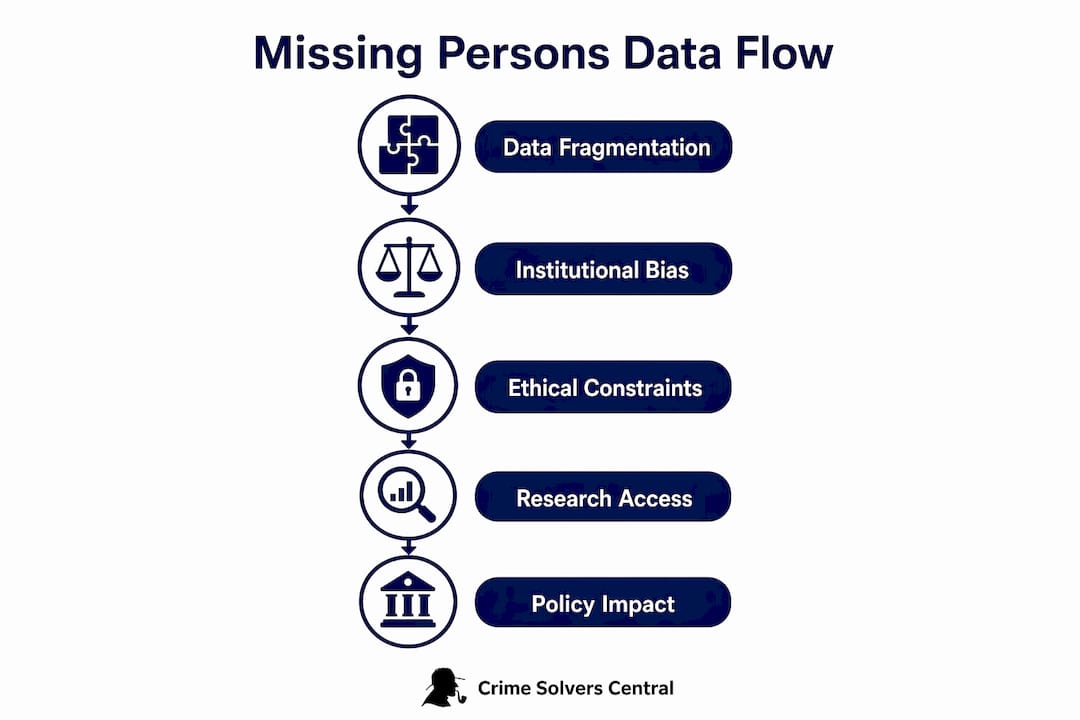
The “ideal victim” framework explains much of the distortion. Police risk assessments are vulnerable to bias, with individuals labeled as non-ideal victims having significantly less data recorded about their cases. In practice, this means girls and suicidal teenagers receive more thorough documentation than ethnic minorities or individuals flagged as Child Protection cases. The research sample that emerges from police records is not random. It is filtered through a set of institutional assumptions about whose disappearance warrants attention.
The scale of undercounting is measurable. UK data reveals a stark gap: 180,000 cases logged in official statistics versus 353,000 cases actually opened. That is nearly a 2:1 ratio between what gets counted and what gets worked. Researchers who rely solely on logged statistics are analyzing less than half the picture.
“Data is selective and incomplete due to police reporting practices and political or legal suppression, challenging sole reliance on institutional data. Researchers must treat official missing persons records as a filtered output of institutional decision-making, not a neutral census of disappearances.”
The practical consequences for research design are significant:
- Audit your data source. Determine whether records come from logged statistics, opened cases, or resolved cases. Each category captures a different slice of reality.
- Test for demographic skew. Run frequency distributions by ethnicity, age, and gender before drawing any population-level conclusions.
- Triangulate across agencies. A single police department’s records will reflect local classification norms. Cross-referencing with nonprofit databases and federal sources reduces source-specific bias.
- Document classification criteria. Police agencies use different thresholds for opening a missing persons case. Undocumented variation in those thresholds is a confounding variable in any comparative study.
Missing persons data for social scientists carries particular weight when studying how institutions respond to marginalized communities. The bias in recording is itself a research finding, not just a methodological nuisance.
What challenges do researchers face accessing missing persons data?
Data fragmentation is the single largest obstacle to rigorous missing persons research. No country has a unified, comprehensive real-time missing persons database. Researchers must navigate independent institutional ecosystems that rarely communicate with each other, let alone share data in interoperable formats.
The table below maps the most common data sources against their key limitations:
| Data source | Coverage | Primary limitation |
|---|---|---|
| Local police records | Jurisdiction-specific | Classification inconsistency across agencies |
| Federal databases (e.g., NCIC) | National, law enforcement only | Access restricted to credentialed agencies |
| Nonprofit platforms (e.g., NCMEC) | Selective case types | Focused on children; limited adult coverage |
| Academic research datasets | Narrow, study-specific | Small samples; not generalizable |
| Crimesolverscentral | 264,913+ cases, national | Ongoing case updates required |
The technical barriers compound the institutional ones. Even when agencies agree to share data, format incompatibility makes merging records labor-intensive. A case entered as “John Doe, DOB unknown” in one system and “unidentified male, approximate age 40” in another represents the same person but will not match in any automated cross-reference. Researchers spend significant time on data cleaning that could be spent on analysis.
Ethical constraints add another layer. Privacy protections for living missing persons, particularly minors, limit what researchers can access without institutional review board approval and law enforcement cooperation. Those approval processes can take months, slowing research on time-sensitive questions like trafficking trends.
Institutional data can be selective and incomplete due to reporting limitations and political factors. That selectivity is not random. It correlates with the same demographic variables researchers are often trying to study, which means the missing data problem is not just a technical inconvenience. It is a substantive bias.
Pro Tip: Build your data access plan before your research design. Knowing which databases you can realistically access in your timeline will determine which research questions are answerable. Starting with a question and then discovering the data does not exist wastes months.
How can researchers use missing persons data to improve outcomes?
The benefits of missing persons records extend well beyond academic publication. Data-driven research directly influences how law enforcement allocates resources, how social services design interventions, and how policymakers write legislation.
Longitudinal datasets are the most powerful tool available for this work. When researchers track the same population of cases across years, they can identify which risk factors predict long-duration disappearances and which early interventions reduce them. That kind of pattern recognition is impossible with cross-sectional snapshots. Investigative files enable cross-referencing that can revive cold cases and reduce the time individuals remain missing. The ICRC’s work in Mexico demonstrates that coordinated data use between families, researchers, and prosecutors produces results that siloed agency work cannot.
Practical applications researchers are currently pursuing:
- Risk scoring models: Using demographic and circumstantial variables to flag cases at high risk of becoming long-term disappearances, enabling earlier resource deployment.
- Geographic clustering analysis: Identifying spatial patterns in disappearances that suggest organized trafficking routes or environmental risk factors.
- Resolution time benchmarking: Comparing how quickly different agencies resolve similar case types, which surfaces best practices and systemic failures simultaneously.
- Policy impact evaluation: Measuring whether legislative changes, such as Amber Alert expansions or trafficking task force funding, produce measurable shifts in case outcomes.
- Family-centered data protocols: Developing frameworks that incorporate family-provided information into official records, closing gaps that institutional sources leave open.
The importance of missing persons data for policy reform is most visible when researchers publish findings that contradict official narratives. Studies showing that ethnic minority cases receive fewer investigative resources than demographically similar white cases have directly informed department-level policy changes in several jurisdictions. That is research producing real-world accountability.
Collaboration is the multiplier. Researchers who work alongside law enforcement, nonprofit organizations, and affected families produce more complete datasets and more credible findings. The benefits of missing persons records compound when multiple parties contribute to and draw from the same data infrastructure.
Key Takeaways
Missing persons data is a filtered institutional output, not a neutral census, and researchers who treat it as objective population data will produce systematically biased findings.
| Point | Details |
|---|---|
| Data reflects police activity | Official records measure institutional response, not the true count of disappearances. |
| Demographic bias is measurable | Non-ideal victims have less data recorded, skewing sample representativeness in research. |
| Fragmentation limits analysis | No unified real-time database exists; researchers must merge incompatible institutional sources. |
| Longitudinal data drives policy | Tracking cases over time reveals which interventions reduce long-duration disappearances. |
| Cross-referencing revives cold cases | Coordinated data use between agencies, families, and researchers shortens time missing. |
What researchers consistently get wrong about this data
Working with missing persons data for any length of time teaches one lesson faster than any methodology course: the absence of a record is not evidence of absence. Researchers new to this field routinely mistake a clean, well-formatted database for a complete one. The formatting is institutional. The completeness is not.
The deeper problem is that the biases in missing persons data are not random noise. They are structured. They follow the same fault lines of race, class, and gender that shape every other interaction between marginalized communities and state institutions. That means a researcher who does not actively correct for those biases will produce findings that replicate and legitimize the original institutional failure. The data does not just reflect reality. It reflects who institutions decided was worth recording.
My strongest recommendation is to treat every missing persons dataset as a hypothesis about institutional behavior, not a description of disappearances. Ask what the data would look like if every disappearance were recorded equally. The gap between that hypothetical and what you actually have is your most important research variable.
— Crime
Crimesolverscentral: a research resource worth knowing
Researchers who need structured, accessible case data will find Crimesolverscentral worth examining closely. The platform’s national cold case database catalogs over 264,913 missing persons and unsolved homicide cases, organized by state and case type. That organization matters for researchers who need to build geographically bounded samples or compare case outcomes across jurisdictions. The database also supports community-level engagement, which means researchers studying family and community responses to disappearances have a secondary data layer available. For academics studying the impact of missing persons statistics on law enforcement behavior and public awareness, Crimesolverscentral provides a starting point that reduces the time spent on initial data collection.
FAQ
What is missing persons data used for in research?
Missing persons data is used to identify demographic patterns, measure institutional response times, evaluate policy interventions, and study the social conditions that produce disappearances. Researchers in criminology and sociology rely on it to build evidence for resource allocation and legislative reform.
Why is missing persons data often incomplete or biased?
Missing persons statistics reflect police classification rather than a true count of disappearances. Cases involving non-ideal victims, including ethnic minorities and individuals in Child Protection systems, are less likely to be recorded or prioritized, creating systematic gaps.
How do researchers access missing persons data?
Researchers access missing persons data through federal databases like the National Crime Information Center (NCIC), nonprofit platforms like NCMEC, academic datasets, and public resources like Crimesolverscentral. Each source has different access restrictions, coverage scope, and classification standards.
What does data fragmentation mean for missing persons research?
Data fragmentation means no single database captures all missing persons cases in real time. Researchers must merge records from multiple agencies with incompatible formats, which introduces cleaning errors and limits the generalizability of findings.
How can missing persons data influence policy?
Research using missing persons data has directly informed Amber Alert expansions, trafficking task force funding decisions, and department-level policy changes on case prioritization. Longitudinal analysis showing disparities in investigative resources by race has produced measurable accountability in several jurisdictions.