

What Is a Missing Person Bulletin? The Official Guide

A missing person bulletin is a formal document or public posting created by law enforcement to share information about a missing individual and generate leads from the public. Unlike emergency alerts such as AMBER or Silver Alerts, which trigger immediate wireless device notifications, a bulletin serves as an ongoing investigative tool, staying active until the person is located. Agencies like the Texas Department of Public Safety and the Alaska State Troopers publish these bulletins on their official websites, keeping cases visible to the public for as long as needed.
A standard missing person bulletin typically includes:
- A recent, clear photograph of the missing individual
- Full name, age, height, weight, and physical description
- Unique identifiers such as birthmarks, scars, or tattoos
- Last known location, date, and time
- Vehicle information if the person may be traveling
- Contact instructions directing tips to the lead investigating agency
Table of Contents
- What is a missing person bulletin, and when does law enforcement issue one?
- How you can help when a bulletin is issued
- Real-world examples of bulletins in practice
- Expert guidance and resources on missing person bulletins
- Key Takeaways
- FAQ
What is a missing person bulletin, and when does law enforcement issue one?
Law enforcement issues a bulletin when a missing person case does not meet the strict criteria for an emergency alert, or when a case requires sustained public awareness beyond the short window of an emergency notification. No 24-hour waiting period exists before filing a report. For children and at-risk individuals, federal law mandates immediate entry into the National Crime Information Center (NCIC). California guidelines require entry into the state Missing Persons System within two hours for at-risk cases.
The table below shows how urgency level and case type shape the law enforcement response.
| Case Type | Database Entry Requirement | Bulletin Issued? | Emergency Alert Possible? |
|---|---|---|---|
| Missing child (any circumstances) | Immediate NCIC entry | Yes | Yes, if abduction criteria met |
| At-risk adult | Within two hours (state systems) | Yes | Depends on state criteria |
| Voluntary adult, no risk factors | Standard report filing | Often | Rarely |
| Elderly or cognitively impaired | Immediate, per state protocol | Yes | Silver Alert if criteria met |
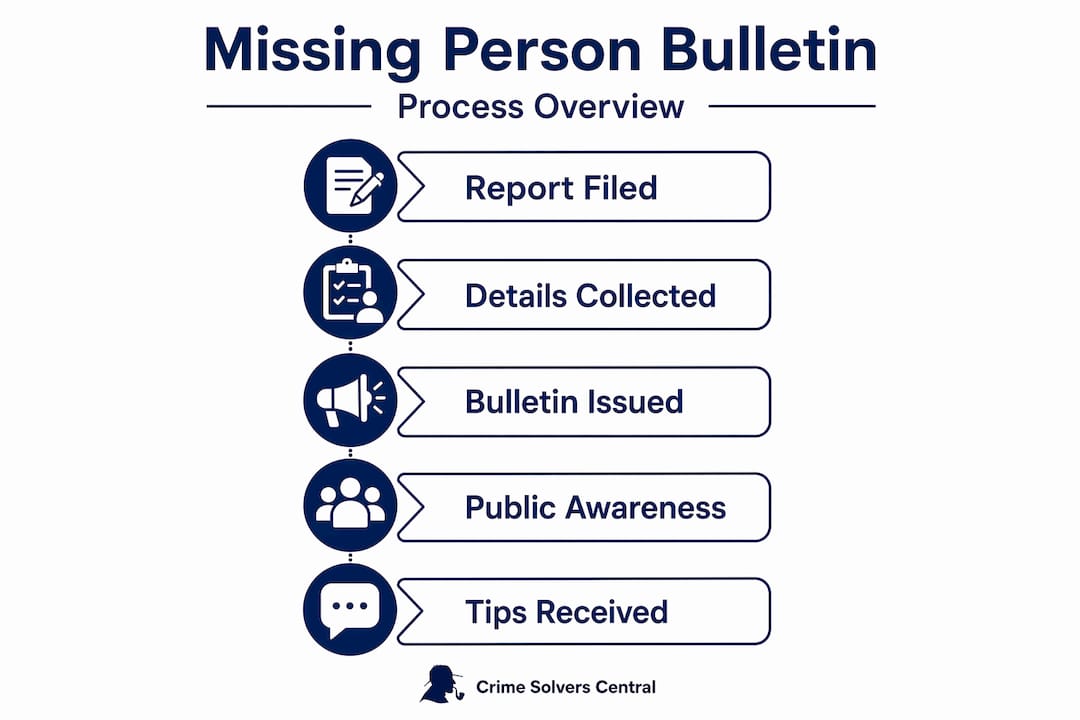
Once a report is filed, investigators gather photographs, physical descriptors, and circumstantial details before the bulletin is approved and disseminated through agency websites, law enforcement databases, and community channels.
How you can help when a bulletin is issued
The public functions as extra eyes for investigators, not as independent searchers. When you spot someone matching a bulletin description, the right move is to contact the single point of contact listed in that bulletin, usually the lead investigating agency’s tip line or non-emergency number. Tips routed through official channels reach investigators intact. Tips spread across social media often fragment, get distorted, or simply go untracked.

When calling in a tip, be specific: describe what you saw, where, and when. Vague reports slow investigators down. If you witnessed something, note the exact location, the time, and any details about clothing or companions.
Pro Tip: Families can speed up bulletin dissemination by having a recent, high-resolution photograph and a list of unique physical identifiers ready before contacting law enforcement. Detailed identifiers like tattoos or scars significantly improve public recognition.
Ways the public can support an active bulletin:
- Report sightings directly to the contact number listed on the bulletin
- Share official bulletin links from agency websites rather than reposting unverified information
- Sign up for community notification systems such as CodeRED where available
- Avoid speculating publicly about the case, which can mislead investigators
- Contact the National Center for Missing and Exploited Children (NCMEC) at 1-800-843-5678 for child cases
Real-world examples of bulletins in practice
The Alaska State Troopers maintain a dedicated Missing Persons Bulletin page through the Alaska Bureau of Investigation, listing active cases with photographs, physical descriptions, and agency contact details. Cases remain posted until the individual is located or the bulletin is officially cleared.
The Alabama Law Enforcement Agency (ALEA) illustrates how bulletins fill the gap when emergency alert criteria are not met. For cases that fall outside AMBER or MEPA thresholds, ALEA’s Fusion Center posts cases on its Community Information Center and distributes bulletins through CodeRED to generate leads without triggering alert fatigue.
The Utah Missing Persons Clearinghouse operates a continuously updated public bulletin website, coordinating with NCIC and the National Center for Missing and Exploited Children. Utah law enforcement agencies submit photographs and descriptions directly to the clearinghouse for posting, and the site links to clearinghouses in other states for cross-jurisdictional searches.
| Agency | Distribution Channel | Bulletin Duration | Public Tip Contact |
|---|---|---|---|
| Alaska State Troopers | Agency website | Until located | Alaska Bureau of Investigation |
| ALEA (Alabama) | CodeRED, agency website | Until resolved | ALEA Fusion Center |
| Utah Missing Persons Clearinghouse | State bulletin website, NCIC | Until NCIC entry removed | — |
| California DOJ | Email subscription, agency site | Ongoing, quarterly print | Lead investigating agency |
Expert guidance and resources on missing person bulletins
Bulletins reduce misuse of emergency alert systems by giving law enforcement a formal tool for cases that are serious but do not meet abduction criteria. Without bulletins, agencies would face pressure to issue AMBER Alerts in situations where the criteria simply do not apply, which would erode public trust in those alerts over time.
Early reporting is the single most critical factor in recovery. Families should contact law enforcement immediately rather than trying to determine which alert type applies. That classification is law enforcement’s job, not the family’s.
Crimesolverscentral maintains a national database of a large number of categorized missing persons and cold cases, organized by state and situation. For families and investigators tracking a case across jurisdictions, searching the cold case database can surface connections that individual agency bulletins may not capture. You can also explore missing persons database resources to understand how national and state systems work together.
Key Takeaways
A missing person bulletin is law enforcement’s primary long-term tool for keeping a case visible and generating public leads when emergency alert criteria are not met.
| Point | Details |
|---|---|
| No waiting period | Law enforcement must enter children and at-risk persons into NCIC immediately upon report. |
| Bulletins vs. emergency alerts | Bulletins sustain ongoing awareness; emergency alerts are short-lived, urgent interruptions. |
| Tip routing matters | Tips sent to official channels reach investigators; social media posts often cause lost leads. |
| Detailed identifiers speed recovery | Unique marks like tattoos and scars, plus a recent photo, improve public recognition significantly. |
| Bulletins stay active | A bulletin remains posted until the person is located or the case is officially resolved. |
FAQ
What is a missing person alert called?
The general term is a missing person bulletin. Specific emergency versions include AMBER Alerts for abducted children, Silver Alerts for missing elderly or cognitively impaired adults, and Endangered Missing Advisories for individuals in danger who do not meet AMBER criteria.
What are the two types of missing persons?
Law enforcement generally distinguishes between voluntary missing persons, adults who left of their own will, and involuntary missing persons, including abducted children or individuals who disappeared under suspicious or dangerous circumstances.
Is there a timeline for when a missing person is considered deceased?
There is no set timeline for declaring a missing person deceased. Investigations remain active until the person is located, and bulletins stay in circulation throughout that period.
How long before a missing person report can be filed?
There is no waiting period. Families should report immediately to local law enforcement, which will enter the information into NCIC and begin the bulletin process without delay.