

Wanted Murder Suspects: 4 U.S. Sources and Safe Tip Steps
Start with the Department of Justice “Identify Our Most Wanted” portal, the FBI’s Ten Most Wanted and Violent Crimes pages, the U.S. Marshals’ 15 Most Wanted list, and your local Crime Stoppers archive. If you have information, send it once through the agency’s tip form or hotline, with dates, times, locations, vehicle details and any photos. Never confront a suspect. If you believe there is immediate danger, contact emergency services.
TL;DR:
- A local homicide suspect may not appear on federal lists, so check the police department serving the crime’s jurisdiction before ruling out a wanted notice.
- Keep original photos or videos untouched with their timestamps, and record source URLs; investigators can check preserved evidence more readily than vague recollections.
- The FBI accepts anonymous tips, but omitting contact details can hinder follow up; many Crime Stoppers programs provide a unique number to protect identity.
- Wanted pages change when people are captured, cleared, or reclassified, so verify the issuing agency’s current listing before sharing a notice or acting on it.
- The FBI says public cooperation directly led to about 30% of Ten Most Wanted captures, but agencies decide whether to investigate each tip.
Table of Contents
- 1. Where can you find authoritative wanted murder suspect lists?
- 2. How do you read a wanted profile and know which details matter?
- 3. How do you submit a tip safely and effectively?
- 4. How can you verify a listing and share responsibly?
- 5. What happens after you report a tip?
- 6. Why do wanted lists for murder suspects exist?
- 7. How are wanted murder suspect databases maintained and updated?
- 8. What legal limits apply to publishing suspect information?
- 9. How can the community help beyond submitting tips?
- 10. Which success stories show what community help can do?
- 11. What is our view on community databases and organized tips?
- 12. Where can you go deeper with Crime Solvers Central?
- FAQ
- Sources
1. Where can you find authoritative wanted murder suspect lists?
Official government pages are a reliable place to check whether someone is wanted. Social media reposts and third-party compilations may be outdated or contain errors. These are the sources we check first:
- The Department of Justice portal. Federal agencies including the FBI, ATF, DEA and U.S. Marshals keep their own wanted pages, and the Identify Our Most Wanted Fugitives portal links to all of them. It is the fastest way to jump to the right agency.
- FBI wanted pages. The Ten Most Wanted list covers high-profile fugitives, and the FBI keeps a separate Violent Crimes, Murders page for homicide suspects. The Ten Most Wanted list is dynamic, so names come off and new ones go on as cases change.
- U.S. Marshals Service. Its 15 Most Wanted Fugitive Program is meant to focus public attention on violent offenders and dangerous career criminals, and the Major Case Fugitive Program covers other high-priority cases.
- State and local sources. City police departments, sheriffs’ offices and Crime Stoppers programs publish local wanted pages with hotline numbers. For a crime that happened in your area, local police contact information is usually the most reliable starting point.
A suspect wanted for a local homicide may never appear on a federal list. If you cannot find a name on the federal pages, check the police department for the jurisdiction where the crime occurred before you assume the person is not wanted.
2. How do you read a wanted profile and know which details matter?
A wanted profile is built to help the public recognize one person, so every field has a purpose. Knowing which fields investigators care about most helps you decide what to write down before you contact anyone.
Profiles can include identifying details, case information and safety warnings. Check the specific profile for what it contains. Treat any warning seriously. The FBI says never to try to apprehend or confront a wanted suspect, because many are armed and dangerous.
When you think you have useful information, collect these items first:
- The exact date and time of what you saw, not a rough guess.
- The precise location, including cross streets, business names or addresses.
- Vehicle make, model, color and license plate, if you got one.
- Video or photo timestamps and the original file, not a screenshot of a screenshot.
- Social media handles, usernames or URLs tied to the person.
The more specific and checkable a detail is, the more weight an investigator can give it. A vague “I think I saw him downtown last week” is hard to act on. A time-stamped video from a named gas station is not.
Pro Tip: Keep original files untouched and do not edit metadata unless an investigator asks you to; never post unverified allegations about anyone publicly.
3. How do you submit a tip safely and effectively?
Use the official channel that matches the case. For a federal fugitive, that means the FBI’s electronic tip form or the tip procedures listed on the U.S. Marshals page. For a local case, use the police department or Crime Stoppers hotline named on the wanted profile. The DOJ portal links out to each component agency’s tip page, so you do not need to guess where to go.
Follow these steps:
- State the facts you personally observed: date, time, location and what you saw.
- Add vehicle descriptions, plates, photos or video details and any social media URLs.
- Give witness contact information only if you are willing to be contacted.
- Submit once, to the correct agency. Duplicate submissions create confusion and waste investigators’ time.
- Call 911 instead of using a form if the suspect is present and dangerous.
On anonymity, the FBI form accepts anonymous submissions, but leaving out contact details can make follow-up harder. Many Crime Stoppers programs give tipsters a unique tip number to protect identity and keep reward eligibility intact.
Anonymous does not mean careless: federal agencies recommend submitting information only once, with specific details such as URLs, usernames and dates, so the tip can be verified.
If you want to protect photo metadata first, our guide on submitting an anonymous tip walks through it.
4. How can you verify a listing and share responsibly?
Accusing the wrong person can ruin a life and can interfere with a real investigation. Before you share anything, confirm it on an official page.
- Cross-check every name against the agency’s own wanted page, not a repost or a roundup site.
- If you spot a suspect’s photo or posts online, screenshot them and record the URLs and timestamps. Do not name or accuse anyone publicly.
- Send what you found to the tip channel, not to a comment thread.
- If you want to help spread the word, link to the official wanted page and add a reminder not to approach the suspect.
Official listings are updated or removed when someone is captured, cleared or reclassified. A graphic that circulated last month may now be wrong, which is another reason to link to the source instead of reposting an image.
Pro Tip: Before you share a wanted notice, open the agency’s page and confirm the person is still listed; if you cannot find them there, do not post.
For readers learning to search ethically, our state-by-state guide to searching unsolved murders covers the same ground in more depth.
5. What happens after you report a tip?
Agencies may review tips and decide how to follow up. The process can vary by agency and case. A tip may help investigators decide whether further steps are warranted. An agency may retain a tip for possible later review; its handling depends on the agency.
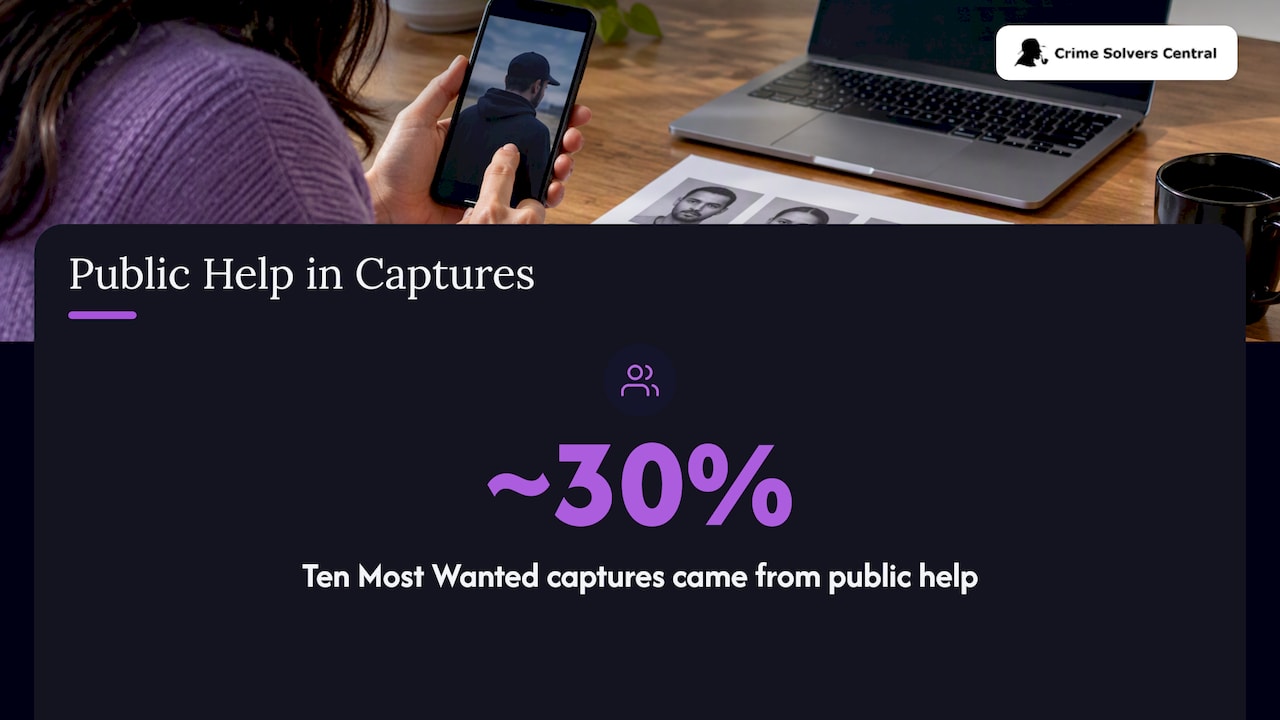
Public cooperation matters. The FBI reports that about 30% of fugitives on the Ten Most Wanted list have been captured as a direct result of citizen cooperation. A documented example: a U.S. Marshals press release describes an arrest that began with a tip after a fugitive’s profile aired on television, followed by coordination with international authorities.
If you left contact details, an investigator may follow up with questions. If you stayed anonymous, do not expect a reply. The agency determines how it handles anonymous submissions.
6. Why do wanted lists for murder suspects exist?
Wanted lists turn a private search into a public one. The FBI’s Ten Most Wanted program is the best-known example, and the Bureau marked a 75th anniversary of it in a recorded podcast episode. The program publicizes fugitives in the hope that members of the public may recognize them and share useful information.
Over time, lists have become more specialized. Agencies now keep separate pages for violent crimes and murders, and the Marshals run programs aimed at dangerous career offenders. These lists highlight selected cases and invite the public to share information. They are not comprehensive catalogs of everyone with a warrant.
The significance for you as a reader is practical. A listing signals that investigators believe public help could make a difference, and it tells you exactly which agency wants to hear from you. The page is maintained by the agency, so check it directly rather than relying on unofficial rumors.
7. How are wanted murder suspect databases maintained and updated?
Each agency owns its own list. The Department of Justice portal does not store a single master file. It points to the pages that the FBI, ATF, DEA, U.S. Marshals and other components maintain themselves. The agency responsible for a case maintains its profile; check that agency’s page for current information.
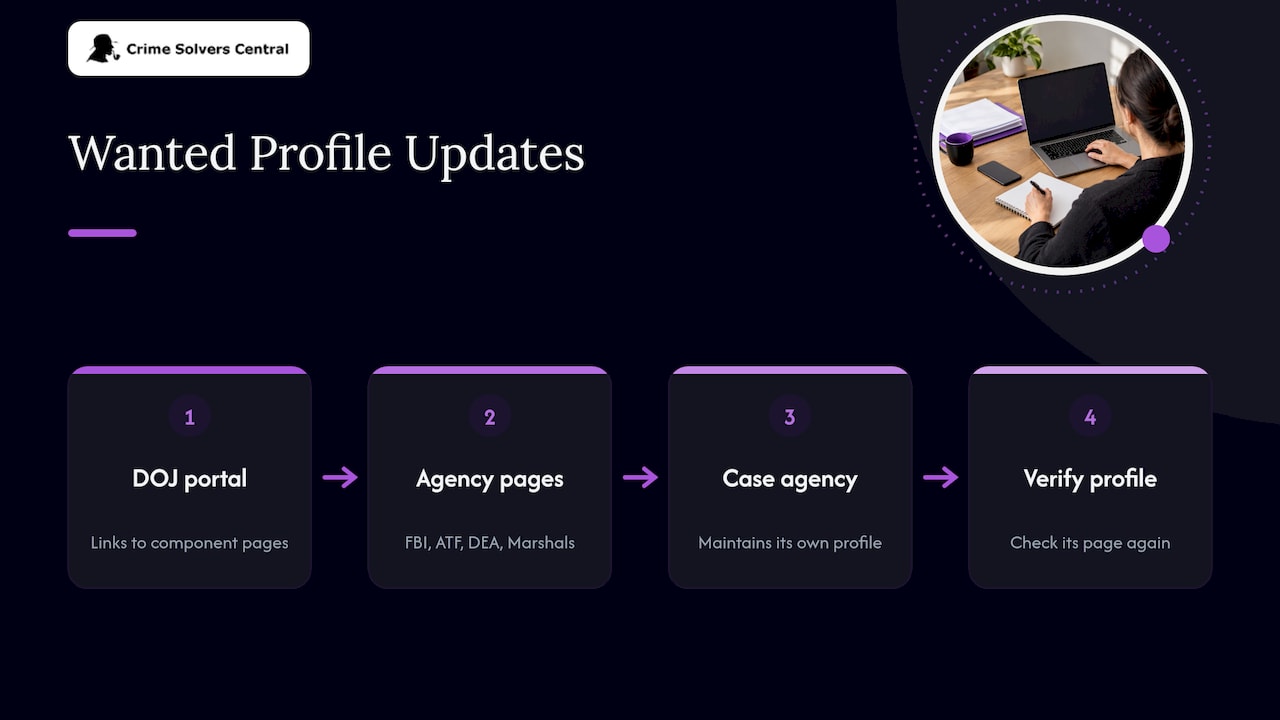
That structure explains why you may see different information in different places. A state police page may show a warrant that a federal page does not, or a local archive may keep a closed case visible long after the arrest. The reliable habit is to treat the agency that issued the warrant as the source of truth, and to check its page again before acting on anything you read elsewhere.
We take a different role. We do not issue warrants or confirm who is wanted. Our database is a searchable collection of cold cases, including missing persons and unsolved homicides, organized by state and case type so researchers and families can find them. Counts and categories change as cases are added, and we encourage readers to confirm anything urgent against the official agency before relying on a summary.
If a suspect profile looks outdated, tell the issuing agency rather than correcting it yourself. They can verify and fix it.
8. What legal limits apply to publishing suspect information?
Naming someone in public carries legal and ethical weight. An arrest or a warrant is not a conviction, and publishing the wrong name or a false claim can expose a person to real harm and the publisher to legal trouble. We keep the general principle simple: rely on information that an official agency has released, attribute it, and avoid adding speculation.
Some practical limits follow from that. Do not publish allegations you cannot trace to an official source. Do not identify someone from a blurry photo or a hunch. Do not post private information such as a home address, even when the person is wanted, because doing so can invite vigilante behavior or put bystanders at risk. And if a case involves a minor or a sealed record, the rules can be stricter.
Laws on defamation, privacy and the use of images vary by state and by situation, so this is not legal advice. If you run a page, group or newsletter that discusses suspects, consider asking a licensed attorney in your state about your specific practices. For everyday readers, the safe path is the one we have described all along: send what you know to law enforcement and let them decide what becomes public.
9. How can the community help beyond submitting tips?
Submitting a tip is one way to help, but it is not the only one. Families of victims and volunteers often do quieter work that keeps a case alive when the news cycle moves on.
On our platform, community members take part through membership, fundraising and health and safety initiatives. Fundraisers can support community efforts. Members can use organized case information, a flyer builder and digital evidence boards to support volunteer efforts.
Beyond our own tools, ordinary habits help too. Share official wanted notices from the agency’s page, not screenshots. Remind friends not to approach suspects. You can also learn about and support local Crime Stoppers programs. And if you are a victim’s relative, consider asking the investigating agency how volunteers can help without interfering with the case.
Our guide on how to crowdsource tips on unsolved homicide cases explains how to organize that effort responsibly.
10. Which success stories show what community help can do?
Public attention can change a case. In the U.S. Marshals example mentioned earlier, an arrest in a Kay County murder case began with a tip generated after the fugitive’s profile aired on television. The Marshals’ release describes how that lead was followed through coordination across international authorities, and the suspect was arrested after having fled to Mexico. Someone watching a broadcast set the whole sequence in motion.
Citizen cooperation also shows up in the broader record; families can use resources like Finding an Inmate in California: Official Search Guide to stay informed about detained individuals and the bail process. The FBI’s own account says roughly 30% of Ten Most Wanted captures came directly from help by members of the public, which is why agencies keep raising rewards and publicizing profiles.
On our site, testimonials from people who used our resources describe reconnecting families and advancing law enforcement investigations. We cannot promise any particular outcome, and we do not claim credit for arrests. What the stories share is a pattern: someone paid attention, collected specific details and passed them to the right agency. That is a pattern anyone can repeat.
11. What is our view on community databases and organized tips?
We publish a national database of cold cases because we think organized information helps people do the right kind of work. Our role is to gather case summaries and offer coordination tools for volunteers, never to replace official tip channels. A well-organized board can help a family keep track of what they know. It cannot arrest anyone, and it should not be used to name suspects.
My view, and ours, is that the best community involvement is boring and evidence-based: dates, timestamps, source links and a clear handoff to law enforcement. Speculation feels productive but often poisons a case. When a lead looks urgent or actionable, the agency’s tipline is the proper legal channel, and we would rather you call it than post about it.
— Crime
12. Where can you go deeper with Crime Solvers Central?
We run a searchable national cold-case database of missing persons and unsolved homicides, sorted state by state, with member tools for readers who want to prepare better and coordinate research. Members can unlock full case details, sources, forums and videos, plus a flyer builder, digital evidence boards and volunteer coordination. Use it to organize what you know, then send actionable tips to the official agency.
- Jr. Detective: $3.97 per month or $39 per year
- Sr. Detective: $9.97 per month or $99 per year
- True Crime Influencer: $39.97 per month or $399 per year
Browse the cold case database or compare plans on the pricing page and join when you are ready to dig in.
FAQ
Who are the top 10 most wanted criminals?
The FBI maintains the Ten Most Wanted Fugitives list, and the roster changes as people are captured or added. Check the FBI’s wanted pages through the Department of Justice portal for the current names rather than relying on a repost.
Can you look up if someone is wanted?
Yes, begin with the official agency pages. The DOJ portal links to FBI, Marshals and other federal lists, and your local police or sheriff’s office publishes local warrants and wanted notices. If a name does not appear, that does not prove the person is not wanted, so contact the agency for the jurisdiction.
Who is currently on the wanted list in Houston, Texas?
Houston lists change often, so use the Houston Police Department and the local Crime Stoppers program for current profiles and the tip number. Federal fugitives with ties to the area appear on the FBI and U.S. Marshals pages. Confirm any name on an official page before sharing it.
Who is on the America’s Most Wanted list for 2026?
Rosters change as arrests happen, so the safest answer is to open the FBI Ten Most Wanted page and the U.S. Marshals 15 Most Wanted page directly. Those pages show who is listed today and how to submit information.
Should I post a suspect’s photo online to help find them?
It is better to link to the official wanted page and send your own information to the tip channel. Reposting images can spread outdated or incorrect details, and it can put people at risk if the wrong person is accused.
Sources
- Department of Justice | Wanted Fugitives
- Fugitive Investigations | U.S. Marshals Service
- Fbi
- Electronic Tip Form | FBI