

Virtual Memorial for a Murder Victim: How to Create One
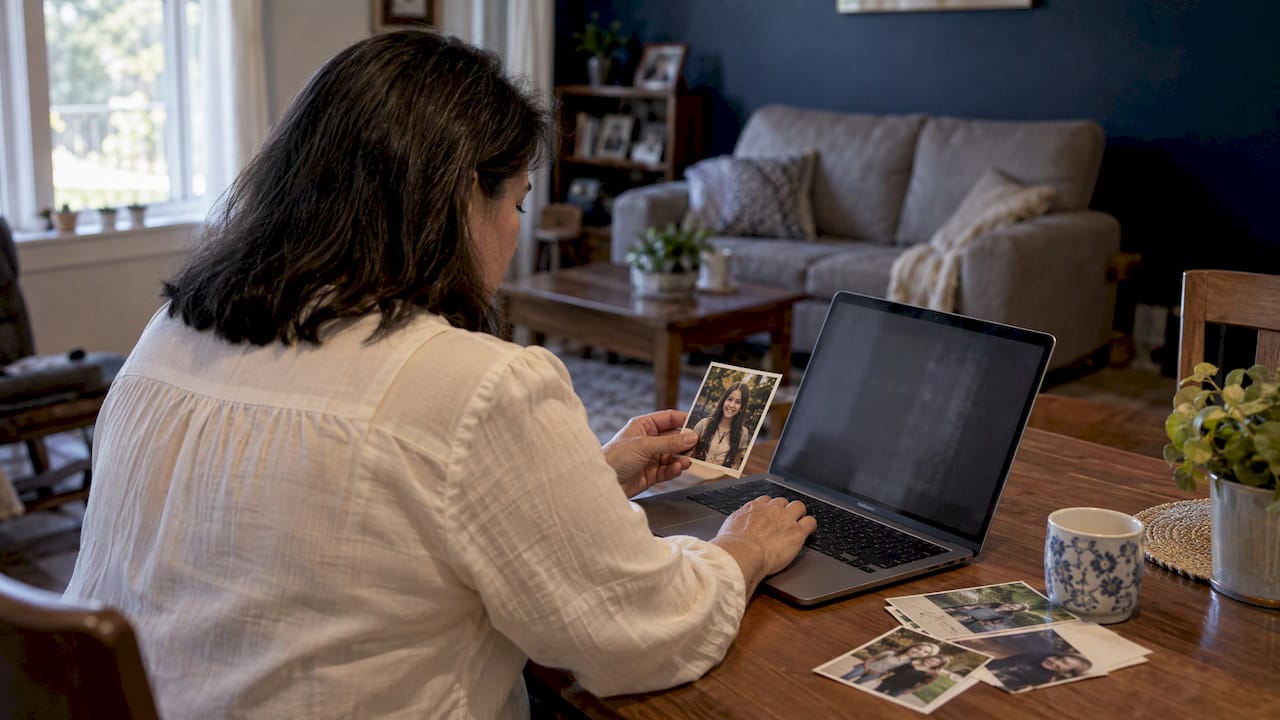
A virtual memorial for a murder victim is a dedicated online page where family and friends share the person’s life story, photos, videos, dates and tributes in one place. A good one does two jobs. It shows who the person was, and it keeps their name in front of people who may know something. Below you will find what to include, how to protect the family, how to handle facts about an open case, and how to link the tribute to the case itself. We built this guide for families, volunteers, advocates and students who work with unsolved cases every day.
TL;DR
- Build the memorial around who the person was: roles, hobbies, favorite things and stories. Facts about the death come second.
- Get the next of kin’s permission, then choose privacy settings (public, link-only or invitation-only) and turn on comment approval before you share the page.
- Label confirmed facts with a source and a date. Never name suspects or motives unless authorities or a court have.
- If the case is unsolved, pair the tribute with a case profile so the page serves the family and the investigation.
- Support for the family is a phone call away: VictimConnect is 855-484-2846, 24/7.
Table of Contents
- What a virtual memorial for a murder victim can be
- Step 1: Decide who owns the page and get permission
- Step 2: Build the tribute around who they were
- Step 3: Handle facts about an open case carefully
- Step 4: Set privacy before you share the link
- Step 5: Moderate messages with care
- Step 6: Keep the memorial connected to the case
- Step 7: Support the people behind the page
- Our perspective
- How membership helps
- A quick checklist before you publish
- FAQ
- Sources
What a virtual memorial for a murder victim can be
There is no single format. A virtual memorial can be a private family page, a public tribute site, a social media group, a livestreamed service or a crowd-built archive. What they share is a permanent, shareable place where people can visit at any hour.
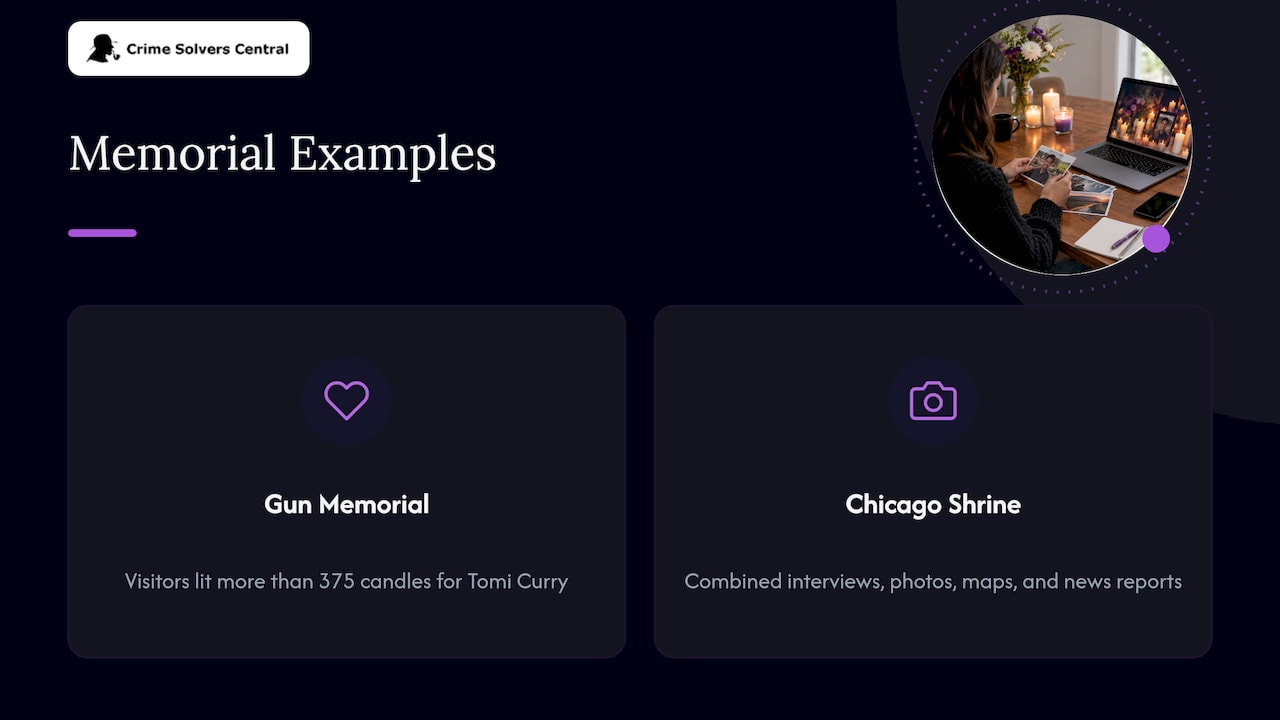
Two well-documented examples show the range. The National Gun Violence Memorial was created by Northwestern computer science professor Steve Tarzia after the December 2015 San Bernardino shooting. Volunteers build a page for each U.S. gun-violence victim with name, age, when, where and how the person died, links to news stories, and photos drawn from obituaries and social media. Visitors can anonymously add words, light virtual candles and post in forums. One victim, Tomi Curry, had more than 375 candles lit.
The second example is older. In 2012, PBS FRONTLINE described an interactive digital shrine site for victims of urban violence in Chicago, built by Kartemquin Films. It combined video interviews with loved ones, photos, maps of where people were killed and news reports. Anton Seals, the project’s outreach coordinator, said people usually forget that victims had lives and were humans, not just victims. That idea should guide every choice you make.
Common features
Most memorial pages draw on the same toolkit:
- A life story or biography
- Photo and video galleries
- A guestbook or memory wall for written tributes
- Virtual candles
- Service details and livestream links
- Privacy controls for who can view and who can contribute
You do not need all of them. A small, well-written page with ten strong photos and a clear biography will do more for the family than a sprawling site nobody maintains.
Step 1: Decide who owns the page and get permission
Before anything goes online, decide who speaks for the family. In a homicide, that is usually the next of kin: a parent, spouse, adult child or sibling. Volunteers, friends, advocates and community groups should ask first.
This is not a formality. Families are often dealing with detectives, reporters and funeral costs at the same time. The National Memorial & Visitor Resource Center’s media guidelines for homicide survivors say it is up to the family to decide whether they want media coverage of wakes, funerals or memorial events. A Victim Service Professional can communicate those wishes and help arrange security to protect the family’s privacy. A public page is a kind of media, so the same principle applies.
The Bureau of Indian Affairs follows this approach in its own work. On its Missing and Murdered Cases page it says it publishes only cases that next of kin and families have authorized.
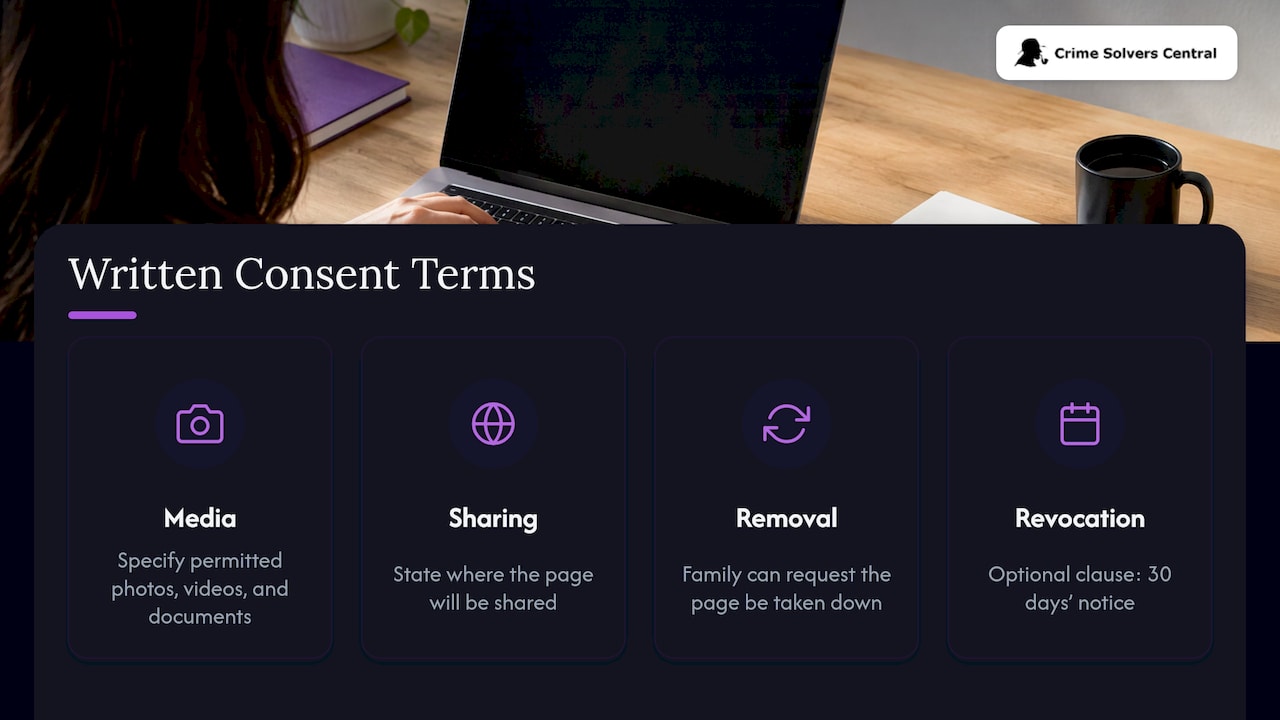
If you are a volunteer or advocate, get the family’s consent in writing. A short written release from the next of kin should say which photos, videos and documents you may use, where the page will be shared, and that the family can ask you to take it down. One practical guide suggests a sample clause allowing revocation on 30 days’ notice.
Step 2: Build the tribute around who they were
The strongest memorials do not read like crime reports. The NMVRC guidelines advise families to portray the victim’s roles (grandparent, parent, sibling), personal and professional accomplishments, hobbies, faith affiliations, favorite music, food or quotation, along with personal anecdotes that show what was lost. It also suggests curated photos of the victim alone or with family.
In practice, that means:
- Open with a portrait, not an event. Start with a sentence a friend would say: what made them laugh, what they were known for.
- Choose photos on purpose. Pick images that show the person living their life: at work, at a birthday, with their dog. Avoid crime scene images and anything graphic.
- Collect short stories. Ask a favorite teacher, coach, mentor or coworker for two or three sentences. The NMVRC notes a Victim Service Professional can help identify such a person.
- Add a timeline of their life. Birthdays, graduations, jobs and milestones give visitors something to hold on to.
- Put the case details in a separate, clearly marked section. Date, location and the investigating agency belong there, with a way to contact it.
Step 3: Handle facts about an open case carefully
Murder cases are often unsolved or still moving through the courts. A memorial that gets a fact wrong can hurt the family, mislead the public or complicate a prosecution.
A few rules keep you safe:
- Label what is confirmed. One guide recommends wording such as “Authorities released the following information on [DATE]. Further details remain under investigation”.
- Do not name suspects or motives unless they are legally verified. That guide also advises talking to legal counsel about active investigations, so nothing you publish could affect a prosecution, defame someone or violate a gag order.
- Link to the source. If you cite a news story or a police release, link it and date it.
- Check recordings. In the U.S., some states require all-party consent for recordings and others allow one-party consent, so ask before posting audio or video of calls or conversations.
If you are unsure what can be said, ask the detective assigned to the case. If a lawyer represents the family, ask the lawyer before publishing anything about the investigation.
Step 4: Set privacy before you share the link
A memorial can be seen by far more people than the family intended. Decide the settings first.
The key choice is who can see the page. One funeral-planning guide advises families to decide up front whether the page is public, link-only or invitation-only. Another suggests separating three questions: who can view the board, who can contribute, and whether it can be found through search. It also recommends publishing the least sensitive version first, because personal details are much harder to pull back once they have been copied, screenshotted or forwarded.
Here is how that plays out in the two situations we see most:
| Situation | Suggested setting | Why |
|---|---|---|
| Recent death, family grieving, case active | Invitation-only or link-only, comments approved first | Protects the family from strangers and speculation |
| Cold case, family wants public tips | Public page with moderated comments and a tip line for law enforcement | Reach matters, and the investigating agency receives tips |
| Anniversary or vigil | Public page for a set period, then review | Gives people a place to gather without leaving it open forever |
Minors need extra care. Leave out the names and photos of children connected to the case unless a parent or guardian has agreed.
Step 5: Moderate messages with care
A public guestbook invites kindness and also theories, anger and cruelty. Plan for it on day one.
A workable plan has five parts:
- Approve comments before they appear. One guide says to turn on comment approval early.
- Write simple rules. Comments should be respectful, relevant and non-invasive. Leave out speculation about cause of death, graphic details, family conflict and anything involving minors.
- Name a moderator. Appoint one person so the closest mourners do not absorb every notification.
- Create a private channel. Sensitive messages that do not belong on the public wall can go to a private inbox. Decide, too, whether the page closes to new posts after a set time, as Evaheld’s moderation workflow suggests.
- Respond gently. If a post is borderline, message the person first. FuneralQuestions.net notes that hiding the specific post, rather than blocking the person, is usually enough, and that restricting access is a last resort for genuine harassment.
Families often hesitate to moderate for fear of seeming ungrateful. A line such as “Comments are moderated with care” gives you permission to remove harmful content without a fight.
Step 6: Keep the memorial connected to the case
For a family with an unsolved homicide, a memorial that only honors is half the job. Visitors who knew the person may also know something: a name, a date, a rumor they never reported. The memorial can invite them to come forward, as long as the invitation goes to the right place.
On the memorial page, include:
- The investigating agency’s name, case number if the agency allows it, and its tip line
- A short, factual summary of what is publicly known, dated
- A line telling visitors to send information to investigators and not to post it in comments
This is where a case database becomes useful. Crime Solvers Central holds a national database of over 264,913 cold cases (missing persons, unsolved homicides and unidentified remains), organized by state and type. If your loved one’s case is not easy to find, our guide to the murder victim database shows how to search NamUs, ViCAP and community leads. If you are working through the first steps after a disappearance or killing, the family action guide walks you through them.
For memorial events, a flyer helps. Our flyer builder lets you print missing persons flyers and other documents, and a vigil or anniversary flyer can carry the same photo and tip line as the page.
Step 7: Support the people behind the page
The page is for the person. The family is the reason it exists, and they need support too.
If you are a friend or volunteer, the California Catholic Conference’s pastoral guide counsels supporters to meet them where they’re at. It adds that victims’ families may feel isolated, frustrated with the lack of information, angry with the system, or helpless. Do not rush them toward closure. Offer to handle the practical parts of the memorial, such as moderation, uploading photos and answering messages.
What do you say to a parent whose son was murdered? Say the person’s name. Share a specific memory if you have one. The NMVRC guidance on focusing on who he was applies here too: stories that show his character are often welcome. Avoid asking about the investigation or offering theories.
Trauma lingers in the body and memory long after the funeral. Therapists describe how traumatic memories are processed and treated, which can help family members understand why anniversaries or certain photos hit so hard. If children are grieving, this guide on helping a child after a traumatic event explains how to talk with them.
Where to find victim assistance
These are national resources listed by U.S. government and agency pages:
- VictimConnect: 855-484-2846, 24/7, English and Spanish, with interpretation in more than 200 languages via 711, listed by the Office for Victims of Crime. That page also notes that state crime victim compensation programs may help offset funeral, mental health and medical expenses. Ohio’s program is the example it describes, so check your own state’s rules.
- Homicide survivor groups: the U.S. Attorney’s Office for the District of Columbia lists Parents of Murdered Children at (513) 721-5683, Compassionate Friends at 877-969-0010, and Homicide Survivors National Resources, which has a resource listing for each state. It also lists the 988 crisis line.
- County victim-witness advocates: the New Jersey Office of Attorney General explains that county victim-witness staff are trained to help with the initial shock of a crime, can help find a counselor, and that several counties sponsor homicide survivor support groups. Most states have a similar office through the prosecutor’s office.
If you or someone you love is in crisis, call or text 988.
Our perspective
We see the same thing in every cold case: the victim becomes a file number. A virtual memorial pushes back against that. It puts a face, a laugh and a life story where a case summary would otherwise sit.
We built Crime Solvers Central around that idea. Our database holds more than 264,913 cases, sorted by state and situation, because a case that can be found is a case that can be worked. Members can open full case details, sources and videos, join forums, use digital evidence boards, and coordinate with volunteers. Our tools, including A.I. image progression and the flyer builder, are designed to keep a name in circulation.
A memorial and a case profile do different jobs, and together they do more. The memorial tells people who this person was. The case profile tells them what happened, where to send information, and who is still looking. Families who want both should start with the memorial the family controls, then make sure the case is easy to find.
Crime
How membership helps
The case information, forums and tools are available through membership. Plans on our pricing page are:
| Plan | Monthly | Yearly |
|---|---|---|
| Jr. Detective | $3.97 | $39 |
| Sr. Detective | $9.97 | $99 |
| True Crime Influencer | $39.97 | $399 |
Members get full case details, sources, videos, forums, digital evidence boards, the flyer builder, A.I. image tools and volunteer coordination. If you are building a memorial for someone whose case is unsolved, a membership puts those tools and a community of people who care about the case in one place. You can start by browsing the free cold case database by state to see how a case profile is laid out.
A quick checklist before you publish
- The next of kin has given permission, in writing if you are not family.
- The page opens with who the person was, not how they died.
- Every fact about the case has a source and a date.
- No suspects, motives, graphic images or minors’ details appear.
- Privacy settings are chosen and comment approval is on.
- One person is named as moderator.
- The investigating agency’s tip line is on the page.
- The family knows how to reach support if the page brings up hard days.
Revisit the page on anniversaries and after any news in the case. A memorial that is kept current tells visitors that the person is still remembered and the case is still open.
FAQ
Can I create a memorial for a murder victim if I am not family?
Yes, but ask the next of kin first and follow their wishes on photos, wording and privacy. Many families welcome help from friends and volunteers, especially with moderation and sharing. If the family says no, respect that and consider a private tribute for your own circle.
What should I avoid putting on a memorial page?
Leave out graphic images, speculation about the cause of death, the names of suspects unless they are legally verified, and details about minors. Do not post anything that could affect an active investigation. If you are not sure, ask the investigating agency or a lawyer before you publish.
Should the memorial be public or private?
That depends on the family’s goals. A recent death with an active case often calls for a link-only or invitation-only page. A cold case where the family wants tips may benefit from a public page with moderated comments and a clear tip line for law enforcement.
How do I help a grieving family through a memorial?
Offer to take on practical tasks, such as moderating comments and uploading photos, and let the family set the pace. Share specific, kind memories of the person. Point them to VictimConnect at 855-484-2846 or a homicide survivor support group when they are ready.
Can a memorial help solve a cold case?
It can help keep the case visible and bring forward people who knew the victim. Include the investigating agency’s tip line and ask visitors to send information there, not in the comments. Pairing the memorial with a case profile makes the case easier to find.
Sources
- A Crowdsourced Internet Memorial Humanizes U.S. Gun Violence Victims
- A Digital Memorial For Victims of Violence, PBS FRONTLINE
- Media Guidelines for Homicide Family Survivors, NMVRC
- Missing and Murdered Cases, Indian Affairs
- Online Memorial Websites: How They Work, What to Include, and Privacy Tips
- Create a collaborative online memorial board
- How to Moderate an Online Memorial Page Respectfully
- Pastoral Support for Grieving a Violent Death
- Support for the Victims of the Shooting in Dayton, OVC
- District of Columbia Resources, U.S. Attorney’s Office
- Victim Resources, New Jersey Office of Attorney General
- Traumatic Memories and Treatment
- How to Help a Child After a Traumatic Event