

Search 264,913 Unsolved Murders by State for Researchers

Unsolved murders by state are cataloged across three types of sources: official state and county law enforcement portals, federal databases like the FBI’s Uniform Crime Reports and NAMUS, and specialized platforms such as the Murder Accountability Project and Crime Solvers Central. Start with a state portal or Crime Solvers Central’s searchable database to locate a specific case file, then cross-reference NAMUS or the Murder Accountability Project for supporting documents, patterns, or tip-submission details.
TL;DR:
- Unsolved homicide data varies greatly between states, with some only listing recent or high-profile cases on official portals, making cross-reference essential.
- Federal databases like NAMUS and the Murder Accountability Project complement state records by providing case-specific details and analysis of solve rates across jurisdictions.
- Clearance rates differ significantly by department and are influenced by staffing, forensic capacity, and reporting practices, with current national rates around 61% in 2024.
- When researching cases, verify legitimacy by checking if a case page is hosted by law enforcement or reputable sources, and avoid unverified rumors or social media claims.
- Submitting detailed, factual tips through official anonymous channels can be more effective in advancing investigations than vague or secondhand information.
Table of Contents
- State-by-State Unsolved Murder Lists and Portals
- The National Databases Worth Knowing
- How to Search State and National Databases the Right Way
- What Clearance Rates Actually Tell You
- How Notable Cold Cases Get Documented
- Submitting Tips and Supporting Families Responsibly
- A Note From Crime on What This Database Represents
- Search the Cold Case Database by State
- Sources
- FAQ
State-by-State Unsolved Murder Lists and Portals
Every state handles cold-case records differently, but three patterns show up almost everywhere. State police departments and attorneys general offices maintain cold-case pages, usually with a searchable list or PDF roster. County sheriff’s offices publish their own case rosters, often more current than the state-level page because county detectives work the files directly. Nonprofit compilations fill the gaps state sites leave open, though not every nonprofit source carries the same reliability.
Finding a state’s official portal usually means searching a pattern like “[state] attorney general cold case unit” or “[state] state police unsolved homicide list.” Expect PDFs, searchable web tables, or press-release archives rather than a unified database.
Most usable state records include:
- Victim name, age, and last known location
- Date and approximate time of the incident
- Case or file number for referencing with investigators
- A dedicated tip line or email address
Coverage varies wildly. Some states post decades of case summaries; others limit public listings to a handful of high-profile files. That inconsistency is exactly why pairing a state search with a centralized database like Crime Solvers Central’s cold case search engine tends to save researchers hours of digging across scattered county sites.
The National Databases Worth Knowing
Three federal and nonprofit resources anchor most serious cold-case research, and each one answers a different question.
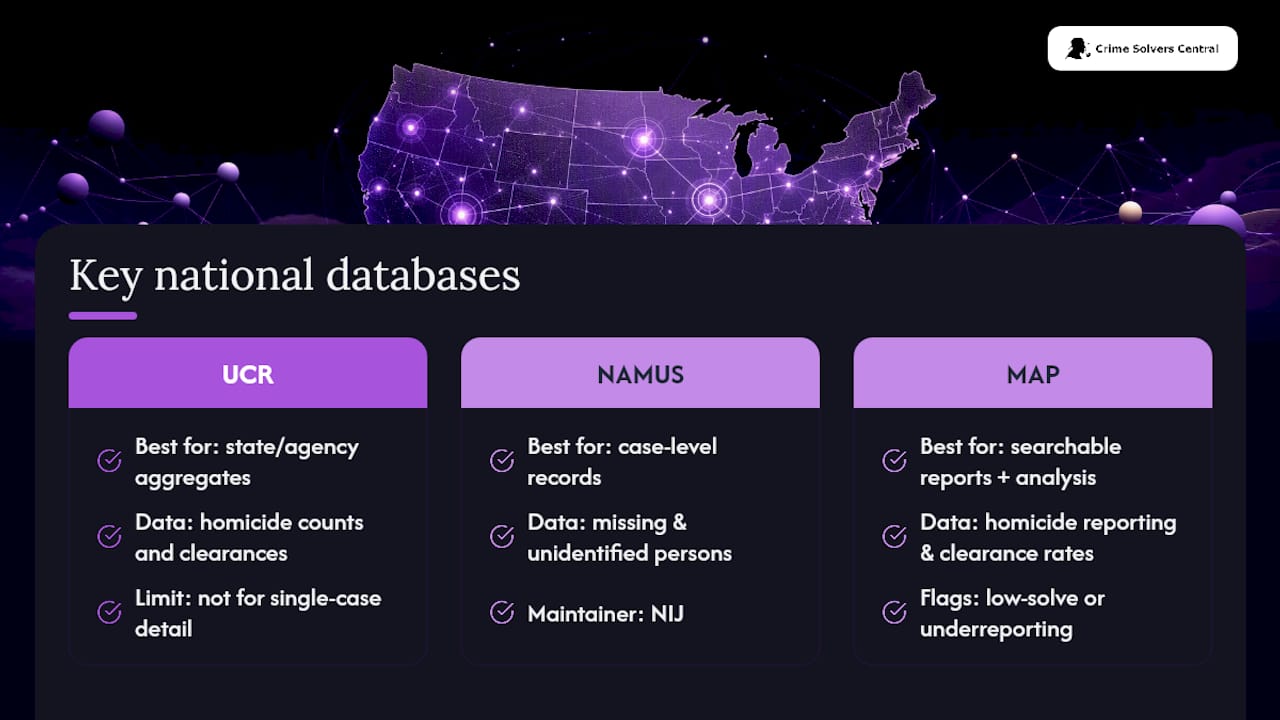
The FBI Uniform Crime Reports (UCR) aggregate homicide counts and clearance rates by state and agency. It’s the right tool when you need to compare how one state’s unsolved homicide rate stacks up against another, not when you need details on a single case.
NAMUS (National Missing and Unidentified Persons System) works at the case level. Maintained by the National Institute of Justice, it houses records for missing and unidentified persons, many of which connect directly to open homicide investigations.
The Murder Accountability Project fills a gap the others don’t: searchable homicide reporting paired with clearance-rate analysis that flags jurisdictions with unusually low solve rates or spotty federal reporting.
Fast fact: the Murder Accountability Project has documented wide, state-by-state gaps in how consistently homicides even get reported to federal systems in the first place, which means two states’ “official” numbers aren’t always measuring the same thing.
Use state portals for the narrative and local detail, then run the same case name or region through NAMUS and MAP to see if it surfaces elsewhere.
How to Search State and National Databases the Right Way
Jumping straight to a Google search wastes time. A tighter process gets you further, faster.
- Identify the correct jurisdiction first. A case might sit with a city police department, a county sheriff, or a state bureau of investigation, and searching the wrong one is the most common dead end.
- Search by case name, date range, or keyword in the state portal or in Crime Solvers Central’s database, which organizes records by state and case type.
- Cross-reference NAMUS and the Murder Accountability Project for the same name, location, or timeframe to pull additional documents or spot patterns in similar unsolved cases nearby.
- Document everything methodically. Note the source URL, the date accessed, and the exact case number, since state pages get reorganized without warning.
Pro Tip: Save a screenshot or PDF of any case page you cite. State agencies periodically restructure their sites, and cached versions of case listings can vanish overnight.
If you’re contacting investigators with a lead, stick to observable facts. Speculation about a suspect, dates you’re not certain of, or secondhand rumors do more harm than good in a tip.
What Clearance Rates Actually Tell You
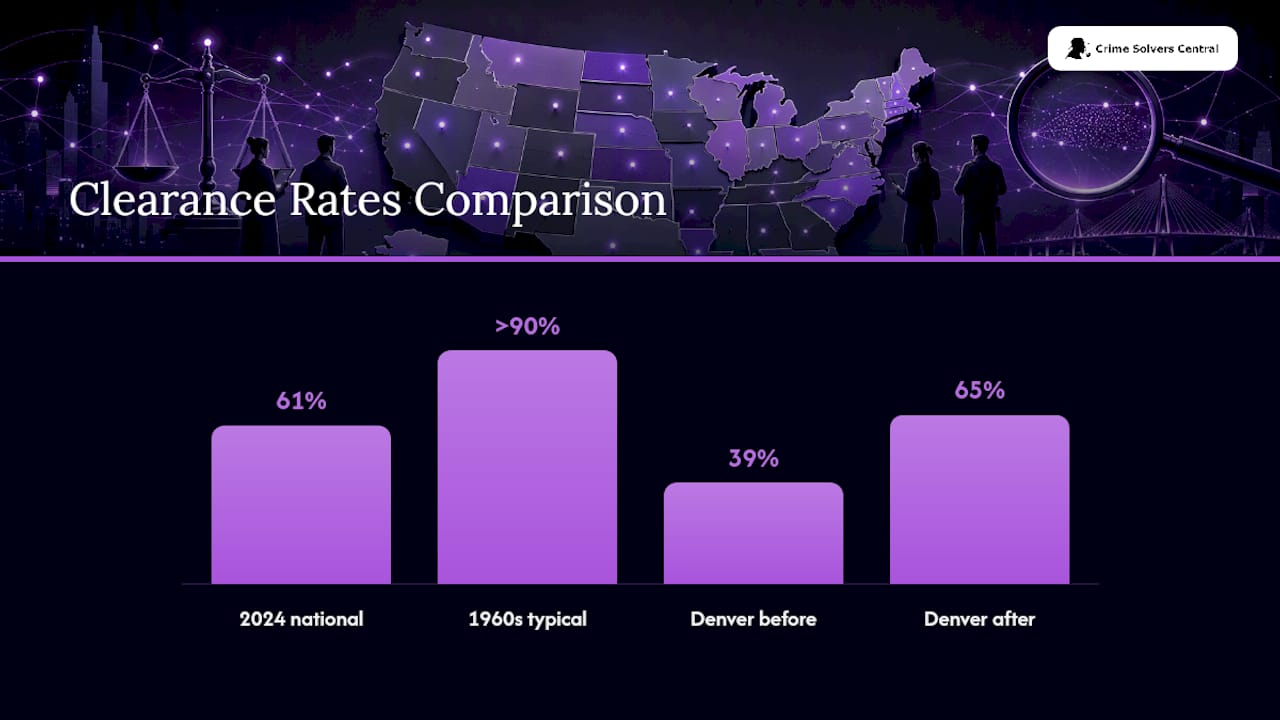
A clearance rate measures the share of reported homicides that end in an arrest or are otherwise closed by the reporting agency, not necessarily a conviction. National clearance rates climbed toward 61% in 2024, but that’s still far below the rates agencies posted in the 1960s, when solve rates commonly exceeded 90%.
The gap between states isn’t random. A few forces drive it consistently:
- Staffing and forensic lab capacity, which vary enormously by department size
- Inconsistent reporting practices, since not every agency submits complete data to federal systems
- Case backlog and how quickly detectives can respond while evidence is fresh
Statistic worth sitting with: targeted investment can move the needle fast. Denver’s specialized non-fatal shootings unit raised its clearance rate from 39% to 65% after the department dedicated resources specifically to that case type.
Treat any single state’s clearance rate as a starting point, not a verdict. Reporting inconsistencies mean two states with identical numbers might be measuring very different realities on the ground.
How Notable Cold Cases Get Documented
High-profile unsolved cases, from decades-old disappearances to homicides that made national headlines, follow a fairly consistent documentation pattern once you know what to look for. A complete case profile usually includes a timeline of events, a summary of physical evidence, notes on witness statements, and direct contact information for the investigating agency.
When you land on a case page anywhere online, check for a few signals of legitimacy:
- Is the page hosted by a law enforcement agency, a known nonprofit, or a database with visible sourcing?
- Does it name an actual detective, unit, or tip line rather than just a generic “contact us” form?
- Does the information match what’s listed on the state’s own portal or in NAMUS?
Rumor forums and unmoderated social media threads spread outdated or flatly wrong details constantly. If a claim about a case can’t be traced back to a law enforcement source or a credible database, treat it as unverified.
Submitting Tips and Supporting Families Responsibly
Investigators need specifics: dates, names, locations, and how you know what you know. Vague tips rarely go anywhere.
- Most state and local agencies offer anonymous tip lines, separate from any direct outreach to detectives.
- Avoid contacting persons connected to a case directly. That can compromise an active investigation.
- Support beyond tips matters too: fundraising for reward funds, filing public records requests, or contacting elected officials about cold-case unit funding all push cases forward.
Pro Tip: If you’re unsure whether information is relevant, submit it anyway through an official channel. Investigators would rather sort through extra tips than miss the one that matters.
A Note From Crime on What This Database Represents
Crimesolverscentral organizes more than 264,913 cases by state and situation, built specifically so families and researchers aren’t stuck piecing together scattered county sites. Community tips and cross-referencing have, in coordinated cases, surfaced leads investigators didn’t have on file. Every case here represents a family still waiting, and that reality shapes how this platform is built and moderated.
— Crime
Search the Cold Case Database by State
Scattered county rosters and inconsistent state portals are the biggest obstacle to researching unsolved murders by state, and that’s the exact gap Crimesolverscentral was built to close. Instead of hunting through a dozen separate agency websites, you get one searchable, state-organized database covering missing persons, unsolved homicides, and unidentified remains in a single place. Members can access additional case details, digital evidence boards, forums, and tools for building flyers or submitting tips, provided alongside the public records. Pair it with NAMUS or the Murder Accountability Project for federal cross-referencing, and Crimesolverscentral becomes the fastest route to a complete picture. Search the Cold Case Database by State now to find a case, review its file, or join as a member to support ongoing investigations.
Sources
- FBI Uniform Crime Reports (UCR)
- NAMUS (National Missing and Unidentified Persons System)
- Murder Accountability Project
- The Case to Improve Clearance Rates | Third Way
FAQ
What state has the most unsolved murders?
No single, universally agreed ranking exists because states report homicide data inconsistently to federal systems, a gap the Murder Accountability Project has documented extensively. Comparing raw case counts is less reliable than comparing clearance rates within the FBI’s UCR data, which at least standardizes how “cleared” is defined.
What city has the highest rate of unsolved murders?
Clearance rates vary significantly by city and department size, and smaller or underfunded departments often post lower rates than large metro forces with dedicated cold-case units. Denver’s experience shows how much investment alone can shift the numbers, moving clearance from 39% to 65% after adding a specialized unit.
What are the most famous unsolved murders in the US?
Famous unsolved cases span decades and states, and most maintain documented profiles through state cold-case units, NAMUS, or specialized databases like Crimesolverscentral. Rather than relying on rumor sites, verify any case detail against the agency’s own listing or a sourced database entry.
What are the top 10 deadliest states?
Homicide rates and unsolved-case counts don’t always track together, and reporting gaps make a clean top-ten list unreliable without noting each state’s data-completeness caveats. The FBI UCR publishes the closest thing to an official comparison, though researchers should read state figures alongside Murder Accountability Project notes on reporting consistency before drawing conclusions.