

37% of Murders Remain Unsolved: How Families and Researchers Can Act
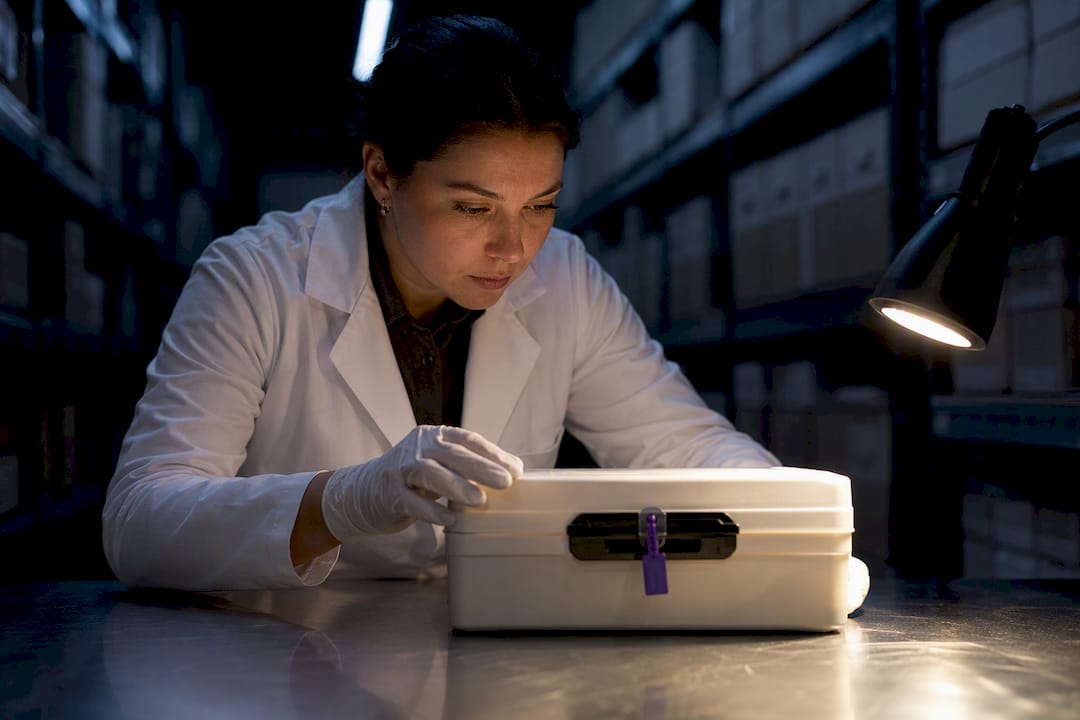
Unsolved murders, more precisely called unresolved or cold cases, are homicide investigations where no suspect has been identified, charged, or convicted. A significant portion of U.S. homicides fit this description in an average year. This guide covers notable examples, the real statistics behind clearance rates, why cases stall, how breakthroughs actually happen, and where families and researchers can search records or submit tips.
TL;DR:
- The national homicide clearance rate averages around 63 percent, meaning nearly 37 percent of murders go unresolved each year.
- Cold cases often stall due to degraded evidence, early investigative errors, witness silence, jurisdictional issues, or limited resources.
- Breakthroughs mainly occur through forensic DNA genealogy, new tips, or media pressure, but legal and privacy limits can slow progress.
- Most unresolved cases remain accessible for review or new testing, especially since homicide has no federal statute of limitations, allowing decades-long investigations.
- Public databases like NamUs and ViCAP, along with official agency channels, help families and researchers search for truth and submit tips, but cannot replace formal legal action.
Table of Contents
- Notable Unsolved Murders and Their Current Status
- How Common Are Unresolved Homicides? The Real Numbers
- Why So Many Homicide Cases Stay Unsolved
- How Cold Cases Actually Get Reopened and Solved
- Where to Search Records and Submit Tips
- The Toll Unsolved Cases Take on Families and Communities
- How Investigative Techniques Have Changed Over Time
- Why Forensic Evidence Degrades and Complicates Cold Cases
- Legal and Ethical Questions When Cases Reopen
- Patterns Among Serial Offenders in Unsolved Cases
- Crime Solvers Central’s Role in Supporting Unresolved Cases
- Publisher Perspective: What a National Case Database Can and Can’t Do
- Sources
- FAQ
Notable Unsolved Murders and Their Current Status
Some cases stay in public memory for decades because the crime was brutal, the victim was prominent, or a piece of evidence teases a resolution that never comes. A few of the most cited examples, drawn from public lists of murders and widely reported coverage:
- The Black Dahlia (1947): Elizabeth Short’s murder in Los Angeles remains one of the most examined unsolved homicides in American history, with dozens of self-proclaimed suspects and no forensic resolution.
- The Zodiac Killer (1968–1969, California): A serial killer who taunted police with ciphers; one cipher was decoded in 2020, but the killer’s identity is still officially unconfirmed.
- JonBenét Ramsey (1996, Colorado): A six-year-old found dead in her family’s basement; DNA evidence exists but has never matched a suspect.
- The Long Island Serial Killer / “Gilgo Beach” case (discovered 2010–2011): Multiple victims found along Ocean Parkway; an arrest was made in 2023, though additional victims tied to the area remain unresolved.
- Tupac Shakur (1996, Las Vegas): One arrest occurred in 2023 nearly three decades later, showing how “cold” rarely means closed.
- The Boy in the Box (1957, Philadelphia): The child victim was identified through DNA and genealogy in 2022, though his killer is still unknown.
- Jack the Ripper (1888, London): Not a U.S. case, but the namesake for the entire genre of unsolved-murder speculation.
Status varies widely. Some, like the Boy in the Box, get partial resolution through victim identification even without an arrest. Others sit untouched for lack of new evidence.
How Common Are Unresolved Homicides? The Real Numbers
The national homicide clearance rate averaged about 63% between 1990 and 2019, according to a multi-state study of clearance rates. That means roughly 37 out of every 100 homicides during that period never resulted in an identified, arrested suspect.
Clearance rate measures whether a case was closed by arrest or “exceptional means” (the suspect died, fled prosecution, or was otherwise unavailable), not whether anyone was convicted. A cleared case and a solved case are not always the same thing.
The state-by-state spread is wide. A few caveats matter for anyone trying to use these numbers:
- No single federal database tracks every unresolved case nationwide in real time.
- Agencies define “cold case” differently. Some use a 12-month threshold; others wait years.
- Clearance statistics can undercount because “exceptional means” closures sometimes mask cases where no one was ever formally charged.
If you want a deeper statistical breakdown, Crime Solvers Central’s guide to homicide statistics walks through how analysts interpret these figures by state and year.
Why So Many Homicide Cases Stay Unsolved
Cases don’t go cold for one reason. They go cold because several things fail at once, often in the first 48 to 72 hours after a killing.
- Degraded or missing physical evidence. Older cases predate modern DNA collection standards, and some files were stored poorly or lost during agency transitions.
- Early investigative mistakes. A rushed scene, a missed witness, or a wrong initial theory can send detectives down the wrong path for years.
- Witness silence or death. Fear of retaliation, distrust of police, or witnesses passing away before they talk all remove critical leads permanently.
- Jurisdictional handoffs. Cases crossing county or state lines sometimes fall between agencies with no clear owner.
- Resource constraints. Understaffed departments triage active threats over decades-old files, and under-resourced jurisdictions, including many serving Indigenous communities, see disproportionately lower clearance rates.
Pro Tip: If you’re a family member of a victim, keep a dated log of every conversation with investigators, including names and case numbers. Departments rotate detectives, and a written record often becomes the only continuity across a case that outlives multiple assigned officers.
How Cold Cases Actually Get Reopened and Solved
Breakthroughs rarely come from a single dramatic clue. The NIJ’s cold-case guidance identifies three recurring triggers: family or media pressure that keeps a case visible, new forensic technology applied to old evidence, and information surfacing from an unrelated investigation.
Forensic genetic genealogy, which combines DNA profiling with public genealogy databases, has become the single biggest driver of recent breakthroughs, identifying both victims and suspects in cases decades old. It comes with legal limits: genealogy matches are leads, not standalone probable cause, and many departments require a confirmatory DNA sample before an arrest. Traditional DNA retesting, new witness statements, jailhouse confessions, and true-crime media coverage all continue to generate tips that reopen files, as reporting on family experiences with cold cases has documented repeatedly.
Detectives typically hold onto cold-case files indefinitely. A case rarely “closes” in the administrative sense; it waits until an arrest, a positive identification, or a confirmed processing outcome gives it somewhere to go.
Homicide carries no federal statute of limitations, and most states follow the same rule, so a case from 1985 can still result in prosecution today. If you want to formally request a file review:
- Contact the original investigating agency and ask for the assigned detective or cold-case unit, not the general tip line.
- Request a written case status update citing the relevant case file review provisions that govern agency review timelines.
- Ask specifically whether physical evidence still exists and is eligible for updated DNA testing.
- If the agency stalls, escalate to the state attorney general’s office or a victim advocacy liaison.
- Consider whether forensic genetic genealogy applies to your case type and ask if the lab has capacity for it.
Where to Search Records and Submit Tips
Three official systems anchors most legitimate cold-case research. NamUs (the National Missing and Unidentified Persons System) is a public, searchable database covering missing persons and unidentified remains, useful when a homicide victim was never formally identified. ViCAP, the FBI’s Violent Criminal Apprehension Program, is a behavior-based database that links violent crimes across jurisdictions by comparing offender patterns, and it supported the FBI’s Highway Serial Killer initiative. State and local police departments maintain their own unsolved-homicide pages listing active cases with tip-submission forms.
| Resource | What it covers | How to use it |
|---|---|---|
| NamUs | Missing persons, unidentified/unclaimed remains | Search by state, physical description, or case number online |
| ViCAP | Violent crime pattern-linking across agencies | Submitted by law enforcement; public tips route through local police |
| State cold-case pages | Active unsolved homicides by state | Search by county, submit anonymous online tips |
When you submit a tip, include specifics: dates, names, locations, and how you know the information. Anonymous submission options exist through most state tip lines, and you don’t need to identify yourself to be taken seriously. If a case sits stalled for years with no response, contacting the local prosecutor’s office or an oversight body is a reasonable next step.
Be cautious of anyone requesting money to “unlock” case information or promising private access to sealed police files. Legitimate victim-service nonprofits and community collaboration efforts never charge families for basic case searches.
The Toll Unsolved Cases Take on Families and Communities
Grief without resolution behaves differently than grief with an answer. Families of unsolved-murder victims frequently describe a suspended state, unable to fully mourn because the investigation is technically still open, yet unable to move forward because no one has been held accountable.
That uncertainty compounds over time. Anniversaries, media anniversaries stories, and even casual conversations can reopen trauma years or decades later. Some families report strained relationships with law enforcement, especially when communication drops off after the first year, a pattern that has helped drive the shift toward calling these “unresolved” rather than “cold,” since the latter term can unintentionally suggest investigative abandonment.
Communities carry a parallel burden. A string of unsolved homicides in one area, particularly among marginalized or under-resourced populations, erodes trust in police and can suppress future witness cooperation, since residents see little payoff for coming forward. That erosion becomes self-reinforcing: fewer tips lead to fewer clearances, which further discourages tips. Breaking that cycle usually requires sustained, visible follow-up from investigators rather than a single case reopening.
How Investigative Techniques Have Changed Over Time
Homicide investigation in the 1970s and 1980s relied heavily on witness interviews, informants, and physical matching like fingerprints and blood typing, methods that left enormous room for error and missed connections between related crimes. Detectives often worked cases in isolation, with little cross-jurisdictional communication.
The 1990s introduced two major shifts: computerized case databases and the early rollout of DNA profiling. ViCAP, launched in the 1980s, matured into a genuine pattern-recognition tool during this period, letting analysts flag similar offender behaviors across states that a single department would never have connected on its own.
Today’s cold-case units, as outlined in NIJ’s best-practices guidance, operate more like triage centers than single-detective assignments. They prioritize files using solvability factors: does physical evidence still exist, is there potential for new witnesses, and does new forensic technology apply. That prioritization model is a direct response to decades of departments treating every cold case with equal (and often minimal) attention. The result isn’t more detectives working more hours; it’s smarter allocation of the hours available.
Why Forensic Evidence Degrades and Complicates Cold Cases
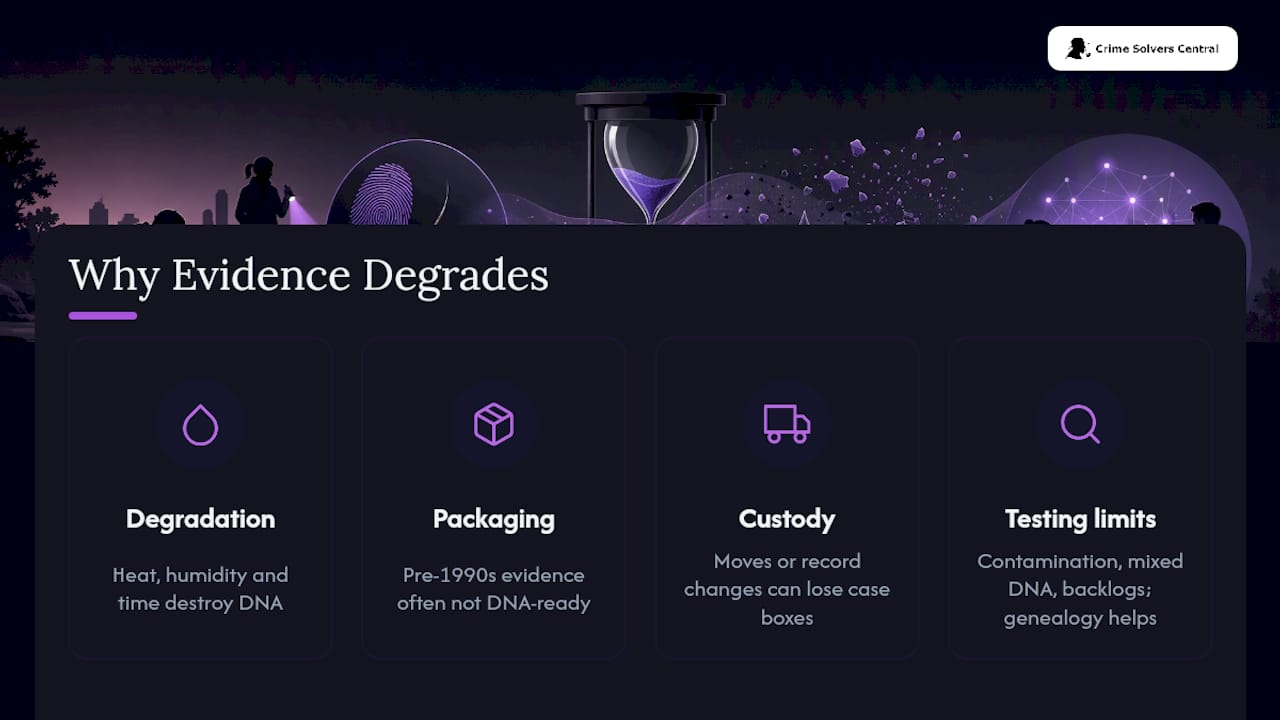
Physical evidence has a shelf life, and older cases routinely run into it. Biological samples degrade with heat, humidity, and time, sometimes to the point where DNA extraction becomes impossible even with modern lab equipment. Evidence collected before the 1990s often wasn’t packaged with future DNA testing in mind at all, since the technology didn’t yet exist in usable form.
Chain-of-custody problems compound the issue. Agencies that changed evidence storage systems, moved facilities, or digitized records incompletely sometimes cannot locate physical evidence that technically still exists somewhere in a warehouse. A few departments have lost entire case boxes during building relocations, a mundane but devastating failure mode that has nothing to do with the crime itself.
Even when evidence survives intact, testing has limits. Contamination from decades of handling, mixed DNA profiles from multiple contributors, and degraded sample quantities can produce results too ambiguous for a match. Labs also face backlogs, meaning even a well-preserved sample might wait months or years for processing. Forensic genetic genealogy has pushed past some of these barriers by working with smaller, more degraded DNA fragments than older testing methods required, but it isn’t a universal fix, and it still depends on a decent starting sample.
Legal and Ethical Questions When Cases Reopen
Reopening a cold case isn’t purely a forensic decision. Prosecutors have to weigh whether newly developed evidence would actually hold up in court, especially when a case relies on genetic genealogy leads that identify a person of interest but don’t yet meet the evidentiary bar for an arrest.
Genetic genealogy raises its own set of ethical questions. Investigators using public genealogy databases to identify suspects walk a line between effective policing and privacy concerns for unrelated relatives who never consented to law-enforcement use of their genetic data. Some states have started drafting specific guidelines for how and when police can access these databases, though the rules remain inconsistent nationwide.
There’s also the question of wrongful convictions layered on top of a reopened case. If new DNA testing exonerates someone previously convicted, the case doesn’t just reopen. It effectively restarts, with all the legal complexity of overturning a prior verdict while pursuing a new suspect. Because homicide carries no federal statute of limitations and most states mirror that rule, prosecutors can, in theory, pursue charges decades later. Whether they choose to often comes down to resource allocation and the strength of the evidence, not a legal deadline.
Patterns Among Serial Offenders in Unsolved Cases
A disproportionate share of long-unsolved murders, particularly those involving multiple victims with similar circumstances, trace back to serial offenders. Behavioral analysts have long noted that serial killers often follow a geographic or victim-type pattern: a preferred age range, occupation, or location type that repeats across cases even when the killer changes methods.
That pattern recognition is exactly what ViCAP was built to exploit. By comparing behavioral details, not just physical evidence, across jurisdictions, analysts can flag cases that likely share a perpetrator even when local police in different counties never connected them. The Highway Serial Killer initiative grew directly out of this approach, linking dozens of homicides along interstate corridors to a small number of likely offenders.
Serial offenders also tend to exploit exactly the jurisdictional gaps that make homicides go unsolved in the first place. Moving between counties or states means no single department sees the full pattern, and victims are sometimes chosen from populations less likely to trigger urgent investigation, a grim reality that researchers point to as one reason certain serial cases stayed active for years before pattern-matching databases caught up. Understanding these patterns doesn’t just help academics. It’s often the reason a decades-old case suddenly connects to a known offender once the right database comparison finally happens.
Crime Solvers Central’s Role in Supporting Unresolved Cases
A national database covering a large number of cases, organized by state and case type, is available to provide families and researchers a starting point official channels don’t always provide. Some members may get access to additional features like full case files, digital boards, flyer builders, and community forums where volunteers coordinate research and awareness efforts.
That kind of resource works best alongside official channels, not instead of them. Use the Crime Solvers Central database to research case history, connect with other family members, or organize a tip campaign, but file formal review requests and evidence questions directly with the investigating agency.
Publisher Perspective: What a National Case Database Can and Can’t Do
Most families don’t need another database telling them a case is cold. They need a place to organize what they already know, connect with other researchers, and keep pressure visible without waiting on a single detective’s caseload. That’s the gap a resource like Crime Solvers Central’s database is built to fill: case files organized by state, community forums, and tools like flyer builders that turn scattered family effort into something searchable.
None of that replaces a subpoena, a lab request, or a prosecutor’s decision to file charges. Treat a database as the organizing layer sitting alongside official channels, not a substitute for them. The families who make the most progress tend to run both tracks at once: official requests through the agency, and public visibility through community platforms.
— Crime
Sources
- Homicide clearance rates, 1990–2019 (study)
- National best practices for implementing and sustaining a cold case investigation unit (NIJ)
- Case file review statutory text (example federal provision)
- Unresolved cases: protocols and resources (excerpt referencing ViCAP)
FAQ
What Are the Most Famous Unsolved Murders in History?
The Black Dahlia case, the Zodiac Killer murders, and JonBenét Ramsey’s death rank among the most cited unsolved cases in American history, alongside international cases like Jack the Ripper’s Victorian-era London killings.
What Is the Strangest Unsolved Case?
The Zodiac Killer case is widely considered among the strangest, given the killer’s use of encoded ciphers sent directly to newspapers, one of which wasn’t decoded until 2020, decades after the murders occurred.
What Are the Top Unsolved Mysteries?
Beyond the Zodiac and Black Dahlia cases, frequently cited unsolved mysteries include the D.B. Cooper hijacking, the Isabella Stewart Gardner Museum art theft, and long-running serial-killer cases like the original Long Island Serial Killer investigation before its 2023 arrest.
What Is the Biggest Unsolved Missing-Person Case?
There’s no single “biggest” case by any official metric, but high-profile long-term disappearances like Amelia Earhart’s vanishing remain among the most searched and debated missing-person cases on record.
Why Are So Many Murders Never Solved?
Homicides going uncleared based on a 1990 to 2019 study.