

The Role of Video Analysis in Cold Cases: A Field Guide
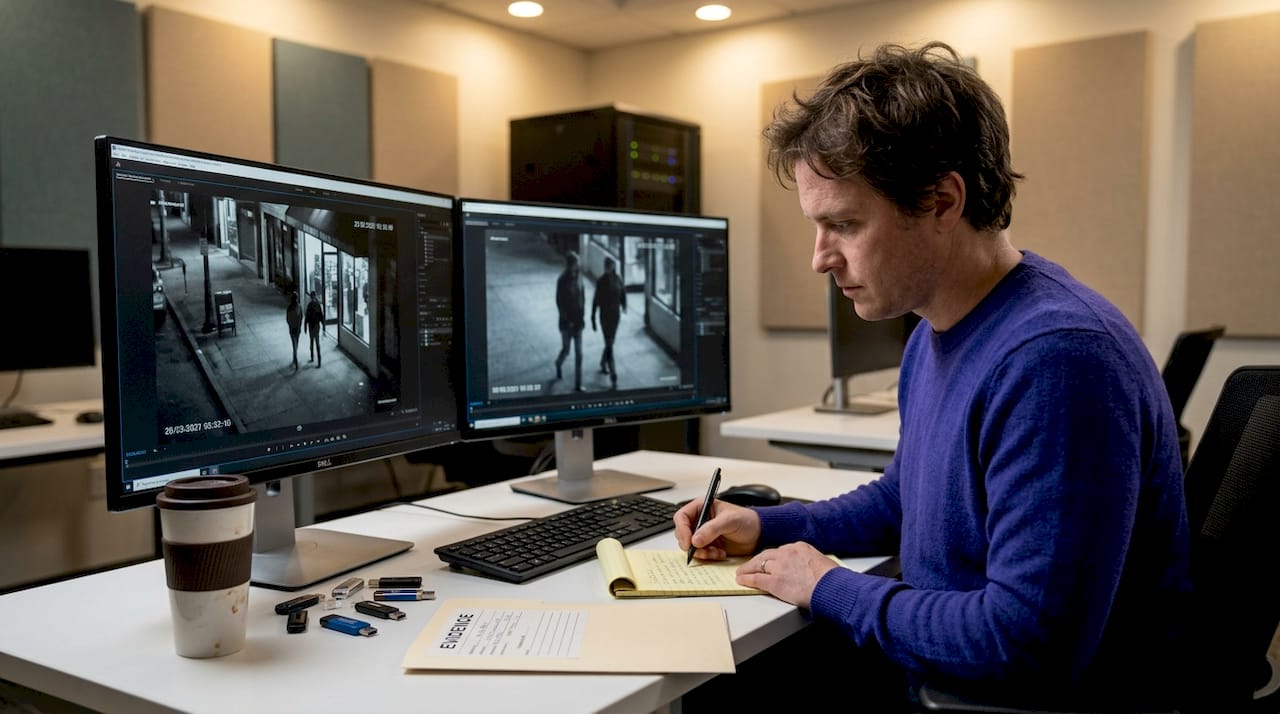
Video evidence sits at the center of many cold case reinvestigations, yet the role of video analysis in cold cases is far more technical and nuanced than most people assume. Raw footage rarely speaks for itself. A grainy parking lot recording from 2003 or a compressed surveillance clip can contain critical evidence that only a trained forensic video analyst can extract. Without proper forensic methodology, investigators risk misreading footage, tainting evidence, or building a case on conclusions that collapse under courtroom scrutiny. This guide breaks down exactly how forensic video analysis works, where it succeeds, where it fails, and how emerging technology is reshaping what investigators can accomplish with aging visual evidence.
Table of Contents
- Key takeaways
- The role of video analysis in cold case investigations
- Challenges and limits of cold case video quality
- AI technology and its impact on cold case workflows
- Legal and evidentiary standards for video evidence
- Best practices for investigators using video analysis
- My perspective on video analysis and cold case investigations
- Take your cold case reinvestigation further
- FAQ
Key takeaways
| Point | Details |
|---|---|
| Expert analysis is non-negotiable | Expert assistance is necessary when judges or jurors cannot interpret video evidence on their own. |
| Enhancement has hard limits | Clarification improves visibility but cannot create details that were never captured in the original recording. |
| AI accelerates but does not replace experts | AI tools consolidate and triage evidence; human verification and documentation remain required for court admissibility. |
| Chain of custody is foundational | Every analysis step must be documented with hash verification to protect evidence integrity from collection through trial. |
| Early analyst engagement changes outcomes | Bringing in a qualified forensic video analyst at the start of a reinvestigation produces stronger leads and fewer evidentiary surprises. |
The role of video analysis in cold case investigations
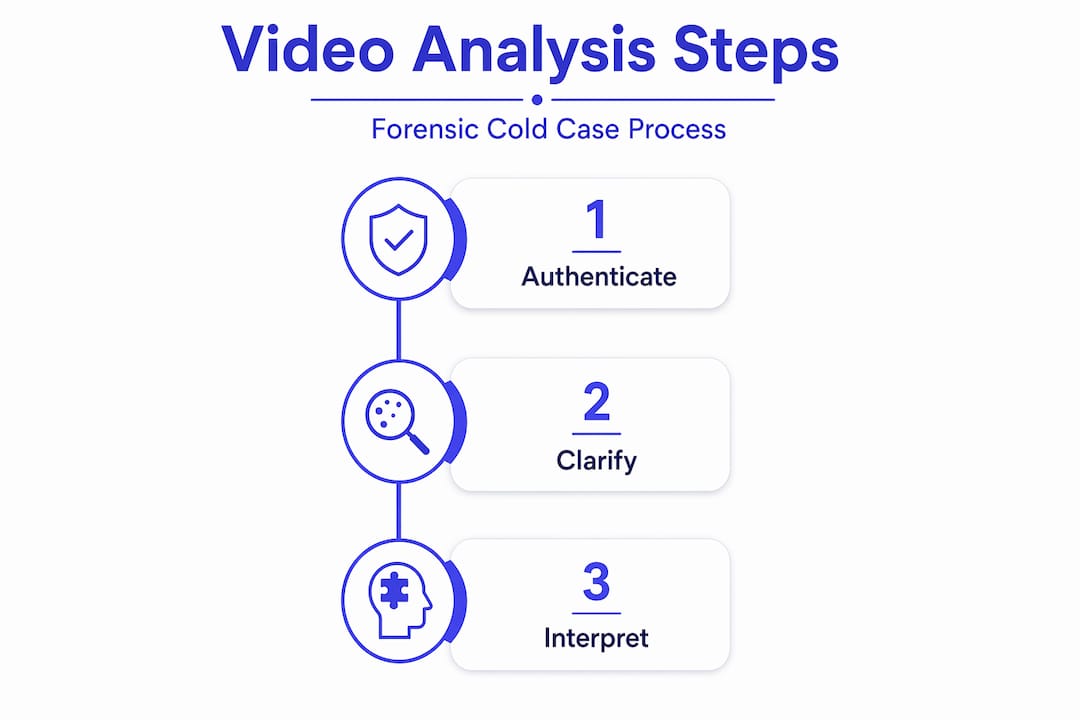
Forensic video analysis is the formally recognized discipline covering authentication, clarification, and interpretation of video recordings for investigative and legal purposes. That technical label matters because it separates the work of a qualified forensic examiner from casual review or consumer-grade editing, and courts treat them very differently.
The process begins with authentication. Before any analysis is meaningful, an examiner must confirm the footage is original, unaltered, and in an unbroken chain of custody from the recording device to the examiner’s workstation. Authentication involves frame integrity checks, audio-video synchronization analysis, and compression characteristic review to detect potential alterations. Skipping this step undermines every conclusion that follows.
Clarification, often called enhancement, comes next. The goal is to improve the visibility of content that was always present in the recording but obscured by poor lighting, compression artifacts, or motion blur. What clarification cannot do is equally critical to understand.
Pro Tip: Never describe video enhancement to a jury or supervisor as “improving image quality” without specifying that it reveals existing detail. Overstating what enhancement accomplishes plants expectations that can destroy credibility when footage still looks inconclusive after processing.
Interpretation is the final and most investigatively significant phase. This is where an analyst frames answers to specific forensic questions: Is this the same person seen at two locations? Does this vehicle match the description of the suspect’s car? What is the sequence of events within this recording? Forensic value depends on asking and answering precise questions about identity, authenticity, and timeline.
Common pitfalls occur when non-experts attempt analysis without this structured workflow. They may apply irreversible filters to the only copy of the footage, fail to document their steps, or draw identity conclusions from footage that supports only movement observations. All three mistakes create problems that range from lost leads to suppressed evidence.
Challenges and limits of cold case video quality
Not all video evidence is created equal, and footage from cold cases rarely resembles the high-definition clarity of modern body-worn cameras. Many recordings from the 1990s and early 2000s were captured on analog tape, digitized at low resolution, and stored on formats that have degraded over time. Understanding these constraints directly shapes what conclusions are defensible.
Analysts use observation strength scales ranging from inconclusive to conclusive to communicate how confident their findings are given footage quality. Low-quality footage often allows only general observations about movement, presence, or approximate size, not definitive identity. Accepting that boundary is not a failure. Overstating it is.
The most common technical obstacles include:
- Compression artifacts: Digital storage systems reduce file size by discarding data. That discarded data is gone permanently and cannot be reconstructed by any enhancement technique.
- Low frame rate: Many older surveillance systems recorded at 1 to 5 frames per second, creating choppy sequences that make motion tracking unreliable.
- Field of view gaps: Cameras positioned for general deterrence, not forensic recording, often miss the specific angle investigators need.
- Storage overwrite: Footage preserved only because someone recognized its potential value years later may represent a fraction of what was originally recorded.
When footage is low quality or fragmented, the correct investigative response is to constrain conclusions and search for additional angles, metadata, or corroborating evidence rather than over-interpret what exists. Forcing certainty where only probability exists does not serve justice.
The integration of other evidence types becomes especially important when video gaps appear. Witness statements, cell tower records, and forensic physical evidence can corroborate what video only partially shows. Video analysis in criminal investigations works best as one layer of a multi-source evidentiary structure, not a standalone proof.
AI technology and its impact on cold case workflows
Artificial intelligence has shifted what is practically achievable when investigators face the kind of massive, multi-format evidence archives that accumulate around long-unsolved cases. The practical challenge in many cold cases is not that evidence does not exist. It is that the evidence is scattered across decades, formats, and agencies in ways that make manual review prohibitively slow.
AI platforms now address this directly:
- Transcription and indexing: Old audio from interviews conducted in the 1980s can be automatically transcribed and made keyword-searchable alongside modern surveillance footage from the same case.
- Cross-format evidence consolidation: Dashcam footage, body-worn camera recordings, CCTV clips, and scanned documents can be queried together in one record, surfacing connections that fragmented storage made invisible.
- Vehicle and person tracking: AI can flag consistent clothing descriptions or vehicle types across hundreds of hours of footage faster than a team of analysts reviewing manually.
- Facial recognition workflows: Algorithmic matching narrows identification pools, but outputs require expert verification and documented confirmation before they become court-ready findings.
Pro Tip: When briefing command staff or prosecutors on AI-assisted findings, always frame outputs as investigative leads requiring verification, not conclusions. The moment AI results are presented as definitive without documented human review, you create a challenge the defense will exploit.
| Capability | AI-assisted | Manual review |
|---|---|---|
| Processing speed (100 hours of footage) | Hours | Weeks |
| Cross-format evidence linking | Automated | Labor-intensive |
| Facial recognition matching | Algorithmic with expert validation | Expert-only |
| Audit trail for court | Requires documentation protocols | Built into examiner workflow |
| Decision reliability | High with human verification | High |
AI serves as a force multiplier in cold case reinvestigations, compressing the time needed to surface leads while leaving interpretive judgment where it belongs: with qualified human examiners.
Legal and evidentiary standards for video evidence
The courtroom is where forensic video analysis either delivers or collapses. Understanding what courts require before you begin analysis protects the integrity of the work and the admissibility of the evidence.
The foundation is chain of custody documentation, supported by hash verification at every handoff. A hash is a digital fingerprint confirming the file has not changed. If you cannot demonstrate that the footage presented in court is byte-for-byte identical to what was collected at the scene, the defense has grounds to challenge authenticity.
Beyond custody, courts look at:
- Audit trails: Every enhancement step, every filter applied, and every parameter adjusted must be recorded in a format that allows another qualified analyst to reproduce the work and reach the same result.
- Separation of phases: Authentication, interpretation, and presentation must be treated as distinct processes. An analyst who authenticates footage and then interprets it for the same case should document both roles explicitly.
- Qualified expert witnesses: When footage requires technical explanation that a typical juror cannot evaluate independently, a qualified forensic video analyst must provide that context. Non-expert testimony about complex video evidence frequently fails admissibility challenges.
- Software standards: Consumer editing applications, regardless of capability, are not appropriate for forensic work. Courts expect tools used in evidence processing to meet recognized forensic standards.
| Practice | Forensic standard | Consumer approach |
|---|---|---|
| File handling | Hash verification, working copies only | Direct editing of original |
| Enhancement documentation | Step-by-step audit log | Undocumented edits |
| Software | Forensic-certified tools | General video editing apps |
| Expert qualification | Certified forensic video analyst | Untrained reviewer |
Mishandling any one of these elements does not just weaken a case. In serious cold case prosecutions, it can result in complete exclusion of video evidence that took years to locate and analyze.
Best practices for investigators using video analysis
The single most impactful decision an investigative team makes regarding video evidence is when to bring in a qualified forensic video analyst. Most teams bring them in too late, after detectives have already reviewed footage, made conclusions, and sometimes inadvertently compromised the original recording.
Follow these steps to protect both the evidence and the investigation:
- Secure originals immediately: When reopening a cold case, locate all original recordings before conducting any review. Request the original file, not a converted copy, and document the source device and storage format.
- Engage your analyst before reviewing footage: An analyst can establish the correct workflow for review, identify what questions the footage can realistically answer, and prevent inadvertent evidence handling errors.
- Frame specific forensic questions: Video analysis in criminal investigations produces the best results when investigators arrive with precise questions. “Can this footage help us establish where Subject A was between 10:00 PM and midnight on this date?” is answerable. “Tell me what this footage shows” is not.
- Build a cross-disciplinary team: The most effective cold case reinvestigations combine video forensic expertise, detective knowledge of the original case, and input from legal counsel on admissibility thresholds before analysis begins.
- Document everything in parallel: Investigators and analysts should maintain synchronized documentation. If the analyst’s audit trail references a review session, the detective’s case notes should reflect the same session.
Pro Tip: Ask your forensic video analyst to prepare a written report that separates observations from interpretations. Observations describe what is visible. Interpretations draw investigative conclusions. Keeping those categories distinct makes expert testimony cleaner and harder to challenge on cross-examination.
My perspective on video analysis and cold case investigations
I have watched video evidence transform cold case investigations from a long shot to a prosecutable case, and I have also seen it mishandled in ways that closed doors that took decades to open. The pattern that stands out most is overconfidence in raw footage.
Detectives and investigators with no formal visual literacy training will watch a grainy clip, convince themselves they recognize something significant, and build an investigative direction around that interpretation. Then a defense analyst dismantles it in court because the original footage was never properly authenticated and the conclusion was not supportable at the resolution available. The early involvement of forensic analysts is not a luxury. It is how you avoid that outcome.
What gives me real confidence about where this field is heading is the integration of AI into multi-decade evidence archives. Combining AI with human expertise creates something genuinely powerful: the ability to surface a lead buried in 30-year-old interview transcripts and connect it to footage that was only collected last year. That kind of cross-era linkage was not practically achievable a decade ago.
The caution I would press on every investigator is this: AI is not a shortcut around forensic rigor. It is a tool that magnifies what rigorous forensic practice can accomplish. Use it that way and the results will follow.
— Crime
Take your cold case reinvestigation further
When video analysis surfaces new leads in a long-unsolved case, investigators need more than footage. They need context: historical case details, corroborating records, and the ability to cross-reference findings against a structured, verified database of related cases across the country.
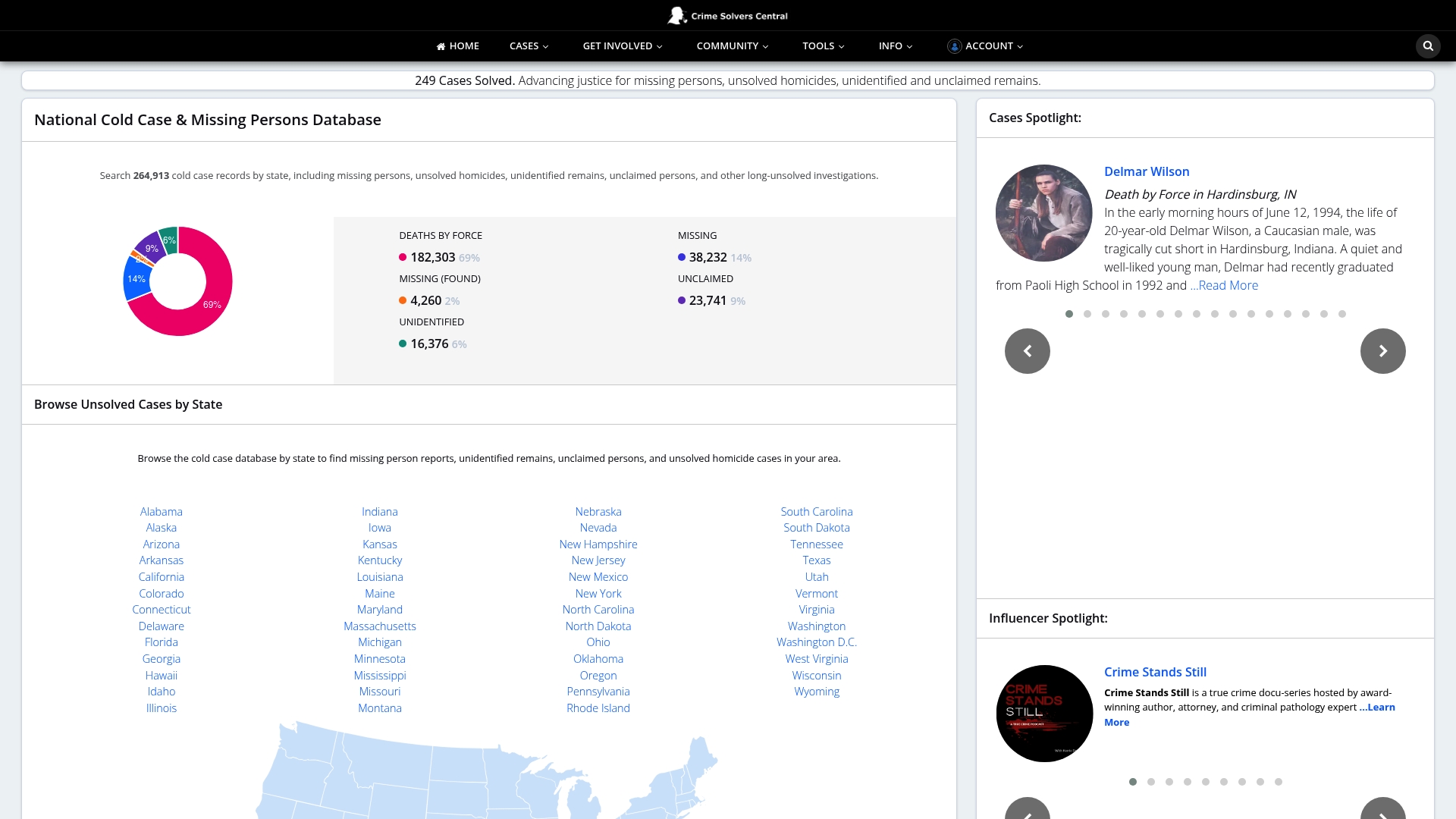
Crimesolverscentral maintains a national database of over 264,913 unsolved cases, organized by state and case type, specifically designed to support exactly this kind of investigative cross-referencing. If you are working a cold case and video analysis has generated new leads, checking those findings against a broader case catalog can reveal patterns, similar offenses, or connected incidents that individual agency records miss. Access the cold case database by state to search missing persons and unsolved homicides relevant to your reinvestigation. The platform is built for law enforcement professionals and investigative researchers who need organized, accessible case information at every stage of a reopened case.
FAQ
What does forensic video analysis involve?
Forensic video analysis covers three distinct processes: authentication to confirm footage integrity, clarification to improve visibility of existing content, and interpretation to extract investigative conclusions. Each phase follows documented, repeatable protocols to withstand courtroom scrutiny.
Can video analysis solve unsolved cases on its own?
Video analysis rarely solves a case in isolation. It works best as one layer of a multi-source investigation, corroborated by physical evidence, witness statements, and records. What it can do is confirm timelines, narrow suspect pools, and provide court-admissible visual documentation.
How does AI improve video analysis for cold cases?
AI tools can consolidate and index multi-format evidence from across decades into a single searchable record, dramatically reducing review time. However, AI outputs require human verification and documented confirmation before they are suitable for court use.
Why does chain of custody matter for video evidence?
Chain of custody establishes that footage has not been altered from the moment of collection through trial. Without hash verification and documented handling at every stage, the defense can challenge the authenticity of the footage and potentially exclude it from evidence.
When should a forensic video analyst be brought into a cold case?
As early as possible. Engaging a qualified analyst before footage is reviewed by non-experts prevents inadvertent handling errors and ensures the investigative questions are framed in ways the footage can actually answer.