

Strip EXIF First: Anonymous Tips for Families on Crime Solvers Central

You can submit an anonymous tip to Crime Solvers Central right now through the platform’s anonymous submission workflow. Prepare verifiable details, such as dates, locations, or photos, and strip identifying metadata before you send anything. Crime Solvers Central follows disclosure and privacy safeguards on the intake side, but the strongest tips are the ones you’ve already scrubbed and organized before hitting submit.
TL;DR:
- Most effectively prepared tips identify precise dates, locations, vehicle descriptions, and distinguishing features, rather than vague or broad details.
- Scrubbing metadata from all files and choosing appropriate anonymity levels protect your privacy without sacrificing the clarity of your information.
- Using a dedicated account or separate email helps maintain your anonymity and prevents accidental exposure through reply mechanisms or follow-up questions.
- Submission confirmation IDs or hashes are critical for tracking case progress; always save them separately from your tip data.
- Community-based platforms excel at long-term case collaboration, especially for old or cold cases, but urgent reports about ongoing crimes should be directed to law enforcement immediately.
Table of Contents
- How Do You Prepare a Tip Before Submitting?
- What Should You Include in an Anonymous Tip?
- How Do You Protect Your Privacy While Reporting?
- What Happens After You Submit a Tip?
- Crime Solvers Central’s Role in Cold Case Reporting
- How Do You Confirm Your Tip Was Received?
- Crime Solvers Central vs. Official Law Enforcement Tip Lines
- Why Format and Discipline Matter More Than Volume
- Turn Your Tip Into Ongoing Case Access
- Sources
- FAQ
How Do You Prepare a Tip Before Submitting?
A rushed tip is a wasted tip. Volunteer investigators can only act on what’s verifiable, so the prep work you do before you open the submission form matters more than the form itself.
Here’s the sequence that keeps a tip useful and keeps you protected:
- Gather your materials. Collect photos, screenshots, timestamps, and original filenames in one place. Don’t edit anything yet, just consolidate.
- Copy everything to a secure folder before you touch it. Keep untouched originals somewhere offline, in case anyone later needs to verify authenticity.
- Strip the metadata. Photos carry EXIF data that can reveal GPS coordinates, device model, and timestamps you didn’t intend to share. Use a metadata scrubber or convert images to a clean PDF before uploading.
- Pick your anonymity level. A fully anonymous web form leaves no account trail but also no way to follow up. A pseudonymous account lets you track replies without using your name. A throwaway email splits the difference. Choose based on whether you expect to answer follow-up questions.
- Fill out the form with concise, factual context. Skip the backstory. State what you saw, when, and where, then attach your files.
- Save your confirmation ID. If Crime Solvers Central provides a submission hash or reference number, write it down somewhere separate from the tip itself. It’s your only way to check status later.
Pro Tip: Rename your files before uploading. “IMG_4821.jpg” tells volunteers nothing, but “vehicle_seen_maple_st_march3.jpg” gives them context before they even open it.
What Should You Include in an Anonymous Tip?
Volunteer investigators sift through a lot of noise. Community-contributed details work best when they’re small, specific, and clearly separated from theory, according to reporting on a UK missing persons charity that relies on expert volunteers to reexamine cold cases. Old photos and precise dates are often exactly the kind of fresh input that breaks a case open, far more than a new theory ever does.
Prioritize these details:
- Exact dates and times, not “sometime last summer.”
- Precise locations, an intersection or street address beats a neighborhood name.
- Vehicle descriptions, including plate numbers if you have them.
- Distinguishing features, scars, tattoos, clothing, anything repeatable.
- Patterns, if you’ve noticed the same behavior or sighting more than once.
- Social media post IDs or URLs, if the tip involves something you saw online.
For photos and files, always include the original image rather than a screenshot of a screenshot. Note where the photo came from and whether it has a visible timestamp or landmark that helps date it.
Format matters as much as content. Open with one sentence summarizing the lead. Then list the factual items underneath. If you have a theory, label it clearly as speculation and keep it separate from what you actually observed. Volunteers can build on facts; they can’t build on guesses dressed up as facts.
How Do You Protect Your Privacy While Reporting?
Operational security isn’t a single checkbox, it’s a process you manage from the moment you start collecting information to long after you’ve hit submit. Opsec guidance for publishing findings stresses that replies, follow-ups, and even copies of your own submission can expose your identity if you’re not deliberate about how you handle them.
Start with the basics:
- Scrub metadata from every file before upload. Filenames, EXIF data, and hidden document properties can all leak identifying information.
- Use a project-specific account or a separate email, never your personal social media or main inbox.
- Decide your reply strategy in advance. Will you check back for follow-up questions? If so, set up a dedicated inbox now, not after someone asks you a question you can’t safely answer.
- Use privacy tools where appropriate. A Tor browser session, a burner phone, or an encrypted messaging app can add a layer of separation between your real identity and your submission.
Ethical guardrails matter just as much as technical ones. Never publish accusations against a named individual based on suspicion alone. Don’t contact a victim’s family directly, even with good intentions, that’s not your role as a contributor. Avoid sharing anyone’s private medical or financial information, even if you think it’s relevant. Academic guidance on open-source investigations into international crimes warns specifically about the mosaic effect: individually harmless details, once combined, can identify a person you never meant to expose. If a tip suggests someone is in immediate danger, use emergency services first. A tip line is not a substitute for a 911 call.
Pro Tip: If you’re worried about retaliation, submit from a device and network you don’t normally use for anything tied to your identity. Consistency is what gets people identified over time, not any single mistake.
What Happens After You Submit a Tip?
Your tip doesn’t vanish into a void, but it also doesn’t trigger instant action. Staff and volunteers triage incoming submissions, checking for completeness and filtering out anything that could compromise an active investigation if made public.
Here’s the realistic path a tip usually follows:
- Intake and moderation. Someone reviews what you sent for clarity and relevance before it goes anywhere else.
- Private verification. Volunteers may try to confirm details quietly. Academic research on online crime-discussion communities shows that moderation and vetting happen before anything escalates publicly, which protects both the investigation and your identity.
- Case integration. Useful tips get folded into case notes, added to digital evidence boards, or routed to volunteer teams. In some situations, information gets passed along to law enforcement.
- No guarantee of immediate action. Not every tip leads to a breakthrough right away. Cold cases move slowly by definition.
You can stay involved by watching for case updates on the platform and providing clarifications if asked, without ever revealing more identifying information than you’re comfortable sharing.
Crime Solvers Central’s Role in Cold Case Reporting
Crime Solvers Central maintains a large national database of cold cases, organized by state and situation, according to the platform’s own case catalog. That scale is the reason volunteer contributions matter: a single detail can connect to a case that’s been sitting untouched for years.
Community members participate through membership, fundraising, or volunteer safety initiatives, and testimonials on the platform describe tips that led to real family closures. Behind the scenes, submissions go through moderation, redaction where necessary, and metadata handling designed to protect both contributors and the integrity of the investigation itself. Community database research on co-production models backs this approach: structured, moderated contribution spaces consistently outperform open, unfiltered forums.
How Do You Confirm Your Tip Was Received?
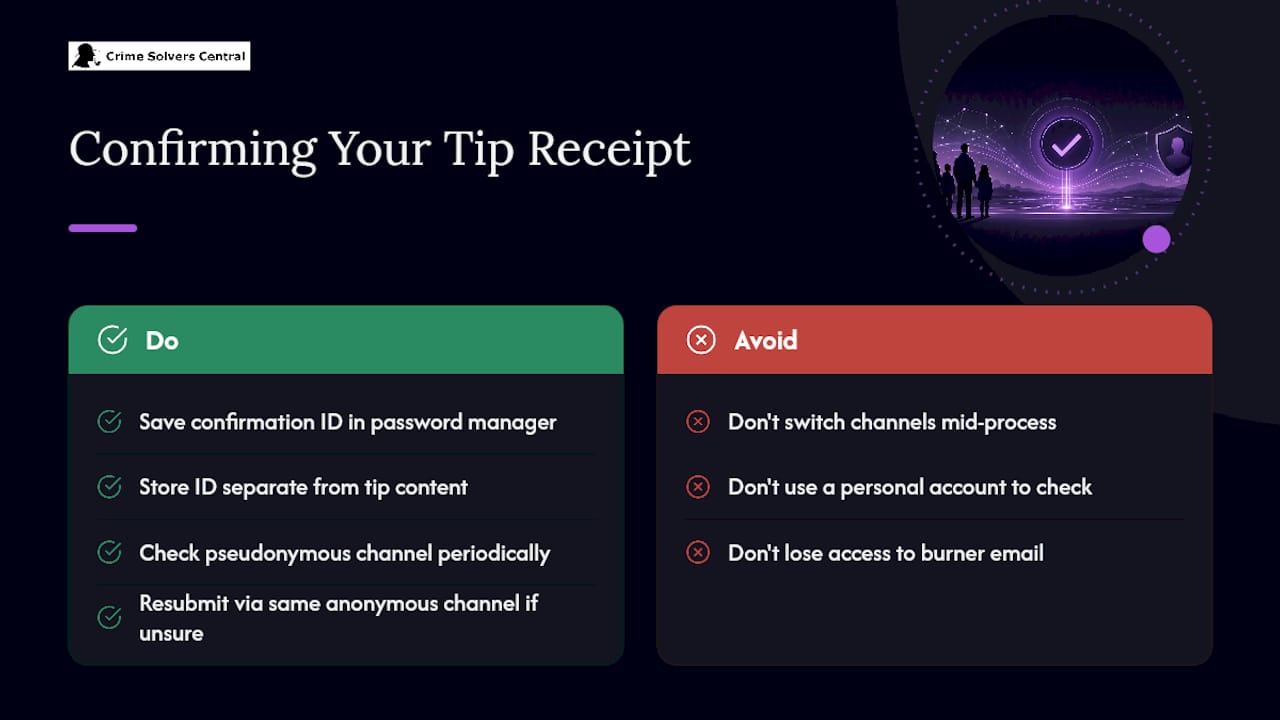
If Crime Solvers Central issues a confirmation ID or reference hash when you submit, that’s your proof of receipt. Save it somewhere separate from the tip content itself, ideally in a password manager or a notes file that isn’t tied to your real identity.
If you set up a pseudonymous account or dedicated email during submission, check that channel periodically for status updates or follow-up questions from volunteers. Don’t expect instant responses. Cold case review moves on its own timeline, and volunteers are often working through a backlog of submissions across hundreds of cases.
If you didn’t receive a confirmation and you’re worried the submission didn’t go through, the safest move is resubmitting through the same anonymous channel rather than switching to a personal account to “check in.” Switching channels mid-process is one of the more common ways contributors accidentally undermine their own anonymity. If you used a burner email, make sure you can still access it before you need it for a reply. A common opsec mistake is submitting a tip using a throwaway email account, then losing access to that account before anyone responds.
If your tip included information you later want to correct or expand, submit a follow-up through the same channel and reference your original confirmation ID if you saved one. That lets volunteers connect the two without needing you to reveal anything else about yourself.
Crime Solvers Central vs. Official Law Enforcement Tip Lines
The biggest difference isn’t legal, it’s structural. Official law enforcement tip lines feed directly into active police investigations and are built around chain-of-custody requirements for potential prosecution. Crime Solvers Central operates as a community-driven database and investigative network, where tips get added to case files, discussed among volunteers, and attached to digital evidence boards that a wider community of researchers can reference.
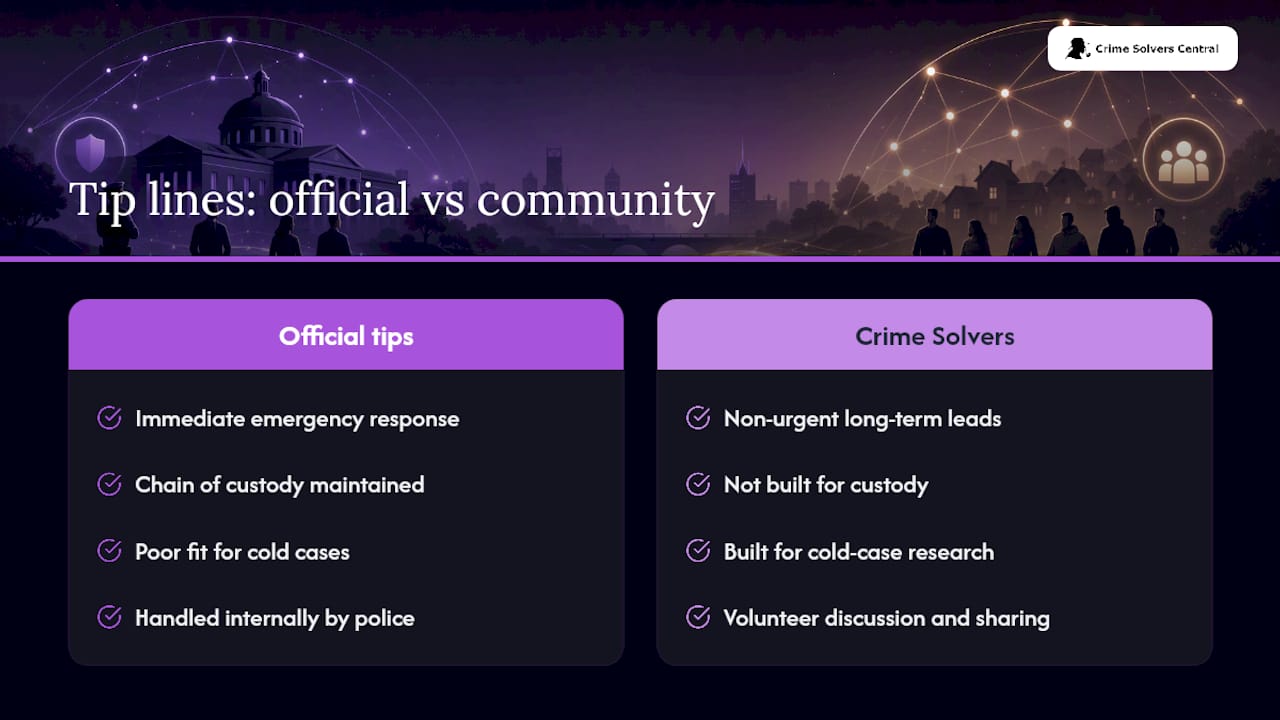
That distinction changes what kind of information fits best where. A tip about an ongoing crime in progress belongs with law enforcement or emergency services immediately. A tip about an old photo, a decades-old sighting, or a pattern you noticed while researching a cold case fits naturally into a platform built around long-term case tracking and volunteer collaboration.
Crime Solvers Central also gives contributors visibility that official tip lines typically don’t: you can watch a case profile, see how a lead gets discussed, and stay part of the process rather than submitting information into a system that offers no further contact. For families of missing persons especially, that visibility can matter as much as the tip itself. It turns a one-time report into an ongoing connection to the case.
Neither path replaces the other. Use official tip lines for anything urgent or evidentiary. Use a community database when you’re contributing historical context, media, or pattern recognition to a case that’s already gone cold.
Why Format and Discipline Matter More Than Volume
The instinct with cold cases is to share everything you know and let investigators sort it out. That instinct is usually wrong. Volunteer teams don’t have unlimited time, and a scattered submission with ten possible theories buried in it is far less useful than one clean fact with a verified date attached.
What gets underestimated is how much the packaging of a tip determines whether it gets acted on. A disclosure log, a metadata scrub, and a one-line summary before the details aren’t bureaucratic overhead, they’re what separates a tip that gets read carefully from one that gets skimmed and filed away. Chain-of-custody practices built for professional investigators apply just as well to a family member submitting a single old photograph.
The other misconception is that anonymity means vagueness. It doesn’t. You can scrub every identifying trace from your submission and still write with precision. Prioritize clarity over caution about the wrong things, protect your identity, not your facts.
— Crime
Turn Your Tip Into Ongoing Case Access
Submitting a tip is free and stays anonymous whether you ever create an account or not. But if you want to track the case you contributed to, dig into full case files, or use tools like digital evidence boards and the flyer builder, a membership gets you there. Crime Solvers Central offers tiered membership plans with monthly fees; current prices are on the pricing page. Full details on membership plans are on the pricing page. Every tier includes access to the same national case database your tip just helped strengthen, without changing how privacy protections work on the intake side. Browse the database, pick a plan that matches how involved you want to be, or skip membership entirely and submit your next tip anonymously, either way, your information reaches the same case files.
Sources
Before sharing sensitive material publicly, review the opsec guidance on publication and disclosure and the ethical framework for open-source investigations. Both address risks that a quick tip submission can easily overlook.
- Ethical considerations for open-source investigations into international crimes
- Opsecguides
- How a UK missing‑persons charity solves cold cases using expert volunteers
- Investigations/Techniques/sop-reporting-packaging-disclosure.md
FAQ
Can I Submit an Anonymous Tip Without Creating an Account?
Yes. Crime Solvers Central’s anonymous submission workflow doesn’t require an account, though a pseudonymous account lets you follow up on your tip later.
What Files Should I Remove Metadata From Before Submitting?
Remove metadata from any photo, screenshot, or document you upload, since EXIF data can reveal GPS coordinates, device information, and timestamps you didn’t intend to share.
Will Anyone Find Out I Submitted a Tip?
Volunteers and moderators rarely reveal a contributor’s identity publicly, and platforms built around co-produced research generally verify details privately before anything gets discussed further.
How Long Does It Take to Hear Back About a Tip?
There’s no fixed timeline. Cold case review moves slowly, and not every tip leads to an immediate update, though useful tips do get folded into case notes and evidence boards.
Should I Report an Emergency Through Crime Solvers Central?
No. If a tip involves someone in immediate danger, contact emergency services directly first, then consider submitting supporting details to a case database afterward.