

Radford’s 4,743 Cases: What the Data Shows About U.S. Serial Killers

A serial killer, under the working definition law enforcement uses, is someone who unlawfully kills two or more victims in separate events. This article uses that standard to walk through documented profiles, the datasets researchers rely on, unresolved cases that may fit the same pattern, and the forensic tools now closing decades-old files. Everything here draws on federal reporting, academic databases, and case records rather than speculation.
TL;DR:
- The FBI now defines serial killers as individuals who unlawfully kill two or more victims in separate incidents, allowing earlier detection and intervention.
- DNA technology and forensic genetic genealogy have dramatically increased the resolution of cold cases, with the Golden State Killer case highlighting a breakthrough through family DNA searches.
- Most documented serial killers operated mainly between the 1970s and 1990s, with recent cases often solved decades later due to advances in forensic science.
- Official datasets likely underreport the true number of serial killers, as many cases remain unresolved or victims unreported, especially among vulnerable populations.
- Media coverage often distorts public perception by emphasizing sensational cases, which can skew resource allocation and investigative priorities.
Table of Contents
- What Counts as a Serial Killer in the United States?
- Profiles of Notable Identified Serial Killers
- Unidentified and Suspected Serial Killers: Unsolved Patterns
- Serial Killer Statistics: What the Major Databases Show
- How Investigators Identify and Link Serial Offenders
- Where to Research Serial Killer Cases and Cold Case Data
- How Serial Murder in America Has Changed Over Time
- How Investigators Build a Psychological Profile
- How Media Coverage Shapes Public Perception and Investigations
- The Legal Hurdles in Prosecuting Serial Murder Cases
- Publisher Perspective: Reporting on Serial Murder Responsibly
- Sources
- FAQ
What Counts as a Serial Killer in the United States?
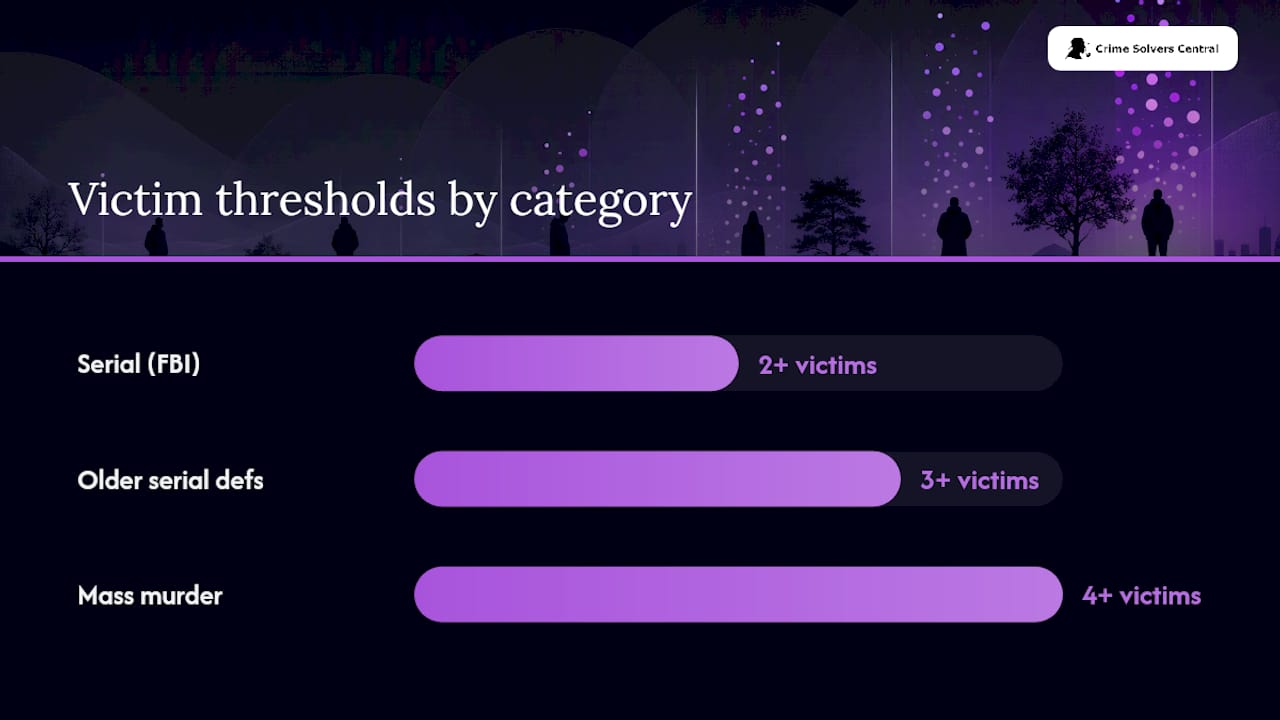
The FBI settled on its current definition in 2008, but the real work happened three years earlier. In 2005, the Bureau convened a Serial Murder Symposium that brought together 135 experts, including investigators, prosecutors, and academics, specifically to resolve decades of disagreement over where “serial murder” begins. The result, published in the FBI’s monograph on serial murder, is deceptively simple: the unlawful killing of two or more victims by the same offender or offenders, in separate events.
That two-victim threshold is lower than older definitions, which often required three or more killings before a case earned the “serial” label. The change was not cosmetic. Setting the bar at two lets local departments flag a possible pattern and request federal behavioral or forensic support after a second body turns up rather than a third or fourth. Earlier flagging means earlier resource allocation, and in a discipline where offenders often escalate in frequency, that head start can matter.
Serial murder is also frequently confused with two related but distinct categories:
- Serial murder: two or more victims killed in separate incidents, typically with a cooling-off period between them.
- Spree murder: multiple victims killed across different locations but within one continuous, unbroken timeframe, with no real gap between the killings.
- Mass murder: four or more victims killed in a single incident, in one location, at roughly the same time.
The distinction is temporal, not just about body count. A gunman who kills five people in one building in one hour is a mass murderer. Someone who kills five people over five years, in five separate incidents, fits the serial pattern.
Even the FBI’s own definition has critics. Academic reviews, including work published through the Journal of Mixed Methods Research on serial murder conceptualization, note that a purely numeric threshold ignores motive, victim selection, and psychological continuity between crimes. Two accidental deaths years apart, technically committed by the same person, would satisfy the letter of the definition without matching what most researchers mean by “serial killer.” Scholars generally treat the FBI definition as a practical starting point for investigators, not a complete psychological or legal category.
Peer-reviewed literature also consistently flags that serial murder remains statistically rare, representing well under 1% of all homicides in most analyses, even though it draws a disproportionate share of media coverage and public fascination. That gap between rarity and attention shapes almost everything else in this article, from how data gets collected to how the public perceives the risk.
Profiles of Notable Identified Serial Killers
The following profiles cover offenders with confirmed convictions or, in one case, a confession accepted by prosecutors. Victim counts vary between “convicted,” “confessed,” and “suspected” figures, so each entry notes which number applies. These are not the only significant cases in American history, but they represent a cross-section of methods, eras, and investigative outcomes.
-
Ted Bundy operated primarily across Washington, Utah, Colorado, and Florida from 1974 to 1978. He was convicted of three murders in Florida and confessed to 30 killings shortly before his 1989 execution, though some researchers believe the true number is higher. Bundy targeted young women, often using a feigned injury or authority figure disguise to lure victims before assaulting and killing them. His case remains a foundational reference point in offender profiling because of his mobility across state lines and his ability to evade capture for years despite multiple close calls.
-
Gary Ridgway, known as the Green River Killer, murdered women and girls, largely sex workers and runaways, in the Seattle-Tacoma area of Washington State beginning in 1982. He pleaded guilty in 2003 to 48 murders as part of a plea deal that spared him the death penalty in exchange for helping investigators locate remains, though he claimed responsibility for closer to 90 killings. Ridgway’s case set a grim record for the most confirmed victims of any American serial killer and demonstrated how a single unresolved case can span decades before DNA technology catches up to the evidence.
-
Jeffrey Dahmer killed 17 men and boys in Wisconsin between 1978 and 1991, most of them in his Milwaukee apartment. He was arrested in 1991 after a victim escaped and flagged down police, and he was convicted the following year. Dahmer’s case exposed serious lapses in how Milwaukee police handled reports involving minority and LGBTQ victims, a failure that has since been cited repeatedly in discussions of victim bias in serial-murder investigations.
-
Dennis Rader, the offender known as BTK (Bind, Torture, Kill), murdered at least 10 people in and around Wichita, Kansas, between 1974 and 1991. What made Rader’s case unusual was the long dormant period between his known killings and his eventual capture in 2005, which came after he sent a floppy disk to a local news station that investigators traced back to a church computer he used. Rader’s arrest is one of the clearer examples of an offender undone by a small forensic mistake rather than a break in physical evidence.
-
Joseph James DeAngelo, identified decades later as the Golden State Killer, committed at least 13 murders and more than 50 rapes across California between 1974 and 1986. DeAngelo evaded identification for over 30 years until investigators used forensic genetic genealogy in 2018 to match crime-scene DNA to a distant relative’s genealogical profile, then narrowed the search to DeAngelo himself. He pleaded guilty in 2020, and his case is widely cited as the moment consumer genealogy databases became a mainstream tool in cold-case investigations.
-
John Wayne Gacy murdered at least 33 young men and boys in the Chicago area between 1972 and 1978, burying most of the remains beneath his own home. Gacy was a licensed clown who performed at children’s parties and community events, a detail that has made his case a recurring reference point in discussions of offenders who maintain a respectable public persona.
-
Samuel Little confessed to 93 killings across multiple states between 1970 and 2005, and the FBI has confirmed at least 60 of those confessions against verified case details, making him the most prolific confessed serial killer in documented American history. Little’s case is notable because many of his victims were initially classified as overdoses or undetermined deaths, a pattern that researchers point to as evidence that official victim counts likely undercount serial murder’s true toll.
-
Aileen Wuornos killed seven men in Florida between 1989 and 1990, claiming self-defense against clients who solicited her for sex work before turning violent. She was convicted and executed in 2002. Wuornos remains one of the few female offenders widely classified under the FBI’s serial murder definition, and her case is frequently cited in academic discussions of how gender affects both offending patterns and public perception.
A few patterns run through these profiles worth flagging directly:
- Several offenders, including Bundy, Ridgway, and DeAngelo, exploited jurisdictional gaps between counties or states that slowed information sharing.
- Confession-based victim counts (Ridgway, Little) frequently exceed the number of murders prosecutors could formally charge or verify.
- Forensic breakthroughs, not investigative hunches, closed the two most recent high-profile cases on this list (BTK and the Golden State Killer).
Unidentified and Suspected Serial Killers: Unsolved Patterns
Not every suspected serial case ends in an arrest. Investigators sometimes see a pattern across unsolved homicides long before, or instead of, identifying a suspect, and the criteria they use to flag those patterns are fairly consistent across departments.
Detectives generally look for a cluster of shared indicators before treating separate homicides as potentially linked:
- Victimology: victims sharing similar age, occupation, lifestyle, or vulnerability (frequently sex workers, hitchhikers, or transient individuals, who face higher risk partly because their disappearances draw less immediate attention).
- Modus operandi: consistent method of killing, weapon choice, or post-mortem behavior across multiple scenes.
- Geographic clustering: bodies or disappearances concentrated along a specific corridor, transit route, or jurisdiction boundary.
- Temporal spacing: a pattern of killings separated by consistent or escalating intervals rather than random timing.
Pro Tip: If you’re researching a possible pattern among unsolved cases in your own area, cross-reference victim details against a state-level cold-case catalog before assuming a connection. Superficial similarities, like age range alone, produce false patterns more often than genuine ones.
Some of the more widely discussed suspected serial patterns in American criminal history remain formally unresolved. The Long Island Serial Killer case, tied to remains discovered along Gilgo Beach beginning in 2010, went unsolved for over a decade before an arrest in 2023 connected a suspect to multiple victims, illustrating how long a suspected pattern can sit dormant even with strong victimology links. The Zodiac Killer case out of Northern California in the late 1960s remains formally unsolved despite decades of tips, amateur investigation, and at least one controversial claimed identification that law enforcement has not confirmed. Neither case should be treated as definitively “solved” or attributed to a specific person beyond what courts or agencies have formally confirmed.
The scale of the backlog behind these individual examples is larger than most people assume. The National Institute of Justice notes that a substantial share of American homicides go unresolved, and some studies cited in that reporting estimate that as many as 15% of homicides may involve a serial offender, a figure that hints at how much of the backlog could theoretically represent repeat-offender activity rather than isolated cases. That estimate carries real uncertainty. Underreporting, jurisdictional fragmentation, and inconsistent record-keeping mean any single percentage should be read as a rough signal, not a precise count.
Families and independent researchers working through cases like these often start by mapping victim details against a searchable state-by-state catalog, which is one of the more practical uses of a resource like Crime Solvers Central’s unsolved murder database. Roughly 37% of American murders remain unsolved by some estimates, a backlog large enough that any individual case can sit dormant for years without a fresh set of eyes on the file.
Serial Killer Statistics: What the Major Databases Show
The most frequently cited dataset in this field is the Radford University / Florida Gulf Coast University Serial Killer Database, a researcher-maintained project that, as of its September 2016 update, documented 4,743 serial killers and 13,105 victims, drawn primarily from cases in the United States and Canada. That is the number most journalists and true-crime writers quote when they cite “how many serial killers” have operated historically, and it is worth understanding both its scale and its limits.
The Radford project’s own methodology description explains where those figures come from: prison records, court transcripts, and media reporting compiled and cross-checked by researchers over years of ongoing work. That sourcing makes the database genuinely useful for spotting broad historical trends, but it also means the count reflects documented and publicly reported cases rather than every offender who ever existed. Offenders never caught, victims never identified, and cases buried in local records that were never digitized simply do not appear.
The NIJ’s cold-case reporting adds a complementary angle: it focuses less on historical totals and more on the present-day backlog of unresolved homicides that could theoretically include undetected serial offenders.
A third resource, the National Missing and Unidentified Persons System (NamUs), does not track “serial killers” as a category at all. It tracks missing persons and unidentified remains, which matters because a meaningful share of serial-murder victims are never reported missing by anyone in a position to flag the connection, particularly victims experiencing homelessness or estrangement from family.
Why do these three sources never quite agree on a single number? A few structural reasons explain most of the divergence:
- Radford counts identified, documented offenders, while NIJ estimates undetected activity within an existing homicide backlog, which is a fundamentally different measurement.
- Media-sourced records (Radford’s primary input) lag behind court outcomes, so recent arrests take time to appear in the dataset.
- NamUs data depends entirely on someone filing a missing-persons report, which never happens for a meaningful share of the most vulnerable victims.
Academic reviewers, including the peer-reviewed conceptualization work published through JMVR, generally caution against treating any single figure as a definitive prevalence rate. The honest answer to “how many serial killers are there” is that no dataset currently captures the full picture, and researchers who claim otherwise are usually overstating their own data’s completeness.
How Investigators Identify and Link Serial Offenders
Forensic genetic genealogy is the single biggest shift in this field over the past decade. The technique works by uploading crime-scene DNA to consumer or law-enforcement genealogy databases, then working outward through distant genetic matches, third cousins, fourth cousins, to build a family tree that eventually narrows to a specific suspect. It is slower and more labor-intensive than a direct DNA match, but it works on cases where the offender has no criminal record and no DNA already on file.
The Golden State Killer case is the clearest proof of concept: investigators used the technique in 2018 to identify Joseph James DeAngelo after more than three decades of dead ends, and the case became the template other agencies now follow for their own cold cases.
Programs funded and promoted through federal cold-case initiatives have demonstrably improved lab capacity and encouraged the kind of cross-jurisdictional data sharing that lets a rape kit processed in one county finally connect to a homicide filed in another county, sometimes decades apart.
That data-sharing piece matters as much as the DNA science itself. A few components tend to work together on any successful cold-case identification:
- NamUs connects unidentified remains to missing-persons reports across state lines, closing a gap that used to require manual cross-referencing between disconnected local systems.
- Improved lab capacity, funded through federal grant programs, has cut DNA-processing backlogs that once left evidence sitting untested for years.
- Behavioral analysis support from the FBI’s specialized units helps local departments interpret crime-scene patterns and prioritize suspects when DNA alone is not available.
- Multi-jurisdictional task forces formalize the kind of information sharing that, absent a task force, depends on individual detectives happening to compare notes.
Genetic genealogy carries real trade-offs, though. Consumer databases vary in their policies on whether law enforcement can search them at all, and privacy advocates have raised legitimate concerns about the technique’s reach. Agencies do not apply a uniform national policy, which means a technique that cracks a case in one state might be legally unavailable to investigators in another. That policy patchwork is likely to keep evolving as more states weigh in.
Where to Research Serial Killer Cases and Cold Case Data
Anyone doing serious research on this topic eventually needs more than a single database, because each authoritative source covers a different slice of the picture.
- The FBI publishes the field’s foundational definitional monograph and offers historical context on the Bureau’s role in developing behavioral-analysis support for local investigators. Start here for definitions and federal investigative history.
- NIJ publishes ongoing research on cold-case backlogs, forensic funding programs, and case studies where new technology closed decades-old files. Use it for current data on investigative methods and program outcomes.
- The Radford/FGCU Serial Killer Database offers the most comprehensive historical count of documented offenders and victims, with transparent methodology notes. Use it when you need a research-grade offender count rather than a media estimate.
- NamUs is the right tool specifically for missing-persons and unidentified-remains research, not offender profiles. Use it if you are trying to determine whether a missing family member’s case might connect to a broader pattern.
Crime Solvers Central operates in a related but distinct lane: a national, state-by-state searchable database covering cold cases involving missing persons, unsolved homicides, and unidentified remains. The platform’s victims database explains the methodology behind its case catalog, and members get access to full case files, digital evidence boards, an AI image progression tool, and forum access to connect with other researchers and volunteers working the same cases.
If you believe you have information relevant to an active investigation, the responsible move is always to contact the investigating agency or a tip line directly. These resources are built for research and awareness, not for replacing a formal police report.
How Serial Murder in America Has Changed Over Time
The offenders most people picture when they hear “serial killer” (Bundy, Gacy, Ridgway) mostly operated during a specific window: roughly the mid-1970s through the late 1990s. That era saw a documented rise in reported serial cases, driven partly by growing interstate mobility, weaker cross-jurisdictional communication, and the absence of DNA testing as an investigative tool. An offender could kill in three states and rarely worry about a shared database connecting the dots.
Earlier periods had their own documented cases, including H.H. Holmes in the 1890s Chicago, but detection and record-keeping were far less systematic, which is part of why historical counts before the 20th century are so sparse and unreliable.
The late 1990s and 2000s brought a measurable decline in newly identified serial cases, a trend criminologists attribute to several converging factors: routine DNA collection at booking, improved interstate law enforcement databases, and a shift in offender risk calculation as forensic capability became public knowledge. Offenders who might once have felt confident evading capture across state lines now face a much higher chance of a DNA hit connecting them to a prior scene.
The most recent shift is retrospective rather than active. Forensic genetic genealogy has turned the 2010s and 2020s into an era defined less by new serial killers emerging and more by old, previously unsolved cases finally closing, decades after the killings themselves stopped.
How Investigators Build a Psychological Profile
Behavioral profiling starts with the crime scene itself, not with guesswork about personality. Investigators examine victim selection, method of killing, level of planning, and post-offense behavior (does the offender return to the scene, follow news coverage, or change routine) to build what profilers call an offender’s behavioral signature.
That signature gets sorted into two broad categories that shape how a task force allocates resources. An “organized” offender plans in advance, brings his own weapon, and minimizes evidence, which usually signals higher intelligence and more deliberate victim selection. A “disorganized” offender kills more impulsively, often leaves forensic evidence behind, and may have a documented history of significant psychological disturbance.
Profilers also study geographic behavior, sometimes called geographic profiling, which maps where crimes occur relative to an offender’s likely home base, workplace, or comfort zone. Many serial offenders, including Ridgway and BTK, killed within a fairly consistent radius of somewhere they lived or worked, and that pattern has become one of the more reliable tools for narrowing a suspect pool geographically before DNA evidence is even available.
None of this produces a name. Profiling narrows a search and helps prioritize leads; it does not replace physical evidence, and departments that have leaned too heavily on profiling alone have produced well-documented wrongful-suspicion cases as a result. The strongest modern investigations pair behavioral analysis with forensic science, using each to check the other rather than treating profiling as a standalone answer.
How Media Coverage Shapes Public Perception and Investigations
True-crime podcasts, documentaries, and streaming dramatizations have made offenders like Bundy and Dahmer more culturally recognizable than most victims of any other crime category, and that visibility cuts in two directions.
On the useful side, media attention has directly generated tips that cracked real cases. Renewed coverage keeps decades-old cases in public view long enough for a witness, a family member, or even an offender’s own associate to finally come forward, sometimes years after the original investigation went cold.
On the harmful side, heavy coverage distorts risk perception. Given how rare serial murder actually is statistically, the volume of content about it creates a public sense of prevalence wildly out of proportion to the real numbers. That distortion can pressure departments to over-invest in “serial killer” narratives around cases that are more likely isolated homicides, pulling resources away from other unsolved cases that get no media attention simply because they are less dramatic.
Coverage also affects victims unevenly. Cases involving young, middle-class, conventionally sympathetic victims draw dramatically more coverage than cases involving sex workers, homeless individuals, or people of color, a disparity researchers and journalists have both documented repeatedly. That coverage gap likely affects investigative priority too, since public attention often translates into political pressure and funding, and it is one reason cases like Samuel Little’s went unrecognized for so long despite dozens of victims.
The Legal Hurdles in Prosecuting Serial Murder Cases
Multi-jurisdictional cases create a specific legal headache: figuring out which state or county actually has the authority to prosecute, especially when an offender killed across several jurisdictions and evidence sits scattered across departments that rarely talk to each other. Coordinating a single prosecution, or deciding which jurisdiction goes first, can delay charges for months even after a suspect is identified.
Evidence age compounds the problem. Cold cases decades old often depend on physical evidence that degraded before modern testing existed, witnesses whose memories have faded or who have died, and chain-of-custody records that were never digitized. Prosecutors have to build a case that satisfies modern evidentiary standards using materials collected under decades-old procedures.
Plea deals, as seen in the Gary Ridgway case, introduce their own tension. Prosecutors sometimes trade the death penalty for a guilty plea specifically because a confession that locates additional victims’ remains gives families closure that a trial verdict alone cannot guarantee. That trade-off is controversial, but it has repeatedly produced outcomes that a contested trial might never have delivered.
Competency and insanity defenses add another layer of complexity specific to this category of crime, given how frequently serial-murder cases involve extensive psychological evaluation before trial even begins. Courts have to weigh genuine mental illness against strategic legal defense, a distinction that is rarely simple to establish and that shapes both sentencing and public perception of the verdict.
Publisher Perspective: Reporting on Serial Murder Responsibly
Crime Solvers Central exists because unsolved cases deserve more than a news cycle. Our national database catalogs over 264,000 cases by state and category specifically so families and researchers have somewhere to turn after the headlines move on, and our community tools, from digital evidence boards to volunteer coordination, exist because case resolution usually depends on more eyes on the file, not fewer.
That mission comes with an obligation we take seriously: we source claims from federal reporting, academic databases, and documented case records, not speculation dressed up as fact. When a case is genuinely unresolved, we say so plainly rather than implying a pattern the evidence does not yet support. Naming an unconfirmed suspect, or treating a coincidence as a confirmed serial pattern, does real damage to real families, and we would rather leave a question open than answer it wrong.
If you are researching a case involving your own family, or you have information relevant to an active investigation, the right first step is always your local law enforcement agency. Our resources are built to support that process, not substitute for it.
— Crime
Sources
This article draws its factual claims from five primary sources, each covering a different piece of the picture. The FBI’s 2008 serial murder monograph supplies the working definition used throughout, along with historical context on the Bureau’s investigative role. The National Institute of Justice’s cold-case reporting documents backlog estimates and the forensic programs closing decades-old files. The Radford University / FGCU Serial Killer Database provides the most cited historical offender and victim counts, alongside its own methodology documentation explaining how those figures were compiled. Finally, peer-reviewed academic literature, including work on serial murder conceptualization, tempers the numbers with the caveat that no dataset fully captures the true scope of this crime category.
- Serial Murder: Multi-Disciplinary Perspectives for Investigators — FBI (2008)
- Serial Killer Connections Through Cold Cases — National Institute of Justice (2020)
- Serial Killer Statistics — Radford University / FGCU Serial Killer Information Center
- Relevant peer-reviewed overview in PMC
FAQ
What Is the Official Definition of a Serial Killer?
The FBI defines serial murder as the unlawful killing of two or more victims by the same offender in separate events, a standard set after a 2005 symposium involving 135 experts. It deliberately does not require a specific motive or a minimum time gap between killings.
How Many Serial Killers Have Operated in the United States?
The Radford/FGCU database, as of its 2016 update, documented 4,743 serial killers and 13,105 victims across the United States and Canada combined. Researchers caution this reflects documented cases only, since undetected offenders and unreported victims fall outside any dataset’s reach.
What Percentage of Homicides Involve a Serial Offender?
Some studies cited in NIJ’s cold-case reporting estimate that as many as 15% of homicides may involve a serial offender, though this figure carries significant uncertainty due to underreporting and fragmented record-keeping. Peer-reviewed literature separately confirms that serial murder itself remains rare, representing well under 1% of all homicides overall.
How Did DNA and Genetic Genealogy Solve the Golden State Killer Case?
Investigators uploaded crime-scene DNA to a genealogy database and traced distant family matches until the search narrowed to Joseph James DeAngelo, ending a more than three-decade search. The technique, forensic genetic genealogy, has since become a standard tool for cold cases with no direct DNA match on file.
Where Can I Research an Unsolved Case Involving a Family Member?
Start with your local law enforcement agency’s cold-case unit, then supplement that with public resources like NamUs for missing-persons records and a state-by-state catalog such as Crime Solvers Central’s searchable database for broader case context. Membership plans, including the Jr. Detective and Sr. Detective tiers, unlock full case files and community research tools for readers who want deeper access.