

Recent Unsolved Murders: Where to Find Cases and Help

No single official list covers every recent unsolved murder in the United States. The most reliable cases sit in three places: state bureau and state police pages, local police press releases, and national case databases. This guide shows where each one is, what the numbers say about how many cases stay open, and how to pass on a tip so it helps.
TL;DR
- There is no federal rule that forces local agencies to send unsolved homicides to a central database, so every national count is incomplete. Check the state and local source as well.
- Homicide clearance has improved. The Council on Criminal Justice reports a 69% national clearance rate in 2025, up from 50% in 2021. Thousands of cases still stay open each year.
- Recent cases often come with time-limited rewards. As of October 16, 2026, Texas has raised the reward in a 1995 El Paso case to as much as $6,000.
- If you hold video or other evidence, send the original file untouched. Edited or compressed footage can be useless to investigators.
Table of Contents
- What counts as a “recent” unsolved murder
- The numbers behind unsolved homicides
- Where to look for recent cases
- Why recent cases need a different kind of help
- How to share a tip so it is usable
- If your family member is missing or unidentified
- Our perspective
- Using Crime Solvers Central for your search
- Related reading
- FAQ
- Sources
What counts as a “recent” unsolved murder
People use the phrase for three different things, and the right place to look depends on which one you mean.
- Cases from the past few weeks or months. A homicide happened, police are still working it, and the public is asked for information. These appear in police press releases and local news.
- Cases that went cold in the past few years. The first leads have run out and the file has moved to a cold case unit. State agencies often feature these on a rotating basis.
- Older cases with fresh activity. A new reward, a new DNA result or an identified victim puts a decades-old case back in the news.
A case from 1995 can be “recent” news if the reward was announced this week. That is why a search by year of death alone misses so much.
The numbers behind unsolved homicides
The national picture is better than it was a few years ago, but the backlog is large.
| Measure | Figure | Source |
|---|---|---|
| Homicides in 2024 | 20,162, a rate of 5.9 per 100,000 | CDC FastStats |
| Firearm homicides in 2024 | 15,364 | CDC FastStats |
| Homicide victims reported to NIBRS in 2025 | 15,522 | FBI 2025 crime summary |
| Violent crimes cleared in 2025 | 47.4% | FBI 2025 crime summary |
| Homicide clearance rate, 2025 | 69%, highest since 1988 | Council on Criminal Justice |
Two cautions when you read these. First, the CDC counts deaths from death certificates, while the FBI counts offenses reported by participating agencies, so the totals differ. Second, a “cleared” case means an arrest or an exceptional clearance, not necessarily a conviction. The Council on Criminal Justice explains that exceptional clearances cover cases where police identify the person responsible but circumstances prevent an arrest.
The fact that matters most for anyone searching is that official systems undercount. Newsweek’s reporting on NamUs notes there is no federal requirement for local law enforcement to report missing persons or unsolved homicides to centralized databases. What you see in a national system depends on who chose to submit it.
Where to look for recent cases
State bureau and state police pages
Many states publish their own unsolved homicide lists. The pages that rank for this search include the Georgia Bureau of Investigation and the North Carolina State Bureau of Investigation, both of which list victims by name with the date of death. Michigan State Police works with a university cold case program in which students help detectives review unsolved homicide and missing person files. These pages are authoritative, but each one covers only its own state and its own agency’s cases.
Local police press releases
The freshest information is at the city or county level. In September 2026, the Salisbury, North Carolina police department held a press conference on three unsolved homicides after the governor issued rewards. In October 2025, the Portland Police Bureau renewed a call for video in a homicide investigation. Bookmark your local department’s newsroom page. It is often the only place a new appeal appears first.
Featured cold case programs
Some states rotate a featured case. The Texas Department of Public Safety is seeking new tips in the 1995 murder of Celia Loya, a 30-year-old woman killed on El Paso’s east side. The reward is increased to as much as $6,000. Local coverage reports that the higher reward is temporary and applies to qualifying tips received before the state announces its next featured Texas Rangers case. If you know something, the time limit is a reason to act early.
National databases
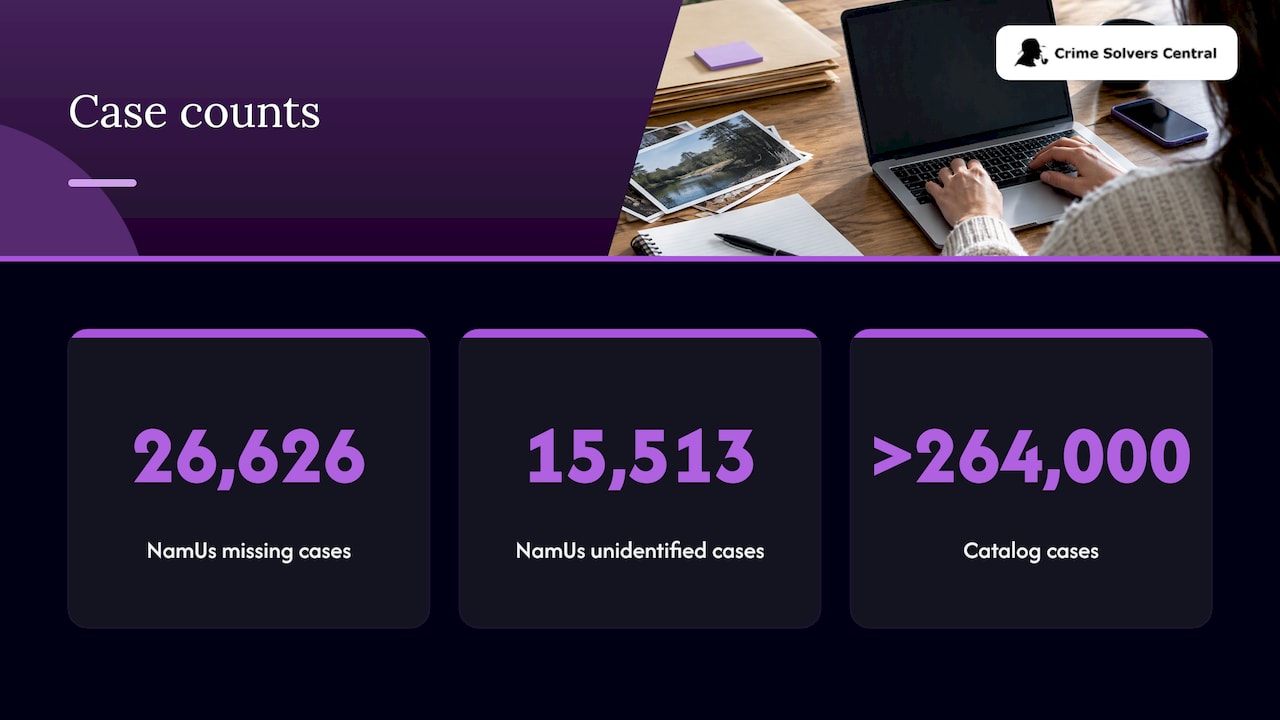
A national case database lets you search across states instead of visiting fifty agency sites. Missing and unidentified person records are also tracked in federal systems. As of June 2026, the NamUs biannual report lists 26,626 active missing persons cases and 15,513 unidentified persons cases. Unidentified remains matter for homicide research because many victims of unsolved killings are first found without a name.
On our own site, you can browse a catalog of more than 264,000 cases sorted by state and type. Our guides on searching unsolved murders by state and where to search a list of unsolved murders are written for first-time researchers.
Why recent cases need a different kind of help
The U.S. Department of Justice says cold case investigations face heavy legal and factual hurdles, which makes prosecution rare. The same Civil Rights Division page says outreach to the public, researchers and advocacy groups matters because their work can identify witnesses and evidence that investigators missed years ago.
In practice, that means the useful public contribution is rarely a theory. It is one of these:
- A memory of a person, a vehicle or a conversation from the time of the crime
- A file you still hold, such as doorbell video, dashcam footage or photos from that night
- A relationship you know about that was never documented
- A willingness to speak now, after circumstances have changed
How to share a tip so it is usable
- Go to the agency that owns the case. Use the phone number or tip line in the original release. Posting in a forum is not a report.
- Write down what you personally saw or heard. Separate it from what you read or were told.
- Keep original files. Portland police asked for raw security video within a narrow window of the crime. Compression or editing can make footage useless for forensic analysis, so send the original file without trimming or reviewing it first.
- Mention the reward only if the agency does. Rewards usually have conditions, such as a tip leading to an arrest, and the agency decides whether a tip qualifies.
- Do not confront anyone. Pass what you know to investigators and let them act on it.
For a longer walkthrough, see our guide to crowdsourcing tips on unsolved homicide cases.
If your family member is missing or unidentified
Families often assume that giving DNA or details to one agency covers every database. It does not. The FBI’s missing persons enrollment sheet explains that fingerprints must be enrolled in the Next Generation Identification system for a match to be possible there. It also says NGI, NamUs and NCIC are separate systems. Ask the investigating agency, in writing, which systems your relative’s information has been entered into. If you are unsure, speak with the detective on the case or a victim advocate at your local prosecutor’s office.
Our perspective
We built Crime Solvers Central because a recent case and a forgotten one often fail for the same reason: the information is scattered. A tip line is in one press release, a reward is on a state site, a family’s flyer is on social media, and none of it connects.
Here is what we have learned from running a national catalog.
- Search by state first, then by situation. Almost every useful lead is local, so we sort our catalog by state and by case type: missing persons, unsolved homicides and unidentified or unclaimed remains.
- Treat every count as a floor. Official systems depend on voluntary reporting. A case missing from a database is not a case that does not exist.
- Pair interest with a tool. Our members use digital evidence boards, a flyer builder, forums and volunteer coordination to organize what they find, so it goes to investigators as a clear tip and not a pile of speculation.
- Respect the victim. These are people with families. We encourage members to share verified case information, not rumor.
We do not replace law enforcement, and we do not solve cases from a keyboard. Our job is to make it easier for the right person to see the right case and know where to send what they know.
— Crime
Using Crime Solvers Central for your search
Browsing summaries is open to everyone. Members unlock full case details, sources, videos, forums, digital evidence boards, a flyer builder, AI image tools and volunteer coordination. Plans on the pricing page:
| Plan | Monthly | Yearly |
|---|---|---|
| Jr. Detective | 3.97 USD | 39 USD |
| Sr. Detective | 9.97 USD | 99 USD |
| True Crime Influencer | 39.97 USD | 399 USD |
If you want to start with a state or a case type, the cold case database is the place to begin.
Related reading
If you want to go deeper after this guide, these pieces cover the next steps:
- Unsolved homicides: cases, clues and cold case truths
- How to collaborate with communities on unsolved crimes
- How to amplify overlooked cold case victims
FAQ
Are there any unsolved murders in 2026?
Yes. New homicides occur every year and some are not cleared. The FBI’s 2025 summary reported 15,522 homicide victims through NIBRS, and the Council on Criminal Justice puts the 2025 clearance rate at 69%, so a substantial share remains open at any time. Recent examples appear on local police newsrooms, such as the Salisbury, North Carolina update from September 2026.
How can I find unsolved murders in my state?
Start with your state bureau of investigation or state police unsolved homicide page, then check your city or county police newsroom. A national catalog sorted by state, such as ours, helps you see cases across agencies in one search. No single list is complete, so use more than one source.
Why do so many murders stay unsolved?
The Department of Justice describes cold case work as facing immense legal and factual hurdles. Evidence degrades, witnesses move or die, and early leads may never have been recorded. Public tips matter because they can bring forward witnesses or evidence that investigators did not have.
Can a reward help solve a recent case?
Sometimes. Rewards are meant to encourage people to share information, and agencies can raise them, as Texas did in the Celia Loya case with up to $6,000 for qualifying tips. They are usually time-limited and conditional, so read the agency’s notice and contact investigators directly.
Sources
- Council on Criminal Justice, Trends in Homicide
- CDC FastStats, Homicide
- FBI, Summary of Reported Crimes in the Nation, 2025
- Newsweek, Map Shows US Missing-Persons Cases by State
- Salisbury Police, Three Unsolved Murder Cases Update
- Portland Police Bureau, Renewed Call for Video
- Texas DPS, Celia Loya cold case
- NamUs Bi-Annual Report, June 2026
- U.S. Department of Justice, Cold Case Initiative
- FBI, Missing Persons Services enrollment sheet