

Recent Missing Persons Cases: Verify Before You Share

The fastest places to check recent missing-person cases are official law enforcement pages, NamUs, and local news outlets covering active investigations. If you have information about a specific case, call local police or submit a tip through the FBI’s tips portal rather than posting it online. Official channels and law enforcement tip lines remain the most reliable way to confirm a status, and sharing unverified claims can slow down an investigation instead of helping it.
TL;DR:
- Report a disappearance to local police immediately; no federal waiting period applies, and prompt NCIC entry can help agencies consider relevant alerts sooner.
- NamUs lets people search cases by name, state, or case number; its verified label means authorities confirmed details, not that the person was found.
- State missing person clearinghouses and the originating police agency often provide fresher local updates than national databases, so check those sources before sharing.
- Most 2025 NCIC entries with a circumstance code were classified as runaway; 88,093 records remained active, out of 498,038 entered that year.
- Before reposting, verify the source and timestamp, avoid personal details or unsupported allegations, and send specific observations privately to the investigating agency.
Table of Contents
- Latest Reported and Trending Cases
- Live Databases and Maps to Search
- How to Report a Missing Person in the First 48 Hours
- How to Follow and Share Updates Responsibly
- High-Profile Ongoing Cases Readers Are Searching For
- Scope and Statistics: NCIC’s 2025 Snapshot Explained
- How the Public Can Help Long-Term and Cold Cases
- Publisher Perspective: Why Public Awareness Helps Investigations
- Crime Solvers Central: A Resource for Following and Organizing Cases
- FAQ
- Sources
Latest Reported and Trending Cases
News cycles move fast, and the cases drawing the most searches change week to week. Below is a snapshot of the kind of recent and ongoing cases that tend to dominate search interest, along with where to find verified updates. Because statuses shift quickly, always check the linked source directly before sharing a case forward.
- Recently reported local disappearances: these typically surface first on a police department’s Facebook page or press release, often within hours of a family filing a report.
- College-campus disappearances: cases involving students tend to generate sustained local and national coverage, with updates posted on campus safety pages and local news sites.
- Child abduction alerts: AMBER Alerts post immediately to state transportation signs, phone alerts, and the NCMEC site, and are usually resolved or updated within days.
- Elderly or at-risk adult cases (Silver/Endangered alerts): these often involve a cognitive or medical condition and are typically resolved faster when agencies issue a public alert quickly.
- Long-term cold cases resurfacing: renewed tips, new forensic technology, or anniversary coverage can reopen public interest in a case that had gone quiet for years.
- Cases involving domestic violence concerns: law enforcement sometimes withholds certain details in these cases for safety reasons, which can make public updates slower or less detailed.
- Multi-jurisdictional cases: when a person is believed to have crossed state lines, updates may come from more than one agency, so checking both the originating department and any state clearinghouse is worthwhile.
For any individual case, the safest approach is to search the name directly on the law enforcement agency’s own site or social media account, then cross-check with NamUs for a verified case profile. National outlets like CNN and NBC affiliate stations also maintain updated case pages for stories they continue to cover, particularly when a case has drawn sustained public attention.
A status label like “active,” “located safe,” or “closed” can change within hours of a tip coming in, so treat any case summary, including this one, as a snapshot rather than a final answer. When in doubt, the agency that issued the original report is the most current source, and most post updates to the same page or account where the case first appeared.
If a case involves a child, NCMEC often maintains a parallel profile with additional identifying details and, in some instances, age-progressed photos. If a case involves an adult, state-level missing-person clearinghouses, which exist in most states, frequently carry more detail than national aggregators. Readers who want a broader view of how missing-person cases are organized by state and category can review our state-by-state missing-person listings for additional context on how these records are structured.
One practical habit: before sharing any case update on social media, check the timestamp on the source. A three-year-old news article resurfacing in a social feed can look current even when the case status has already changed, and sharing it as breaking news creates confusion for families and investigators alike.
Live Databases and Maps to Search
Several public tools let you search missing-person records directly, but they differ in what they cover and how current the information is. Understanding those differences helps you avoid treating an outdated or unverified entry as confirmed fact.
- NamUs, the National Missing and Unidentified Persons System, is a public database where law enforcement agencies and medical examiners enter verified case information. You can search by name, state, age range, or case number, and every listed case includes identifying details that have been confirmed by an investigating agency, which makes it one of the more reliable public-facing resources available.
- NCIC, the National Crime Information Center, is not a public lookup tool. It is a national record system used by law enforcement agencies to share missing-person and unidentified-person data across jurisdictions, and its aggregated statistics, published annually by the FBI, give the public a sense of scale even though individual case files are not browsable by the public.
- Interactive missing-person maps, such as those maintained by nonprofit and advocacy organizations, aggregate publicly reported cases and plot them by location. These maps update on varying schedules depending on the source feeding them, so a marker that looks current may reflect a report filed weeks earlier; always click through to the original source before assuming an entry is up-to-date.
- State missing-person clearinghouses, run by state police or attorney general offices, often carry case details that are more current for in-state cases than national aggregators, since they are the first point of entry for local reports.
When searching any of these tools, use narrow filters first, name plus state or county, then widen the search if nothing appears. A “verified” label on NamUs means a law enforcement agency or medical examiner’s office confirmed the details, not that the case has been solved. If you find information in a public database that seems to connect to an active investigation, the right move is to contact the listed investigator directly rather than posting the connection publicly, since premature public speculation can complicate an active case.
How to Report a Missing Person in the First 48 Hours
There is no federally mandated waiting period before reporting someone missing, contrary to a persistent myth. Report immediately to local law enforcement and ask that the case be entered into NCIC right away, since faster entry allows broader tools like AMBER Alerts to activate sooner when applicable.
The DOJ/OJJDP family survival guide outlines a clear first-48-hours checklist for families, and the core actions apply whether the missing person is a child or an adult:
- Call local police first, not a hotline, since the local department of jurisdiction is the agency that opens the case and requests NCIC entry.
- Gather identifying details: recent photos, physical description, clothing last worn, medical conditions, and any devices or accounts the person uses.
- Preserve potential evidence: avoid cleaning the person’s room or washing clothing, since investigators may need to examine these items later.
- Document every communication, including texts, calls, or social media messages around the time the person was last seen.
- Designate one point of contact for investigators and media, which keeps information consistent and reduces the chance of conflicting statements.
- Contact NCMEC when the missing person is a child, since the organization provides case management support, search assistance, and public awareness tools alongside law enforcement.
- Use the FBI tips portal or ViCAP resources when a case appears to involve interstate elements or signs of foul play, as described in the DOJ action center guidance.
Pro Tip: Keep a physical and digital copy of your missing person’s most recent photo and full description ready before you need it: having it prepared in advance saves critical minutes when speaking with police or media.
Families should also keep a duplicate set of items, such as a similar shirt or a copy of a photo, for public distribution while preserving the originals for investigators, a detail the DOJ guide specifically recommends. For a more detailed walkthrough aimed at families and advocates, our guide on missing children and what families must know expands on each of these steps.
How to Follow and Share Updates Responsibly
Verifying a case update before sharing it protects both the investigation and the family involved. The instinct to help by reposting information is understandable, but unverified details can send tips chasing a false lead or expose a family to unwanted attention during an already difficult time.
Before sharing anything, check whether the update comes from an official source: the local police department, a state missing-person unit, a verified NamUs entry, or a major outlet with direct knowledge of the case. If the only source is a screenshot circulating without attribution, treat it as unconfirmed until you find the original post.
- Avoid posting unverified allegations about a suspect or circumstance that has not been confirmed by investigators.
- Avoid sharing photos from unknown sources, since an incorrect or outdated photo can send public attention toward the wrong person.
- Never post personal data such as a home address, workplace, or medical information, even when it seems helpful, since it can create safety risks for the family.
- Submit tips privately through a police department’s tip line or the FBI tips portal rather than commenting publicly with details you believe are relevant.
- Include specifics when submitting a tip: date, time, location, and anything you directly observed, since vague tips are harder for investigators to act on.
When sharing an official appeal, stick to the language and images the agency provided rather than adding your own theory about what happened. A flyer or alert shared exactly as issued travels further and causes less confusion than one with added commentary.
High-Profile Ongoing Cases Readers Are Searching For
Some long-running missing-person cases remain active in public searches for years after the initial disappearance, often because new coverage or investigative developments reopen interest. The two most-searched examples illustrate how differently these cases can unfold over time.
- Brian Shaffer, an Ohio State University student, disappeared in 2006 after being seen entering a Columbus bar from which he never emerged on surveillance footage. Two decades later, local outlets continue to revisit the case, and recent Dispatch coverage marking 20 years since his disappearance notes the case remains open with investigators still seeking tips.
- Kyron Horman went missing from his Portland-area elementary school in 2010 in what became Oregon’s largest criminal investigation. CNN’s June 2026 reporting describes renewed investigative staffing and the digitization of case files, showing that even 16 years on, the case continues to receive active attention from investigators.
- Renewed local reporting, including NBC4’s coverage of the Shaffer case, shows how podcasts and anniversary journalism can generate fresh tips that get forwarded to the original investigating agency.
For both cases and others like them, the most reliable path to an update is the original investigating agency’s tip line, paired with ongoing coverage from outlets that have maintained direct contact with investigators over the years. A general internet search can surface outdated forum posts or theories with no connection to the actual case file, so sticking to named law enforcement contacts and established news coverage avoids chasing dead ends. Readers interested in a wider set of long-running cases can see our roundup of unsolved missing persons cases for additional background on how these investigations typically progress.
Scope and Statistics: NCIC’s 2025 Snapshot Explained
As of December 31, 2025, NCIC held 88,093 active missing-person records, while 498,038 missing-person records were entered into the system over the course of the year. That gap between active records and total entries reflects how many cases resolve relatively quickly: people are located, records are found to be duplicates, or entries are invalidated, so the active count at year’s end represents only a fraction of everyone reported that year.
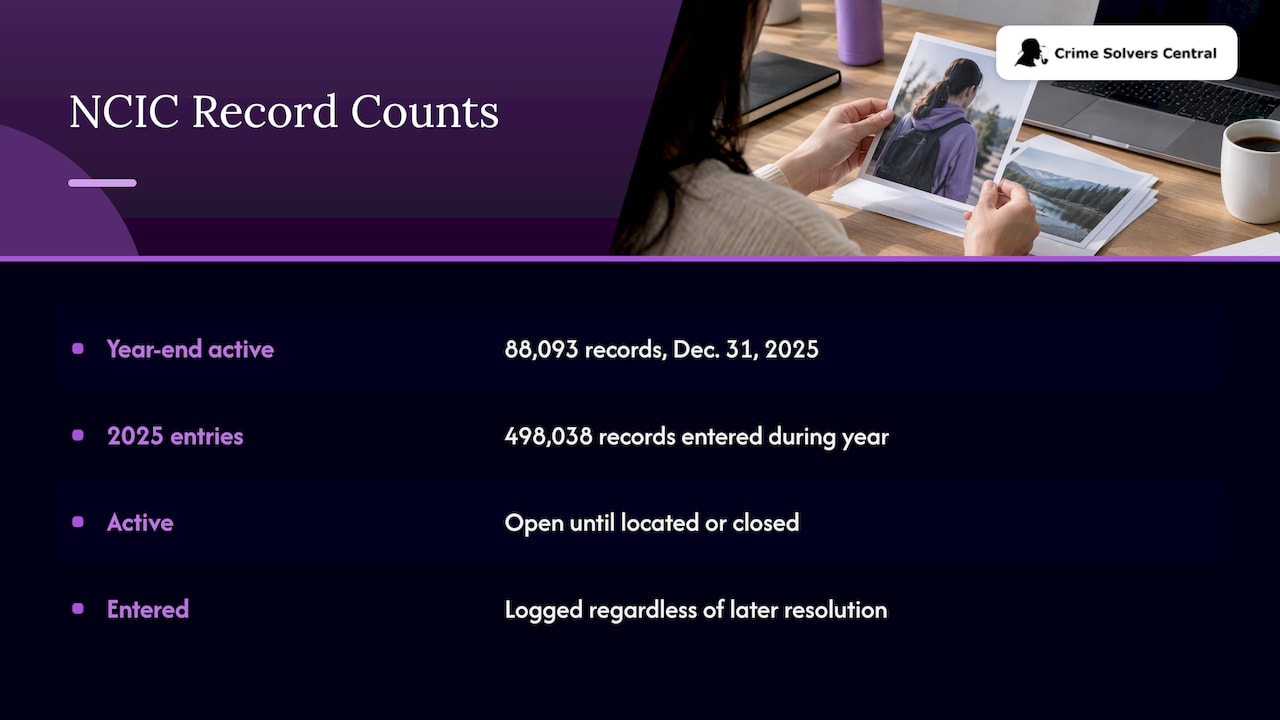
NCIC’s Missing Person Circumstances coding, when applied, shows that the majority of 2025 entries flagged with a circumstance code fell under the “Runaway” category, which shapes how the overall statistics should be read. A large entry count does not mean a large number of long-term, unexplained disappearances; it reflects the full range of reported cases, including many resolved within days.
“Active” means a record remains open in the system because the person has not yet been located or the record has not been otherwise closed. “Entered” simply means a report was filed and logged during the year, regardless of how quickly it was resolved afterward. Understanding that distinction matters when interpreting any headline number about missing persons, since the active total and the annual entry total answer different questions about the same system.
How the Public Can Help Long-Term and Cold Cases
Long-running cases often stay solvable years later because of a single well-documented tip, not a flood of general speculation. Investigators consistently say that precise, verifiable details, a specific date, a location, a direct observation, are more useful than a broad theory about what might have happened.
- Submit tips with specifics: names, dates, locations, and exactly what you saw or heard, rather than general impressions or secondhand rumors.
- Use official tip lines rather than commenting publicly, since a private tip reaches investigators directly and preserves your ability to follow up.
- Volunteer through organized search efforts coordinated by law enforcement rather than conducting independent searches, which can inadvertently disturb evidence or duplicate work already done.
- Support organized case clearinghouses that keep a case visible over months or years, since sustained public attention has, in multiple long-running cases, led to the kind of renewed tips that reopen an investigation.
Pro Tip: If you remember a detail from years ago that you never reported, submit it anyway: cold case investigators regularly reexamine old tips when new forensic technology or leads become available.
For readers who want a concrete way to organize or pass along information, our guide on what investigators find most useful in a tip breaks down the kind of detail that tends to move a case forward versus the kind that tends to get set aside. Families who want guidance on reducing risk in their household more broadly, including when vetting caregivers, may also find this family safety guide on vetting your au pair useful as a general safeguarding resource, independent of any specific case.
Publisher Perspective: Why Public Awareness Helps Investigations
We built our database because cold cases lose momentum when they lose visibility, not because they lose solvability. Every case entered and organized by state keeps a name in front of people who might recognize a detail years later.
Public awareness works best paired with discipline: use official tip lines, respect what families choose to share publicly, and resist the urge to speculate in a comment thread. We compile cases specifically so communities can engage constructively instead of guessing, and that distinction is what keeps a cold case moving toward answers rather than noise.
— Crime
Crime Solvers Central: A Resource for Following and Organizing Cases
Beyond news coverage and official databases, Crime Solvers Central organizes more than 264,000 cold cases by state and category, covering missing persons and unsolved homicides in one searchable catalog. Our membership tools include a flyer builder, digital evidence boards, and volunteer coordination features that complement what you’ll find on NamUs or in a law enforcement press release, giving family members and advocates a place to organize what they learn as a case develops.
Membership starts with the Jr. Detective plan at $3.97 per month, with Sr. Detective and True Crime Influencer tiers available for readers who want deeper access to case files and community features. Visit our pricing page to see which plan fits how closely you want to follow a case.
FAQ
How many missing person cases are there in the US?
As of December 31, 2025, NCIC had 88,093 active missing-person records, with 498,038 records entered during the year. The gap between those two numbers reflects how many cases resolve quickly after being reported.
Was Brian Shaffer ever found?
No, Brian Shaffer’s case remains open two decades after his 2006 disappearance from Columbus, Ohio. Recent coverage marking 20 years since his disappearance confirms investigators are still seeking tips in the case.
What should you do when someone goes missing?
Call local police immediately and request that the case be entered into NCIC, since there is no required waiting period before reporting. Gather recent photos and identifying details, preserve potential evidence like clothing or personal items, and designate one point of contact for investigators and media, following the steps outlined in the DOJ family survival guide.
Has Kyron Horman been found?
No, Kyron Horman has not been found. CNN’s June 2026 reporting on the case notes continued investigative staffing and digitization of case files 16 years after he went missing from his Portland-area school.
Where can I search current missing person listings myself?
NamUs is the main public database for searching verified missing-person cases by name, state, or case number. State missing-person clearinghouses and local law enforcement social media pages often carry more current detail for recently reported, in-state cases.
Sources
- 2025 NCIC missing person and unidentified person statistics
- When your child is missing: family survival guide (5th edition, 2025 update)