

Online Memorial Pages: How to Build One That Does Its Job

An online memorial page is a web page made in memory of a person who has died. Family, friends or a professional can create it, and it collects photos, stories, condolences and service details in one place. If your loved one is missing and has not been found, you need a different page. It is built to bring in tips, it is coordinated with the investigators, and it should not read like a farewell. This guide covers both, and shows where the line between them sits.
TL;DR
- A memorial page is for someone who has died: photos, stories, service details, condolences. A page for a missing person is a search tool and follows different rules.
- If police are involved, coordinate with them before you post anything. Some case details should not be public.
- Public pages can be found by anyone and reused by others. Decide who can see and comment before you publish.
- Use one clear recent photo, a plain description, and the investigating agency’s contact for tips, never your own phone number.
- For unsolved cases, a searchable case database and a flyer builder can extend the reach of what you publish.
Table of Contents
- What an online memorial page is, and what it holds
- Memorial page or search page: which one do you need?
- How to make a memorial page for someone who has died
- How to build a page for a missing person
- Privacy, consent and accuracy
- Where a cold case database fits
- Our perspective
- Membership options
- FAQ
- Sources
What an online memorial page is, and what it holds
A memorial page lives on its own web address. People visit it to remember someone, so it usually carries a life story, a photo gallery, a guestbook for condolences and sometimes a link for donations. It can also share an obituary, service details and updates, and it gives grieving people a place to reconnect.
The reasons families build one vary. Some want to give distant relatives a way to take part. Some want a permanent place that outlasts a social media post. After a suicide, a page can help people remember the person, share hope, raise awareness or raise funds for a cause that mattered to them.
A typical page has these parts:
| Part | What goes in it |
|---|---|
| Header | Name, birth and death dates, location, one primary photo |
| Life story | A short biography or obituary, a timeline of key moments |
| Gallery | Photos and video from different years of the person’s life |
| Tributes | Stories and condolences from visitors |
| Service details | Time, place and livestream link, if there is one |
| Giving | A link to a charity or family fund, if the family wants one |
Memorial page or search page: which one do you need?
The answer depends on one fact: has the person been found?
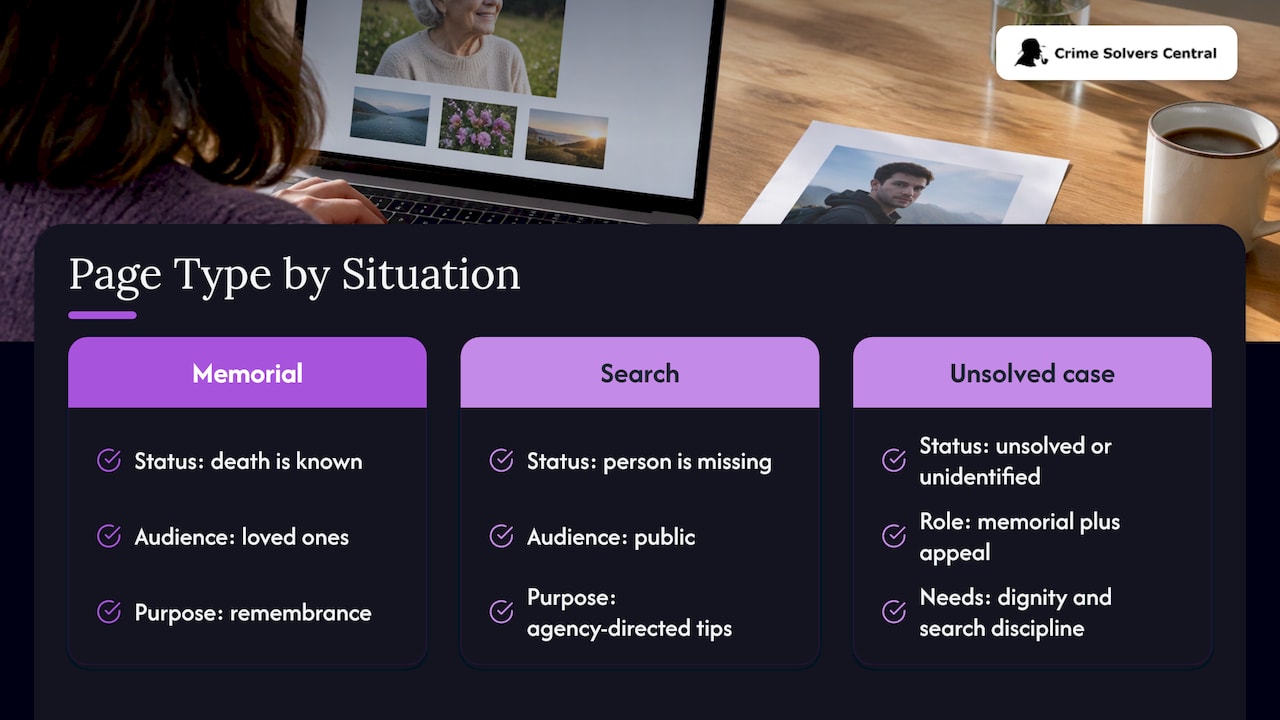
If someone has died and the family knows it, a memorial page is the right tool. Its audience is people who knew and loved the person.
If someone is missing, a memorial page can do harm. It tells readers the search is over, and it fills the page with tributes instead of the facts a stranger needs to recognize the person. The audience of a search page is the public, and its job is to produce a call to the right agency. The U.S. Department of Justice’s Office of Justice Programs (OJP) describes a missing-person search as something coordinated with law enforcement, with public details agreed with investigators and tips sent to police. The same guide treats online sharing as a way to spread awareness and bring the community into the search.
There is a third case: the person has died, but the case is unsolved, or remains are unidentified. Here the page is part memorial, part appeal. It needs the dignity of a memorial and the discipline of a search page. The rules in the sections below apply.
How to make a memorial page for someone who has died
The process is short. Most platforms ask for the same basics.
- Gather the facts. You need the person’s name, birth and death dates, location and your relationship to them. An obituary can come later.
- Choose the primary photo. Add at least one clear photo so visitors know they have reached the right page. Pick a recent, well-lit image where the face is easy to see.
- Write the life story. Aim for a few paragraphs: where the person grew up, what they cared about, who they leave behind. Specifics beat adjectives.
- Decide who can see it. Public or private is the most important setting, and the privacy section below explains why.
- Invite people. Share the page by its public link, by email or on Facebook, and ask relatives and friends to add photos, stories and condolences.
- Set ground rules and moderate. Tell visitors what kinds of posts are welcome, and remove anything that is not.
Where the cause of death is under investigation, leave out personal or death details. More on that below.
How to build a page for a missing person
A page for a missing person follows the same mechanics, but every choice serves recognition and tips. This is where families lose the most time, so it helps to work through it in order.
Start with the investigators
If police are involved, speak to the detective first. Families should coordinate with law enforcement before posting, because there may be case details that should not be shared publicly. Ask which details are safe to publish and which tip line the agency wants the public to use. Our guide to common mistakes in missing persons searches lists the errors that cost families the most time.
Searching for a missing relative is exhausting, and the load is heavy on the people doing it. Families in California who want someone to talk to can look at family therapy in Oakland and Walnut Creek, which offers in-person sessions at those locations and telehealth across the state.
Give the page a search-oriented title
NAMI suggests a heading such as “Find [name]” or “Missing [name]”. That is what a stranger will search for and what they will understand in half a second.
Put identifying facts above the story
NAMI recommends a recent picture and specific details: clothing last seen, physical description, age, glasses or tattoos, and where the person was last seen. OJP’s flyer guidance adds the date of disappearance, identifying marks or scars, and the contact number the law enforcement agency prefers.
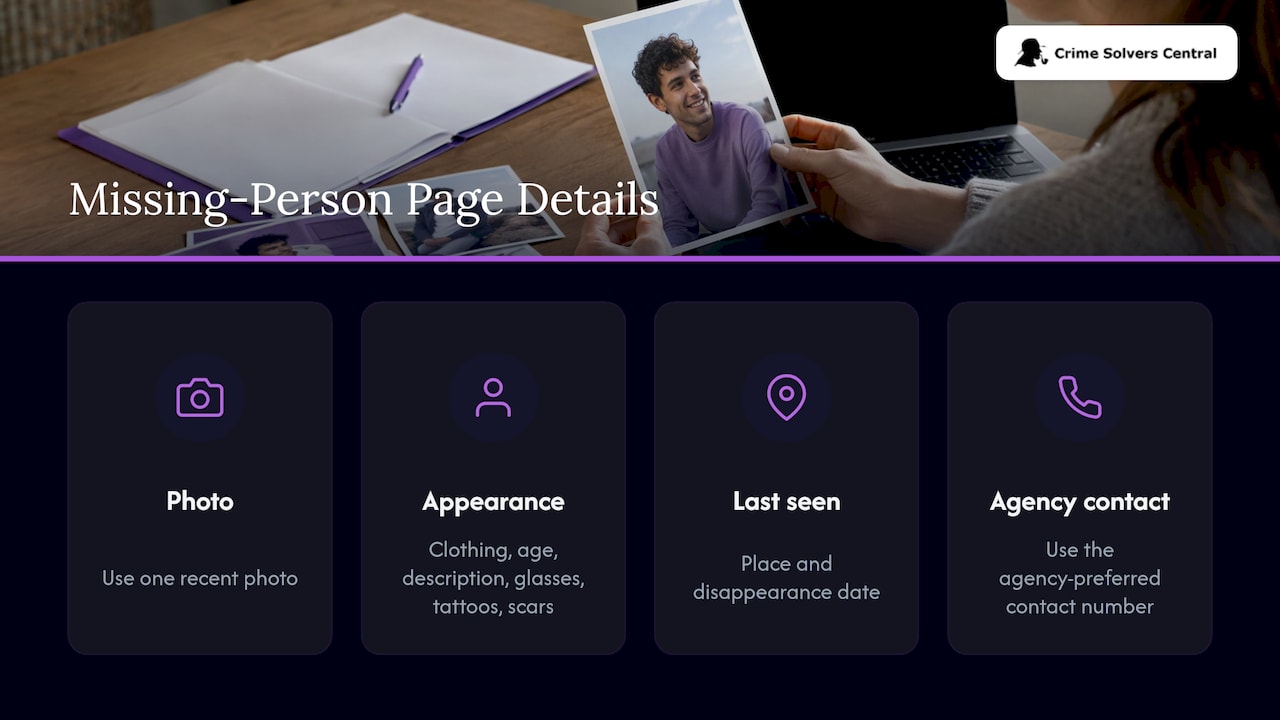
Use one photo. A grid of snapshots makes it harder for a stranger to know which face to look for. Our piece on missing person flyer design explains why, and our flyer builder lets you produce a printable version of the same facts.
Route every tip to the agency
OJP advises using the agency’s non-emergency number or hotline for tips and avoiding publishing personal contact information. NAMI likewise recommends directing people with information to the police department handling the case. Your own phone and email attract well-meaning strangers, false leads and, sometimes, people who want to exploit a family in crisis.
Think about what you reveal about health
NAMI advises careful thought before saying that a missing person has a mental-health condition, and suggests a less revealing description of vulnerability or medical care may be appropriate. Say what a finder needs to know to help safely, and no more.
Keep it current
When the person is found, or the agency changes its request, update the page the same day. A stale page keeps sending tips to the wrong place. Our guide on verifying recent missing persons cases before sharing shows how to check that a post is still accurate before it travels.
Privacy, consent and accuracy
Three questions decide most of the risk.
Who is allowed to see it? Public pages can be opened by anyone, appear in search results, and have photos or messages reused by news outlets without permission. One memorial platform’s privacy notice states that content posted through its services is considered public and may be seen by non-users. Treat anything you post as permanent and visible.
Do you have permission? The same notice says content about a person may be shared only with that person’s consent or the consent of their legal representative. In practice, tell close family before you publish. Samaritans also suggests considering permission, especially where the person who died was under 18.
What should stay off the page? Samaritans recommends avoiding personal or death details, particularly while a police investigation is ongoing. Details that only the person responsible would know can matter to detectives later. Detectives decide which those are, so ask them.
A short checklist before you publish:
- The investigating agency has seen the text and the photo.
- Tips go to the agency’s number, not yours.
- Comments are moderated, with ground rules posted.
- Photos are cleaned of hidden location data. Our guide on stripping EXIF data before sending a tip shows how.
- You have told close family and friends.
Where a cold case database fits
A single page reaches the people who find it. A cold case is different: it can sit unsolved for years, and the people who might know something live in other states. Case profiles organized by state and type let volunteers, researchers and investigators find a case without knowing a link.
If you are searching for a missing relative, the federal route comes first. Register the case, then look at how others are working similar cases. Our guides to registering with NamUs first and to three federal resources for missing persons searches walk through that order. If you want to see how profiles are laid out, our practical guide to finding missing persons cases in the U.S. is the place to start, and the cold case database by state lets you browse them directly.
Those are the audiences that benefit most:
- Families who want their case seen beside others and a way to build a flyer.
- Volunteers who want to read case files and help with coordinated work.
- Law enforcement who want public tips on open cases.
- Students and researchers who want to study patterns across states.
- Justice advocates who want to keep forgotten cases visible.
If you want to write about a case on your own site or blog, our guide to reading, writing and sharing missing persons blogs covers tone and accuracy, and our tips for families and investigators covers what to share.
Our perspective
A memorial page and a search page answer different questions. One says: this is who they were. The other says: this is what they look like, this is where they were last seen, and this is who to call.
Most families we hear from are doing both jobs at once, often with no help. We built Crime Solvers Central around a national database of more than 264,000 cases, sorted by state and by situation, because a case that people can find is a case that can move. Members get full case details, sources and videos, forums, digital evidence boards, a flyer builder, AI image tools and volunteer coordination.
Our site also carries testimonials from people who used these resources, including families reconnected and investigations advanced. Our view is simple: put the facts where the right people can see them, send tips to law enforcement, and let a community stay engaged for as long as a case stays open.
Crime
Membership options
A free page tells your story. Full case files, forums, digital evidence boards, the flyer builder and the AI image tools sit behind a membership. As published on our pricing page:
| Plan | Monthly | Yearly |
|---|---|---|
| Jr. Detective | $3.97 | $39 |
| Sr. Detective | $9.97 | $99 |
| True Crime Influencer | $39.97 | $399 |
Families who only need a printable flyer can go straight to the flyer builder.
FAQ
What is the difference between a memorial page and a tribute page?
The terms are used interchangeably. Both are web pages that collect photos, memories and condolences for someone who has died. Online memorial pages often add an obituary and service details.
Can I make a memorial page for someone who is missing?
It is better to build a search page. A memorial tells visitors the person has died, and it holds tributes instead of the details a stranger needs. Use a title like “Missing [name],” one recent photo, a description, and the agency’s tip line. Ask the investigators before you publish.
Should the page be public or private?
For a memorial, private suits families who want a closed circle of visitors. Public pages can be found in search and have photos and messages reused by others. For a search page, public is the point, but the content should be agreed with law enforcement first.
What should I put on a missing-person page?
A recent photo, the person’s name and age, the date and place last seen, clothing, physical description and identifying marks. Add the contact number the investigating agency prefers. Leave off your own phone number and anything detectives ask you to withhold.
How do I get my loved one’s case in front of more people?
Start with the agency handling it and register the case with federal systems. Then share an accurate flyer and add the case to a searchable database so volunteers and researchers can find it.
Sources
- What Is An Online Memorial?
- How To Create An Online Memorial
- Privacy Notice, May 23, 2025
- Remembering friends or family who have died by suicide in a safe way online, Samaritans
- When a Loved One Goes Missing: Resources for Families, Office of Justice Programs
- Finding a Missing Loved One, NAMI