

NamUs Database Search: A Step-by-Step Family Guide

Search NamUs at namus.nij.ojp.gov to find missing, unidentified, and unclaimed person records across the United States. The fastest first step: go to the site, choose the correct database (Missing, Unidentified, or Unclaimed), and type in a name, state, or approximate age. No account required for a basic search.
- Missing Persons database: search by name, date last seen, state, age, or physical description
- Unidentified Persons database: search by location found, estimated age, sex, and physical characteristics
- Unclaimed Persons database: search for deceased individuals whose identity is known but next of kin has not been located
- Register as a public user to save searches, upload family photos, and submit a case directly
As of 2024, NamUs held 58,252 case records available to families and investigative agencies. That scale means a match could already exist in the system before you even register.
Crimesolverscentral is a complementary resource for amplifying cases and surfacing community leads once you have run your NamUs search.

Table of Contents
- What NamUs is and why it exists
- How to run an effective NamUs database search
- Searching the Unidentified Persons database effectively
- Searching the Missing Persons database and avoiding common pitfalls
- What to do if a NamUs record looks like someone you know
- How to create a NamUs account and submit a case
- NamUs limitations, privacy controls, and data protection
- Analytical and forensic services NamUs offers beyond search
- How Crimesolverscentral complements your NamUs search
- Authoritative resources and key contacts
- Key Takeaways
- Why public participation in NamUs changes outcomes
- Crimesolverscentral: search cold cases by state alongside NamUs
- Useful sources
- FAQ
What NamUs is and why it exists
NamUs is a national repository administered by the National Institute of Justice (NIJ) under the Office of Justice Programs. Its core purpose: centralize missing, unidentified, and unclaimed person records so that investigators, medical examiners, and families can search across state and county lines from a single system.

Before NamUs, a missing person reported in Texas and an unidentified decedent found in Oklahoma might never be connected. Local agencies kept their own records, and cross-jurisdictional matching was slow and inconsistent. NamUs bridges those data gaps by creating a unified, searchable record system that is also the only national database of its kind to allow limited public access.
The three public record types you will encounter:
| Database | Who enters records | What it contains |
|---|---|---|
| Missing Persons | Families, law enforcement | Reports of individuals who have not returned or been located |
| Unidentified Persons | Medical examiners, coroners | Decedents whose identity has not been established |
| Unclaimed Persons | Medical examiners, coroners | Identified decedents with no located next of kin |
Pro Tip: If you are searching for a loved one who disappeared near a state border, run separate searches in both states’ filters. NamUs records are tied to the jurisdiction where the case was entered, not necessarily where the person was last seen.
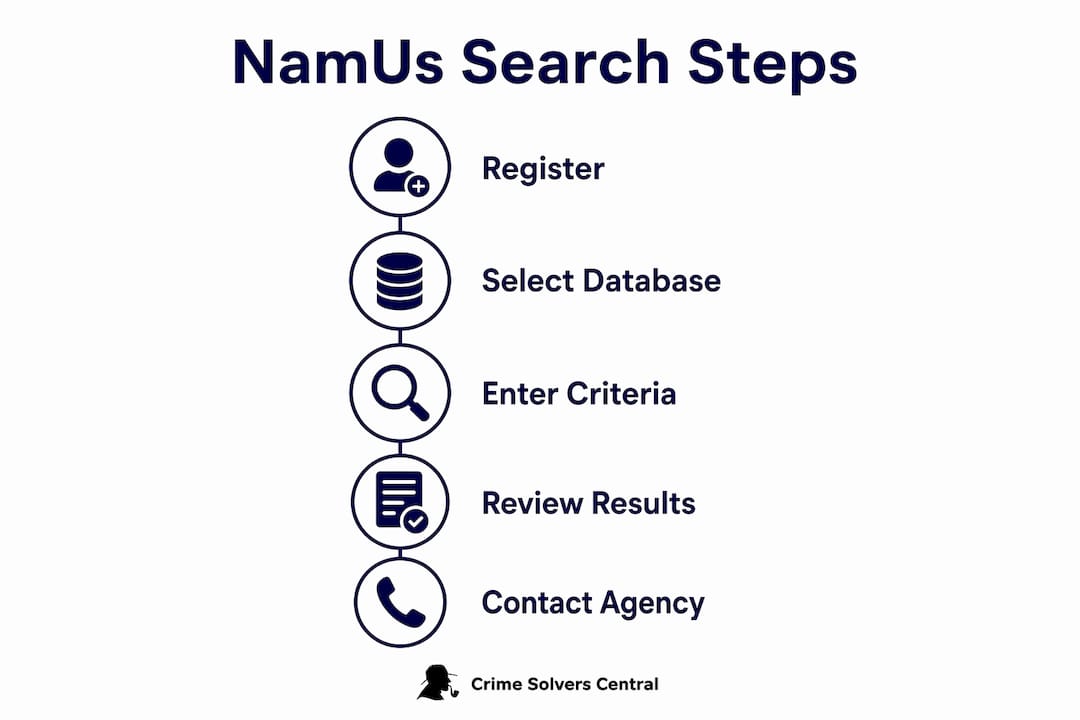
How to run an effective NamUs database search
The search interface at namus.nij.ojp.gov is free and requires no login for basic queries. Here is the workflow that gets results.
-
Choose the right database first. If you are looking for someone who disappeared, start with Missing Persons. If you suspect someone may have died unidentified, go to Unidentified Persons. Do not skip this step — the two databases have entirely different record structures.
-
Run a basic search. Enter whatever you know: a full or partial name, the state where the person was last seen, and an approximate age. Partial information works. NamUs returns all records that match any combination of your inputs.
-
Refine with filters. Once results load, narrow by sex, race, stature, date last seen (or date found for Unidentified), and county. Image thumbnails appear alongside records — scan them carefully, since visual recognition sometimes catches what text fields miss.
-
Use advanced fields for harder cases. The advanced search panel includes circumstance keywords, physical descriptors (hair color, eye color, scars, tattoos), and indicators for dental or fingerprint records on file. These fields are especially useful when a name is unknown or uncertain.
-
Save your search and note case numbers. Registered public users can save search parameters and receive notifications when new records match their criteria. Whether or not you register, write down the NamUs case number for any record that looks promising. You will need it for every follow-up contact.
Pro Tip: Avoid common missing persons search mistakes like searching only the exact legal name. Try nicknames, maiden names, and alternate spellings — NamUs does not auto-correct for spelling variants.
Searching the Unidentified Persons database effectively
Unidentified entries are created by medical examiners and coroners, not families. That distinction changes what you find and how you interpret it.
Each record typically includes the date and location the decedent was found, estimated age range, sex, and physical characteristics. Many entries include photographs of clothing, jewelry, or distinguishing features. Forensic notes on trauma or decomposition stage may appear in some records, though the most sensitive forensic data — fingerprint cards, full dental charts, and lab reports — is restricted to Professional Users such as law enforcement and medical examiners.
The fields most likely to surface a match:
- Date found and county: cross-reference with when and where your loved one was last seen
- Estimated age range: use a wide bracket, since forensic age estimates carry a margin of error
- Sex and race: reliable baseline filters
- Scars, marks, and tattoos: often the most specific identifiers in the database
- Dental and fingerprint indicators: if a record shows these are on file, a professional user can compare them against known records
What you will not see as a public user: law enforcement sensitive (LES) data, full forensic reports, and Social Security numbers. If a record looks like a strong match and you need access to restricted data, the next step is contacting the investigating agency or NamUs regional staff directly — not requesting the files yourself.
Pro Tip: Check why unidentified cases matter for context on how these records move through the system. Understanding the process helps you ask the right questions when you call an agency.
Searching the Missing Persons database and avoiding common pitfalls
Missing entries can be submitted by families or law enforcement, but a record typically requires a confirmed report and a local case number before it is published. That means a case filed with local police but never entered into NamUs simply will not appear — a gap worth knowing before you conclude someone is not in the system.
High-value search signals for Missing Persons records:
- Full name and known aliases or nicknames
- Last-known city, county, and state
- Date last seen (use a range if uncertain)
- Vehicle make, model, and color if the person may have been driving
- Clothing description at last sighting
The most common pitfalls: searching only the state where the person lived (inter-jurisdictional movement is frequent), using only the legal name when a nickname was more commonly used, and entering a precise date of birth when the record may carry a slightly different age. Widen every variable you are uncertain about. A missing persons report guide can help you organize the details before you search.
What to do if a NamUs record looks like someone you know
Finding a possible match is not the moment to act impulsively. Here is the right sequence.
-
Document everything before you do anything else. Record the NamUs case number, the database it appears in, the specific fields that match, and any image references. Screenshot the record if possible.
-
Contact the investigating agency listed on the case page. Every NamUs record shows the agency responsible for the case. Call them directly, identify yourself, provide the NamUs case number, and explain which details you believe match. Be specific — “the tattoo description on the left forearm matches” is more useful than “I think this might be my brother.”
-
If no agency contact is listed, or if you get no response, contact NamUs regional staff. The NamUs program maintains regional coordinators who can facilitate contact between families and investigating agencies. Reach them through the program help desk at namus.nij.ojp.gov.
-
Do not share sensitive personal details publicly. Posting potential matches on social media or community forums before law enforcement has reviewed them can compromise an investigation and cause serious distress to other families.
Pro Tip: When you call an agency, ask whether the case has an assigned detective and request a direct callback number. NamUs case numbers are universally recognized — any agency can pull the record immediately.
How to create a NamUs account and submit a case
NamUs offers two account types with meaningfully different access levels.
Account types:
- Registered Public Users: families, volunteers, and advocacy group staff. Can enter new missing person cases, upload photos, track cases, and view all publicly visible information. Cannot access LES data or forensic records.
- Professional Users: law enforcement, coroners, medical examiners, and forensic specialists. Can view and enter sensitive forensic data, compare dental records and fingerprints, and access CLEAR investigation software.
How to register as a public user:
- Go to namus.nij.ojp.gov and select “Register.”
- Provide your name, email address, and relationship to the case (family member, advocate, or general public).
- Verify your email and complete the profile.
- Once registered, you can submit a new missing person case or add information to an existing one.
Before submitting a case, gather:
- A recent photograph (clear, well-lit, showing the face)
- Full legal name and known aliases
- Date of birth and physical description
- Date last seen and last-known location
- Local law enforcement case number if one exists
Regional System Administrators (RSAs) vet all public entries before they are published. Some states — including New York, New Jersey, Connecticut, and Tennessee — require law enforcement to enter cases into NamUs, which can speed up the vetting process in those jurisdictions. Elsewhere, law enforcement confirmation may be required before a record goes live.
NamUs limitations, privacy controls, and data protection
NamUs is powerful, but it is not a complete picture of every missing or unidentified person in the country. The system relies on voluntary submissions from families, law enforcement, and medical examiners. If a case was never entered by an authorized party, it will not appear — regardless of how well-known it is locally.
What public users can and cannot see:
- Visible to the public: basic case details, physical descriptions, photographs, date and location information, and the investigating agency contact
- Restricted to Professional Users: fingerprint cards, dental records, full forensic reports, Social Security numbers, and law enforcement sensitive case notes
On the data protection side, NamUs operates within OJP SecureCloud and has completed a Privacy Impact Assessment that governs what personally identifiable information is collected, how it is stored, and who can access it. Public users’ personal data is protected under those same controls.
Analytical and forensic services NamUs offers beyond search
A NamUs database search is the starting point, not the ceiling. The program provides active investigative support that goes well beyond a public records query.
| Service | Who benefits | Details |
|---|---|---|
| Cross-database matching | Families, law enforcement | Automated and analyst-driven matching across Missing and Unidentified records |
| DNA kinship testing | Families of the missing | Families can submit reference samples; many were added recently helping generate potential new matches |
| Forensic specialist access | Law enforcement, MEs | Anthropology, odontology, and other specialty consultation |
| Analytical staff queries | Law enforcement | Staff can query additional databases using CLEAR software |
| Training and outreach | All user types | Individualized training, conference presentations, Missing Person Day events |
Key services worth knowing:
- NamUs works with the University of North Texas Center for Human Identification (UNTCHI) to develop nuclear and mitochondrial DNA profiles from unidentified decedents and family reference samples, uploading eligible profiles to CODIS for national searching.
- Smaller jurisdictions often lack in-house forensic resources. NamUs fills that gap by providing access to specialty testing and expert analysis that most county-level agencies cannot fund independently.
- Analytical staff can perform cross-database record-linkage tasks using investigation software not available to the general public, generating leads from disparate data sources.
How Crimesolverscentral complements your NamUs search
NamUs is the official system of record. Crimesolverscentral is a different kind of tool — a community-driven national catalog with over 264,913 cases organized by state and situation, built to amplify cases and surface local knowledge that official databases may not hold.
Practical ways to use both together:
- Run your NamUs search first to check official records, then search Crimesolverscentral’s cold case database to see if the case has community activity, tips, or local coverage
- Share non-sensitive case details with community volunteers through Crimesolverscentral to generate local outreach in the right state
- Use Crimesolverscentral’s state-by-state filters to identify community members or advocates in the jurisdiction where a case is active
Pro Tip: Crimesolverscentral is a complement, not a substitute. All forensic actions, official case updates, and DNA submissions must go through law enforcement and NamUs. Use community tools to amplify awareness, not to conduct independent investigations.
Authoritative resources and key contacts
Official program pages:
- NamUs portal: namus.nij.ojp.gov — search, register, and submit cases
- NIJ NamUs overview: nij.ojp.gov/namus — program context, funding history, and policy background
- DOJ Privacy Impact Assessment: justice.gov/opcl — data protection details and access tier documentation
How to find regional coordinators:
Regional NamUs coordinators are listed on the NamUs site and can be reached through the program help desk. They facilitate contact between families and investigating agencies, assist with case entry, and coordinate Missing Person Day DNA collection events.
When to contact whom:
| Situation | Who to contact |
|---|---|
| Possible match found in NamUs | Investigating agency listed on the case page |
| No agency contact listed | NamUs regional coordinator via program help desk |
| Case not yet in NamUs | Local law enforcement first, then NamUs regional staff |
| DNA reference sample submission | NamUs regional coordinator or UNTCHI through NamUs |
| Disposition or next-of-kin questions | Local medical examiner or funeral service resources |
Key Takeaways
The NamUs database search is free, publicly accessible, and holds tens of thousands of case records — making it the most direct starting point for any missing or unidentified persons inquiry in the United States.
| Point | Details |
|---|---|
| Start at the official portal | Go to namus.nij.ojp.gov, choose the correct database, and run a basic search before registering. |
| Use multiple search signals | Try name variants, nicknames, wide age ranges, and location filters to avoid missing records. |
| Document before you call | Record the NamUs case number and matching fields before contacting any agency. |
| Know what public users cannot see | Forensic records, fingerprints, and LES data are restricted to Professional Users only. |
| Crimesolverscentral extends your reach | Use it to amplify non-sensitive leads and find community contacts in the right state. |
Why public participation in NamUs changes outcomes
The conventional wisdom treats NamUs as a law enforcement tool that families can passively check. That framing undersells what public users actually contribute. When a family submits a photograph, a nickname, or a DNA reference sample, they are creating a new data point that NamUs analytical staff can match against unidentified records. The 170 family DNA reference samples added in 2024 alone represent 170 potential connections that would not exist without family action.
Cross-jurisdictional matching is where NamUs most consistently moves cold cases forward. A case stalled for years at the county level often breaks open once it is visible in a unified system. Public users reduce jurisdictional blind spots simply by entering cases and uploading information that local agencies never had the bandwidth to digitize. The right call is not to wait for law enforcement to act — it is to participate within the system’s structure, collaborate with NamUs staff, and let the program’s analytical tools do what they were built to do.
Crimesolverscentral: search cold cases by state alongside NamUs
When NamUs gives you the official record, Crimesolverscentral gives you the community layer. With over 264,913 cases cataloged by state and situation, the platform connects families and volunteers with local knowledge that official databases rarely capture. You can search the state-by-state cold case index to find community leads, connect with advocates in the right jurisdiction, and amplify non-sensitive case details to people who may have seen something.
The difference from NamUs is straightforward: Crimesolverscentral is community-driven, not forensic. It does not replace official submissions, law enforcement channels, or NamUs case entries. All forensic actions and official updates belong in NamUs and with the investigating agency. What Crimesolverscentral adds is reach — volunteer networks, state-focused outreach, and a community that actively works cases others have forgotten. Search the database today and see whether your case already has community activity behind it.
Useful sources
Official NamUs and NIJ pages:
- NamUs home portal — search, register, and submit cases
- NIJ NamUs program overview — funding history, policy, and program scope
- NamUs FAQ page — common questions answered by program staff
- NamUs fact sheet (PDF) — program capabilities and database overview
- NamUs for Loved Ones of the Missing (NIJ/OJP PDF) — family-focused guide to registration, submission, and DNA reference samples
- NamUs for Law Enforcement (NIJ/OJP PDF) — professional user guide and state entry requirements
- DOJ Privacy Impact Assessment — data protection, access tiers, and PII handling
| Resource | Best used for |
|---|---|
| namus.nij.ojp.gov | Searching records, registering, submitting cases |
| nij.ojp.gov/namus | Program background and NIJ policy context |
| NamUs FAQ | Quick answers on archived cases and account questions |
| NIJ/OJP family PDF | Step-by-step guide for families and DNA submission |
| NIJ/OJP law enforcement PDF | State entry requirements and professional user tools |
| DOJ Privacy Impact Assessment | Understanding data protection and access restrictions |
FAQ
What is the NamUs database?
NamUs (National Missing and Unidentified Persons System) is a national repository administered by the NIJ that centralizes missing, unidentified, and unclaimed person records across the United States. It is free to search and allows limited public access alongside professional tools for law enforcement and medical examiners.
Is NamUs free to use?
Yes. Searching NamUs requires no account and no fee. Registering as a public user to save searches, submit cases, or upload photos is also free.
Who can access the NamUs database?
Both the public and authorized criminal justice professionals can access NamUs. Family members register as public users; law enforcement, coroners, and medical examiners register as Professional Users with access to forensic records and law enforcement sensitive data not visible to the public.
Can I search for unidentified remains on NamUs?
Yes. The Unidentified Persons database is publicly searchable at namus.nij.ojp.gov. Records are entered by medical examiners and coroners and include physical descriptions, photographs of clothing or features, and location data. Sensitive forensic files are restricted to Professional Users.
What should I do if I find a possible match on NamUs?
Record the NamUs case number and the specific matching details, then contact the investigating agency listed on the case page. If no contact is listed, reach the NamUs regional coordinator through the program help desk at namus.nij.ojp.gov.