

Missing Persons in Canada: Where to Search, Report and Help

If you are looking for a missing person in Canada, start with the official sources: the Government of Canada’s cold case and missing persons pages, the national Canada’s Missing website run by the RCMP, and the police service that holds the file. If the person may be in danger right now, call local police first. There is no waiting period. This guide covers where to search, what to tell police, how to send a tip safely and how to help without putting a case at risk.
TL;DR
- Search official listings first: the Government of Canada’s database of missing persons and unidentified remains is the central starting point.
- You do not have to wait before reporting. Canadian police say there is no minimum time, and a child, an elderly person or someone at medical risk is an emergency.
- Send sightings and tips to the investigating police service or to Crime Stoppers at 1-800-222-8477 (TIPS), not to social media threads.
- Talk to police before organizing a private search. Well-meant searches can damage evidence.
- Community case profiles can add context and help you organize what you know, but they never replace the police file.
Table of Contents
- Where to find reliable missing persons information in Canada
- Reporting someone missing in Canada
- Submitting a tip or sighting safely
- Missing children: who supports families
- Long-term cases, DNA and unidentified remains
- How to help without harming the case
- Perspective: why organized community effort matters
- Using Crime Solvers Central alongside official Canadian sources
- A practical checklist for the first 24 hours
- FAQ
- Sources
Where to find reliable missing persons information in Canada
Canada does not have one single public list that every police service feeds automatically, so it helps to know the layers.
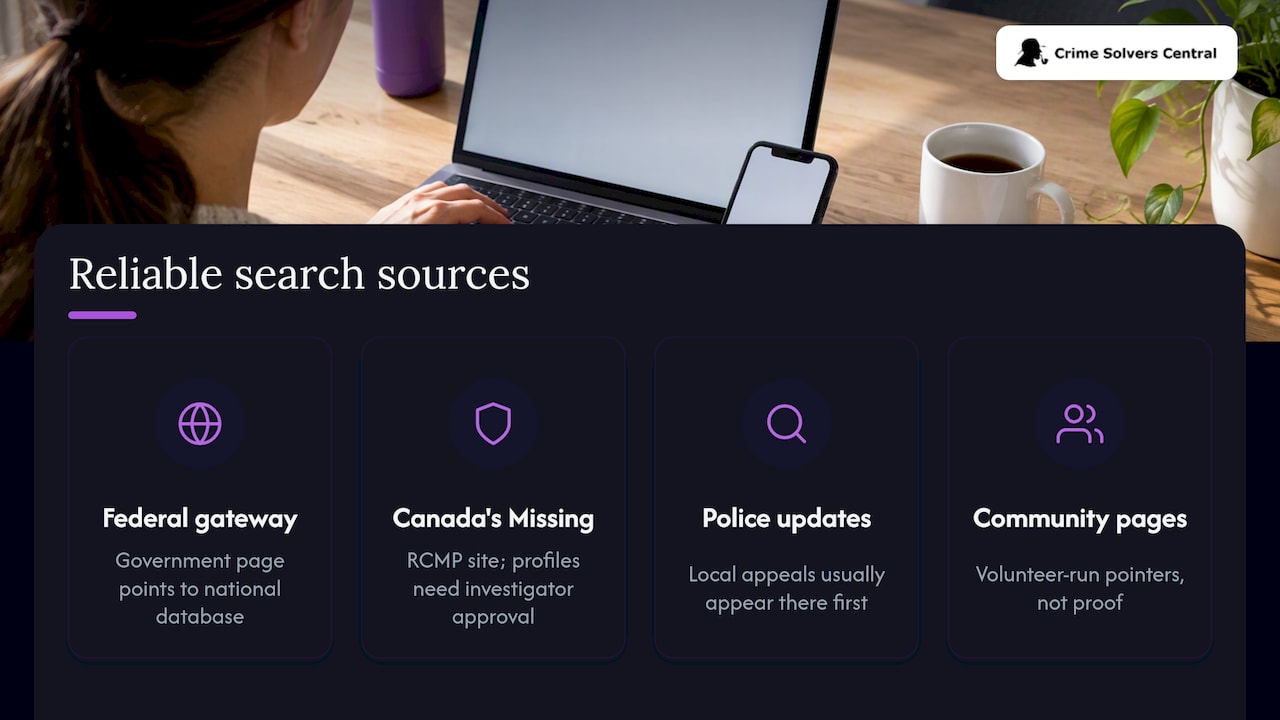
The federal gateway. The Government of Canada’s cold cases, missing, murdered and wanted individuals page points to the national database of missing persons and unidentified remains. Begin there.
Canada’s Missing. This national website is maintained by the RCMP’s National Centre for Missing Persons and Unidentified Remains for all police services. Profiles appear only when the lead investigator asks for publication and decides it is appropriate, according to the RCMP’s guidance for families. So a person’s absence from the site does not mean police are not looking. It can simply mean the investigator has not published the case.
The police service in charge. Municipal, provincial and RCMP detachments each handle files in their own territory. Their own news pages and social accounts are where current appeals usually appear first.
Community pages. Many Canadian cases are also collected by volunteer-run pages and social media groups. They can raise visibility, but treat them as pointers, not proof. More on that below.
How to tell whether a listing or alert is official and current
Before you share or act on a listing, run through five checks:
- Who posted it? An official profile comes from a police service, coroner or medical examiner. The Canada’s Missing site says its profiles originate from those agencies.
- Is there a police contact and file reference? A real appeal names the investigating service. If it only gives a personal phone number or a private message link, be cautious.
- Is the date clear? Sightings and “last seen” details go stale quickly. Re-shared posts often carry old photos and old circumstances.
- Does the same case appear on a police or government page? If you cannot find it there, ask the police service before sharing widely.
- Is anyone asking for money or private data? Official tip channels do not ask you to pay.
Always report new information to police, even if you think someone else already did.
Reporting someone missing in Canada
The rule is simple: report early. The RCMP states that there is no minimum time required before reporting someone missing. It also lists the situations that need immediate police contact: the missing person is a child, is elderly, has a disability or medical risk, or may be in immediate danger for another reason. In those cases, call without delay.
The same guidance notes that the vast majority of missing people are found safely within the first week. That is a reason to report quickly, not a reason to wait and see.
Reporting from the United States
If the person went missing in Canada, contact the police service for the place where they were last seen. If you are not sure which service covers the area, call the local police non-emergency line for that town or the nearest RCMP detachment and ask. If the person lives in the US but disappeared while traveling, also file a report with your local US police so both files can reference each other. Give both agencies the same facts and ask each to note the other’s file number.
What to have ready
The RCMP lists what helps investigators most. Gather these before you call, but do not delay the call if you are missing some:
- Full name and any nicknames
- Physical description
- Last seen location and time
- What they were wearing
- Cellphone number
- Vehicle details, including plate if known
- A recent, clear photograph
- Risk factors such as medical, mental health or cognitive conditions
The RCMP’s best practices for reporting a missing person and its family information page both stress the same list. Our own family guide to missing persons reports walks through what to expect after you file, and our piece on federal resources and what families can share covers the paperwork side.
Submitting a tip or sighting safely
If you have seen something, the public can report sightings or tips directly to the investigating police service or contact Crime Stoppers at 1-800-222-8477 (TIPS) or through its website. Crime Stoppers is the route to use if you want to stay anonymous.
A good tip is specific:
- What you saw or heard, in plain words
- Where and when, as precisely as you can
- How you know, whether you saw it yourself or heard it secondhand
- Any photo or video, kept in its original form
If you are sending images, remove hidden location data first. Our guide to stripping EXIF data before an anonymous tip explains how. For how tips move through our platform, see how to submit a cold case tip and our overview of anonymous tips for families and sleuths.
AMBER Alerts: what to do and not do
If you see a vehicle or person tied to an AMBER Alert, the guidance from the RCMP in British Columbia is to call 9-1-1 immediately and not try to stop the vehicle or apprehend anyone. Your job is to be a witness: note the plate, direction, description and time, and let police act.
Missing children: who supports families
When a child is missing, police lead the investigation, and specialized organizations support the family around it. The RCMP’s family guide names national groups that provide advocacy, support and referrals to resources, among them the Missing Children’s Network, the Missing Children Society of Canada and the Réseau Enfants-Retour. Families can ask the investigating officer which services fit their situation.
Prevention matters too. The RCMP’s Just the facts article on missing and abducted children encourages open family communication and safety planning, particularly for children and youth. Our article on missing children: what families and advocates must know covers the practical steps on our side of the border.
Long-term cases, DNA and unidentified remains
When a case goes cold, it does not close. The RCMP says that once investigative steps are exhausted the file may become less active, but the investigation remains open and new tips are investigated. Files are reviewed periodically as technology evolves.
DNA is one of the biggest tools for these cases. The RCMP created the National Missing Persons DNA Program to support investigations of missing persons and unidentified remains using humanitarian indices in the National DNA Data Bank. Two points families often ask about:
- Privacy. According to the same 2018 Public Safety Canada material, reference samples from relatives are compared only against humanitarian indices, never against crime scene or offender profiles.
- Choice. The RCMP’s family guide to the program says that giving DNA is voluntary and that families may decline without reprisal or fear of discrimination.
If your loved one’s disappearance may be connected to a homicide, read our guide to unsolved murders in Canada and the family action guide for missing and murdered people.
How to help without harming the case
Most people who search for “missing persons Canada” are not family. They are neighbors, volunteers, students or people who saw a poster and want to do something. That impulse is valuable. Here is how to use it well.
Do
- Share official appeals from the police service or Canada’s Missing, with the original wording and contact details intact
- Check the post date before you share
- Send tips to police or Crime Stoppers
- Keep a dated record of anything you learn
Don’t
- Start a private search without talking to police. The RCMP warns that private searches can risk volunteer injury and the contamination, damage or loss of evidence.
- Post unverified rumors or names of suspects
- Confront anyone you suspect
- Edit or crop official posters so the contact details disappear
If you want a structured way to contribute, our safe plan for families and volunteers lays out roles that stay within the law and within police direction. For organized public input on older homicide files, see how to crowdsource tips on unsolved homicide cases.
Perspective: why organized community effort matters
Every family we hear from says the same thing: the hardest part is not knowing where to look. Information is scattered across agencies, provinces and states, and cold cases fade from public view long before they fade from a family’s life.
That is why we built Crime Solvers Central around a searchable national database of more than 264,000 cases, sorted by state and type, covering missing persons, unsolved homicides and unidentified remains. Browsing one organized catalog makes patterns easier to see and a forgotten case easier to find again.
Members go further than reading. They can open full case files with sources and videos, work with digital evidence boards, build flyers, use our A.I. image progression tools, join forums and coordinate with volunteers. We believe informed, organized communities are the best partners a investigation can have, as long as every lead goes to police.
Our members’ testimonials show the result: families reconnected and investigators handed useful information. We hold ourselves to one rule above all: we support law enforcement, we never replace it.
Crime
Using Crime Solvers Central alongside official Canadian sources
Official Canadian sources give you the verified record. Our platform gives you the organizing tools around it: a large, state-by-state case catalog, full case details for members, flyer building and volunteer coordination. If you are following a case that crosses the border, or you want to learn how cold cases are documented, it is a practical place to work from.
On the pricing page, Jr. Detective is $3.97 per month or $39 per year. Sr. Detective is $9.97 per month or $99 per year. True Crime Influencer is $39.97 per month or $399 per year. You can also start from our home page and browse the catalog first.
A practical checklist for the first 24 hours
If someone you know has disappeared in Canada, work in this order:
- Call police where they were last seen. If there is any sign of danger, treat it as an emergency.
- Give the details from the list above and a recent photo.
- Ask for the file number and the name of the investigating officer.
- Write down a timeline: last contact, last known messages, recent worries, plans.
- Secure the person’s belongings and avoid deleting messages or accounts, which may help investigators.
- Ask police before publishing a public appeal, and share only what they approve.
- Ask about family support for children and other cases, so you are not alone.
Then keep the line open. Call with any new detail, however small. Police can only follow what they hear.
FAQ
Is there one official list of all missing persons in Canada?
The Government of Canada points to a national database of missing persons and unidentified remains, and the RCMP maintains Canada’s Missing for all police services. Not every case is published, because the lead investigator decides whether and when to publish. For a specific person, ask the police service that holds the file.
Can I report a missing person in Canada from the United States?
Yes. Contact the police service covering the place where the person was last seen, and also file with your local US police. Share the same details and file numbers with both. Police in Canada say there is no minimum waiting time.
What should I do if I see someone from a missing persons post?
Do not approach them. Report the sighting to the investigating police service or to Crime Stoppers at 1-800-222-8477 (TIPS). During an AMBER Alert, call 9-1-1 and do not try to stop a vehicle.
Do I have to give DNA when a relative is missing?
No. The RCMP says DNA submission is voluntary and that families may choose not to provide it without reprisal. Samples from relatives are compared only against humanitarian indices.
Can volunteers search for a missing person themselves?
Talk to police first. Private searches can put volunteers at risk and can damage or lose evidence. Police can tell you if and how volunteers can help.
Sources
- Government of Canada: Cold cases, missing, murdered and wanted individuals
- RCMP: Information for families of missing persons
- RCMP: Best practices for reporting a missing person
- Canada’s Missing: Reporting
- RCMP: AMBER Alert Program in British Columbia
- RCMP: Just the facts, missing and abducted children
- Public Safety Canada: The National Missing Persons DNA Program
- RCMP: A Family’s Guide to the National Missing Persons DNA Program