

Missing Persons Blog: How to Read, Write and Share Cases
A missing persons blog is a place where cases are kept visible after the first news cycle ends. It can be run by a family, a volunteer group, a state agency or a database like ours. The good ones give readers accurate details, a clear way to report a tip, and a reason to care. The bad ones spread rumors and put families at risk. This guide shows you how to tell them apart and how to write or share a case post responsibly. It also covers what to do first if someone you love is missing right now.
TL;DR
- A useful missing persons post names the investigating agency, gives a case number and a tip route, and uses one clear, recent photo.
- If someone is missing, call 911 and the local police first. Official guidance says no law requires a 24-hour wait.
- Volunteers help most with tips, flyers, phone trees and social media, while law enforcement runs searches.
- Before sharing any post, check the source, the date and the agency. Fake posters circulate often.
- Keep personal phone numbers, addresses and sensitive details off public posts.
Table of Contents
- What a missing persons blog is for
- If someone is missing right now
- What a good case post includes
- How to check whether a post is real
- Writing a post as a family member
- How volunteers can help without getting in the way
- What not to do
- Perspective: why we think a case page should be a working tool
- Using Crime Solvers Central
- Coping while you wait
- FAQ
- Sources
What a missing persons blog is for
People search for this topic for different reasons. Some are families looking for a model to follow. Some are volunteers who want to help. Some are students or true crime readers who want to understand how cases move from a report to a public profile.
A blog does four jobs well:
- It keeps a case alive. Media attention fades quickly. A page that is updated gives the case a permanent home.
- It collects tips in one place. A single, trusted page is better than scattered comment threads.
- It gives facts, not speculation. Dates, descriptions and the agency contact are the core of it.
- It teaches. Good posts explain how reporting works, what NamUs and NCIC are, and what readers can safely do.
Government agencies run versions of this too. Iowa’s Department of Public Safety, for example, says its Missing Person Information Clearinghouse combines law-enforcement data with family-provided photographs and lets users search cases and create downloadable posters. That mix of official identification data and a family’s own photos is a good model for any case page.
If someone is missing right now
A blog comes second. The report comes first.
Report the disappearance immediately to 911 and to the police department nearest the person’s last known location. Washington’s missing persons toolkit states that no law requires you to wait 24 hours. The same toolkit lists what to have ready: identifying and descriptive details, medical information, the circumstances, any risk factors, vehicle information and the last known location.
Then do these things:
- Ask for a case number and write down the officer’s name and badge number.
- Ask the officer to confirm the person has been entered into the National Crime Information Center (NCIC) database. The Colorado Bureau of Investigation lists this as a step families should take.
- Ask investigators before you search the residence yourself or go through social media accounts. The same checklist warns that doing so could harm the investigation.
- Talk to investigators before posting details online, so what you release does not get in the way.
For a longer walkthrough, see our guides on what a missing persons report is and missing person tips for families and investigators. If you want to avoid the errors we see most, read common mistakes in missing persons searches.
What a good case post includes
A post that helps a stranger recognize someone, or help a detective, has a predictable shape. Use this as a checklist whether you are writing a post or judging one.
| Element | What it should look like | Why it matters |
|---|---|---|
| Full name and age | Legal name, any nickname, age at disappearance | Lets readers match records |
| Photo | One clear, recent photo of the face, without heavy filters | NCMEC recommends photos with no filters or objects blocking the face |
| Description | Height, weight, hair, eyes, scars, tattoos, clothing last worn | Helps with sightings |
| Date and place last seen | Exact date, city, state, and the circumstances | Anchors the timeline |
| Vehicle | Make, model, color, plate if applicable | Often the fastest lead |
| Agency and case number | Name of the investigating agency and its case number | Lets readers verify the case |
| Tip route | The agency’s phone line or a hotline | Sends tips where they count |
| Update date | When the post was last checked | Stops old information from circulating |
Two details deserve extra care.
Contact information. NCMEC cautions parents against putting a personal phone number or email address on a poster. Send tips to law enforcement or a hotline instead. The Operation Lady Justice guide for families makes the same point: avoid sharing personal contact information online.
One photo, not ten. A page crowded with images makes recognition harder. Our article on missing person flyers explains why one photo, plus a call to police, works best.
How to check whether a post is real
False posts spread because they are emotional and easy to share. Before you repost anything, run through five checks.
- Find the source. Does the information come from an official law enforcement agency, NCMEC or a credible news outlet? NCMEC’s guide to spotting fake missing child posters lists this as a primary test.
- Look for the agency. A real post names the agency handling the case and gives its phone number or a hotline.
- Read for errors. Misspellings and odd wording are warning signs, according to the same NCMEC guidance.
- Check the date. A child found years ago can still be circulating as missing. If there is no date, treat it with suspicion.
- Look for a clear action. A post that only demands shares, with no tip route, is a red flag.
If you can verify the case, share the official version rather than a screenshot. We go deeper in Recent Missing Persons Cases: Verify Before You Share.
For a case that has been missing a long time, a national record helps. Our guide to 88,093 active NCIC records and how to find missing persons by state shows where to look. If you are working through federal resources, Missing Persons Search: 3 Federal Resources and What Families Can Share is a good next step.
Writing a post as a family member
If you decide to start a page, treat it as a communications job, not a diary. Families who do this well tend to follow a few rules.
Coordinate with the detective first
Oklahoma’s family resource guide advises speaking with the law-enforcement official assigned to the case before media interviews and planning what you will say. The same applies to a blog. Ask what details should stay unpublished. Investigators sometimes hold back facts that only the person responsible would know.
Decide what is public
Operation Lady Justice tells families to decide deliberately what is safe to disclose, to keep sensitive details private, and to name one family member or friend to manage posts. That last step matters. One person with the passwords, one person moderating comments, and one clear voice keep the page consistent.
Moderate the comments
Comment sections attract speculation, accusations and scammers. Turn on comment approval. Delete anything that names a suspect or invents a theory. Never reply to a stranger who asks for money or private details.
Keep updating
An update every few weeks, even a short one, tells readers the case is active. Add the date every time. If law enforcement asks you to take something down, do it.
How volunteers can help without getting in the way
You do not need to be a detective to be useful. Oklahoma’s guide describes trusted volunteers as a resource who can create social media sites, monitor incoming tips, run phone trees, canvass communities and post flyers. It also says physical searches should be supervised and coordinated by law enforcement.
That gives you a clear division of labor:
- Family: decides what is shared, and works with the detective.
- Volunteers: manage accounts, filter incoming information and keep updates current.
- Law enforcement: controls searches and follows up on tips.
Washington’s toolkit adds that local and social media can quickly expand awareness and generate potential sightings, as long as the information is coordinated with the investigating agency.
Volunteer groups run more smoothly when people know their roles and how each person prefers to communicate. A short, practical read on onboarding nonprofit volunteers with one-page cheat sheets shows one way to match people to tasks such as tip monitoring, flyer runs and family updates.
If you want to help a family you do not know, start with listening. Ask what they need. Many families are overwhelmed and will welcome help with flyers, a clean social account or a tip log. Do not start your own parallel search or publish theories.
What not to do
Good intentions cause real harm in missing persons cases. Avoid these.
- Do not name suspects. Accusations can derail an investigation and expose you to legal risk.
- Do not search private property or crime scenes. Searches should be coordinated by law enforcement.
- Do not post tips you cannot verify. Pass them to the agency instead.
- Do not share personal contact details. Use the agency line.
- Do not pay anyone who claims to have information. Report them to police.
Perspective: why we think a case page should be a working tool
We built Crime Solvers Central because too many cases sit in the dark. Our national database holds over 264,913 cold cases, covering missing persons, unsolved homicides and unidentified or unclaimed remains, sorted by state and situation. Our view is simple: a case page is not a memorial and not a rumor board. It is a tool.
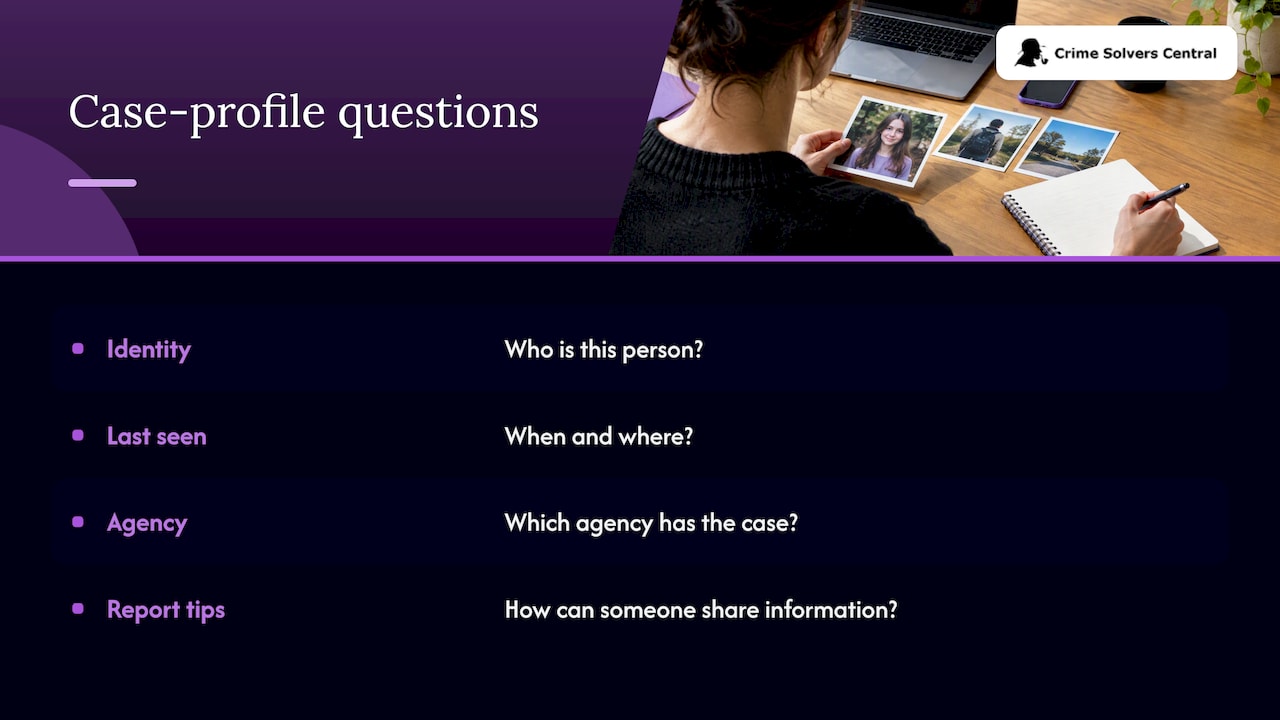
That means every profile should answer the same questions. Who is this person? When and where were they last seen? Which agency has the case? How can someone report what they know? When the answers are clear, a reader who recognizes a detail knows where to send it.
We also believe community help works best when it is organized. Digital evidence boards, volunteer coordination and flyer tools matter because they keep effort focused and keep families from carrying everything alone. Our testimonials reflect that: people have used these resources to reconnect with families and to support law enforcement work. We say this carefully. We do not solve cases for agencies, and no website replaces the detective assigned to a case. What we can do is put accurate information in front of more people and make it easier to share responsibly.
If you are a family member, start with the official report, then use public tools to extend its reach. If you are a volunteer, ask what is needed before you act.
— Crime
Using Crime Solvers Central
You can browse case summaries for free. Full case details, sources, videos, forums, digital evidence boards, a flyer builder and volunteer coordination are for members. Current plans on our pricing page:
| Plan | Monthly | Yearly |
|---|---|---|
| Jr. Detective | $3.97 | $39 |
| Sr. Detective | $9.97 | $99 |
| True Crime Influencer | $39.97 | $399 |
If you are not sure where to begin, look at an example of a case profile or read about us. Families who want to connect with others in similar situations should read our guide to registering with NamUs first, then connecting with vetted families. For related situations, see Missing and Murdered People: A Family Action Guide.
Coping while you wait
People also ask how to cope, and what to say to a family. The honest answer is that there is no formula, but a few practical things help.
- For families: accept help with concrete tasks. Let someone else answer calls, keep a notebook for tips, and handle the page. Sleep and food matter more than they seem to.
- For friends: say you are thinking of them and offer a specific task. Avoid guessing about what happened or promising a happy ending.
- For everyone: keep using the person’s name. Families often say that being remembered is part of what keeps them going.
If the strain is heavy, tell your doctor or a licensed counselor. Many victim assistance programs run through local prosecutors’ offices and police departments, and the detective on your case can tell you what exists near you.
FAQ
Is a missing persons blog a good idea for a family?
It can be, if you coordinate with the detective first and choose one person to run it. Keep personal contact details off the page and send tips to the investigating agency. If investigators ask you to remove something, remove it.
Do I have to wait 24 hours to report someone missing?
No. Washington’s toolkit says no law requires a 24-hour wait. Call 911 and the police department nearest where the person was last seen, then ask for a case number.
How can I tell if a missing person post is fake?
Check whether it comes from law enforcement, NCMEC or a credible news source. Look for the agency name, a phone number, a date, and clean writing. If any of these is missing, do not share it until you have confirmed the case.
How can I help a missing person’s family?
Offer specific help: managing social media, logging tips, running a phone tree or distributing flyers. Keep searches under law enforcement’s direction. Ask the family what they need rather than assuming.
Sources
- DPS Launches New Missing Person Website, Seeks Public’s Assistance (Iowa DPS)
- Missing Indigenous Persons Toolkit (Washington State Patrol)
- Missing Persons Checklist (Colorado Bureau of Investigation)
- Oklahoma Missing Persons Family Resource Guide
- When a Loved One Goes Missing: Resources for Families (Operation Lady Justice)
- NCMEC Poster Creation and Dissemination
- Tips for Spotting Fake Missing Child Posters (NCMEC)