

Where to Search a Missing Children Database Right Now

If a child is missing, your first move is the phone, not a browser tab. Call 911 or your local police immediately, then call the National Center for Missing & Exploited Children hotline, which runs 24/7 and can start forensic and technical support within minutes. Once police are involved, the case can be entered into the National Missing and Unidentified Persons System (NamUs), the main public-facing missing children database, and law enforcement is separately required to log it in the FBI’s NCIC system.
Federal law backs this up directly: under 34 USC 41307, agencies must report missing children under 21 to NCIC and NamUs. While you wait for a case number, start gathering what investigators will ask for.
- Recent, clear photos (face and full body)
- Exact clothing, height, weight, and any identifying marks
- Last known location and time
- Dental or medical records if available
Quick fact: a concentrated six-week federal sweep called Operation We Will Find You 2 located 200 missing children in 2024, showing how fast recoveries happen once the right agencies engage. Crimesolverscentral tracks over 264,913 cold cases nationally and can serve as an additional resource once official channels are underway.
Table of Contents
- Missing Children Database Options: NamUs, NCMEC, and NCIC Compared
- How to Search a National Missing Children Database Effectively
- What You Can Do to Support an Active Search
- Why a Missing Child Might Not Show Up in a Database Yet
- How Crimesolverscentral Fits Alongside Official Systems
- Cross-Border Cases: How Databases and International Agencies Cooperate
- The Role of Facial Recognition and AI in Modern Search Tools
- Do Missing Children Databases Actually Work? What the Numbers Show
- Legal Protections Around a Missing Child’s Data
- Beyond the Database: Counseling and Support for Families
- What Matters Most When You’re Searching
- What the Data Actually Tells Us About Finding Missing Children
- A Faster Way to Organize a Cold Case Search
- Sources
- FAQ
Missing Children Database Options: NamUs, NCMEC, and NCIC Compared
Not every missing children database works the same way, and knowing which one does what saves you time when minutes matter.
NamUs is the closest thing the country has to a true national missing person registry open to the public. Administered by the National Institute of Justice, it lets ordinary users search and, in many cases, submit case information themselves. Professional users, meaning investigators, medical examiners, and coroners, get access to additional forensic fields like dental charts and DNA profiles that stay hidden from public view. That split matters: NamUs is built to cross-match missing person reports against unidentified remains, something no purely local system can do at scale.
NCMEC operates differently. It is not primarily a searchable registry; it is a response organization. Its 24/7 hotline connects families and law enforcement to age progression imaging, digital forensics, and search coordination the moment a child goes missing. Think of NCMEC as the emergency room and NamUs as the medical records system; both matter, but they do different jobs.
NCIC, run by the FBI, is the one database in this trio you cannot access directly. It’s law enforcement only, full stop. Families cannot log in and search it themselves. The only path in is through your local police department, which is exactly why calling police first, before searching anything online, is the correct sequence.
State and local clearinghouses fill in gaps NamUs and NCIC sometimes miss, particularly for:
- Tribal land cases, where jurisdiction can be split between tribal, state, and federal authorities
- Rural counties with slower reporting infrastructure
- Cases still pending official entry into national systems
If a case feels invisible nationally, a state clearinghouse or local sheriff’s office is often where it’s actually sitting.
How to Search a National Missing Children Database Effectively
Searching a missing children database isn’t like Googling a name. The fields matter, and using the wrong ones wastes searches on false negatives.
- Start broad, then narrow. Search full legal name first, then try nicknames, maiden names, or common misspellings. A single transposed letter can hide a match for months.
- Use approximate age ranges, not exact birthdates. NamUs allows date ranges specifically because reported ages are sometimes off by a year, especially in older cases.
- Run a reverse image search on any available photo. This catches cases where a child appears in a database under a different name or location than expected.
- Filter by last-known location and radius, not just city name; children are often found states away from where they disappeared.
- Note clothing and identifying marks in the search notes field if the system allows free text; these details sometimes surface a match faster than demographic data alone.
Forensic identifiers, dental records, fingerprints, DNA profiles, are restricted to investigators for good reason: publishing them widely could compromise an active case or expose sensitive medical information. If you have this documentation, give it to the investigating agency directly rather than trying to attach it to a public record yourself.
Pro Tip: Before submitting a public NamUs entry, call the investigating detective first. Cases entered without coordination sometimes get flagged and delayed during vetting, which slows down the very system meant to help.
Our step-by-step NamUs search guide walks through the submission form field by field if you want a companion checklist while you work.
What You Can Do to Support an Active Search
Public involvement genuinely changes outcomes, but it has to be channeled correctly. Call police for anything urgent or safety-related; call the NCMEC hotline for tips, sightings, or resource requests. Give verifiable facts. Location, time, physical description, not speculation about what happened or private medical guesses that could derail an investigation or hurt a family already in crisis.
Beyond reporting, there’s real work volunteers can do:
- Distribute flyers in high-traffic areas near the last known location
- Organize local search events with coordination from law enforcement, not instead of it
- Run fundraising campaigns to support search costs or reward funds
- Join structured volunteer programs, including Crimesolverscentral’s community initiatives, where efforts stay organized instead of scattered
Genetic genealogy has cracked cases decades old, but it comes with real privacy tradeoffs and should never be a solo project. Peer-reviewed research on cold-case resolution is consistent on this point: genealogy testing works best paired with law enforcement coordination, not as a workaround to it.
Pro Tip: If you’re considering a DNA database submission to help identify a missing relative, loop in the investigating agency before you submit. It keeps the process legally clean and avoids duplicate or conflicting records.
Why a Missing Child Might Not Show Up in a Database Yet
A missing children database is only as current as its inputs, and there are legitimate reasons a case isn’t showing up yet.
- Vetting delays. NamUs entries go through agency verification before going public, which can take days.
- Jurisdictional gaps. Tribal and some rural cases route through separate systems before reaching national databases.
- Sensitive details withheld. Investigators sometimes hold back specifics to protect a minor or preserve the integrity of an active investigation.
- Reporting lag. Not every agency processes NCIC entry on the same timeline, even though 34 USC 41307 requires it for children under 21.
If you believe a case is missing or incomplete, don’t wait it out. Contact the investigating agency directly, or reach out to NamUs or NCMEC staff to ask about status. Persistence from families genuinely moves cases forward faster than passive waiting.
How Crimesolverscentral Fits Alongside Official Systems
Official databases are the backbone of any missing children search, but they aren’t the only resource families and volunteers need. Crimesolverscentral maintains a national cold-case database covering over 264,913 cases, organized by state and by situation, missing persons, unsolved homicides, and unidentified remains alike.
Families searching for a missing loved one often need more than a case number. They need a place to organize flyers, coordinate volunteers, track leads, and stay connected to a community that hasn’t stopped looking. That’s the gap a structured, publisher-backed platform can fill alongside the official systems.
Membership unlocks tools that most public databases don’t offer:
- Full case files with sourced documentation
- Digital evidence boards for organizing leads and tips
- A flyer builder for local distribution campaigns
- Community forums connecting families and volunteers
- Coordinated volunteer and fundraising programs
Families often use Crimesolverscentral to centralize the scattered pieces, social media posts, tip lines, flyer drafts, into one organized hub that’s easier to hand off to investigators or share with the public. It’s a complement to NamUs and NCMEC, not a replacement for the legal reporting process those systems require.
Cross-Border Cases: How Databases and International Agencies Cooperate
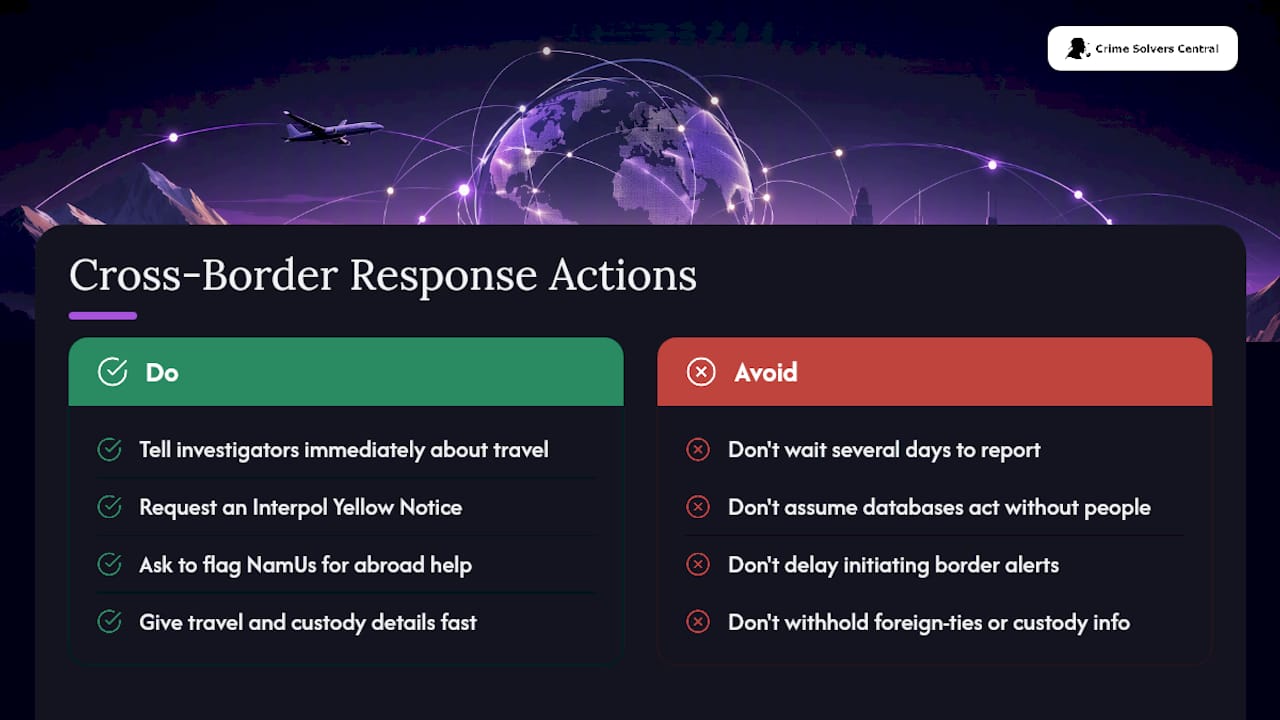
Missing children cases don’t stop at the border, and neither does the response. When a case involves suspected international travel or abduction, U.S. agencies coordinate with international counterparts including Interpol, whose Yellow Notice system flags missing persons across member countries. NCMEC works with the International Centre for Missing & Exploited Children network, which links child protection organizations across dozens of countries so a photo or alert issued in one nation can circulate globally within hours.
This matters because a child who vanishes domestically can cross into another country within a day, especially in custody disputes involving a parent with foreign ties. NamUs entries can be flagged for international coordination, and NCIC records feed into broader law enforcement information sharing that touches border and customs agencies.
The practical reality for families: if there’s any suspicion of international travel, tell investigators immediately, since border alerts and international notices have to be initiated fast to be effective. Waiting even a few days can mean the difference between an alert reaching a border checkpoint in time and missing the window entirely. This is one area where database technology alone accomplishes little without the human coordination between agencies that actually pushes an alert across a border.
The Role of Facial Recognition and AI in Modern Search Tools
Technology has changed what a missing children database can do beyond simple text search. Facial recognition tools now let investigators run a submitted photo against booking records, other case files, and in some jurisdictions, public surveillance footage, dramatically narrowing what used to be manual review.
Age progression software, long a staple of NCMEC’s forensic support, uses AI modeling to predict how a child’s face changes over years, which has helped identify people missing since childhood who are now found as adults. Image enhancement tools sharpen blurry or low-resolution photos submitted by the public, sometimes recovering details investigators can act on directly.
Some platforms, including tools Crimesolverscentral offers to members, use AI-assisted image processing to help clarify old or degraded photos submitted for cold cases, useful when a family’s only photo of a missing loved one is decades old. None of these tools replace investigator judgment. A facial recognition match is a lead, not a confirmation, and every serious system treats it that way. The technology’s real value is speed: narrowing thousands of records down to a handful worth a detective’s time, rather than replacing that detective altogether.
Do Missing Children Databases Actually Work? What the Numbers Show
The honest answer is that databases work best when paired with active human follow-up, not as a passive digital filing cabinet. The clearest evidence of this came from Operation We Will Find You 2, a six-week U.S. Marshals operation in 2024 that located 200 missing children. Of those, 123 were removed from what investigators described as dangerous situations, and 57% were recovered within seven days of the Marshals getting involved.
That speed didn’t come from a database running quietly in the background. It came from dedicated agents cross-referencing database records with fieldwork, tips, and targeted operations in specific cities. The takeaway for families is blunt: entering a case into NamUs is necessary but not sufficient. Recoveries happen when that entry gets combined with active investigation, public tips, and sometimes a concentrated push like the Marshals’ operation.
Resolution rates vary widely by case type. Cases involving abduction by a stranger tend to see faster, more intensive resources deployed than long-term runaway cases, which can linger in databases for years without new leads. What consistently improves the odds, according to NIJ guidance, is families who stay engaged: updating case details, providing new photos, and pushing for DNA or dental record submission when appropriate.
Legal Protections Around a Missing Child’s Data
Storing a missing child’s information in a national database isn’t a free-for-all. Federal reporting requirements under 34 USC 41307 create the obligation to report, but they don’t strip away protections around how that data gets used and shared.
Sensitive details, medical history, custody disputes, abuse allegations tied to the disappearance, are typically restricted to law enforcement and vetted investigators rather than displayed on public-facing records. NamUs draws this line deliberately: the public sees enough to help identify a child, while forensic and case-sensitive fields stay locked to professional users who need them for cross-matching against unidentified remains.
This protects two things at once: the child’s privacy if and when they’re found, and the integrity of an active investigation that could be compromised by premature public disclosure. Families sometimes push back on this, wanting every detail visible in hopes it speeds recovery, but investigators generally have specific reasons for what stays private. If you disagree with what’s been withheld in a specific case, that’s a conversation to have directly with the investigating agency, not something to work around by posting sensitive details independently on social media.
Beyond the Database: Counseling and Support for Families
A missing children database can point you toward answers, but it can’t carry a family through the waiting. NCMEC’s support extends past its hotline into crisis counseling and case management services designed specifically for families of missing children, recognizing that the emotional toll runs parallel to the investigative one.

Local victim advocacy organizations, often connected through police departments or district attorney’s offices, provide grief counseling and practical support, everything from navigating media requests to managing the logistics of an extended search. Support groups connecting families who’ve been through similar experiences offer something databases simply can’t: people who understand exactly what the waiting feels like.
Crimesolverscentral’s community forums serve a similar function for members, connecting families with volunteers and other families navigating cold cases, alongside the platform’s structured case tools. It’s not a substitute for professional counseling, but it fills a gap many families describe as isolating: having somewhere to talk to people who won’t ask you to explain what’s happening from scratch.
If finances are a barrier to counseling, many victim advocacy centers offer services free of charge specifically for families of missing or exploited children. Asking the investigating agency for a referral is often the fastest way to find one.
What Matters Most When You’re Searching
The single most important fact in this whole guide is that no database, by itself, finds a missing child. People do, using the database as one tool among several.
| Point | Details |
|---|---|
| Call first, search second | Police and the NCMEC hotline start official processes a public search cannot trigger alone. |
| NamUs is public, NCIC isn’t | Families can search and enter NamUs cases directly; NCIC requires law enforcement involvement. |
| Speed depends on follow-up | Operation We Will Find You 2 located 200 children in six weeks through active fieldwork, not passive database entry. |
| Coordinate before you act | Genetic genealogy, forensic submissions, and public entries work best when cleared with investigators first. |
| Crimesolverscentral adds structure | Its 264,913-case database and community tools help families organize efforts alongside official systems, not instead of them. |
What the Data Actually Tells Us About Finding Missing Children
The conventional advice on missing children cases tends to stop at “check the database,” as if searching NamUs is the end of what a family or volunteer can do. That’s incomplete, and arguably a little irresponsible. The Marshals’ 2024 operation didn’t succeed because a database quietly did its job; it succeeded because agents used database records as a starting point for active fieldwork, then closed 57% of cases within a week through direct pursuit.
What gets underestimated is persistence. Families who keep pushing, updating case details, providing new photos, following up with investigators, tend to see better outcomes than those who treat a database entry as a finished task. The system rewards engagement, not submission.
What the reader should prioritize first isn’t a specific tool. It’s sequence: police, then hotline, then documentation, then public database entry, coordinated the whole way through with whoever is actually investigating. Skip that order and you risk delays that a perfectly designed database can’t fix.
— Crime
A Faster Way to Organize a Cold Case Search
Official systems handle reporting and forensic matching, but they weren’t built to help a family organize flyers, track volunteer leads, or keep a case visible to the public over months or years. That’s the specific gap Crimesolverscentral fills. Instead of juggling scattered social media posts, printed flyers, and disconnected tip lines, members get a structured cold case database organized by state and case type, alongside a digital evidence board, flyer builder, and community forum built for exactly this kind of sustained effort.
It suits families who’ve already filed with police and NamUs but need a place to keep momentum going, and volunteers who want to plug into an organized search rather than start from scratch. If you’re supporting a case that needs long-term visibility, start by browsing the database by state to see how similar cases are documented, then consider a membership to unlock full case tools and community coordination.
Sources
- National Missing and Unidentified Persons System | National Institute of Justice
- 34 USC 41307 — Reporting requirements (U.S. Code)
- U.S. Marshals find 200 missing children across nation during Operation We Will Find You 2
- National Center for Missing & Exploited Children
- FBI — NCIC
FAQ
Is there a national database for missing children?
Yes. NamUs, administered by the National Institute of Justice, is the primary public-facing national system for missing and unidentified persons, including children. NCMEC and NCIC support it with hotline services and law-enforcement-only records, respectively.
Where did they find the 200 missing children?
The 200 children were located across the country during Operation We Will Find You 2, a six-week U.S. Marshals operation in 2024 that concentrated resources in cities identified as recovery hotspots.
Who is the longest missing child found alive?
Cases vary widely, and specific record-holders change as new cases resolve; the article’s research doesn’t establish a single definitive answer. Verified case details are best confirmed through NamUs or NCMEC’s own case archives rather than general claims.
Did they find 45 missing children in Memphis?
The research behind this guide doesn’t confirm a specific Memphis operation with that figure. The documented multi-city recovery total comes from Operation We Will Find You 2, which located 200 children nationally in 2024, and any city-specific numbers should be verified through official Department of Justice press releases.