

How to Request an Autopsy Report: A U.S. Step-by-Step Guide
You request an autopsy report from the medical examiner or coroner’s office in the jurisdiction where the death occurred, usually with a written form, proof of your relationship to the person who died, and sometimes a fee. There is no single national process. Each county or state office sets its own rules, and whether the report is public or limited to family depends on state law. Families of missing persons and victims of unsolved homicides often wait the longest, because open investigations can hold a report back. This guide walks through the steps in order and shows where requests stall. It also shows how our case database helps you work out where to start.
TL;DR
- Contact the medical examiner or coroner where the death happened or where remains were found. That office holds the report, not the police department and not the hospital.
- Next of kin (spouse, adult child, parent, sibling) can usually get a full report. In some states anyone can, and in others only family, attorneys and insurers.
- Expect to send a form, photo ID and the decedent’s name and date of death. Fees range from nothing to about $75, depending on the office and your relationship.
- Reports often take 90 days or longer. Homicide and other open cases can be held until the investigation or court case ends.
- If you are denied, ask for the specific legal reason, then look at written next-of-kin authorization, a court order or a subpoena.
Table of Contents
- Who can get an autopsy report
- Step 1: Find the office that holds the report
- Step 2: Gather what the office will ask for
- Step 3: Submit the request in the form the office accepts
- Step 4: Plan for fees and waiting time
- Step 5: What to do if the office delays, redacts or denies
- Using the report once you have it
- Where our membership fits
- Our perspective
- FAQ
- Sources
Who can get an autopsy report
An autopsy report is the written findings of the examination: cause and manner of death, injuries, and often toxicology and lab results. Whether you can get one depends on the state, and the differences are large.
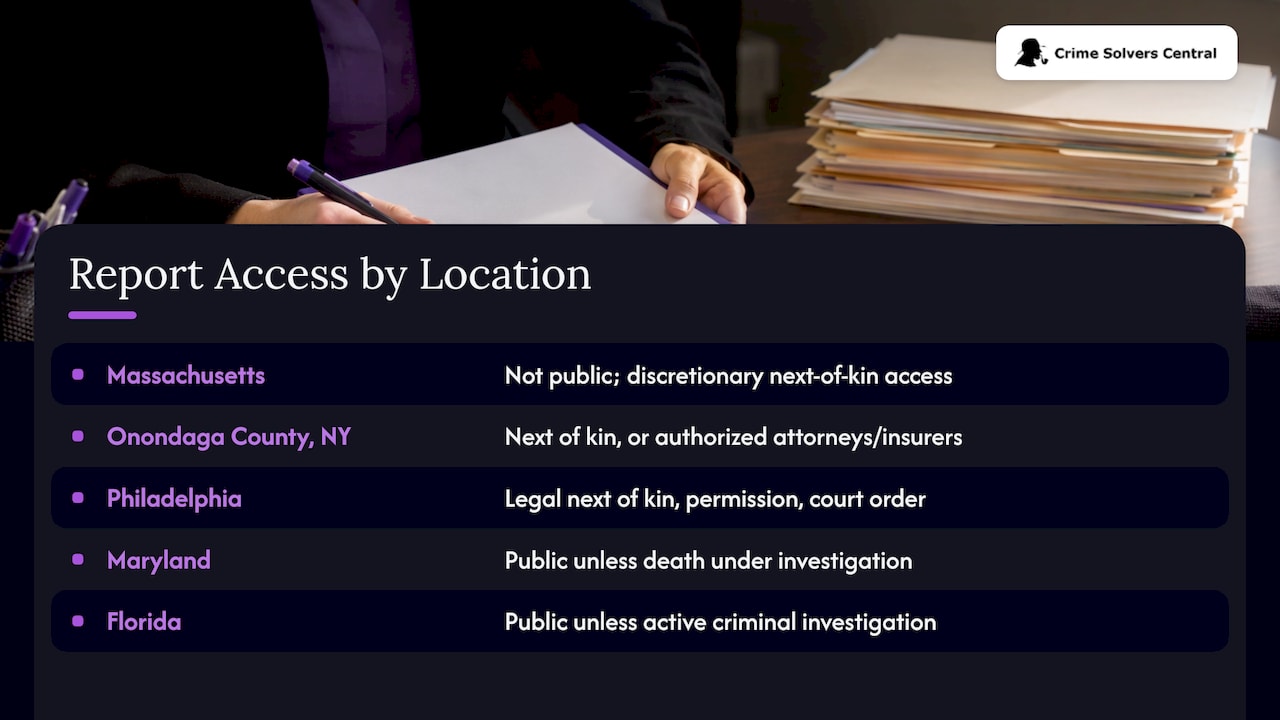
In some places the report is a confidential medical record. Massachusetts’ medical examiner says autopsy reports are not public record. The office may, at its discretion, give a copy to a surviving spouse or next of kin in priority order: spouse, adult children, parents, siblings, grandparents, and then more distant relatives. Onondaga County, New York limits requests to legal next of kin, or to attorneys and insurers holding a signed next-of-kin release. Philadelphia allows legal next of kin, a person or agency with written next-of-kin permission, or anyone with a court order or subpoena.
In other places the rules are looser. Maryland’s Office of the Chief Medical Examiner says an autopsy report is generally a public document unless the death is under investigation. In Florida, District Six’s FAQ explains that medical examiner case files are public record under state law and any person may obtain a copy, except files under active criminal investigation.
The rules also change. Recording Law’s state-by-state survey reports that North Carolina rewrote its law effective October 1, 2025, making the text of an official autopsy report a public record unless it is protected as a criminal-investigation record or involves a decedent under 18. It also reports that Colorado made autopsy reports for deaths of minors confidential for requests on or after January 1, 2025. In Washington, D.C., a 2023 amendment lets the public request ten listed facts about a decedent, such as cause and manner of death, while the full report stays limited to next of kin, notarized authorization holders and court orders.
The practical rule: assume you need to prove you are next of kin, and check the office’s own page to see whether you need to.
Step 1: Find the office that holds the report
The report belongs to the medical examiner or coroner with jurisdiction over the death. That is normally the county where the person died or where the body was found. Florida’s District Six office notes that the place a body is found or brought ashore determines geographic jurisdiction. A few states run a statewide medical examiner system, and some large cities have their own office, as New York City does.
Where it goes wrong: families chase the wrong agency. A police department or sheriff may have an investigative file, but the autopsy report comes from the examiner or coroner. If the person was moved between counties, or the remains were found far from where they were last seen, the responsible office may not be the one nearest your home.
This is where families of missing persons often get stuck. If remains were found and later identified, the jurisdiction is where they were found, which can be a different county or even a different state from where the person disappeared. Our explainer on the role of coroners in unidentified cases shows how these offices handle unidentified remains. If you are searching for a relative who may be among the unclaimed or unidentified, our five search steps for unclaimed bodies cover how to narrow it down. Our database organizes more than 264,000 cases by state and type, so you can look at the cases in the state where remains were found and see which jurisdiction is involved.
Step 2: Gather what the office will ask for
Have this ready before you contact the office. Most requests ask for the same core details:
- The decedent’s full name, date of birth and date of death
- The case number, if you have it (it is often on the death certificate or in a letter from the office)
- Your name, contact details and relationship to the decedent
- Which records you want: the full autopsy report, the toxicology report, the investigator’s report, or all of them
- A copy of your government photo ID
Offices spell out their own lists. Waukesha County, Wisconsin asks for the decedent’s name, date of birth and date of death, your relationship, your preferred delivery method (email or U.S. mail), and which report you want: investigative, examination, or toxicology and laboratory. New York City’s medical examiner asks for the ME case number, date and borough of death, and your relationship. If the report is to be sent to someone else, such as an attorney or insurer, your signature must be notarized.
Where it goes wrong: proving the relationship. If you are a sibling or an adult child, expect to be asked for something showing the link. Where the office uses a priority list, a more senior relative, such as a spouse, may have to authorize the release first. Sort out who in your family is the legal next of kin before you send anything, so the request is not bounced.
Step 3: Submit the request in the form the office accepts
Most offices post a request form on their website. Methods vary:
- Email or mail with a form and ID. King County, Washington requires family members to complete its records request form and email it with a copy of legal photo ID. Connecticut has a next-of-kin records request form that is emailed or mailed, with no payment up front.
- Phone, in person, mail or email. Santa Clara County, California accepts requests in person, by phone, by mail or by email. By mail, include the decedent’s name, date of death, case number and a check for all costs.
- In person with notarized paperwork. In Washington, D.C., next of kin can request the full report in person or by notarized written request.
Keep a copy of everything you send and note the date. If the report is not ready, ask whether the office will hold your request on file. Maryland says pending requests are held until the report is available, which saves you from refiling.
Where it goes wrong: sending a request before the examination is complete, or to an office without checking whether it wants a notarized signature. Both cost weeks.
Step 4: Plan for fees and waiting time
Costs are modest but inconsistent. These published examples show the range:
| Office | Who pays what | Typical timing |
|---|---|---|
| Washington, D.C. | $15 for family, $75 for private organizations | Released only to next of kin, authorization holders or by court order |
| Philadelphia | $35 for autopsy and toxicology reports, $50 for a complete case file, $8 per histology slide | Not stated on the request page |
| Connecticut | $40 per case, plus $10 for a certified copy; invoiced when the report is complete | Sent within 24 hours of payment |
| Maryland | No fee for first-degree family, $50 for others | About 90% of written reports within 90 days of the cause and manner determination |
| Onondaga County, NY | No charge to next of kin unless the record is more than 5 years old, then a $150 prepayment | About 90 days from the autopsy, longer if more testing is needed |
| King County, WA | Paid by electronic link, with card or e-check processing fees | 4 to 6 months for current cases, 3 to 5 business days for completed cases |
Fees and timelines change, so confirm the amount on the office’s page before you pay. In Florida, District Six provides autopsy reports free to immediate next of kin, among others, and charges per page for broader public-records requests.
The wait is the part families find hardest. Santa Clara County says reports can take 3 to 6 months, and that homicide reports are not available until the case is adjudicated. Complex cases with extra toxicology or specialist consultation take longer than simple ones. Our guide to common delays in missing persons reports explains why paperwork in these cases often runs slower than families expect.
Step 5: What to do if the office delays, redacts or denies
A denial is not always the end. Start by asking in writing what the legal basis is and when the restriction is expected to lift.
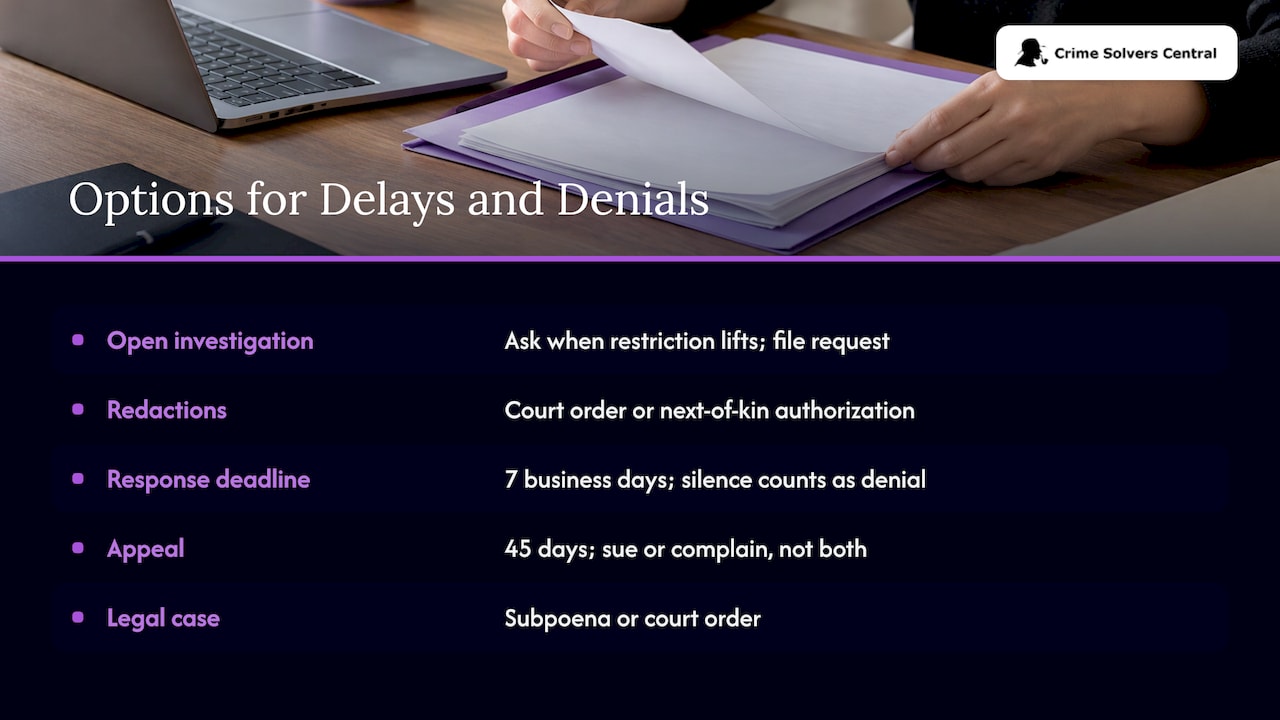
Open investigations. Many offices hold reports while a case is open. Massachusetts requires district attorney approval for release in open law-enforcement cases. Florida’s exemption for active criminal investigations applies until the designation is lifted. Ask the office to put your request on file and tell you when the hold ends.
Redactions. Some reports arrive with information blacked out. Clark County, Nevada redacts private contact, medical and health information unrelated to cause and manner of death in public-records responses. It says an unredacted report requires a court order or written authorization from the legal next of kin. If you are the next of kin, ask whether a signed authorization gets you the full version.
Public-records requests that go unanswered. Where the report is a public record, state open-records law sets deadlines. In New Jersey, the Government Records Council’s guide to OPRA says custodians must respond within 7 business days. A denial must state the lawful reason, and silence counts as a denial. A requester can then sue in Superior Court or file a complaint with the council within 45 calendar days, but not both. Other states have their own deadlines and appeal paths, so check yours.
Subpoena or court order. When an office will not release a report to you but a legal case is underway, a subpoena or court order is the standard route. Philadelphia and D.C. both list these among the ways to obtain records. This is a point to take to an attorney licensed in the state where the death occurred.
If the death is a homicide and the case is cold, remember that the report you want may be in a file that has not been opened to the public for years. The state-by-state differences in this step are why we built our playbook for searching unsolved murders ethically.
Using the report once you have it
An autopsy report is dense. It lists the external and internal findings, then the cause and manner of death. For families working on a cold case, the useful parts are usually the time-of-death estimate, the injuries described, any identifying features (tattoos, scars, dental work) and the toxicology results. These details can be compared against what is known about a missing person or an unidentified case.
Take care with what you share. Autopsy reports contain private medical information, and sharing them publicly can hurt other family members or compromise an investigation. Give new details to the investigating agency first. Our overview of the missing and murdered database landscape explains where families can place information so investigators see it.
Where our membership fits
Requesting the report is one task. Making sense of a cold case is another, and that is what our members do on the platform. Members unlock full case details, sources, videos, forums, digital evidence boards and a flyer builder. The searchable database covers missing persons, unsolved homicides and unidentified or unclaimed remains, and each case is sorted by state and type.
Two plans suit most families. The Jr. Detective plan is $3.97 per month or $39 per year. The Sr. Detective plan is $9.97 per month or $99 per year. A True Crime Influencer plan is also available, at $39.97 per month or $399 per year. If you have an autopsy report in hand and want to place it in context with a case profile, you can see the membership plans.
Our perspective
Families usually come to us after the hardest part has already happened. The official paperwork is slow, the rules change at every county line, and no one office sees the whole picture.
We built Crime Solvers Central around that gap. A national database of more than 264,000 cases, sorted by state and by situation, means a family can see which cases sit in the jurisdiction where remains were found, and which unidentified or unsolved cases might connect to theirs.
An autopsy report is one piece of evidence. Our members put it alongside case profiles, sources and community leads, use digital evidence boards to organize what they know, and build flyers that keep a name in front of people. Our testimonials show what that can lead to: families reconnected and investigators with new tips.
Request the report from the right office, keep your paperwork in order, and bring what you learn into a community that is working on the same problem.
Crime
FAQ
Can anyone get someone’s autopsy report?
It depends on the state. In places such as Massachusetts, New York’s Onondaga County and Philadelphia, reports go only to next of kin or people they authorize, or to those with a court order. In Florida and Maryland, reports are generally public unless the death is under investigation. Check the office’s page in the state where the death occurred.
Who is considered next of kin?
Definitions vary. Connecticut defines legal next of kin as a legal parent, sibling, spouse, or child 18 or older. Massachusetts uses a priority order running from spouse and adult children to parents, siblings and more distant relatives. Ask the office which relationships it accepts and in what order.
How long does an autopsy report take?
Often about 90 days, according to offices in Massachusetts, Maryland and Onondaga County, and longer when additional testing is needed. Santa Clara County says up to 3 to 6 months, and King County gives 4 to 6 months for current cases. Homicide reports may wait until the case is adjudicated.
What if the office says the case is still open?
Ask to have your request held on file and ask when the restriction is expected to end. If you need the report sooner for a legal matter, an attorney in that state can advise on a subpoena or court order.
Does a request cost money?
Sometimes. Maryland charges nothing to first-degree family. Washington, D.C. charges family $15, and Philadelphia charges $35 for autopsy and toxicology reports. Check the current fee on the office’s page before sending payment.
Sources
- Request a Copy of an Autopsy Report, Families | Mass.gov
- Autopsy Reports Requests, Onondaga County Medical Examiner’s Office
- Request Medical Examiner records, City of Philadelphia
- Autopsy Reports, Maryland Office of the Chief Medical Examiner
- District Six Medical Examiner FAQs
- District Six Medical Examiner Records Request and Fees
- Are Autopsies Public Records? Recording Law
- Request Documents, DC Office of the Chief Medical Examiner
- Report Requests, Waukesha County Medical Examiner
- Autopsy Report, NYC311
- Medical examiner records requests, King County
- Attorney Information, Connecticut Office of the Chief Medical Examiner
- Reports, Santa Clara County Medical Examiner-Coroner
- FAQs, Clark County Coroner/Medical Examiner
- A Citizen’s Guide to OPRA, New Jersey Government Records Council