

4 Priority Actions That Help Solve Crime Online Ethically

The fastest way to help solve crime online is to submit tips through official channels like NamUs or a case’s assigned tip line, document any digital clues with basic verification before sharing them, and join a reputable case database like Crime Solvers Central to organize your research where investigators can actually find it. Skip the speculation and the suspect naming. Structured, verified information moves cases forward; theories posted for engagement do not.
TL;DR:
- Submitting verified tips through official channels like NamUs and crime tip lines significantly increases the chances of advancing cold cases.
- Verifying digital clues using reverse image searches, metadata, and source tracing prevents misinformation from diverting investigations.
- Ethical guidelines prohibit doxing, naming suspects without charges, and unauthorized contact with victims’ families to avoid legal and moral harm.
- Trusted databases such as NamUs, The Doe Network, and open records requests are essential for credible research, unlike consumer DNA kits or scattered online forums.
- Cases actively soliciting public help feature clear signals like official outreach, public pleas, or open records, while undisclosed investigations should not be disrupted.
Table of Contents
- Prioritized Ways to Help Solve Crime Online Today
- How Do You Verify Digital Clues Before Sharing Them?
- What Are the Ethical and Legal Limits for Citizen Investigators?
- Which Databases and Records Should You Actually Trust?
- How Do You Submit a Tip Investigators Will Actually Use?
- What Can Genetic Genealogy Actually Do for a Cold Case?
- Which Cases Actually Want Public Help?
- Why This Kind of Volunteer Work Actually Moves Cases Forward
- Join a Community Built for Serious Cold Case Work
- Sources
- FAQ
Prioritized Ways to Help Solve Crime Online Today
Not every task carries equal weight. If you have an hour tonight, here’s the order that actually helps:
- Find the official tip channel first. Every case has one, whether it’s a state clearinghouse, an FBI field office tip line, or a detective’s direct line listed on the agency’s cold case page. Submit there before anywhere else.
- Add verified details to a structured case record, including a timeline, dated sources, and links to original documents. Vague theories aren’t useful. A verified timeline with citations is.
- Publicize responsibly. Share official flyers and verified images with a link back to the agency’s tip line. Never build your own narrative around a case, and never name a suspect who hasn’t been charged.
- Take on archival work. Digitizing microfilm, requesting open records, transcribing old case files, and moderating a forum for accuracy sound unglamorous, but these tasks give investigators material they can actually cite.
Volunteers who focus on documentation over speculation tend to produce work that agencies keep using, according to guidance from National Cold Case Month, which frames tasks like records requests and case publicity as core citizen contributions.
How Do You Verify Digital Clues Before Sharing Them?
Investigators trust three checks: technical, content, and source. Run all three before you post anything.
- Technical check: Reverse image search a photo (Google Images or TinEye) to see where it’s appeared before. Pull metadata with a free EXIF viewer to confirm when and where an image was actually taken.
- Content check: Look for internal inconsistencies. Does the weather in the photo match the reported date? Do shadows and lighting match the claimed time of day?
- Source check: Trace who posted the material first and whether that account has a history of accuracy or fabrication.
This layered approach mirrors the framework used in open-source investigation ethics, which recommends verifying digital content across all three dimensions before treating it as evidence.
Pro Tip: Keep a dated log for every source you check: the URL, the date you accessed it, and a one-line note on whether it’s confirmed fact or your own inference. That single habit is what separates a usable tip from noise.
What Are the Ethical and Legal Limits for Citizen Investigators?
Enthusiasm without restraint is how well-meaning volunteers end up causing real harm. Some lines should never be crossed:
- Never dox anyone, including people who seem suspicious. Publishing someone’s home address or workplace based on a hunch can ruin an innocent life.
- Never publicly name a suspect who hasn’t been charged. Misidentification has derailed real investigations and destroyed reputations.
- Never contact victims’ families directly unless they’ve explicitly opened themselves to outreach. Grief is not a research opportunity.
- Understand that hacking into accounts or systems, even to “help,” can expose you to liability under laws like the Computer Fraud and Abuse Act, and that defamation risk varies by state, so when in doubt, ask an attorney rather than assume you’re in the clear.
Ethical guidance for online investigators consistently warns against vigilante behavior and stresses transparency about your methods instead of certainty about your conclusions, per MIT Technology Review’s guide to ethical online investigating. Cold case material is often disturbing. If you find yourself losing sleep or fixating on a case, step back and talk to someone. This work should never cost you your own well-being.
Which Databases and Records Should You Actually Trust?
Not every resource serves the same purpose, and using the wrong one wastes your time.
- NamUs is the go-to for missing persons cases and unidentified remains, run with federal support and searchable by state, age, and physical description.
- The Doe Network focuses specifically on unidentified remains and long-term missing persons, often cross-referencing cases NamUs also tracks.
- State open records requests (FOIA equivalents) get you original documents: police reports, autopsy summaries, court filings. These beat secondhand summaries every time because they’re the primary source.
- Crime Solvers Central’s state-by-state case catalog lets you search organized case profiles instead of hunting across scattered forums.
Skip consumer DNA kits if you’re trying to contribute forensic-grade evidence. They’re built for ancestry curiosity, not chain-of-custody standards, which matters a lot once law enforcement gets involved.
How Do You Submit a Tip Investigators Will Actually Use?
A tip buried in speculation gets ignored. A tip with a clear structure gets read.
- Identify the right contact. Look for a cold case unit, the assigned detective, or the nearest FBI field office if the case crosses state lines. Most agencies list a dedicated tip line on their website.
- Build a chronology. Lay out what happened, in order, with dates attached to each event.
- Link your sources. Every claim should trace back to an original document, article, or verified image, not a screenshot of someone else’s opinion.
- Separate fact from inference. Say clearly which parts are confirmed and which are your own reasoning.
- Leave physical evidence alone. If you find something that seems like actual evidence, don’t handle it. Civilians can break chain of custody in ways that make evidence inadmissible later, so call it in and let trained personnel collect it.
What Can Genetic Genealogy Actually Do for a Cold Case?
Consumer ancestry matches and forensic-grade DNA testing are not the same thing, and mixing them up creates real problems.
- A match on a consumer platform like 23andMe or AncestryDNA can suggest a family connection but carries no evidentiary weight in court.
- Uploading someone else’s DNA sample without their consent raises serious privacy issues, even when your intentions are good.
- Legal and forensic DNA testing requires proper chain-of-custody protocols that consumer kits were never designed to meet.
- Opt-in public genealogy programs, the kind National Cold Case Month highlights as a legitimate volunteer role, let you become a “genetic witness” without crossing consent lines.
If your research turns up a promising genetic lead, hand it off to a credentialed genealogy project or the investigating agency. That’s where it becomes usable rather than just interesting.
Which Cases Actually Want Public Help?
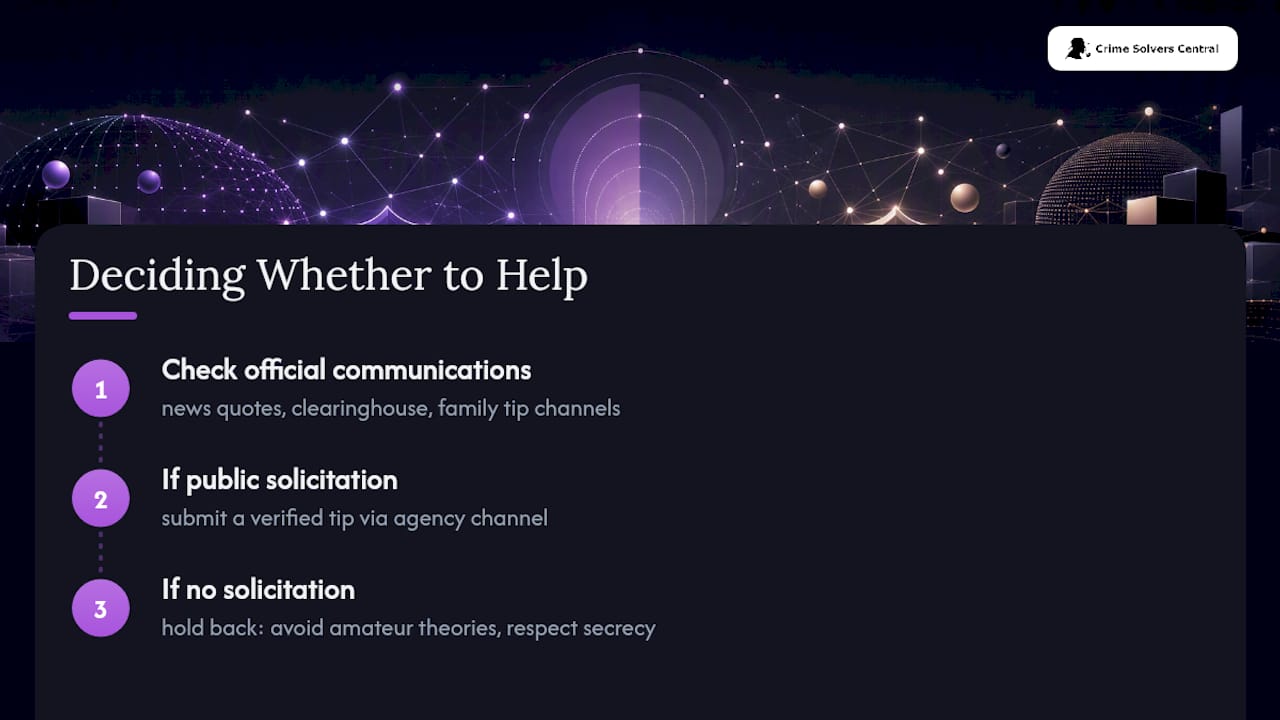
Not every cold case benefits from a crowd. Some investigations are actively closed to outside input because premature publicity can tip off a suspect or contaminate a witness’s memory. The cases where your effort pays off are the ones where an agency has explicitly asked for it: a posted tip line, a public plea for information, an open records request that’s been approved, or a case featured in a program like National Cold Case Month.
Look for signals that the door is open. A detective quoted in local news asking the public to come forward. A state clearinghouse actively promoting a case profile. A family that has set up an official channel for tips, distinct from their personal social media. These are invitations, not just information.
Cases with no public solicitation, ongoing grand jury proceedings, or active undercover work deserve a different kind of respect: distance. Piling on with amateur theories when investigators haven’t asked for input can create false leads that waste real investigative hours, or worse, alert a suspect that they’re being watched. If you’re unsure whether a case welcomes outside help, check the agency’s own communications before assuming your contribution is wanted. The goal is to add signal, not noise, and that starts with reading the room before you start digging.
Why This Kind of Volunteer Work Actually Moves Cases Forward
A large number of cases are cataloged across states and situations on Crime Solvers Central, reflecting how coordinated, documented volunteer research produces leads that scattered social media speculation never will. Deeper training lives in guides like how to collaborate with online crime-solving communities. Civilian contributions matter most when they’re disciplined, verified, and routed through official channels, not when they go viral.
— Crime
Join a Community Built for Serious Cold Case Work
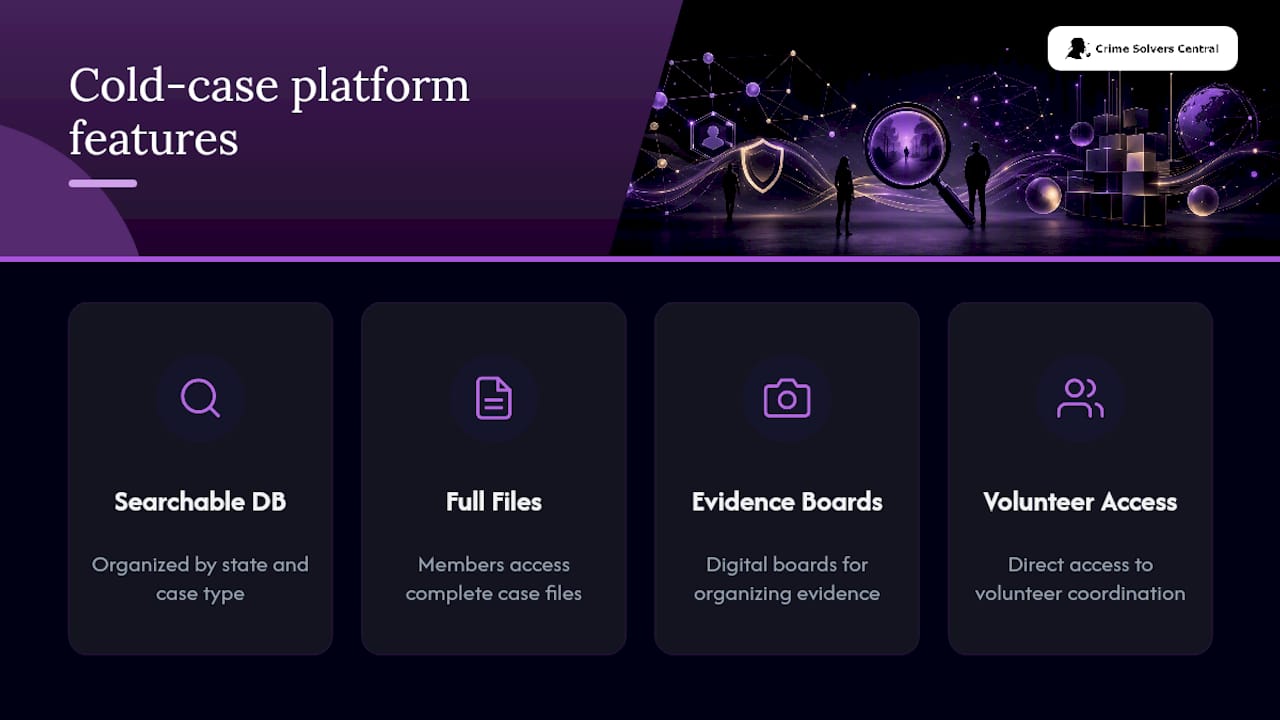
Certain platforms offer what scattered forums and social media groups can’t: a searchable national database organized by state and case type, so your research effort compounds instead of getting lost in a comment thread. Members can access full case files, digital evidence boards, a flyer builder, AI image tools, and direct access to volunteer coordination instead of piecing together fragments from a dozen different sites.
Getting started is straightforward. Join as a member, pick a role that fits your skills, and follow the platform’s ethics guidelines from your first post. If you’ve read this far, you already care about doing this right. Visit the cold case database by state to find a case near you and start contributing where your work will actually be seen.
Sources
- Cyber-Sleuths | National Cold Case Month
- Ethical considerations for open-source investigations (American Journal of International Law)
- A guide to being an ethical online investigator (MIT Technology Review)
FAQ
What Are Some Websites That Can Help Solve Crimes?
NamUs and The Doe Network specialize in missing persons and unidentified remains, while platforms like Crime Solvers Central offer a broader searchable database organized by state and case type for community research and coordination.
Has Websleuths Ever Solved a Case?
Independent crowdsourcing forums have contributed tips and leads to real investigations over the years, though credit for solving a case almost always involves law enforcement and forensic work alongside any civilian input.
Can Civilians Help Solve Cold Cases?
Yes. Civilians regularly contribute by submitting verified tips, filing open records requests, digitizing archival materials, and opting into genetic genealogy programs, all of which National Cold Case Month lists as legitimate volunteer actions.
What Is the Hardest Case to Solve?
Cases without physical evidence, credible witnesses, or DNA are consistently the hardest, since investigators and volunteers alike have little to verify against, which is why disciplined documentation of any new lead matters so much in cold cases that have gone cold for decades.