

Find Cold Cases by State: 5 Search Tactics Using NamUs and State Lists

Start with your state’s Bureau of Criminal Investigation or Attorney General page, then cross-check the National Missing and Unidentified Persons System (NamUs) and any relevant National Institute of Justice summaries. Coverage varies wildly by state, since reporting rules and time thresholds differ, so treat gaps as normal rather than dead ends. If a case isn’t listed, submit a tip directly to the state portal or local agency with whatever names, dates, or case numbers you have.
TL;DR:
- Cold case listings vary widely by state, depending on statutory reporting requirements and agency discretion, impacting how many cases are publicly available.
- Effective searching involves using variant spellings, broad date ranges, and cross-referencing NamUs IDs with local and news sources, since records are often inconsistent.
- Most states publish their cold cases on specialized portals, with some restricting details to family or law enforcement, leading to potential gaps in public information.
- Using forensic DNA technology, especially genetic genealogy, has significantly increased case solvability over recent years, though active case work remains limited by evidence and resource constraints.
- Submitting tips requires organized information and following official channels, with registering for victim-notice programs helping keep investigators and families updated.
Table of Contents
- Where to Search for Cold Cases by State
- How to Search Cold Case Records the Smart Way
- Why Cold Case Coverage Looks Different in Every State
- How Many Cold Cases Are There, and How Solvable Are They?
- How to Submit a Tip or Request a Case Be Added
- Building a Realistic Research Workflow
- Sources
- FAQ
Where to Search for Cold Cases by State
Every state handles its cold case records differently, and knowing the hierarchy of sources saves hours of dead-end searching. Most state-level information lives on one of three types of pages: a Bureau of Criminal Investigation (BCI) database, an Attorney General’s office cold case unit, or a state police cold case list. Each tends to publish something slightly different.
- State BCI or public safety departments often run the most detailed public database, including case summaries, victim photos, and a direct tip form.
- Attorney General cold case units typically focus on homicide reviews and sometimes coordinate with county prosecutors on active reinvestigations.
- State police or highway patrol pages usually list missing persons and unidentified remains cases separately from homicide cold cases.
- Local police department press pages fill in gaps when a case never made it to a statewide list, especially for older cases predating digital record keeping.
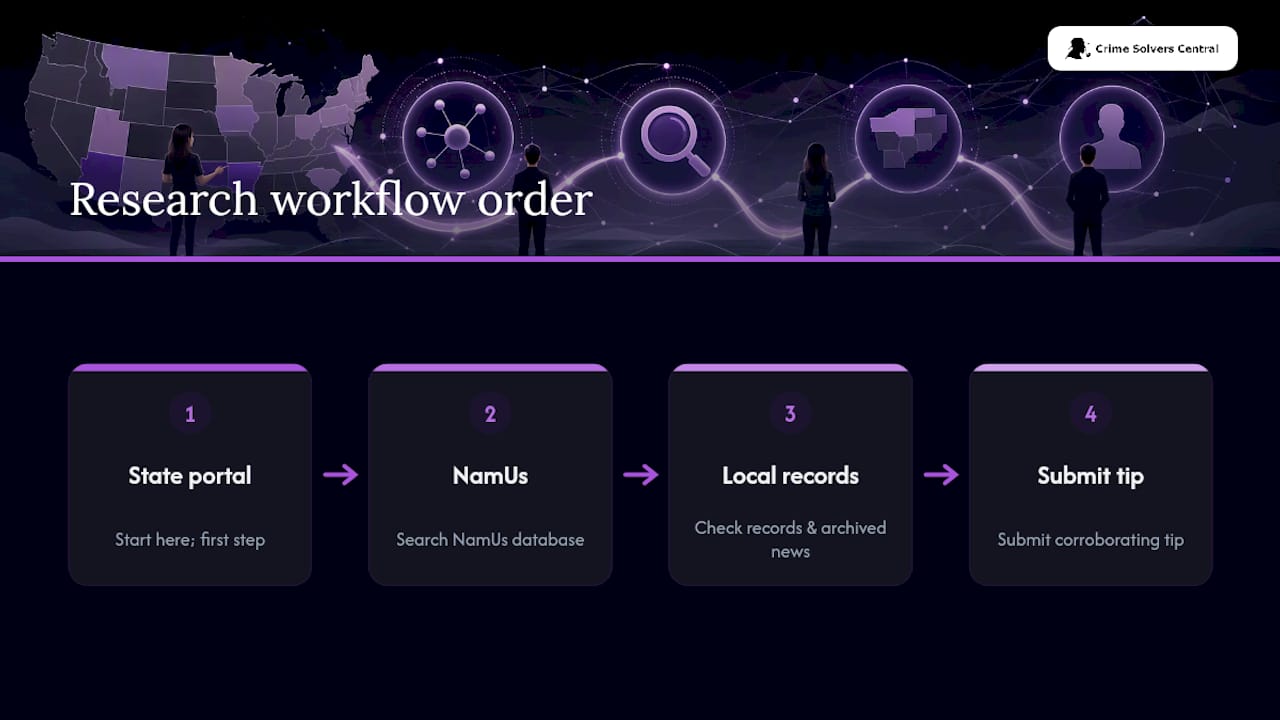
The most efficient search order is: state portal first, then NamUs for missing and unidentified persons records, then local agency press releases, and finally archived newspaper coverage for cases too old to have a digital footprint. NamUs matters here because it’s the only truly national aggregator, and it catches cases that never made it onto a state’s own site.
One access wrinkle worth knowing: some states publish full public case lists, while others restrict full details to registered family members or law enforcement, releasing only a redacted summary to the general public. That split explains why the same case might show a full narrative on one state’s site and a two-line entry on another’s.
How to Search Cold Case Records the Smart Way
Search results are only as good as the search terms behind them, and cold case names are notoriously inconsistent across records. Try these before assuming a case doesn’t exist online:
- Search variant spellings and nicknames. Maiden names, hyphenated surnames, and common misspellings all produce different (or zero) results on the same database.
- Widen the date window. Search a range of years around the reported date. Some agencies log the case by discovery date, others by the estimated date of death.
- Use unidentified-remains filters. If a name search fails, filter by state, estimated age, and year, since many entries exist only under “unidentified” until a match is confirmed.
- Cross-check with NamUs case numbers. A NamUs ID lets you verify that a state listing and a national listing describe the same person, not two similar cases.
- Check archived news alongside official records. Local newspaper archives frequently contain details, like a suspect description or a specific street name, that official summaries omit.
Confirming a record means treating the state portal, NamUs, and news archives as three independent sources that should agree on the basics. When they don’t, that mismatch itself is useful information.
Pro Tip: Redacted details, like a specific wound location or a withheld piece of physical evidence, are usually held back on purpose to protect the investigation, not because the agency is disorganized. Requesting more information through the official tip line is more productive than searching for a leak of that detail elsewhere.
Why Cold Case Coverage Looks Different in Every State
Public cold case information is inconsistent because state law treats the term differently. Some states mandate reporting; others leave it to agency discretion, and that single difference determines how much you’ll actually find online.
- Utah requires it by statute. Senate Bill 160 forces every law enforcement agency in the state to submit cases unsolved for three years or more into a centralized database run by the Department of Public Safety.
- Colorado takes a task force approach. The state maintains a public database and a multiagency Cold Case Task Force that advises the Colorado Bureau of Investigation’s cold case unit and keeps thousands of cases searchable.
- Arizona embeds family rights into law. Its statute establishes a cold case register that defines what counts as a cold case and gives victims’ families procedural notice rights.
Most states use a threshold somewhere between one and five years of inactivity before a case gets flagged as “cold,” and that threshold quietly shapes what you’ll find online. A state with a shorter mandatory window tends to publish more cases, faster. Dedicated cold case units and task forces, where they exist, are also the fastest route to a direct human contact rather than a generic tip line.
How Many Cold Cases Are There, and How Solvable Are They?
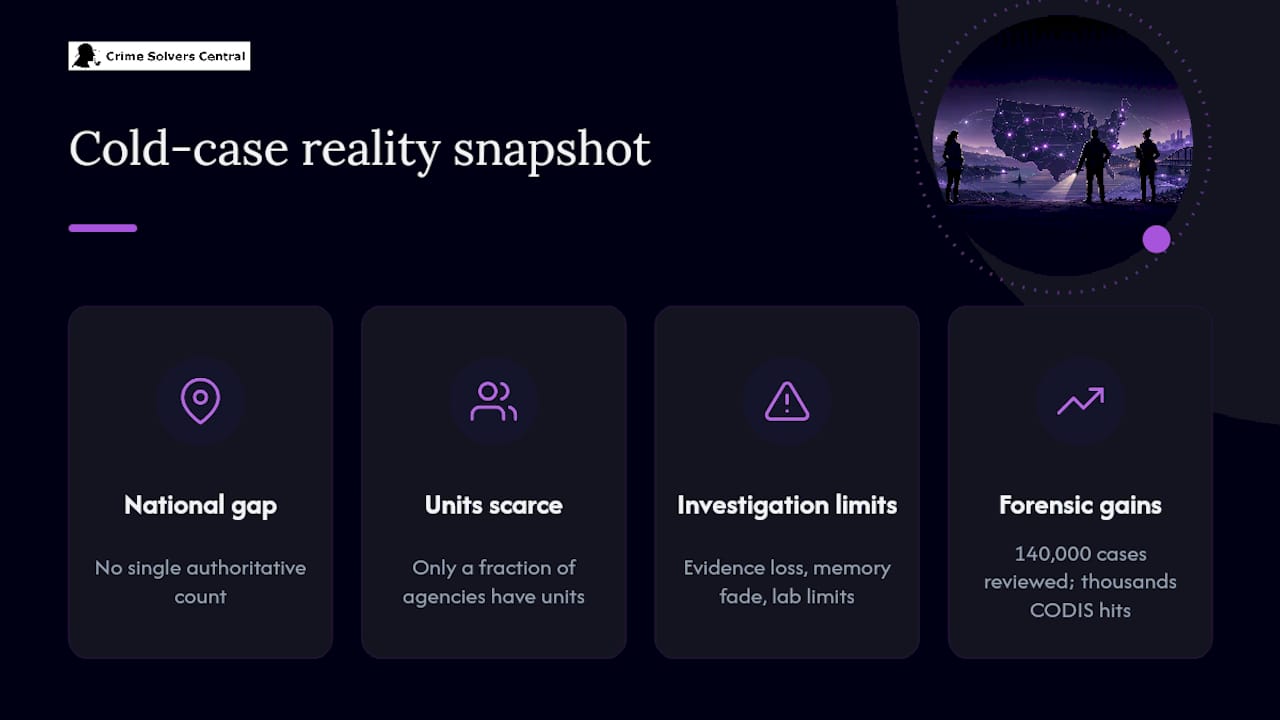
There’s no single authoritative count of every unsolved homicide in the country. Researchers have to triangulate between state portals, NamUs, and NIJ or academic data to even approximate a national figure, and that gap is exactly why state-by-state searching matters more than trusting one master list.
The bigger structural problem: only a fraction of U.S. law enforcement agencies maintain a dedicated cold case unit, according to the NIJ’s Cold Case Investigation Working Group, which is why the agency now recommends systematic case inventories and periodic reviews as baseline best practice.
Evidence degradation, fading witness memory, and limited lab capacity all cap how many cases any agency can actively work at once, according to academic research on cold case investigation challenges. A case sitting in a public database isn’t necessarily being actively worked. It may simply be catalogued.
Forensics have changed that calculus, though. NIJ-funded Solving Cold Cases with DNA grants reviewed more than 140,000 unresolved cases between 2005 and 2014, generating thousands of CODIS uploads and cold hits. Forensic genetic genealogy has pushed that further still, cracking cases that traditional DNA matching couldn’t touch. Our guide to DNA’s role in cold cases covers how that technology actually works.
How to Submit a Tip or Request a Case Be Added
Before contacting anyone, gather what you actually have: case numbers, full names and known aliases, approximate dates, photos, and any documents that corroborate the information. Keep originals and submit copies.
- Use the state portal’s tip form first, if the case already has an entry. This routes information directly to the assigned investigator rather than a general queue.
- Call the local agency’s non-emergency line if the case isn’t listed anywhere yet, or if you’re requesting a case be formally added to a state register.
- File through NamUs’s inquiry process for missing or unidentified persons cases, which flags your submission for review by their analysts.
After submission, expect a delay. Case review is archival and resource-heavy work, not a single phone call that produces an immediate answer, and agencies typically won’t share details of an active review. Follow up in writing after a few weeks if you hear nothing, and keep a dated record of every contact you make.
Pro Tip: Ask specifically whether the agency offers a victim-notice or family-registration program. Registering puts you in line for updates automatically, instead of you having to call and check status every few months.
Building a Realistic Research Workflow
The order that actually works: state portal first, NamUs second, local records and archived news third, then a corroborating tip submitted with everything you’ve gathered. Skipping steps just means redoing them later when a detail doesn’t match.
Families and advocates have more leverage than they usually realize. Registering for a victim-notice program, and formally requesting a case review through the state’s cold case unit, puts pressure on an agency in a way that a single phone call doesn’t. Our Cold Case Search Engine Playbook walks through the search mechanics in more depth, and our state-by-state directory guide is the better next stop if you’re still narrowing down which portal to start with.
One habit worth adopting from methodology-focused case trackers: always note where a detail came from and when you found it, the way any credible sourcing page would document its own corrections. Cold case information changes as agencies update records, and a dated note saves you from citing something that’s since been revised.
— Crime
Sources
- Expert Panel Issues New Best Practices Guide for Cold Case Investigations | National Institute of Justice
- Cold Cases | DPS - Utah Bureau of Criminal Identification (BCI)
- 2025 Sunset Review Cold Case Task Force (Colorado)
- NamUs (National Missing and Unidentified Persons System)
FAQ
What is the fastest way to find cold cases by state?
Go directly to your state’s BCI, Attorney General, or state police cold case page first, then check NamUs for missing and unidentified persons records that might not appear on the state list.
Why do some states have more cold case listings than others?
States with statutory reporting mandates, like Utah’s SB160, require agencies to submit unsolved cases after a set number of years, while states without a mandate leave publication to individual agency discretion.
Is there one national database of all unsolved homicides?
No single inventory captures every unsolved homicide nationwide; researchers combine state portals, NamUs, and NIJ data to approximate the true scale.
What information should I gather before submitting a tip?
Collect case numbers, full names and aliases, approximate dates, photos, and any corroborating documents, and keep the originals while submitting copies to investigators.
Why don’t public case listings show every investigation detail?
Agencies commonly redact specific evidence, like exact wound details or withheld physical evidence, to protect the integrity of the investigation rather than to withhold information carelessly.