

How to Claim Unclaimed Remains: Steps for U.S. Families
To claim unclaimed remains, you contact the medical examiner or coroner in the county where the person died, prove you are legally entitled to make decisions for the deceased, and arrange burial or cremation through a funeral home. The hard part is rarely the paperwork. It is speed, because an “unclaimed” status starts a clock, and the clock is set by state law, not by your family.
This guide covers who counts as next of kin, how to find a loved one who may be in a county morgue, what the timelines look like, and what to do if the remains have already been cremated or buried by the county.
TL;DR
- “Unclaimed” means the person has been identified by name, but no next of kin has been located to make notifications or claim the remains.
- Start with the medical examiner or coroner where the death occurred. Do not wait to be found, because the office only has to make a “reasonable effort” to find relatives.
- Your right to claim depends on a state-defined order of kin, usually a designated agent, spouse, adult children, then parents.
- Delay can mean public cremation or burial. Once remains are in a common county plot, moving them later is difficult and costly.
- Check NamUs and, if you are searching for someone missing, register them there too.
Table of Contents
- What “unclaimed” actually means
- Who has the legal right to claim
- Step by step: claiming remains in a county morgue
- Timelines: why a few weeks can matter
- If the county has already buried or cremated the remains
- Unclaimed veterans: a separate path
- Where NamUs fits
- Our perspective
- Using Crime Solvers Central while you search
- FAQ
- Sources
What “unclaimed” actually means
People use the word loosely. In the national system run by the Department of Justice, an unclaimed person is a decedent whose name is known but for whom no relative has been located to receive the death notification or arrange the funeral. That is different from an unidentified person, whose name is not known. If you are not sure which category your situation falls into, our guide on what unidentified remains mean explains the difference.
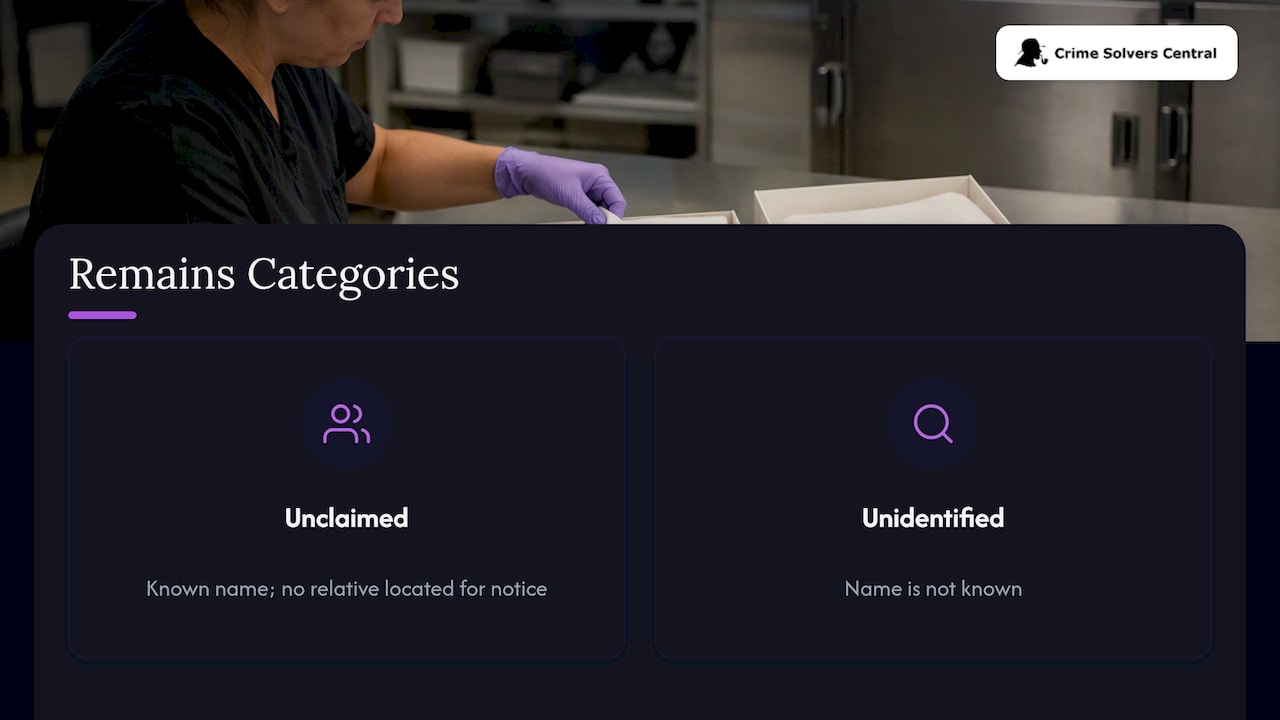
Unclaimed status is administrative, not permanent. It is a countdown toward public disposition. In practice that means a person can be “unclaimed” for a few weeks or for months, depending on the county’s storage space, budget and local statute.
There are also several reasons a body goes unclaimed that have nothing to do with an absent family. Relatives may be estranged, may not have been located, or may be unable to afford a funeral. Reasons for refusal can include limited financial resources for cremation or burial when family cannot be reached. If cost is your barrier, say so when you call. Many counties have indigent burial or cremation programs, and the office can tell you how yours works.
Who has the legal right to claim
Claiming remains is first of all a legal question: are you the person the law lets decide? State statutes set a priority list. In Texas, for example, the list in the Health and Safety Code typically puts a designated agent first, then a surviving spouse, adult children, and parents. Other states vary in the order and in how far down the list goes (siblings, grandchildren, guardians, close friends).
Two practical points follow:
- Disputes come from the order, not the paperwork. If a parent and an adult child disagree, the statute usually decides, not who calls first.
- A distant relative can still act. If nobody higher on the list can be found or will act, you may be allowed to take responsibility. Ask the medical examiner what documents they need to show your relationship.
Because the rules differ by state, treat any general guide, ours included, as a map and not as legal advice. If two relatives disagree, or if you are unsure whether you qualify, a probate or estate attorney in the state where the death occurred is the right person to ask, and many county offices can point you to the statute they follow.
Step by step: claiming remains in a county morgue
1. Find the right office
The office with authority is the medical examiner or coroner in the county where the person died, not where they lived. Start with that county’s official site or call the main line and ask for the medical examiner’s or coroner’s records or family services desk.
If you are not sure where your relative is, search first. Our unclaimed bodies database guide walks through five search steps, and the NamUs search walkthrough shows how to filter by state and date.
2. Do not wait to be contacted
Families often assume the state will track them down. The legal standard is a “reasonable effort” to find next of kin, and what that means varies widely with a jurisdiction’s staffing and budget. If you are a distant relative, contact the county office yourself. Give the full name, date of birth, any known date of death, and your relationship.
3. Prove who you are
Expect to be asked for photo ID and some evidence of kinship: birth certificates, a marriage certificate, or a court order. Some offices will accept these by email or fax. Ask what they accept before you pay for certified copies.
4. Ask what the deadline is
Ask three direct questions: How long will you hold the remains? What happens at the end of that period? Who do I notify if I need more time? Offices often hold bodies for a defined period before authorizing public cremation, and the answer should be written down with the name of the person you spoke to.
5. Choose a funeral home and authorize disposition
Once your standing is confirmed, a funeral home can transport the remains and handle the permits. You sign the authorization for burial or cremation as the person with legal rights. Get a written price list before agreeing to anything. Funeral homes must give you an itemized list on request under federal rules, and you can compare a few.
6. Keep records
Keep the case number, the names of staff, and copies of everything you send. If a death certificate is needed later for benefits or an estate, you will want the paper trail.
Timelines: why a few weeks can matter
There is no single national timeline. Here are examples drawn from state sources:
| Situation | What the source says | Why it matters |
|---|---|---|
| Cremated remains at a funeral home or crematory in Illinois | Authorities may dispose of unclaimed cremated remains 60 days after cremation if no instructions are received, and must keep a permanent record of the final disposition | Waiting two months can end your chance to receive the ashes |
| Unclaimed cremated remains in California | The state Cemetery and Funeral Bureau publishes guidance on how long funeral establishments may hold them before disposition or release to next of kin | Remains can be moved toward final disposition without further notice |
| Estate opened after public burial in Minnesota | If an estate is opened within six years, the county may be reimbursed for burial expenses from the decedent’s property | Public burial can create a claim against the estate |
Check the current statute for the state in question before relying on any figure. Rules change, and local offices apply them differently.
The lesson is the same everywhere: call early. A call made in the first days is a conversation. A call made after the county has cremated and interred the remains is a legal and logistical project.
If the county has already buried or cremated the remains
Sometimes you learn too late. You still have options, but they narrow.
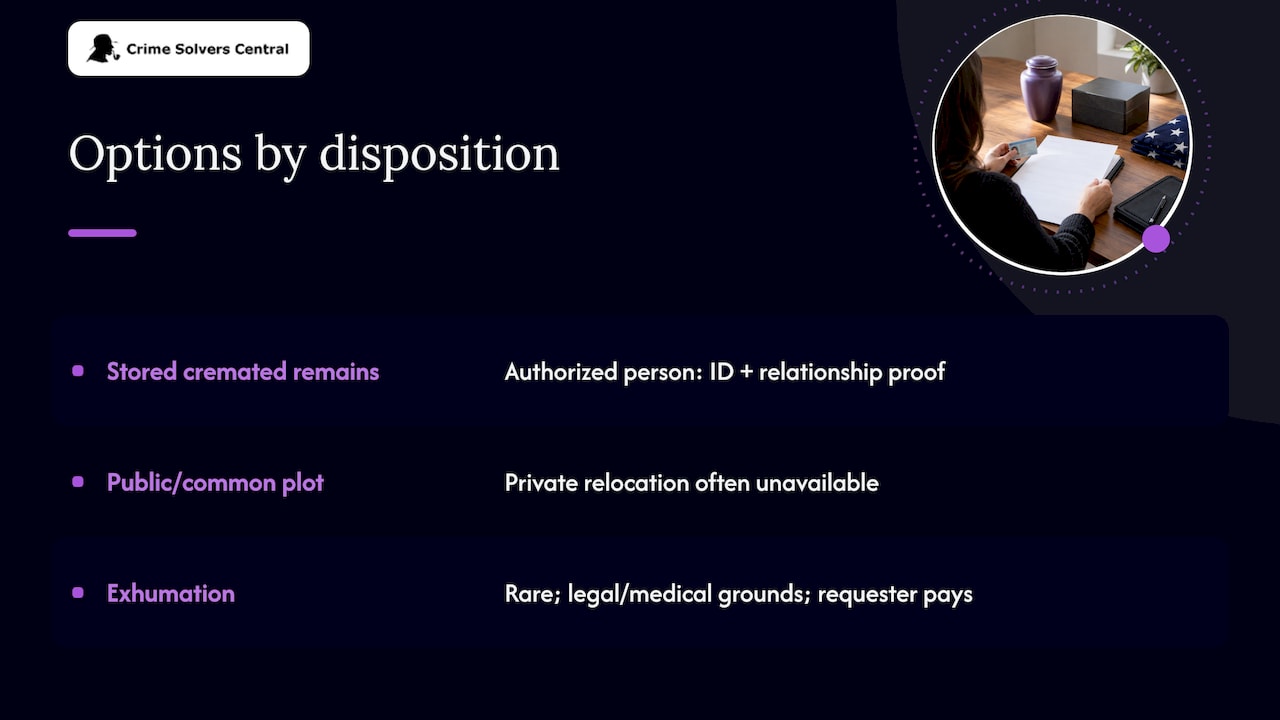
Cremated remains not yet interred. Contact the funeral establishment or crematory that holds them. If they are still in storage, they can usually be released to the legally authorized person with ID and proof of relationship.
Remains placed in a public cemetery or common plot. Public health and parks officials caution that once remains go to a county for public interment, often in a common plot, private relocation may effectively become unavailable because it requires a complex and costly legal process. Ask the county for the cemetery name and plot or location record anyway. Visiting, a marker, or a memorial may still be possible even when removal is not.
Exhumation. It is rarely approved without compelling legal or medical reasons, and the requester pays. Boston’s public health permits office is one example of the paperwork involved: its disinterment and reinterment permits are special-circumstance permits issued separately from standard burial permits. A town cemetery ordinance such as Fremont, North Carolina’s says no one may exhume a body except with the town’s permission under state law. Plan on a certified death certificate, a licensed funeral director’s involvement, cemetery fees, and months of coordination.
Unclaimed veterans: a separate path
If the person served in the military, the Department of Veterans Affairs may help. The VA’s page on unclaimed Veteran remains says the casket or urn must meet certain standards and be used for burial or inurnment in a national cemetery or VA-funded state cemetery. Eligible individuals or funeral homes may seek reimbursement for items such as casket or urn costs, transportation and plot allowances using VA Form 21P-530, and a discharge other than dishonorable is part of eligibility.
The VA’s decedent affairs directive, VHA Directive 1601B.04, governs how the department handles veterans who die in its care. Call the cemetery’s scheduling office or the VA before paying for anything, so you do not forgo a benefit you qualify for.
Where NamUs fits
NamUs is the national repository for missing, unidentified and unclaimed persons. It helps in two ways. If you suspect a relative is in a morgue, you can search the unclaimed persons records. If you are looking for someone missing, you can register them so that a medical examiner searching their unidentified cases may find a match.
Know its limits. Use of NamUs is voluntary, so it does not capture every case in the country, and resolved cases are archived and removed from public view. A relative who does not show up in NamUs may still be in a county that never entered them. That is why a phone call to the county beats a database search alone. Our guide to the unidentified persons database explains what to search beyond NamUs.
If you are also searching for a missing person, NamUs offers help directly. Its Cold Case Advisors provide case consultations and help with biometric collection for missing, unidentified and unclaimed cases. NamUs staff also note that family reference DNA is registered so it can be compared against unidentified remains, and not against arrestee or convict databases. That may ease fears that stop families from coming forward.
For the next step on the missing-person side, see our guides to federal missing persons resources and how coroners handle unidentified cases.
Our perspective
We run a searchable cold case database of missing persons, unsolved homicides and unidentified or unclaimed remains, organized by state and case type. What we see from that vantage point is that families rarely lose a loved one to the system in one dramatic moment. They lose time. A death notification that never arrives, a relative who moved, a county with one overworked investigator: each adds weeks.
So our advice is plain. Treat the first phone call as the most valuable thing you will do. Do it before you gather every document, before you settle who in the family will pay, and before you have a perfect plan. Ask the county for their deadline, then work backward from it.
We also believe a database is a tool, not an answer. Searching records can point you to the right county, but the claim itself happens with a human at a medical examiner’s office. Use what we offer to find leads and to keep a case organized, and then pick up the phone.
— Crime
Using Crime Solvers Central while you search
If your search involves a missing relative or a case that has gone cold, a membership gives you access to full case files, sources, forums and tools such as a flyer builder. Plans are Jr. Detective at 3.97 USD per month or 39 USD per year, Sr. Detective at 9.97 USD per month or 99 USD per year, and True Crime Influencer at 39.97 USD per month or 399 USD per year. You can compare them on our pricing page.
Searching the state-by-state case catalog costs nothing. Our missing persons database guide is a good place to begin.
FAQ
How long does a morgue keep an unclaimed body?
It depends on the state and the county. Some offices hold a body for a set number of days while they search for relatives, then authorize public cremation or burial. Ask the medical examiner for the exact deadline in writing, and do not rely on a general number.
Can I claim remains if I am not a close relative?
Possibly. State law sets an order of priority, often a designated agent, spouse, adult children, then parents, and what happens when no one higher on the list acts differs by state. Contact the medical examiner or coroner and ask what proof they require. If there is a dispute with other family, consult an attorney in that state.
Can I still get cremated remains after a funeral home has held them for months?
Sometimes. Some states let establishments dispose of unclaimed ashes after a fixed period, such as 60 days after cremation in Illinois. Call the establishment right away, ask whether the remains are still on site, and bring ID and proof of kinship.
Can I move remains from a public burial later?
It is rarely simple. Exhumation is generally approved only for compelling reasons and the requester pays, with permits, a certified death certificate and funeral director involvement required. Ask the county for the cemetery and plot location first, then talk to a funeral director about what your state allows.
Sources
- Frequently Asked Questions, NamUs
- What is NamUs?
- Services, NamUs
- Unclaimed Veteran Remains, U.S. Department of Veterans Affairs
- VHA Directive 1601B.04 Decedent Affairs
- Illinois Compiled Statutes, cemetery and crematory provisions
- California Cemetery and Funeral Bureau, unclaimed remains
- Harris County Institute of Forensic Sciences, family information brochure
- California State Parks, scattering ashes
- Boston Public Health Commission permits
- Town of Fremont, NC cemetery ordinance