

Citizen Detectives: Use Crime Solvers Central to Help Cold Cases Safely

Yes, disciplined civilians can genuinely move cold cases forward, but only through public-record research, organized timelines, and properly submitted tips, never through direct contact with suspects or witnesses. The single safest first step: join a vetted program, such as a Crime Solvers Central membership or a NamUs volunteer channel, or simply build a short, sourced timeline on one case and send it through that agency’s official tip line.
TL;DR:
- Civilians should focus on public-record research, timeline building, and submitting organized tips through official channels to genuinely aid cold case investigations.
- Building a clear, sourced timeline involves gathering records via FOIA, court dockets, and archives, then submitting findings through verified tip portals rather than public posts.
- Investigative genetic genealogy requires explicit opt-in consent and close coordination with law enforcement, avoiding self-assignment or unapproved DNA uploads.
- Volunteers must strictly avoid direct contact with suspects, witnesses, or families, and must label unverified claims clearly to prevent legal or safety risks.
- Joining structured programs like Crime Solvers Central provides access to case databases, tools, and community support that significantly increase the impact of civilian research.
Table of Contents
- What citizen detectives actually do for cold cases
- How to start researching a cold case responsibly
- Investigative genetic genealogy: how volunteers can help without causing harm
- Trusted databases and where to learn OSINT skills
- How to write up findings so law enforcement actually uses them
- What Crime Solvers Central offers volunteers and investigators
- Real examples of civilians moving cases forward
- Legal and safety red lines every citizen detective must respect
- Why disciplined public help actually moves cold cases
- Ready to start? What Crime Solvers Central membership includes
- Where to keep learning about cold case research
- Sources
- FAQ
What citizen detectives actually do for cold cases
The useful work is unglamorous. It’s court filings, obituaries, property records, old news clippings, and the patient job of stitching them into a dated timeline. Detectives reviewing a stalled case often lack the hours to dig through decades of paper trails themselves, which is exactly where an organized civilian contribution earns its keep. Notes from cold case units describe outside reviewers producing 40 to 60 page case reviews that give investigators a fast, sourced way to see what’s already known and what’s missing.
Beyond research, there’s real value in non-contact support work:
- Compiling a dated source log with links, page numbers, and archive citations
- Running media amplification campaigns or flyer distribution for missing-persons cases
- Serving as a family liaison through an established nonprofit, not on your own authority
What to avoid is just as important. Never approach a person of interest, never trespass to “check” a location, and never post public accusations naming a suspect based on your own theory.
How to start researching a cold case responsibly
Pick a case that welcomes outside eyes. That usually means it’s officially unsolved, not tied to an active prosecution, and the agency has publicly acknowledged it’s open to leads. Cases still moving through the courts are off-limits; interference there can genuinely damage a prosecution.
- Choose one case and confirm its status is open and unresolved.
- Build a simple timeline with columns for date, event, source, and confidence level (confirmed, reported, unverified).
- Pull records through your state’s public-records law or a federal FOIA request, plus newspaper archives and court dockets.
- Keep every document in a labeled folder, named by date and source, so nothing gets lost or misattributed.
- Submit your findings through the agency’s tip portal, NamUs, or a Crime Solvers Central tip channel rather than posting publicly first.
Pro Tip: Date every file the moment you save it, not when you finish the project. Six months into a case review, you will not remember whether that obituary came from a library archive or a random blog repost.
Investigative genetic genealogy: how volunteers can help without causing harm
Investigative genetic genealogy, often called FIGG, uses distant DNA matches on consumer genealogy sites to build family trees that point toward an unidentified person or a suspect. Agencies turn to it when traditional leads run dry, and it has cracked cases that sat cold for decades.
The catch is consent. Platforms including GEDmatch and FamilyTreeDNA require an explicit opt-in before law enforcement can search a profile. Without that toggle switched on, your DNA is invisible to investigators no matter how close a match you might be.
Volunteering as a distant relative or witness donor carries real emotional risk. Family DNA testing sometimes surfaces unexpected discoveries, like an unknown half-sibling or a non-paternity event, so think it through before you upload.
The practical path looks like this:
- Take an FTDNA Family Finder test or upload existing raw DNA data
- Opt in specifically for law enforcement matching, since default settings usually don’t include it
- Coordinate directly with the investigating agency, which will often walk you through the kit and upload process
- Never self-assign as an “investigator” on a match; let the agency drive next steps
Our DNA and cold cases guide walks through the testing and opt-in process step by step.
Trusted databases and where to learn OSINT skills
Start with the free, public tools before paying for anything. The National Missing and Unidentified Persons System, better known as NamUs, is the federal clearinghouse for missing and unidentified persons cases and lets anyone search by state, physical description, or case details.
A few other resources worth knowing:
- State cold case unit pages, like the Colorado Bureau of Investigation’s cold case unit, which show how official review teams operate
- ViCAP, the FBI’s violent crime database, which is law enforcement only but shapes how agencies triage cases
- GEDmatch and FamilyTreeDNA for genetic genealogy work, provided you understand the opt-in requirements
- Crime Solvers Central’s national database guide and forums, which pair case files with timeline tools built for exactly this kind of research
Local cold case foundations and victim advocacy groups also run structured volunteer programs if you want supervised, hands-on training instead of teaching yourself.
How to write up findings so law enforcement actually uses them
Detectives are busy, skeptical, and trained to distrust unverified leads, so format matters as much as substance. Lead with a one-page executive summary: what you found, why it matters, and where the full documentation lives. Attach the supporting material, source URLs, dated screenshots, and PDFs, in a separate, clearly labeled folder.
- Separate confirmed facts from your own hypotheses, and label each clearly
- Never present a theory as a conclusion
- Submit through the agency’s actual tip channel, not a general phone line or social media message
- Include your contact information for follow-up, but don’t demand a response
Pro Tip: If the agency goes quiet, that’s not necessarily a bad sign. Investigative secrecy protects solvability, and detectives rarely confirm what leads they’re chasing.
What Crime Solvers Central offers volunteers and investigators
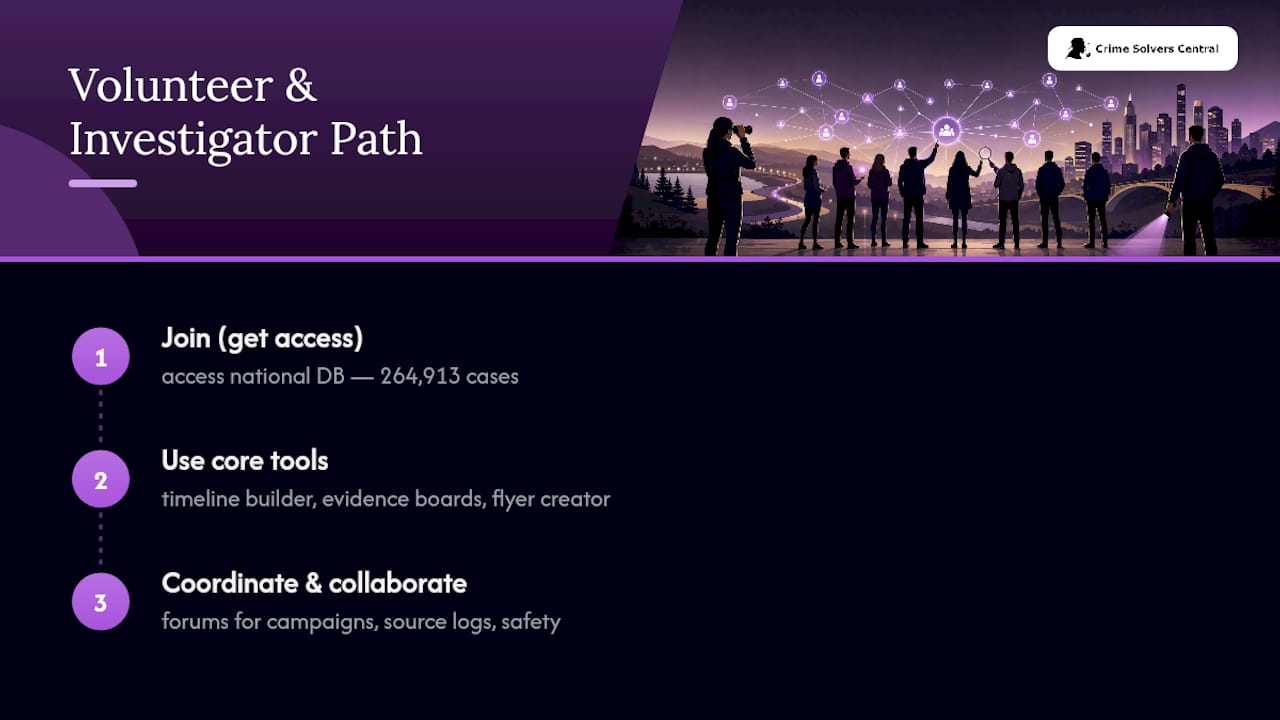
Crime Solvers Central runs a national database covering more than 264,913 cases, organized by state and category, spanning missing persons, unsolved homicides, and unidentified remains. Members get full case files, a timeline builder, digital evidence boards, a flyer creator, AI image tools, and volunteer coordination forums built specifically for this kind of research.
Community members have used these tools to organize flyer campaigns, compile source logs for families, and coordinate safety initiatives, with testimonials describing renewed attention that helped reconnect families or push cases back onto an agency’s active list. New members typically start with database access and the timeline builder before moving into forum collaboration.
Real examples of civilians moving cases forward
Public attention and renewed review have measurably changed outcomes. The FBI’s Kansas City field office documented how a new autopsy, prompted by years of public pressure and community advocacy, reclassified Alonzo Brooks’s death as a homicide after it had initially gone unresolved.
That pattern repeats: a family member or advocate compiles a sourced timeline, submits it through proper channels, and an agency reopens the review. The specific, permissible actions matter here: FOIA requests, organized records, and DNA opt-in, not public speculation about who did it.
Legal and safety red lines every citizen detective must respect
The line between helpful and harmful is thinner than it looks. Direct contact with a suspect, a witness, or a grieving family member is where legitimate research turns into interference, and it’s also where you put yourself at legal risk.
- Never contact suspects, witnesses, or families directly; route everything through the agency
- Don’t trespass or attempt to access sealed, expunged, or juvenile records
- Never publicly name a suspect; unverified accusations can expose you to defamation liability
- Label every unverified claim as such, in your notes and anywhere you share them
- Watch your own mental health; cold case material is heavy, and knowing when to step back matters
Why disciplined public help actually moves cold cases
Fresh eyes catch what tired ones miss. That’s not sentiment, it’s the reason cold case units bring in outside reviewers at all. The work only helps when it stays organized, sourced, and inside legal boundaries.
Put the victim and the law first, always, before your own theory of the case. Join a structured program like our volunteer forums if you want guidance instead of guesswork.
— Crime
Ready to start? What Crime Solvers Central membership includes
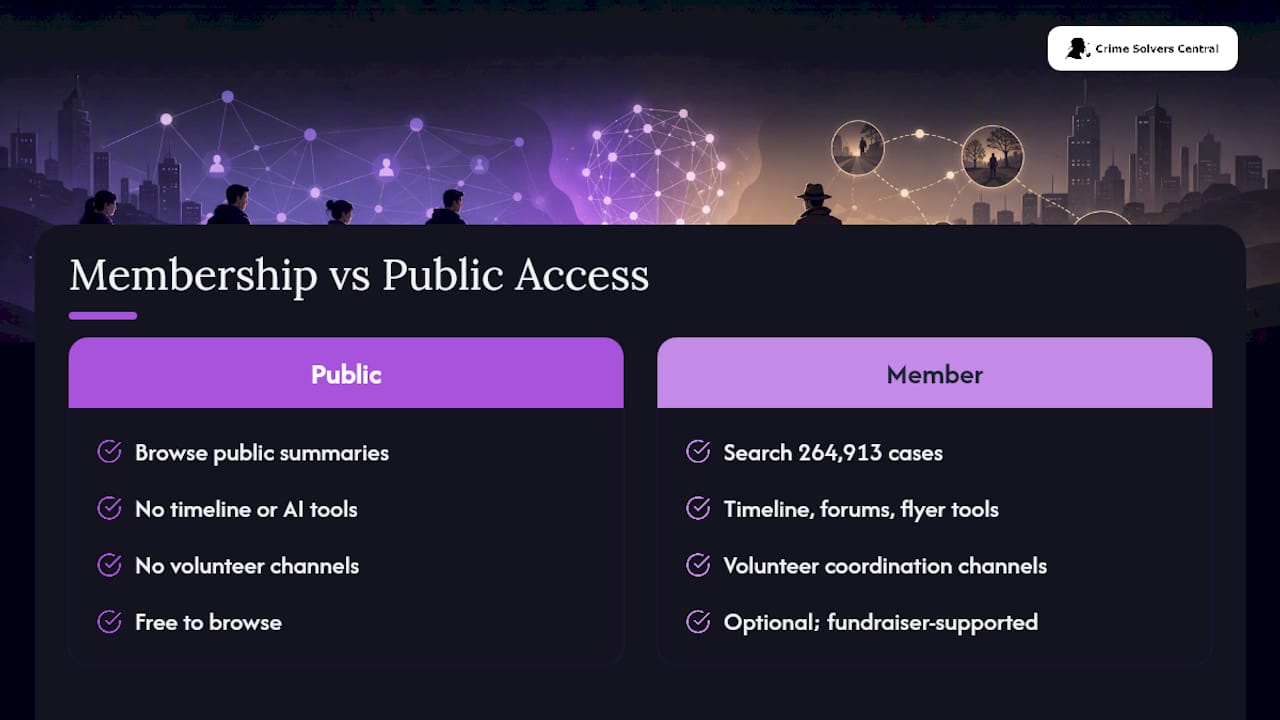
Crime Solvers Central gives you what a solo researcher can’t build alone: a searchable database of over 264,913 cases already organized by state and category, plus the timeline builder, forums, and flyer tools this guide just walked you through. Instead of hunting scattered archives case by case, you start with structured files and a community that’s already doing this work.
Membership unlocks full case details, digital evidence boards, AI image tools, and volunteer coordination channels that connect you with families and other researchers. New members get immediate access to the database and timeline builder, the two tools you need most for the research process outlined above.
Membership is optional and supported in part by fundraisers, not required to browse public case summaries. If you’re ready to turn a single case timeline into something detectives can actually use, start with the Crime Solvers Central database and see what’s already documented in your state.
Where to keep learning about cold case research
For deeper reading, check the NIJ’s cold case unit best practices, search NamUs directly, and review FIGG opt-in guidance before any DNA upload. Our own armchair detective guide and NamUs search walkthrough cover the hands-on steps in more depth.
Sources
- National Best Practices for Implementing and Sustaining a Cold Case Investigation Unit
- Notes From the Field: Expanding the Cold Case Team Beyond Law Enforcement | NIJ
- FIGG Volunteer Testing Information Form (Indiana State Police)
- Cold Case Unit | Colorado Bureau of Investigation
- FBI press release: New autopsy determines death of Alonzo Brooks was a homicide
FAQ
Can civilians access cold case files?
Civilians can access publicly available records, court documents, news archives, and NamUs entries, but full investigative case files stay restricted to law enforcement for evidentiary and privacy reasons.
What is the most famous cold case in history?
The Zodiac Killer case remains among the most widely known unsolved cases in American history, drawing decades of amateur and professional investigation without a confirmed identification.
Why do cold cases sometimes end abruptly without an arrest?
Cases can close or go quiet when evidence degrades, a suspect dies, statutes of limitations expire on lesser charges, or new information fails to meet the legal threshold for prosecution.
What are some of the top unsolved cold cases in America?
High-profile unsolved cases include the Zodiac Killer murders, the Tylenol poisonings, and JonBenét Ramsey’s death; databases like Crime Solvers Central and NamUs list thousands of lesser-known cases still open for public tips.
Do I need special training to help with a cold case?
No formal training is required to start, but structured programs, like Crime Solvers Central’s volunteer forums or local cold case foundations, teach the research and documentation skills that make your work usable to investigators.