

Valuable Anonymous Tips on Crime Solvers Central for Families & Sleuths

Yes, Crime Solvers Central lets you submit tips anonymously on any cold-case profile in its database. Find the case, open its full profile page, and click the secure “Submit tip” form. You can leave every contact field blank. Investigators may never confirm they received it, so don’t wait on a reply before moving forward with anything else you know.
TL;DR:
- Tips submitted without enough specific detail, such as matching the victim’s name, case number, location, and description, are likely to be overlooked.
- Using clear, factual language and including verifiable information increases the chances that investigators will consider and act on your tip.
- Guaranteeing complete anonymity requires leaving optional contact fields blank and removing metadata from uploaded files, including photos and PDFs.
- Silence or lack of follow-up after submission is normal because agencies often do not provide immediate updates to protect ongoing investigations.
- Combining public tips from Crime Solvers Central with official case records in NamUs improves the likelihood of a case progressing by broadening information sharing.
Table of Contents
- How to Submit a Tip Through Crime Solvers Central
- What Information Should You Include in a Tip?
- Anonymity and Data Security on the Platform
- What Happens After You Submit a Tip
- Best Practices for Amateur Sleuths Submitting Tips
- How Crime Solvers Central Fits Alongside NamUs
- Why Community Tips Still Matter
- Find Your Case and Submit With Confidence
- Where to Verify the Process
- Sources
- FAQ
How to Submit a Tip Through Crime Solvers Central
Finding the right case is the first real step, and it matters more than people think. A tip attached to the wrong profile, or submitted without enough case-specific detail, gets buried before anyone reads it closely.
- Search the database by name, state, or approximate date to locate the exact case profile you’re addressing.
- Open the full case page and confirm the victim’s name, case number, and jurisdiction match what you know.
- Click “Submit tip” and select the anonymous option where the form offers one.
- Fill in the structured fields. Most forms ask for a description of your information, how you obtained it, and any dates tied to the events you’re describing.
- Attach files carefully. Photos, PDFs, or screenshots usually upload directly, but check file size limits before you try to send anything large.
- Build a one-page summary if the attachment tool won’t take everything. Write it as a plain document, upload it as a PDF, and reference it in the tip’s text field.
Detailed instructions specific to the platform’s current form layout live in Crime Solvers Central’s own guide to submitting a cold case tip, which walks through each field in the order it appears.
Pro Tip: Draft your tip in a plain text editor first, then paste it into the form. Submission forms sometimes time out or reset if you leave them open too long while typing, and you don’t want to lose ten minutes of careful writing to a browser refresh.
What Information Should You Include in a Tip?
Investigators triage volunteer leads on clarity, verifiability, and novelty. A tip that reads like a police report gets more attention than one that reads like a theory.
Cover these fields at minimum:
- Victim’s full name and the case number, if listed on the profile
- Incident location and date or time window
- A concise description of what you know and how you learned it
- Any supporting detail: a vehicle description, a witness name, a document date, or a timeline point that connects to the existing case file
State cold-case units consistently ask for the same structure. Arizona’s Cold Case Unit guidance tells tipsters to include who, what, when, where, and how they know it, and that pattern holds across most agencies that accept public tips.
Here’s the contrast that matters: a high-value tip says, “I saw a man matching this description at the Route 9 gas station around 11 p.m. on the night in the case file. I know because I worked the counter that shift and remember the state trooper questioning him.” A low-value tip says, “I think her ex-boyfriend did it.” One gives investigators something to check. The other gives them nothing to verify.
Anonymity and Data Security on the Platform
Anonymous means anonymous, but only if you handle your own side of it correctly. The form itself won’t ask for your name, email, or phone number unless you choose to provide one.
Before you upload anything, take these precautions:
- Leave every optional contact field blank if you want full anonymity
- Strip EXIF metadata from photos before uploading. Metadata can embed your phone’s GPS location and the exact timestamp a photo was taken
- Crop or redact any part of an image that shows your face, license plate, or home in the background
- Use a throwaway email address or an encrypted note service if you need a way for investigators to follow up without revealing your identity
Never upload a document that still contains your name in its file properties or a screenshot that shows your own messaging app header with your account visible.
Pro Tip: Right-click any photo on your phone or computer and check “Details” or “Properties” before uploading. If you see GPS coordinates or a device ID listed, resave the image through a basic photo editor first, which usually strips that data automatically.
One caveat worth stating plainly: attachments themselves can still carry information you didn’t intend to share, even after you strip visible metadata, so treat every file as something an investigator will scrutinize closely.
What Happens After You Submit a Tip
Your tip doesn’t disappear into a void, but it also isn’t going to generate a status update most of the time. Here’s the realistic sequence:
- The platform logs and reviews the tip for basic completeness before it’s routed toward the relevant jurisdiction or case contact.
- Investigators receive it, but agencies frequently withhold operational updates to protect the investigation, not because your tip was ignored.
- If you learn something new later, submit a follow-up tip referencing your original submission’s approximate date and the same case number.
- Call 911 or local law enforcement directly instead of using any online form if you have information about an immediate threat or active danger.
Silence after submission is normal. It’s not a signal that your information was dismissed.
Best Practices for Amateur Sleuths Submitting Tips
Detectives read hundreds of speculative theories a year. The ones that get real attention share a few habits.
- Keep the writing factual and short. A tight paragraph beats three pages of theory every time
- Save a screenshot of anything you found online, and note the date and source URL where you found it
- Separate what you personally verified from what you’re guessing, and label the guess as a guess
- Coordinate with investigators before posting publicly about a case; premature exposure can tip off a suspect or compromise evidence
- Use the platform’s community collaboration features to compare notes with other researchers, but don’t publish unverified names
Pro Tip: If you’re active in an online sleuthing group for a specific case, agree as a group not to name suspects publicly until law enforcement confirms an arrest. One premature post can undo months of quiet investigative work.
Modern cold-case work increasingly relies on applying updated forensic methods to old evidence, which means a tip identifying a witness who was never interviewed can matter more now than it would have a decade ago.
How Crime Solvers Central Fits Alongside NamUs
NamUs is built for curated, long-term case management: it requires roughly 18 complete data fields and a formal review before a case goes public, and it supports biometric services investigators rely on for identification. Crime Solvers Central works differently. It’s a public-facing lead channel where anyone can search, flag, and submit tips in real time.
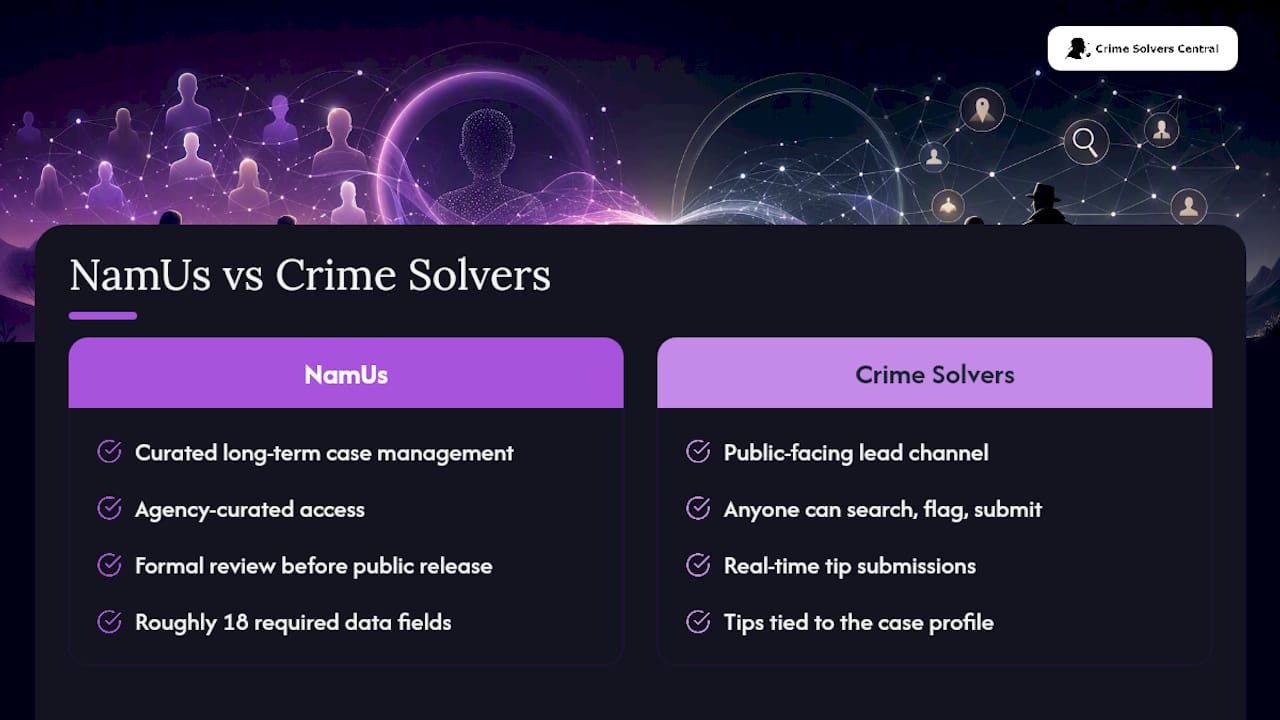
Use both. If a missing person case has passed 180 days without resolution, confirm it’s properly entered in NamUs first, since agencies rely on that record for cross-jurisdiction matching. Then submit any tip you have here, tied to the case profile, to widen who sees it. Cold-case unit best practices recommend exactly this combination: formal case records plus public engagement.
Why Community Tips Still Matter
Crime Solvers Central runs on a large database covering many cases across the country, cataloged by state and situation so families and researchers can actually find what they’re looking for. Community members have used the platform’s tools to reconnect leads that sat untouched for years, and that only happens when people submit what they know instead of sitting on it. Submit responsibly, keep your facts straight, and let the case page guide what you include.
— Crime
Find Your Case and Submit With Confidence
Crime Solvers Central’s Cold Case Database by State organizes every case by location and status, so you’re not scrolling through unrelated files to find the one you’re researching. Paid members can access full case files, digital evidence boards, a flyer builder, and forum features alongside tip submission forms, useful for developing case timelines over time. If you’re ready to search, start on the Cold Case Database landing page, then follow the platform’s own tip submission walkthrough to file your first report. Consider a paid subscription if you need more detailed case records, source documents, or continued access to a case’s evidence board. The next unsolved case in your state might be one search away.
Where to Verify the Process
- NIJ guidance on modern cold-case investigation methods
- NamUs user guide for entering missing person cases
- Arizona Attorney General cold-case tip guidance
- Practical safety detail tips from Armstrong Bail Bonds
Sources
- NIJ — Applying modern investigation methods to solve cold cases
- NamUs user guide — entering missing person cases
- NIJ/OJP guidance on cold case unit organization and operations
- Arizona Attorney General — Cold Case Unit tip guidance
FAQ
Can I submit a tip to Crime Solvers Central without giving my name?
Yes. The platform’s submission form allows fully anonymous tips, and every contact field is optional.
Will I get a response after I submit a tip?
Usually not. Agencies commonly withhold status updates to protect an active investigation, so silence doesn’t mean your tip was ignored.
What details should I include in a cold case tip?
Include the victim’s name, the location and date of the incident, a factual description of what you know, and how you came to know it.
Should I use NamUs or Crime Solvers Central for my tip?
Use both. NamUs holds the official curated case record, while Crime Solvers Central gives your tip public visibility tied directly to the case profile.
Is it safe to upload photos with my anonymous tip?
Strip EXIF metadata and crop out identifying details like your face or license plate first, since image files can carry location and timestamp data you didn’t intend to share.