

Five Steps to Search Missing Persons by Name and Toolkit for Families

The two places to search missing persons by name are NamUs, the public database run through the National Institute of Justice, and your state’s missing-person portal. NCIC exists too, but it’s restricted to law enforcement. Start by running a NamUs name search, then write down every case number and agency contact you find, because that information is what you’ll need if you ever get a match.
TL;DR:
- Searching both NamUs and local state portals increases the chance of finding a missing person, especially for recent cases not yet verified on NamUs.
- Using alternate names, nicknames, and adding known location details helps improve search accuracy and reduce missed matches.
- Verifying any potential match through the case number and contacting the investigating agency is essential before making direct contact or sharing information.
- Maintaining a detailed search log with dates, filters, and screenshots expedites case follow-up and supports credible reporting to authorities.
- Cross-checking findings with official sources like NamUs, NCIC, and NCMEC ensures case statuses are current and prevents false leads.
Table of Contents
- Where to Search Missing Persons by Name Online
- How Do You Search Effectively by Name?
- What to Do if You Find a Possible Match
- NamUs vs. NCIC vs. State Databases: Which One to Use When
- Common Mistakes That Slow Down a Name Search
- How Crime Solvers Central Supports Your Search
- What Actually Matters in a Missing-Persons Search
- Get Full Case Files and Investigative Tools
- Where to Verify What You Find
- Sources
- FAQ
Where to Search Missing Persons by Name Online
NamUs is the only national system open to the public, and it’s built specifically for this. Anyone can create a free account and search missing, unidentified, and unclaimed person records by name, location, or physical description. The database also connects families to free forensic services, including DNA analysis, fingerprint comparison, and forensic odontology, for cases that qualify.
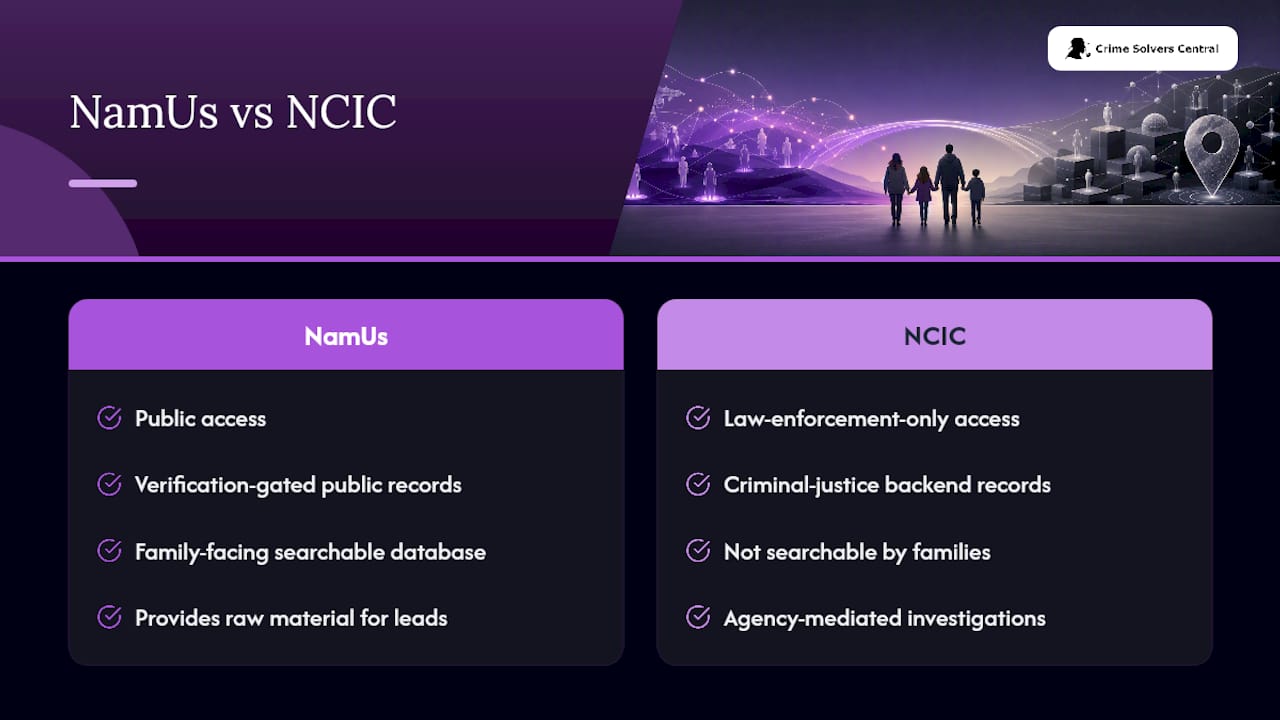
NCIC works differently. The FBI’s Criminal Justice Information Services division manages it, and only criminal justice agencies can add, edit, or search most of its records. You won’t find a public NCIC lookup page anywhere, because one doesn’t exist. What the public does get is secondhand access, through agencies who pull from NCIC and then relay details to NamUs or local media.
That gap matters more than most people realize, since NCIC logs an average of 532,727 missing-person records every year between 2021 and 2025, with estimates suggesting up to 90,000 people are missing at any given moment. Most of those names never surface anywhere you can search directly.
Beyond NamUs, you have a few other legitimate stops:
- State missing-person portals — many states run their own clearinghouse sites, and entries sometimes appear there before they hit NamUs.
- NCMEC — the National Center for Missing & Exploited Children handles cases involving minors and often has faster-moving, more detailed listings for kids.
- Local sheriff or police department pages — smaller agencies sometimes post case flyers that never make it into a national system at all.
Our own missing persons database guide breaks down how these systems overlap and where each one falls short.
How Do You Search Effectively by Name?
A name search sounds simple until you realize how many ways a single name gets recorded wrong, or recorded differently by different agencies. Here’s a sequence that actually improves your hit rate:
- Start with the full legal name, then run separate searches with nicknames, maiden names, and any known alternate spellings. A “Katherine” might be filed as “Kathy,” “Cathy,” or even a middle name used as a first name.
- Add date of birth or approximate age to narrow results, especially for common names. NamUs lets you filter by age range if you don’t have an exact birth date.
- Enter the last known location, including city and state, since many cases are indexed regionally even in a national database.
- Try partial names or wildcard-style searches when spelling is uncertain. Searching just a last name plus a state often surfaces cases a full-name search misses.
- Log every search with the date, filters used, and a screenshot of results. This matters more than it sounds like it should.
Pro Tip: Search both the missing-person side of NamUs and the unidentified-remains side. Cases sometimes cross categories when a person is found but not yet identified as the same individual reported missing, and families searching only one side miss the connection entirely.
Keeping a running log isn’t just organizational housekeeping. If you eventually find something worth reporting, an investigator will ask exactly when you searched, what terms you used, and what came up. Having that ready speeds everything up.
What to Do if You Find a Possible Match
Finding a name that fits is the easy part. Verifying it and acting on it correctly is where people stumble.
- Confirm the case number and agency listed on the record. NamUs profiles typically show the investigating agency’s name and contact information directly on the case page.
- Do not attempt to contact or approach the person yourself, even if you’re confident it’s them. Use the tip line or contact form listed on the case, or call the investigating agency directly.
- Gather supporting details before you call: photos, last known contact dates, any timeline discrepancies you noticed, and, if NamUs offers it for that case, information about DNA comparison options.
- Give the agency your search log. The dates and terms you used can help them understand how you found the match and rule out coincidence.
- If you don’t hear back within a reasonable window, follow up with the agency directly rather than assuming the tip vanished. Case backlogs are common, and a second call rarely hurts.
The instinct to reach out to the person directly is understandable, but it can complicate an active investigation or, in worse cases, put someone at risk. Let the agency make first contact.
NamUs vs. NCIC vs. State Databases: Which One to Use When
Each system plays a distinct role, and knowing which one to check first saves time.
- NamUs is your default starting point for any public search. Cases go live only after a Regional System Administrator (RSA) verifies the record and confirms a complete set of identifying fields, roughly 18 data points covering names, physical description, date of last contact, and investigating agency details. That verification step is why NamUs data tends to be more reliable than random tip sites, but it also means brand-new cases can take time to appear.
- NCIC is the backend system law enforcement relies on daily. You won’t search it directly, but understanding that it exists explains why an agency might reference a record you can’t personally look up. State participation in feeding cases into NamUs is largely voluntary, so NCIC often holds entries that never make the public-facing database at all.
- State portals fill the gap when a case is fresh. Local entries sometimes post there before an RSA has verified them for NamUs, so checking your state’s site alongside NamUs covers more ground, especially in the first days after someone is reported missing.
Common Mistakes That Slow Down a Name Search
Most failed searches don’t fail because the person can’t be found. They fail because of avoidable errors on the searcher’s end.
- Trusting unofficial tip sites or social media rumors without confirming details against an agency-run database first.
- Skipping the unidentified-remains database entirely, which misses potential cross-matches.
- Ignoring age progression. A search for a name last updated years ago should account for how a physical description may have changed.
- Forgetting to cross-check status. A case marked resolved or closed on a state site might still show active on NamUs if updates haven’t synced yet.
- Not saving contact information the first time you find it, then having to redo the entire search later to locate the same agency phone number.
Pro Tip: Before contacting any agency, run through a quick checklist: confirmed case number, agency name and phone number, the date you last verified the record was active, and any details that don’t quite match. That five-minute habit prevents most of the wasted follow-up calls families run into.
Our missing person tips guide covers a longer list of these pitfalls if you want the fuller checklist.
How Crime Solvers Central Supports Your Search
Crimesolverscentral organizes more than 264,913 cases by state and situation, giving you a structured starting point instead of a scattered patchwork of local news mentions and outdated flyers.
Beyond the case catalog, the site offers:
- A step-by-step NamUs family guide that walks through account setup, search filters, and what to expect from RSA verification.
- Background on how DNA fits into cold-case resolution, useful if a case you find mentions forensic testing options.
- Community forums and volunteer coordination tools where families and case followers compare notes on active searches.
- Member testimonials describing cases where organized search efforts and agency follow-through led to real answers.
None of that replaces the official databases. It sits alongside them, built for the moments when you need more context than a bare case listing gives you.
What Actually Matters in a Missing-Persons Search
Most guides on this topic treat NamUs and NCIC as interchangeable, and that’s the biggest misconception families run into. They’re not redundant systems. One is public and verification-gated; the other is a law-enforcement backend you’ll never search directly. Treating them as the same thing wastes time families don’t have.
The conventional advice also underplays how much a search log matters. People search obsessively for a few days, find nothing conclusive, and give up, without ever writing down what they tried. When a real lead surfaces weeks later, they’re starting from zero instead of building on prior work.
If you take one thing from this guide, prioritize verification over speed. A fast, unconfirmed match reported to the wrong contact does less good than a slower, well-documented one handed to the actual investigating agency. Public databases give you the raw material. What you do with it, patiently, with records kept, determines whether a name search actually goes anywhere.
— Crime
Get Full Case Files and Investigative Tools
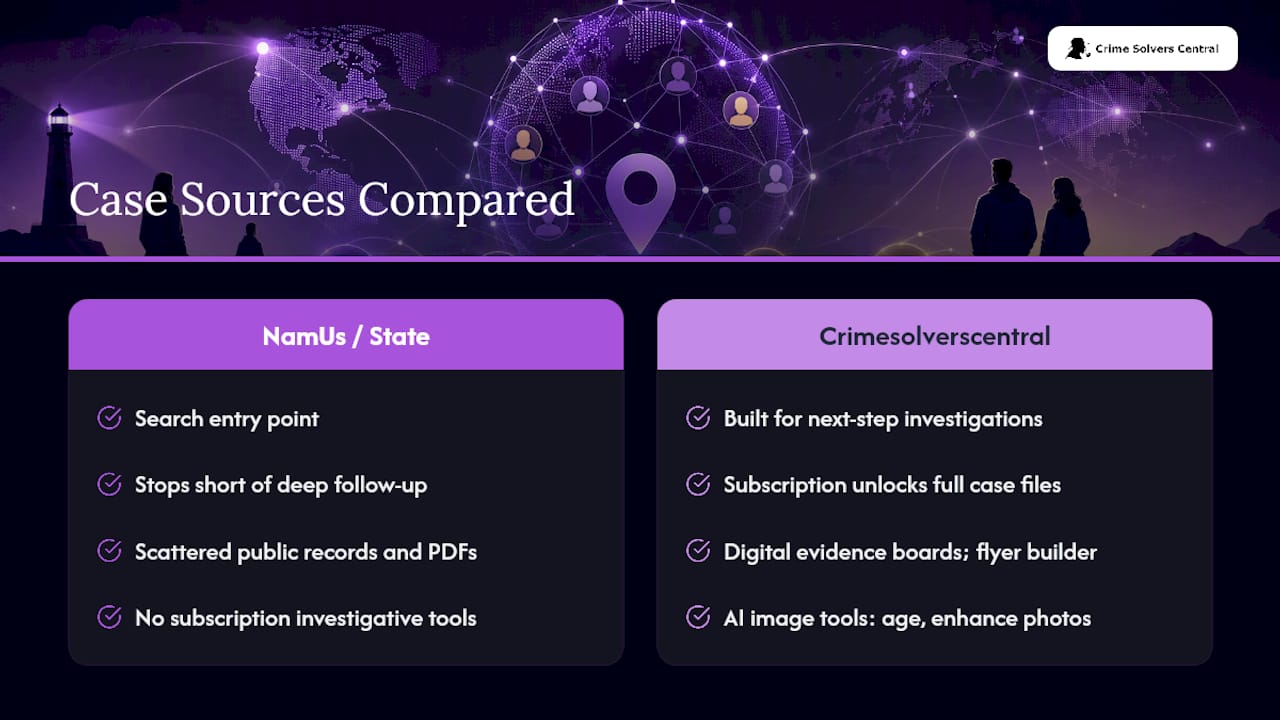
NamUs and state portals give you the search entry point, but they stop short of the depth serious follow-up often requires. Crimesolverscentral is built for the next step: a subscription unlocks full case files, digital evidence boards, a flyer builder, and AI image tools that help you visualize age progression or enhance an old photo. Families tracking a specific case get organized documentation in one place instead of scattered PDFs and screenshots. Amateur investigators and volunteers get forum access to coordinate with others working the same region or case type.
If you’ve already run your NamUs search and found a case that matters to you, start with the Cold Case Database by state to see what deeper resources are available for that specific record.
Where to Verify What You Find
Cross-check any lead against these official sources before acting on it: the NamUs public search and user guide, FBI background on NCIC’s role and record categories, and your state’s missing-person portal or NCMEC for cases involving children.
Sources
- National Institute of Justice — NamUs overview
- Congress Research Service — Missing Adults: Background, Federal Programs, and Issues for Congress
FAQ
What Is the Best Website to Find a Missing Person?
NamUs is the best starting point because it’s the only free, national database with public search access covering missing, unidentified, and unclaimed persons. State portals and resources like Crime Solvers Central’s case catalog fill in gaps NamUs doesn’t cover.
How Do I Find a Family Member Who Is Missing?
Search NamUs by full legal name, then repeat the search with nicknames, maiden names, and alternate spellings, adding date of birth and last known location to narrow results. File a report with local law enforcement first if one hasn’t already been filed, since that’s what feeds records into NCIC and eventually NamUs.
How Can I Tell if a Missing Person Has Been Found?
Check the case status directly on the NamUs listing, since resolved cases are typically marked as such, and confirm with the investigating agency listed on the record if the status seems unclear or outdated on other sites.
Is There a Free National Missing Persons Database?
Yes. NamUs is free and open to the public, unlike NCIC, which is restricted to law enforcement agencies. NamUs also offers no-cost forensic services, including DNA analysis, for qualifying cases.